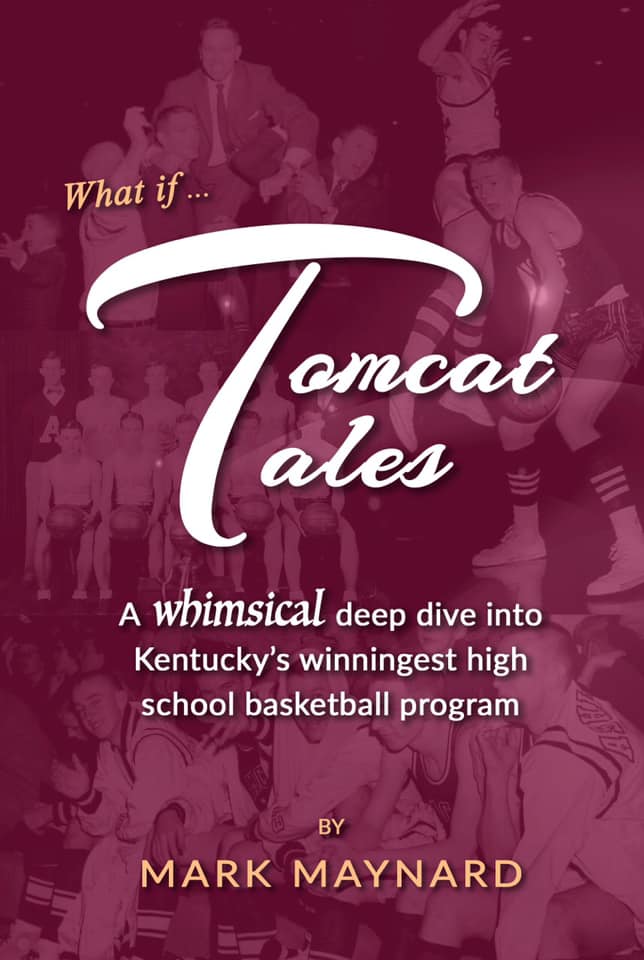
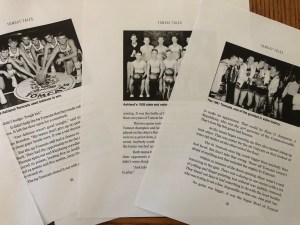
‘Tomcat Tales’ mixes fictional games with real-life tradition

When the 2020 Kentucky high school basketball season abruptly ended without putting down one dribble in the Sweet Sixteen, my heart ached for those 16 schools who had fought so valiantly to earn a place among the state’s elite. They were denied the opportunity to play out their dreams on the Rupp Arena floor because of the coronavirus that paralyzed the world.

It was heartbreaking for each of the regional champions but maybe especially so for the Ashland Tomcats, who had been perfect to that point. They were all dressed up with a 33-0 record and no place to go.

The Tomcats displayed a throwback kind of teamwork that had everybody wanting to watch them play and comparing them to some of the best in Ashland history.

But how would they do against the best of the best?

Sweet 16 games for the 2020 State Tournament were played through computer simulation and stories written using my sportswriter background to “report” the outcomes.

You’ll have to read Tomcat Tales to find out what happened at the Sweet 16 and many more games!

No high school in Kentucky has the tradition of the Ashland Tomcats. They have won 33 regional championships, four state championships, been runner-up four times and a national champion. They were the first team in Kentucky to 2,000 victories – hitting that milestone during the 2020 season. They have more wins than any team in the Commonwealth of Kentucky.

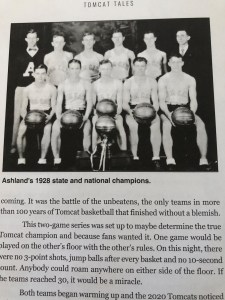
Tomcat Tales will take readers to 1928 when the Tomcats ruled the state. They have battles with the 1961 Tomcats that won the state championship and even the 2020 Tomcats that were striving to match the record. Every regional champion since 1953 is represented at least once, along with a lot of other years.

Tomcat Tales lets your imagination run wild. Go back in time with me to honor some of the greatest basketball players and coaches to ever walk the streets of Ashland, Kentucky.

It may even make for a perfect dream ending.

HOW TO PURCHASE A BOOK!

Book is $20 or $25 if needed to be shipped by USPS.

Available SOON locally at:
Second Hand Rose (3205 13th Street)
Pollock’s Jewelry (913 Winchester Avenue)

Or send check to:
Mark Maynard
2515 Holt Street
Ashland KY 41101

Click to use Paypal

Include your mailing address to mainrod@windstream.net for books that need to be shipped.

‘Is Mickey Mantle bigger than God?’

One great thing about my job of 42 years at The Daily Independent was the chance encounters with the celebrity world.

For me, it was the sports celebrity world.

The list goes on and on of sports heroes that I’ve been able to interview – Muhammad Ali, Pete Rose, and Michael Jordan, to name a few.

And, oh yes, Mickey Mantle.

The story of my five-minute interview with The Mick is much better than the interview itself.

Mantle, the baseball idol of the 1950s and 1960s, is a name that everybody knows.

It was back in 1989, long after Mantle had retired from baseball as one of its all-time home run leaders. The Mick didn’t just hit home runs, he hit them out of sight. His legend was unprecedented.

While browsing through a magazine at work one day, I began reading an article about the Mickey Mantle-Whitey Ford Fantasy Camp in Fort Lauderdale. At the bottom of the article, there was a number to call. It had a 606 area code and a 474 exchange. That said one thing to me — Grayson, Ky.

The curious reporter in me made the call to the number and on the other line was Wanda Greer, who was the camp director. Dave Carter, who produced the “Ashland’s Field of Dreams” documentary and many outstanding others, was the one who started the fantasy camp many years ago before anyone else was doing it. Dave has always been ahead of the curve. Now about all of them do it. But for several years, it was only the Yankees.

I set up an interview with Wanda and she asked if I’d like to speak with Whitey and Mickey.

Well, uh, absolutely, I told her.

So the wheels were put in motion. She actually gave me Ford’s number and I called him about a day later. We spoke for 15 of 20 minutes about the camp, about Mickey and about Wanda. It was a good interview but The Mick would be what could turn the article from good to great, at least in my estimation.

Wanda said Mickey would be a little harder. She wasn’t going to share his number, which was understandable. And, besides that, Mickey was always on the go, flying here and there, doing autograph signings or whatever. He was Mickey Mantle and that was job enough.

Wanda took my home phone number – these were the days before cell phones — and told me when Mickey was available she’d give me a call.

That was good enough for me. So I waited.

One Sunday night, my wife, then 5-year-old son, 2-year-old daughter and I were at church. My wife wasn’t feeling well, so she told me she was taking the kids and going home. We’d driven separately, so that would be fine.

On the way home from church, my wife drove by the Oakview Elementary playground and Stephen, being an energetic 5-year-old, begged her to stop.

“No,” she said, “if we were anywhere right now, it would be in church. The only reason we’re going home is because Mommy doesn’t feel good.”

So that was that. Stephen wasn’t happy about it but understood as much as 5-year-olds understand these things.

Well, lo and behold, when Beth arrived home she got a phone call and Wanda Greer was on the other end. She asked for me and Beth told her I was at church. She told Beth that if there was any way possible, could she have me at the phone in 15 minutes because Mickey Mantle was going to be calling.

Mickey Mantle!

My wife knew I was working on the story and didn’t want me to miss the opportunity. She hurried back to church, with Stephen and Sally in tow, and told someone in the back of the church, in our sound room, to let me know.

He came down the side aisle – I was sitting near the front – and told me. I jumped up and walked out of church and headed for home, excited about the opportunity that awaited.

In the other car, Beth was posed with an interesting question by our 5-year-old: “Mom,” he asked, “is Mickey Mantle bigger than God?”

Wow! What a zinger. Always quick on her feet, Beth said, “Well, no, but this is different. It’s Daddy’s job. That’s why we got him out of church.”

It turned out, that wouldn’t be when the interview with The Mick happened, just a sobering and hilarious sidenote. Mantle was at an airport and didn’t have time to make the call. Wanda called me and apologized and promised that Mantle would call me at work on Saturday.

That was fine with me. I was working on a Saturday morning – the paper was afternoon back then – with the late Tony Curnutte.

Nobody was a bigger baseball fan than Tony. When I told him The Mick was calling today, he was giddy.

I told him that we needed to make sure one of us was always near the phone because I didn’t know when the call would happen. Well, naturally, The Mick called when we were both away from the desk.

Our switchboard operator at the time didn’t look for me because she thought it was a bogus call.

“Somebody saying he was Mickey Mantle called but I knew it couldn’t be him,” she said. “So I hung up on him.”
“What?” I screamed. “That was Mickey Mantle!”

I quickly called Wanda back and told her what had happened. She didn’t know if The Mick would call back but told me to sit right by my desk. I’m sure she had to do some explaining but whatever she said worked.

I told Tony what was happening. He begged me to let him answer the phone so he could say he talked to Mickey Mantle. I agreed.

Ringggggggggg! Ringggggggggg!

Tony, in his most proper and professional voice, cleared his throat and then answered: “Sports, Tony Curnutte.”

The countenance on his face dropped immediately. In subdued tones he said “Yes, uh, I guess. Hang on a minute.”

“It’s not The Mick, it’s The Rick,” he said. Rick Greene, a sportswriter for us at the time, wanted to know if I wanted him to cover an American Legion game in the park that afternoon.

“Get him off the phone!” I said.

We both sat quietly. Tony stared at the phone, poised like a cat getting ready to pounce on a mouse.

Ringgggggg! Ringggggggggg!

Tony answered again in professional voice. “Just a minute,” he said firm and proper. This time it was The Mick. He successfully transferred the call to me and on the other line was none other than Mickey Mantle.

The first thing he said to me, in his thick Oklahoma drawl, was:

“You sure are a hard guy to get a hold of.”

We both laughed. I was as professional as I could be and we had a brief interview that was cut off when I asked him about Pete Rose and gambling.

“I’m not here to talk about that,” he said.

Good enough. I mean, it was Mickey Mantle.

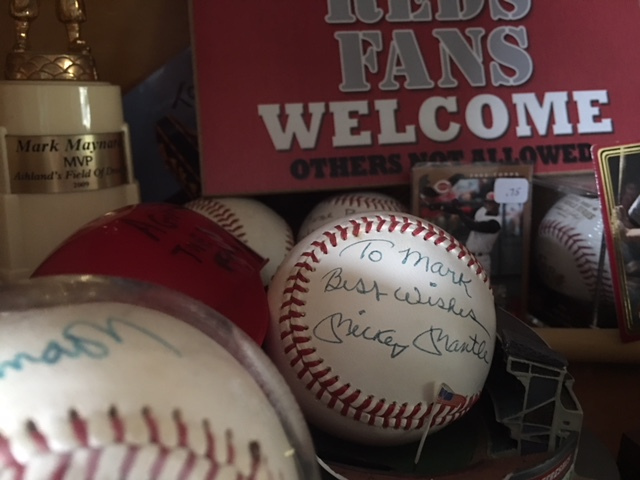
I hung up the phone and the journey had ended. After plugging in Mantle’s quotes in the story, the job was done. The feature ran the following day and Wanda, being so classy, was kind enough to get me an autographed Mickey Mantle baseball. It had “To Mark, best wishes, Mickey Mantle” on it and it still sits today in my memorabilia case at home.

Autographed baseballs that are personalized are worth less on the open market than those that just have the name. But I liked that it was personalized and wouldn’t sell it anyway.

To me, it serves as a reminder of a story worth telling.

’69 team ball signed by Don Gullett makes journey from Sioux Falls, to Reno, to South Shore

The baseball sat for decades nestled in the corner of the closet in the home of Kent Lauer’s mother in Sioux Falls, South Dakota.

It hadn’t moved in more than 40 years, from the time that Lauer put it there after getting it in a promotion with the Sioux Falls Packers baseball team in 1969 when he was 12 years old.

“I’ve always known about the ball and I knew that my mom kept it at my house in Sioux Falls,” Lauer said. “My mom was one of those people who didn’t throw away anything. So I knew it was there. On one of my trips back home, I knew that ball was in the closet. I grabbed it.”

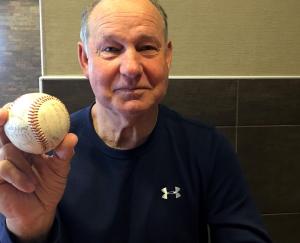
Don Gullett holds a 1969 autographed baseball from his only minor league team.

Lauer became the owner of the baseball 48 years ago. Anybody who caught a foul ball could exchange it for one autographed by the Packers’ players.

Lauer said he didn’t go to many Packers’ games, but he went enough to know there were more chances for foul balls on the outside of the stadium than the inside.

“I didn’t know about the promotion,” he said. “I got there and found out about it. I positioned myself out there rather than trying to catch one in the stands.”

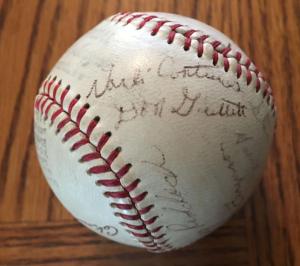
Sure enough Lauer was able to collect one of the foul balls that lifted outside the stadium and he returned it for the autographed ball, which was a Little League ball signed by all the players on the Packers’ team, including Don Gullett.

After gathering the baseball from his mother’s closest, its home for nearly five decades, Lauer took it to his home in Reno, Nevada. The baseball has been sitting on Lauer’s nightstand for several years.

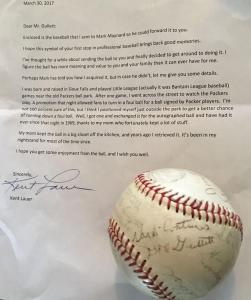
A letter to Don Gullett from a fan he never met.

He pondered what to do with the ball – keep it or send it to Gullett? – and eventually decided Gullett’s home should be the final destination.

“It was probably the first team ball he ever signed,” Lauer said.

Gullett couldn’t remember the first baseball he signed, so it may have been that as well. “It’s definitely the first team ball,” he said. “I really appreciate getting it.”

The 18-year-old arrived in Sioux Falls almost immediately after the Cincinnati Reds made him their No. 1 selection in the 1969 June Amateur Draft. Gullett’s high school season at McKell had ended only a few weeks before in a 1-0 loss to Ashland in the regional semifinals in Morehead.

Now he was pitching in professional baseball. Gullett was getting paid to play.

Don Gullett admires signatures of teammates from 1969.

Professional scouts were visiting in Greenup County before Gullett was old enough to drive. He was also recruited by dozens of major colleges wanting him to play basketball and football.

Where Gullett was selected in the baseball draft would decide his future. If the Reds, or someone else, hadn’t taken him with a high pick, Gullett said he might have taken a different route.

“I would have entertained playing college football,” he said. “My physical stature may have kept me from playing basketball.”

He was not only a good athlete, but a good student. The options were endless. The Reds took out the mystery by taking him with the 14th overall selection in the first round.

“They sent a bunch of us to Florida for mini-camp for a week to 10 days,” he said. “Then we flew out to Sioux Falls, South Dakota.”

Gullett roomed with four others who stayed together in a house owned by one of the Packer boosters. One of his roommate-teammates was Steve Miller of Huntington.

“A bunch of us stayed in the house together,” he said. “We had a good time.”

Gullett was away from home for the first time. It was a long way from Lynn, Kentucky. The bus rides were long and cold, he said. “On one trip to Duluth we were playing and the stadium was by the lake. The fog was settling in over the water and coming toward the stadium. It was glistening ice crystals falling on the ground. I’d never seen anything like that.”

The longest trip McKell made in high school was from South Shore to Morehead. Now he was making much longer bus rides almost daily but it wouldn’t be for long.

The Reds invited Gullett to the big-league camp in 1970, but he wasn’t expected to make the club.

An autographed ball from 1969.

“I stayed off campus in the minor league players’ hotel and drove over to the major league training facility,” Gullett said. “The (minor league) guys were saying, ‘You don’t really think you’re going to make it do you?’ I said, ‘I do. Why would I be down here wasting my time?’’’

Even though Gullett’s blazing fastball was raising eyebrows throughout the Grapefruit League, it still didn’t seem likely he’d be going north with the Reds.

“Pitching coach Larry Shepard told me two days before camp was over, ‘No way we can take you.’ Then I got the word I was going. I got the opportunity and I made the most of it. I had that type of confidence.”

Gullett married high school sweetheart Cathy Holcomb on Jan. 24, 1970 and they moved into an apartment in northern Kentucky once he had made the Reds’ roster later that spring.

“That’s a lot of change,” he said. “Being married, moving into an apartment and pitching for the Reds. I had to get used to a lot of new things.”

One thing that never changed was his ability to throw a baseball hard.

Gullett pitched out of the bullpen and appeared in 44 games as a rookie in 1970 when he pitched in Crosley Field and the first year of Riverfront Stadium. He made two starts but was mostly used in middle and long relief. Gullett was 5-2 with a 2.42 ERA but was even better in the postseason.

He pitched 10 1/3 innings and allowed only one run in the National League playoffs against the Pirates and the World Series against the Orioles. He saved two of the three wins over the Pirates in the NL Championship Series.

The Reds moved him into the rotation the following year and he went 16-6 – leading the NL with a .727 winning percentage – with a 2.65 ERA. He remained the ace of the staff until departing the Reds for the New York Yankees after the 1976 World Series.

Only stop in minors

Gullett’s stop in Sioux Falls for the Short-A season in 1969 was his only time in the minor leagues. The next spring he made the Reds and took off on a star-crossed career that ended far too soon.

Gullett won 109 games and four World Series rings in a career that was cut short by a shoulder injury while pitching for the Reds and the New York Yankees.

He is the only man to pitch the opening game in successive World Series for two different teams.

Lauer did some research on the left-hander who leads the conversation of the greatest athletes in northeastern Kentucky history. He knew about the 72 points scored in a single football game at Wurtland (“The football thing stood out in my mind,” he said) and how his pitching career came to a premature end, that he was a pitching coach for the Reds and that he had retired to his family farm in Kentucky.

“I knew he had a good career,” Lauer said. “I knew his signature was on the ball and I thought ‘Maybe he’d like to have that ball.’ It would have to have much more meaning and value to him and his family than it could ever have for me.”

Lauer said he went back and forth trying to decide if he was going to seek out Gullett to send him the baseball. “I finally decided, I’m going to send it to him.”

A Google search directed him to stories about Gullett in The Daily Independent so he contacted the newspaper for help. “I came across a column on the website and knew that’s how I was going to get him the ball.”

Lauer, who is 63, said the youth league fields in the area were clustered near the Sioux Falls Packers Stadium. The town still has an independent American Association baseball team – the Sioux Falls Canaries – and play in the same stadium. It was built in 1964, five years before Gullett, who turned 66 in January, made his professional debut there.

The stadium underwent major renovations in the late 1990s and has a seating capacity of 4,462 fans with a walkway splitting two levels of seating for the ultimate baseball-watching experience.

Lauer wanted Gullett to have the baseball because of the career he ended up fashioning in the major leagues.

Of the 25-man roster for the 1969 Sioux Falls Packers, five played in the majors and another player managed for three years.

Gullett looked at the roster on an iPhone and rattled off name after name after name. He smiled as he called them out, “Carl Barnes, shortstop; Glenn Bisbing, catcher. Kent Burdick, Nardi Contreras from Tampa (Florida) and and Jimmy Hoff, he was a great baseball man who worked in the Reds’ minor league system for years.”

Since learning about the autographed ball, Gullett said he began thinking a lot about his first professional team. “I was thinking about that team the other day,” he said. “I have a lot of fond memories.”

And at least one scary one.

Gullett made the Northern League All-Star Game and was flying there with Burdick and manager Jimmy Snyder on a flight to Winnipeg, Canada.

“I had a good year and made the Northern League All-Star team,” he said. “I don’t recall getting into the game. But the plane ride we had – it was a single-engine plane that I called the Knucklehead Express. I’ve never told anybody but that gave me something of a scare.”

Others who made it

The best known of the group, besides Gullett, was left-handed pitcher Ross Grimsley, who fashioned an 11-year major league career including a three-year stint with the Reds from 1971 to 1973. He won 124 and lost 99, fashioning a 3.81 earned run average.

“We (the Reds) traded him to Baltimore and he had a real good career,” Gullett said. “Once he learned to throw the changeup he was tough to hit. He won a lot of games.”

Gene Locklear played five seasons in the major leagues and finished with a .274 career batting average with nine home runs. He played for the Reds, Padres and Yankees.

Two other pitchers, Contreras and Mike Johnson, had “cups of coffee” careers. Contreras played eight games with the White Sox in 1980 and Johnson pitched in 18 games for the Padres in 1974.

Greg Riddoch, a player on the ’69 Packers, never made it as a player in the big leagues but managed the San Diego Padres from 1990 to 1992. He had a 16-year coaching career in professional baseball. “Riddoch was a good baseball man,” Gullett said.

Gullett was the most famous alum of the Northern League of 1969. He was 109-50 with a 3.11 earned run average and 921 strikeouts in a nine-year career. He was on four consecutive World Series champions – 1975 and 1976 with the Reds and 1977 and 1978 with the Yankees (although pitching in only eight games in ’78 because of the shoulder injury).

Packers in ‘69

Grimsley and Gullett were the aces of the Sioux Falls Packers, who finished 45-25 and 1½ games out of first place behind the Duloth-Superior Dukes (White Sox).

Grimsley was 9-4 with a 2.80 ERA and 97 strikeouts and Gullett went 7-2 with a 1.96 ERA and 87 strikeouts. Gullett pitched two shutouts and averaged 10 strikeouts a game.

Locklear hit .303 with seven home runs and 28 RBI while Thomas Dittmar (.282, 10 HR, 37 RBI) and Burdick (.228, 10 HR, 40 RBI) provided some pop, too. The Packers blasted 49 home runs as a team. Players ranged in age from 17 to 25.

The rest of the league included the St. Cloud Rox (Twins), Huron Cubs (Cubs), Aberdeen Pheasants (Orioles) and Winnipeg Goldeyes (Royals).

There were a few other players who made it to the major leagues from the 1969 Northern League, but none nearly as significantly as Gullett, whose shoulder injury at 27 cut short a career that looked destined for Cooperstown.

“I could have made the Hall of Fame,” he said.

For one season, though, he was a Packer, just not one in Green Bay.

Now he has an autographed team ball to remember it.


A tip of the hat to champions of Tomcat Shootout

ASHLAND, Ky. – As the players prepared to go through the door leading into James A. Anderson Gymnasium for the championship game of the Tomcat Shootout simulation tournament, they came together in the area where the swimming pool used to be.

The image was like a boxing weigh-in with the competitors looking straight ahead with glassy stares. There was no emotion.

Even though they had a healthy respect for each other, neither side was going to blink first. Nobody looked down at their feet or looked away. It was intense, focused, game faces.

Friendships could wait until after the game. Too much was on the line to let down your guard. It was time to play basketball.

Hobie Rogers, wearing his spiffy maroon sports jacket, swung the door open and out came the 1960-64 Tomcats with Harold Sergent and Larry Conley pumping their fists into the air as the crowd roared its approval. A few seconds later came the 2015-20 Tomcats with the Villers brothers and others and their side of the gym leaped on its feet and began cheering madly.

I’m not sure, but I think Hobie was wiping tears from his eyes after both teams were completely onto the floor doing their drills.

Public address guru Chuck Rist was spinning the songs, first from the 60s and then from the 20s. He was having more fun than anybody.

It was a cultural happening.

The cheerleaders were different from the way they dressed to how they led cheers. The 60s girls were in bloused skirts to their ankles and a few of them had megaphones while the 20s cheerleaders wore short skirts that allowed them to flip their way around the gymnasium. The contrast was striking.

The 1960s was meeting the 21st Century.

One thing hadn’t changed: The game of basketball where the object was to score more points than your opponent.

Tipoff was 20 minutes away.

Jason Mays and Bob Wright, the respective coaches of the Tomcat decades simulation teams, stood together with arms crossed at midcourt exchanging pleasantries but not much else. They were talking, but both were being coy when it came to talking about their own teams. Everybody was looking for an edge.

There wasn’t a seat remaining in Anderson gym. In fact, the aisles were full of fans, too. It was a sea of maroon. “The biggest crowd I’ve seen in here and probably more than is allowed,” said AD Mark Swift, trying to count by hand the number in the gym. “I don’t want to have to tell anybody to leave, but we go by the rules here in Tomcat Nation.”

The fire marshal would have to look away on this night or risk a riot.

Only five minutes before tipoff and both teams left the floor for final instructions. The place was dripping with anticipation.

The 60s cheerleaders were getting their side to stand up and cheer and out from the stands came Joe Swartz, who owned the pharmacy on the corner of Central and 22nd Street and umpired countless Little League games in Ashland during the 1960s. He was the superfan of his era.

Before every home game, he would go to center court and give his famous cheer:

“When you’re up, you’re up

When you’re down, you’re down

When you’re up against the Tomcats

You’re upside down!”

Both sides seemed to receive a jolt of energy – as if they needed it – from big Joe’s cheer. The place was bumpin.

And in a surprise that nobody knew about, the Judds, Naomi and Wynonna, returned to Ashland to sing the national anthem. They also sang “My Old Kentucky Home” and there wasn’t a dry eye in the place.

Now, at last, it was time to play.

Mays said before the game that Conley was his biggest concern and that “he would have to earn whatever points he gets.” He acknowledged, though, that the rest of these 60s Tomcats comprised one of the greatest teams he’d ever coached against with no exceptions.

“They shoot it well, rebound well, pass well, play defense well,” he said. “No wonder they were state champions. A great, great team and that’s not hype.”

Wright called the 2015-20 Tomcats the “ultimate team” and a scoring machine that was going to be hard to keep under 100.

“Great passers and shooters,” he said. “I love watching this team except when they’re playing my team.”

Neither team showed much sign of nervousness early with both teams able to score points rather easily. Up and down the floor they went at a frantic pace.

The message was sent early to Conley that this wasn’t going to be easy. Less than a minute into the game, Cole Villars plastered him into the mat on the wall when he went in for a layup. It wasn’t a dirty foul, but it was a hard one. Conley made both free throws, a harbinger of what was to come.

The biggest lead either team had in the first quarter was five points at 18-13 after Conley sank a pair of free throws. He scored a dozen points in the first quarter, but the 2015-20 Tomcats held a 29-28 advantage. Their biggest lead had been 27-23 on Ethan Hudson’s smooth 15-footer from the corner.

“We kind of got a feel for each other in that first quarter,” Conley said. “They were trying to be physical with me, but we loved that kind of game. Gene Smith, Dale Sexton and Harold Sergent never backed down from a good fight.”

The fouls began piling up for the 2015-20 Tomcats who were at a size disadvantage as well. It began to take a toll in the second quarter. During one stretch Conley completed back-to-back three-point plays when he was fouled while driving. That stretched the lead to double figures for the first time at 54-44.

“I don’t know how he made those two shots,” Mays said. “Selly (Ethan Sellars) went across his arms hard on both of those fouls. That was a big stretch for them.”

Devaunte Robinson connected on a 15-footer at the buzzer, but the 2015-20 Tomcats trailed 61-50 in a high-scoring first half. The 60s Tomcats were beating them at their own game.

“We had to make some changes,” Mays said. “They did a good job on Christian and Cole in the first half. Those guys had to get more touches. Devaunte kept us in the game. He was on tonight and we knew it. That was a good sign.”

True enough, Robinson’s shooting stroke was good. He scored 13 in the first half.

As for the strategy of hacking Conley, it wasn’t working well. Larry Legend had 25 points and it was only halftime.

“How do you stop that guy?” Mays asked rhetorically. “I sure don’t know.”

The 2015-20 Tomcats find their groove early in the second half, trimming the deficit to 66-62 within the first minute. Cole Villers and Robinson were getting hot. They regained the lead at 72-71 when Robinson swished a 3-pointer off a fancy pass from Colin Porter, who had his own battle with Sergent out front.

“Watching their little guard and Harold go at each other was the highlight for me,” Wright said. “That was the best matchup of the night.”

Porter’s scoring was limited but not his passing. He finished with 12 points, 11 assists and seven rebounds. Sergent scored 15 and had three assists. Their play seemed to negate each other.

Meanwhile, there was still no slowing down Conley, who had piled up 36 points by the time the third quarter was over. A three-point play from Ditto Sparks inside the last second put the 60s Tomcats back in front 85-82 going into the last 12 minutes.

The gym had a steady loudness throughout the three quarters and now it was almost shaking. Nobody was going anywhere and it was like a fuse had been lit waiting for the big explosion to come.

Statistic sheets were flying on the scorer’s table from where Dicky Martin was broadcasting with Dirk Payne. In the corner on the visiting side, a table was set up for Dick Martin and Pete Wonn, who were describing the action for the 60s Tomcats.

There was no cultural gap here. Both the Martins were berating officials over some “questionable calls” against their respective Tomcats. It just went to show what a good job they were doing.

Dirk, a 1962 graduate, was torn on what team he wanted to win. He never did decide but sure enjoyed the moment.

The game remained tight with the biggest margin being 92-85 for the 60s Cats after Jim McKenzie scored on an offensive rebound.

Following a timeout from Mays, the 20s Cats got their footing back. They pulled within 99-97 when Porter beat Sergent to the basket and then tied the game at 99 on Chase Villers’ 14-footer from in front of the foul line with 3:35 remaining.

Over the rest of the game, the score was tied at 101, 103, 105, 107 and 110 with big shots from a variety of players. The 60s Tomcats were leading 110-107 with 23 seconds remaining when Robinson lined up for a 3-pointer and was fouled while shooting it. His triple swished to tie it at 110 and he made the free throw, completing the four-point play, for his 30th point and a 111-110 advantage. Anderson gym was going bonkers with an almost maddening sound from both sides and only 13 seconds remained.

Wright called for a timeout and the noise level increased so much there was ringing in your ears.

“I’ve never heard anything like that,” Rist said. “You couldn’t even hear the music and it was up at the loudest level.” He had cued up Elvis Presley and “It’s Now or Never” but, unfortunately, nobody could hear it over the cheers.

The teams broke the huddle. This was going to be it. Thirteen seconds to victory for one of them.  They had given fans a show for the ages, the best game ever played in Anderson gym.

Mays had the 20s Tomcats pick them up man-to-man at halfcourt. Sergent was handling the ball and it zipped around the perimeter and eventually back to him where he launched a shot from the elbow over Porter’s outstretched hand. The shot spun out, but one hand rose above the rest. Guess who? It was Larry Legend, who tipped the ball back into the basket and the 60s Cats had done it! Final score: 112-111.

Within seconds of the tip-in, Stevie Wonder’s “Fingertips” was playing over the sound system. Rist was a master.

Conley’s tip-in gave him 45 points. He was 13 of 20 from the field and 19 of 26 at the foul line in a command performance that will be remembered for ions.

“He was the difference,” Mays said. “We couldn’t stop him right to the end.”

When the game was over, the players from both sides embraced, talked and laughed with each other. They had earned respect.

“Those are the greatest players in Tomcat history,” said Cole Villers, who had 19 points and seven rebounds. “It was an honor to go against them. Larry Conley is like a magician out there. We had him boxed out on that last play but he found a way, and that’s what great players do. Incredible. We didn’t lose this game. They won it.”

Christian Villers and Hudson scored 16 apiece while Chase Villers and Porter scored 12 apiece.

Smith collected 12 points and 13 rebounds and Sparks scored 11 with five assists to back Conley’s amazing effort that also included 13 rebounds and five blocked shots.

The 2015-20 Tomcats were called for 32 fouls – seven players ended up with four fouls apiece – in a vain attempt to slow down the 60s Cats. The difference at the foul line was striking with the 60s Cats making 34 of 48 and the 20s Cats only 21 of 30.

“That is a big difference, but the officiating was great,” Mays said. “We put them on the line with a lot of fouls.”

“By gawd, the fouls weren’t even,” screamed Dicky Martin. “Let’s call it what it is: We got took!”

(Nobody else agreed with him, but it wouldn’t be real if Dicky didn’t make that comparison.)

Wright said it was one of the greatest wins of his career and maybe the best game he could remember too.

“Those 20s Cats are champions too,” he said. “I felt like I was going against a coaching chess master. Coach Mays is one of the best I’ve ever seen. We just got the last touch on the ball, literally. I wouldn’t want to figure out a way to stop Larry Conley either. I’m not sure it’s possible.”

Meanwhile, “Respect” from Aretha Franklin was blaring over the gym’s sound system as the players and fans started filing out.

It seemed fitting.

Tomcat Shootout All-Tournament

Larry Conley (MVP), 1960-64

Harold Sergent, 1960-64

Gene Smith, 1960-64

Christian Villers, 2015-2020

Cole Villers, 2015-2020

Colin Porter, 2015-2020

Mark Surgalski, 2000-2004

Arliss Beach, 2000-2004

Larry Castle, 1955-1959

Jeff Tipton, 1980-1984

Ronnie Griffith, 1970-1974

Marty Thomas, 1990-1994

2015-2020 TOMCATS (111) – Porter 4-9 4-4 12, Robinson 9-17 7-9 30, Cole Villers 7-19 5-9 18, Chase Villers 6-14 0-0 12, Hudson 7-17 2-4 16, Christian Villers 6-13 3-4 16, Miller 0-6 0-0 0, Sellars 2-4 0-0 4, Bradley 1-2 0-0 2, Mays 0-1 0-0 0. FG: 42-102. FT: 21-30. 3FG: 6-13 (Porter 0-3, Robinson 5-6, chase Villars 0-1, Christian Villars 1-2, Sellars 0-1). Rebounds: 50 (Porter 7, Robinson 2, Cole Villars 7, Chase Villars 7, Chrsitian Villars 2, Miller 8, Sellars 6, Bradley 7). Assists: 26 (Porter 11, Cole Villars 4, Chase Villars 5, Hudson 4, Miller 1, Sellars 1). PF: 32. Turnovers: 17.

1960-64 TOMCATS (112) – Sparks 4-7 3-3 11, Sergent 6-9 2-2 15, Hilton 2-13 5-9 9, Smith 6-14 0-0 12, Conley 13-20 19-26 45, Cram 1-7 1-2 4, McKenzie 2-3 1-2 5, Beam 0-5 2-2 2, Sexton 2-3 1-2 5, Wright 2-7 0-0 4. FG: 38-88. FT: 34-48. 3FG: 2-3 (Sergent 1-1, Hilton 0-1, Cram 1-1). Rebounds: 65 (Sparks 2, Sergent 1, Hilton 7, Conley 13, Smith 13, Cram 6, McKenzie 7, Beam 4, Sexton 5, Wright 7). Assists: 16 (Sparks 5, Sergent 3, Hilton 1, Smith 2, Conley 1, Cram 3, Beam 1). PF: 27. Turnovers: 20.

2015-2020 TOMCATS     29       21       31      29          –          111

1960-1964 TOMCATS     28         33     24      27          –          112