Spinning the biggest hits (and misses) with 1954, 2020 Tomcats

ASHLAND, Ky. – A score-fest was expected when the 1954 and 2020 Tomcats tangled at Anderson gym, where the 3-point line would be in play.

Even though the 54 Tomcats didn’t play with that luxury, they had enough players who could launch from there with good success and the 2020 Tomcats simply feasted behind the stripe. A high-scoring game was expected and that may be why the stands were full early.

Just watching the teams in warmups was satisfying enough. It was like watching Barry Bonds take batting practice. Bill Gray of the 54 Tomcats got real comfortable real fast behind the arc, hitting 10 consecutive triples during one shooting session. It was quite a show to watch and even the kids in the stands were in on the countdown. When the 11th one spun out, a loud “awwww!” could be heard.

On the other end of the floor, the 20 Tomcats went through their normal routine which included a lot of attempts from 3-point land and most of them not even moving the net. They called Anderson gym the Splash Pad during the undefeated season for a reason.
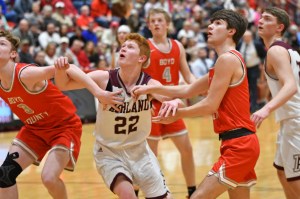
Justin Bradley gave 2020 Tomcats a little of everything. (Kim Phillips photo)

Nobody had seen this many times before in Anderson gym, but the fans were on their feet cheering during warmups!

It helped too that the always prepared public address announcer Chuck Rist was spinning songs from the 1950s and every other era leading up to the 2000s in a rotating basis that only he could do. The place was absolutely bumping and his infectious music was one of the reasons why. It was part basketball, part rock concert.

Meanwhile, 2020 Tomcat coach Jason Mays was sitting on his bench taking in the pregame like it was a giant Slurpee. He couldn’t get enough of the basketball sweetness he was watching.

“Can we just send everybody home now?” he asked. “I mean, this is a show right here. Do we need to mess that up by playing?”

Mays was right. It was a show with a lot of shooting stars. Literal shooting stars. An all-night game of H-O-R-S-E would have been worth the admission. But both teams were itching to play this virtual shootout.

The 54 Tomcats are part of Ashland Tomcat lore, a team that some say overachieved in making it to the state semifinals where they lost a close one to Newport and then finished in third place during a time when consolation games were played.

George Conley was in his last season as coach of the Tomcats in 1954, but the Senator still had a fire burning in his belly and he relayed that competitive edge to his players and to anybody within ear-shot.

Conley was intently watching the 2020 Tomcats swish in shot after shot after shot in pregame. He couldn’t take his eyes off them.

“Do those guys ever miss?” he asked. “Well,” answering his own question, “they will after we knock a few of them on their as…”

He was interrupted by a manager who said he was needed at the scorer’s table, something about the starting lineup. (Good thing since this is a family publication).

Rist quickly pulled up the song “That’s All I Want From You” as Conley walked over to check on the book. He followed that up with “Mister Sandman.”  The fiery coach scowled at him after that one.

“Do we have to play that infernal music?” he asked.

The crowd was worked into a frenzy as the teams headed to the respective dressing rooms with Rist switching to “You Ain’t Seen Nothin’ Yet.” They had sized up each other, received some final instructions from coaches and were ready to go for a rip snorting game.

They may have been too amped. Neither team was able to make a 3-pointer in the first quarter, although both fired them up. The 2020 Tomcats did get the offense moving though and led 20-17 when Cole Villers scored on a putback at the buzzer.

The 54 Tomcats began finding the range from downtown in the second quarter with Gray zeroing in from long range. He drilled 3 of 6 on triples in the second quarter, but rolled his ankle when he came down awkwardly on a rebound. Gray was having a dominating game, scoring 14 with eight rebounds, when he was forced to leave.

There was more firepower behind him. Jerry Henderson, Darryle Kouns and Mike Jones weren’t missing many either.

“They got that running game going and we couldn’t do much with them,” Mays said. “I had to figure out a way to slow them down.”

The 54 Tomcats led 43-41 at the half but only because the 2020 Tomcats closed the first half on an 11-2 run. And they were nailing the triples too.

Rist played “Three Coins in the Fountain” as the teams were leaving the floor.

It promised to be an exciting second half.

The teams were so evenly matched and that’s how the second half began playing it. Back and forth they went, shots flying in from everywhere. It seemed like everybody was hot.

“Some Like It Hot” fittingly blared over the loudspeakers during one timeout. Rist was on his game, too.

And his song choice was true, at least on the basketball court.

Gray returned late in the third quarter, but was mostly ineffective. His ankle was heavily taped and he tried to play but was hampered by the injury. He had five points and two rebounds in the second half and didn’t play in the fourth quarter as he sat with an ice pack on the ankle.

“Losing Gray was a tough deal for us to overcome,” Conley said. “He can get hot like he did tonight. The guy is a pure shooter. We missed that in the second half.”

Villers, meanwhile, was lighting up like a Christmas tree. He finished 7-of-9 from behind the arc to lead an explosion for the 2020 Tomcats. All five starters finished in double figures with Villers collecting 25 with 14 rebounds.

The problem wasn’t scoring, it was stopping the 54 Tomcats from scoring.

“We had a lot of trouble guarding Gray in the first half and Henderson in the second half,” Mays said. “Gray is as good a shooter as we’ll ever face and Henderson is hard to cover. He gave us fits. They are a lot like us with a lot of talented players. It’s no wonder it was such a good matchup.”

The 2020 Tomcats were leading 57-56 when Hunter Gillum scored on a drive. Ethan Sellars zipped him a no-look pass as he was moving toward the basket. He caught it in stride and laid in the bucket.

In a game that was tied a dozen times with eight lead changes, the 2020 Tomcats were trying to finish it off. Justin Bradley, who had 17 points and 12 rebounds, drilled a turnaround jumper and Colin Porter popped in a step-back 12-footer to make it 75-70 with 1:45 remaining.

Conley took a timeout, rallied his players around him, and set up some strategy to get back in the game. And it worked.

They came out to “Shake, Rattle and Roll” playing in the gym as Rist kept pushing the right buttons. The crowd was dancing in the aisles. They really were!

54 Tomcat Bill Kazee drilled his only 3-pointer to make it 75-73. Villers scored again for a 77-73 advantage, but Henderson came right back scored on a putback, then forced a turnover that allowed Kouns to get off a 15-footer at the buzzer that was all net and it was 77-77.

In the overtime period, Villers struck with his seventh 3-pointer to make it 80-77 and again the 54 Tomcats answered. When Kouns rebounded his own miss and put it back in, the game was tied again at 83 with only 15 seconds to play.

Mays called a timeout to set up strategy and set up a last-second play for Porter. But the 54 Tomcats had countered with a defense that trapped Porter before he could drive. Despite a double-team, he was somehow able to kick it out to Bradley who was open in the far corner. The 2020 Tomcats had already made 11 of 24 from behind the arc. Bradley never hesitated, not for a split second, and let it fly … swish! The 2020 Tomcats had won 86-83 with the last-second thriller.

And Rist was ready with “Celebration” already queued up.

Gray area

Bill Gray only played a few minutes in the second half but he still finished with 19 points and 10 rebounds. The 54 Tomcats obviously missed his presence.

“It’s part of the game,” Conley said. “I like this little shooters on this 2020 team. They’re some tough kids, tougher than I thought. Good win for them. They represent the Tomcat tradition well.”

Henderson collected 14 points and 15 rebounds and Kouns 16 points and 11 boards.

Villers and Hudson were backed by Sellars with 12 points and Porter with 10 points and seven assists.

Real life

Ashland’s 1954 team won 28 of 34 games and reached the Sweet 16 semifinals where Newport knocked them off 73-69. The Tomcats won the consolation game against Adair County.

Ashland’s 2020 team went 33-0 – the perfect season – but didn’t get to play in the Sweet 16 because of the coronavirus.

1954 ASHLAND (83) – Bailey 3-13, Kazee 2-7 0-0 7, Gray 8-18 0-1 19, Henderson 7-12 0-1 14, Kouns 7-12 2-3 16, Jones 4-12 5-6 13, Hopkins 2-6 0-0 4, Ware 1-3 1-2 3, Conley 1-2 0-0 2. FG: 35-85. FT: 9-14. 3FG: 4-11 (Kazee 1-3, Bailey 0-1, Gray 3-6, Hopkins 0-1). Rebounds: 58 (Kazee 4, Bailey 5, Gray 10, Henderson 15, Kouns 11, Jones 2, Hopkins 2, Ware 7, Conley 2). Assists: 18 (Jones 7, Kazee 1, Bailey 3, Gray 1, Hopkins 4, Conley 2). PF: 23. Turnovers: 17.

2020 ASHLAND (86) – Porter 5-9 0-0 10, Sellars 4-13 0-0 12, Bradley 5-9 6-6 17, Hudson 5-11 2-4 12, Villers 9-20 0-0 25, Phillips 2-5 0-1 4, Gillum 1-1 0-0 2, Adkins 1-2 0-0 2, Atkins 1-2 0-0 2, Davis 0-0 0-0 0. FG: 33-72. FT: 8-11. 3FG: 12-25 (Porter 0-2, Sellars 4-5, Bradley 1-4, Hudson 0-3, Villers 7-9, Phillips 0-2). Rebounds: 52 (Porter 3, Sellars 2, Bradley 12, Hudson 9, Villers 14, Phillips 5, Gillum 4, Adkins 1, Atkins 2, Davis 1). PF: 16. Turnovers: 18.

1954 ASHLAND      17       26       13        21       6       –           83

2020 ASHLAND      20       21       16         20       9        –         86


Clashing styles collide when 1961 Tomcats meet 1977 Tomcats

ASHLAND, Ky. – When Paul Patterson became Ashland’s new basketball coach in 1976, he made one thing clear. The Tomcats were going to win with defense.

Tough, make-the-opponent-miserable man-to-man defense. Patterson instituted a goal of allowing no more than 49 points per game. He put it on practice jerseys and he drove it into his players’ minds.

Patterson’s defensive philosophy would alter the coaching mindset in the 16th Region. Instead of freewheeling offense and high-scoring games, defense was about to take center stage. Teams went away from zones and it became a man-to-man region with hard-nosed defensive teams becoming the norm.

Of course, it took some proving.

Jim Harkins was a key player for the 1977 Tomcats.

The 77 Tomcats did just that, going 30-2 and allowing only 59 points per game. They held opponents under 49 in 19 games. They won the state quarterfinal game over Shelby County, 44-42, in an absolute physical war.

Defense was always the cornerstone for Patterson, who won four consecutive regional championships and never lost a game against any regional opponent in regular season or postseason during his four seasons on the Tomcat bench. He also had his detractors who feared the slow pace would be boring to fans who were used to run-and-gun basketball. Nobody seemed to get bored with winning though.

So why not match up one of Ashland’s greatest defensive teams with its greatest offensive team? Get ready for the showdown between the 77 Tomcats and the 61 Tomcats in Anderson gym.

The talk leading up to this one was how many points would be put up on the scoreboard in Anderson gym, home of the 77 Tomcats. The 61 Tomcats averaged 85 points per game on the way to a 36-1 record. They were under 60 only one time – the 59-58 loss to Lafayette.

So this was going to be good.

The 77 Tomcats were methodical, always controlling the pace of play, and the 61 Tomcats never stopped running, Both teams had size and college-level talent with outstanding coaches. With 6-foot-7 Jeff Kovach, 6-4 Jim Harkins and 6-3 Mark Swift, the 71 Tomcats matched up well inside.

“If we don’t dictate the pace and limit fastbreak opportunities, they will blow us out of the gym,” Patterson said before the game. “We must control the game.”

It was going to be a tug-of-war of wills. The 61 Tomcats used their fullcourt trap to push the tempo and create scoring opportunities. While they were a high-scoring team, it was because of an extremely effective defense that forced turnovers that quickly became baskets. Patterson knew they had to limit the runs.

Wright said it was important to be patient but take the opportunities because in the halfcourt situation, he hadn’t seen a better defense. “And I’ve seen a lot of good ones,” he said.

There was a nervousness in that statement. Wright knew what the 61 Tomcats were up against in this strong Tomcat team.

Patterson was just as nervous about controlling the 61 Tomcats. “You just don’t see teams with this kind of talent. And Larry Conley’s ability to do everything so well makes him tough to defend. Harold Sergent is one of the best guards I’ve ever seen. We won’t change what we do well though.”

True to his words, the 77 Tomcats jumped in front 17-9 with Jim Harkins scoring seven. It was a stunning start. Fans of the 61 Tomcats kept waiting for the eruption but it hadn’t come yet. The fundamentally solid 77 Tomcats boxed out with ferocity and kept Gene Smith and Bob Hilton from back-tipping rebounds and ignited the fastbreak. Game tempo had successfully been established.

And that’s how they controlled the game.

The 61 Tomcats couldn’t put a run together but did manage to pull within 27-22 on Sergent’s drive past Greg Swift with 34 seconds to play in the first half and that would be the halftime score.

“We were frustrated at halftime,” Conley said. “They had set the tempo and we couldn’t get it away from them.  The little Swift handled our pressure so well. He made some nice passes to get out of some double teams. That’s a well-coached team.”

Kovach’s two free throws made it 34-28 but a 7-0 run – the best the 61 Tomcats had mustered – put them ahead for the first time since early in the first quarter at 35-34. Patterson took a timeout to settle down his team that seemed out of sorts for the first time.

“We missed a couple of easy shots and didn’t take care of the ball on a third possession,” Patterson said. “We had to get back to what we could do well.”

Wright said he thought the 61 Tomcats were about to take off.

“They came back to the huddle more excited than I’d seen them all night,” he said. “They were confident.”

The 77 Tomcats came out of the timeout with the ball and held onto it for two minutes before Dale Dummit buried a 10-footer after following a hard screen from Mark Swift.

However, Cram and Conley scored on back-to-back trips to make it 39-36.

“We had them right there, we had them,” Conley said.

But then they didn’t. Mark Swift scored off a nice pass from his brother Greg and then tipped away the inbound pass, which Dummit ran down and flipped back to Mark Swift for a layup and a 40-39 lead entering the last quarter.

The 1977 pep band started playing “Jet Airliner” and the crowd started getting loud. They were proud of what their team had accomplished. They had held the mighty 61 Tomcats under 40 through three quarters, something nobody was able to do in 1961.

Hilton tied the game at 45 with four minutes remaining on a short jumper, but the 77 Tomcats gained a better grip with back-to-back baskets from Harkins and Kovach to make it 49-45. They never trailed again although the 61 Tomcats pulled within 54-52 with 1:45 remaining on another Conley drive.

The 77 Tomcats finished on a 7-2 run, including three for three on free throws in the last 15 seconds, to secure the 61-54 victory.

Fans rushed the floor to celebrating this hard-fought win over the team most consider the greatest in Tomcat history.

“They played their butts off,” Wright said. “I have no complaints. Coach Patterson had them ready for us and they controlled the pace the whole game. It was a chess match and he got me this time. We’d so some things different if we get a rematch.”

Conley scored 14 with seven rebounds and he made all 10 of his free throws. Smith collected 11 points and five rebounds.

Kovach led the 77 Tomcats with 17 points and Harkins scored 16 and Mark Swift 12. That trio combined for 14 rebounds.

“All my life, those guys were the ones,” Mark Swift said. “Nobody was better. To get the chance to even be on the same floor with them is something I’ll never forget. To actually beat them, well, that just tells you something about my teammates. I’m proud to be a Tomcat.”

Real life

Ashland’s 1961 team finished 36-1 and captured the state championship, the fourth in school history. They are regarded as one of the greatest teams in Kentucky high school history.

Ashland’s 1977 team had a 30-2 record and advanced to the Sweet 16 semifinals before losing to Louisville Valley. These Tomcats may have been the best defensive team of the modern era.


1961 ASHLAND (54) – Sergent 4-10 0-1 8, Cram 4-9 1-1 9, Hilton 3-6 3-4 9, Conley 2-4 10-10 14, Smith 5-6 1-1 11, Sexton 0-2 1-2 1, Daniel 0-1 0-0 0, Fairchild 1-2 0-0 2, Johnson 0-2 0-0 0. FG: 19-42. FT: 16-19. Rebounds: 26 (Sergent 1, Cram 3, Hilton 4, Conley 7, Smith 6, Sexton 3, Daniel 1, Fairchild 1). Assists: 11 (Sergent 3, Cram 3, Hilton 1, Conley 2, Smith 1, Daniel 1). PF: 24. Turnovers: 16.

1977 ASHLAND (61) – G.Swift 3-4 0-0 6, M.Swift 3-7 5-7 11, Smith 2-6 2-3 6, Harkins 5-11 6-10 16, Kovach 4-7 9-10 17, Allen 1-1 0-0 2, Dummit 1-2 1-2 3, Welch 0-1 0-0 0, Henderson 0-0 0-0 0. FG: 19-39. FT: 23-32. Rebounds: 22 (G.Swift 1, M.Swift 4, Smith 2, Harkins 4, Kovach 6, Allen 3, Welch 2). Assists: 12 (G.Swift 5, M.Swift 3, Smith 2, Harkins 1, Kovach 1). PF: 14. Turnovers: 13.

1961 ASHLAND       9          13       17       15            –           54

1977 ASHLAND       17       10       13       21            –           61

‘When you’re up against the Tomcats you’re upside down’

ASHLAND, Ky. – When Joe Swartz ran onto the court before the 1962 Ashland Tomcats took on the 1971 Tomcats, he sent some good vibrations through the old Ashland High School gym with his famous cheer.

“When you’re up, you’re up,

when you’re down, you’re down;

when you’re up against the

Tomcats you’re upside down!”

The fans went crazy. That was all it took. This place was jacked-up. Their beloved 62 Tomcats are one of the forgotten teams even though they achieved more than almost any of them.

Almost.

Their biggest problem? They came after the 61 Tomcats. It’s tough to follow the GOAT even if you still have the GOAT on the roster.

Despite 32 victories and a state runner-up finish, it’s never talked about as one of Ashland’s greatest teams. But they still had Larry Conley, maybe the best Tomcat of them all. Who else was instrumental in 68 wins, a state championship and state runnerup over two years?

Larry Conley’s rebounding was too much.

The 71 Tomcats were another team that’s not spoken of much even though they won 26 and reached the Sweet 16 quarterfinals. It was a team of great balance, well-coached by the venerable Harold Cole. This was the last of his three 16th Region championships in a row.

So everybody had a lot to prove when the 62 Tomcats hosted the 71 Tomcats. It was easy to see during the pregame warmups. Nobody had seen such intensity before a tipoff. The place was absolutely electric with the 1971 pep band playing “The Horse” and everybody was on their feet. It was a special sight to see for these teams. The game was bigger than most people imagined and both sides thought they were going to win.

The coaches in the game, Bob Wright for the 62 Tomcats and Harold Cole for the 71 Tomcats, both did nothing but win. They were alike in some ways and very different in others. Their success was what was demanded in those days.

The idea of Tomcats vs. Tomcats wasn’t easy for everybody.

Joe Swartz did a double-take when he saw the opponents jersey had Ashland on the front. But the fans in the stands on either side sure knew their favorite Tomcats. But it didn’t matter. He’d already done his part.

Now it was time to play.

Maybe the 71 Tomcats were too pumped up as they struggled out of the gate. The 62 Tomcats raced ahead 18-7 with Conley scoring seven, the last coming on an offensive rebound that would be a sign of things to come.

Rebounding proved to be a big difference in this one. The 62 Tomcats crashed the boards hard with Conley pulling down 17 himself, including seven offensive.

“Larry can play anywhere on the floor and do it well,” Wright said. “I’ve never seen a more complete player or a better rebounder. He knows how the ball is coming off the rim.”

Conley said it would look up through the net to determine which way the ball was going. His instincts were frightening.

But if the 62 Tomcats thought it was over after building they 11-point lead, they thought wrong.

The 71 Tomcats were a team of great balance and it showed up again. They began fighting back but another surge from the 62 Tomcats pushed the lead to as much as 13 points at 32-19 when David Hall scored off a Fastbreak.

The 62 Tomcats settled for a 37-26 lead at the half.

“We couldn’t keep them off the boards,” Cole said. “I knew we needed to make some adjustments at half. I wasn’t sure what we were going to do with Conley. He was so active and they knew to get the ball to him. He was hard to handle.”

The 71 Tomcats went to a 1-3-1 and made sure they knew where Conley was at all times. Meanwhile, on offense, they began chipping away at the deficit. It was down to 49-43 when they went on a 12-1 run to take their biggest lead at 55-50.

“I’m telling you, I don’t know what happened,” said 62 Tomcat Jim McKenzie, who scored 16. “We were cruising along and then all of the sudden we’re down five. How did that happen?”

It was two minutes into the fourth quarter when the 71 Tomcats seemed to gain control of the game. Then the 62 Tomcats took a timeout and Joe Swartz made a rare second appearance with his famous cheer.

“When you’re up you’re up,

when you’re down you’re down;

when you’re up against the

Tomcats you’re upside down!”

It was like a bomb went off in that place.

McKenzie caught fire from the corners, making the 1-3-1 ineffective. When they went back to man-to-man, Conley began taking over again.

Before anybody knew it, the teams were dead even at 60 with 2:56 remaining.

Gerry Whitlow’s basket at the 36-second mark was the last score for the 71 Tomcats, who turned cold just like that.

Larry Fairchild’s drive had put the 62 Tomcats in front for good at 62-60 as they finished the game on a 9-2 run. Conley made five consecutive free throws after Whitlow’s basket cut the lead to 64-62.

Conley was the dominating factor with 27 points and 17 rebounds. The 62 Tomcats held a whopping 51-25 rebounding advantage, and that included 19 offensive rebounds.

“That 1-3-1 was giving us fits but Jim broke it open for us with those corner bombs,” Conley said. “I’m not sure we’d have won it without him getting hot.”

Whitlow had 12 points and three rebounds and Paul Hixson collected 11 points and six assists.

The last time anybody saw big Joe Swartz that night he had his arms around two cheerleaders leaving the gymnasium.

His 62 Tomcats had indeed turned things upside down, but  everything was sunny-side-up for him.

Real life

Ashland’s 1971 team was 26-4 and were regional champion. They advanced to the quarterfinals of the Sweet 16 before losing 72-62 to Louisville Central. It was coach Harold Cole’s second-winningest team.

Ashland’s 1962 team finished 32-6, won the regional title and then surprisingly to everybody but them played their way into the championship game. They came close, falling 62-58 to heavily favored St. Xavier for what would have been a second consecutive state title.

1971 ASHLAND (62) – Hixson 4-7 3-4 11, Salyer 1-2 1-2 3, Lynch 4-11 1-2 9, Farrow 3-10 1-2 7, Whitlow 4-11 4-6 12, Kleykamp 0-1 0-0 0, Williams 2-7 0-0 4, Griffith 1-5 4-4 6, Dodd 2-2 0-0 4, Hall 2-3 2-2 6, Brown 0-2 0-0 0. FG: 23-61. FT: 16-22. Rebounds: 25 (Hixson 3, Salyer 2, Lynch 5, Farrow 5, Whitlow 3, Williams 3, Griffith 5, Dodd 1. Assists: 14 (Hixson 6, Salyer 1, Lynch 1, Kleykamp 3, Williams 2, Dodd 1. PF: 23. Turnovers: 12.

1962 ASHLAND (69) – Stewart 1-3 0-0 2, Johnson 2-8 4-5 8, Fairchild 3-8 0-0 6, McKenzie 6-14 4-4 16, Conley 9-18 9-12 27, Hall 2-5 0-2 4, Barrow 1-4 2-3 4, Turpin 0-1 0-2 0, Yancey 1-1 0-0 2, Wheeler 0-1 0-2 0. FG: 25-63. FT: 19-30. Rebounds: 51 (Stewart 2, Johnson 4, Fairchild 10, McKenzie 10, Conley 17, Hall 1, Barrow 3, Turpin 1, Yancey 1, Wheeler 2). Assists: 10 (Johnson 4, Fairchild 2, McKeiznie 1, Conley 3). PF: 21. Turnovers: 21.

1971 ASHLAND 13         13         21         15         –              62

1962 ASHLAND 20         17         13         19         –              69


Wild game, wilder finish between 1961, 1928 Tomcats

ASHLAND, Ky. – When the 1928 Ashland Tomcat basketball team arrived for their rematch with the 1961 Tomcats, they noticed a couple of changes to their old gym at Ashland High School on Lexington Avenue.

For one, the doors had been replaced and painted a nice maroon. But it was inside the gym where the changes were more drastic. There was a stripe painted exactly at the halfway point of the floor. And, they could see clear through the backboards! They went up underneath the goals and studied that part, grabbed a basketball that was sitting near their bench – one with no laces – and began tossing up shots.

“This is going to be different,” said Darrell Darby, who flipped the basketball up against the clear backboard about four times. It came off the backboard much faster than the wooden backboard that deadened the ball when it hit. “It’s going to take some getting used to.”

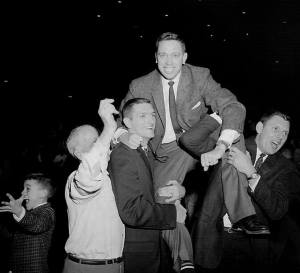
61 Tomcat Coach Bob Wright gets carried off the floor.

One by one, each of the 1928 Tomcats took a turn at shooting bank shots. After about a dozen turns each, with varying degrees of success, the ball was going in every time. They’d at least figured out that part.

“Fast learners,” said 1928 coach Jimmy Anderson.

They saw a plague on the wall commemorating the 28 national championship season.

“Look over here guys,” said Ellis Johnson, maybe the most notable of the ’28 Tomcats. “We need to beat these guys tonight. Maybe they’ll put up another one of these if we do.”

The 61 Tomcats had already done what nobody in 1928 did and that was hand those Tomcats a defeat. It was a heartbreaker, 37-36, when Bob Hilton finished off a fastbreak that was set up by an unfortunate turnover.

“Right here, this is it, right here,” said Jack Phipps of the dead spot on the floor that caused the turnover. “The ball won’t come back up. Just watch!” He bounced a basketball in the very spot and, sure enough, it didn’t come back up. “It’s still dead wood right there.”

Phipps walked away, shaking his head and mumbling something about that fateful play. Probably best it was a mumble. A lot had been said and written about the game, and the return engagement, which has the town excited and a little on edge.

When the 28 Tomcats were ready to get dressed for the game, they started heading down to their old locker room.

“Nope,” said a gentleman in rolled-up shirt sleeves. “You guys are the visitors tonight.”

This was going to be different. They headed to the other side of the gym and went into that locker room. It was mostly the same look except the toilet wouldn’t flush and the showers didn’t have much pressure, only a drizzle. The benches looked like the same ones that had been there for 40 years with a few less splinters.

“This doesn’t matter men,” Anderson told them. “We’re here to play basketball.”

The rematch would be with rules from 1961. That meant a faster tempo and no jump balls after every made basket. It was going to be a different kind of game, but the 28 Tomcats were looking forward to it.

“We’re basketball players,” Johnson said. “One rule that doesn’t change is that the team with the most points wins. That’s all we care about.”

There was a certain resolve with the 28 Tomcats, who were determined to show their fellow champion Tomcats a thing or two in this rematch.

“I’m sure they’ll be ready for us,” said 61 coach Bob Wright. “We’ve been practicing, too. I’ve never seen so many good athletes on one team. They’re incredible. So we practiced … a lot.”

Wright, who was known for his long and sometimes brutal practices, had two four-hour sessions one day. He told them they’d only need their sneakers for the second one.

“We all knew what that meant,” said Gene Smith, a center on the team.

Wright had watched 16 mm film of the first game – probably about 100 times – and was determined his team wouldn’t be making any of the same mistakes.

“He knew every single wrong dribble we took,” said Larry Conley, one of the 61 stars. “He thought we should have scored 60 on them even with their rules. But that wasn’t going to happen. These guys are like trying to move oak trees.”

Another huge crowd was gathering in the old gym. This time they sold advance tickets, which was probably a good thing. Besides nearly 1,500 inside (for a gym that seated a little more than half that) another 500 were on the parking lot hoping somebody would give them reports. They set up a way for them to hear Dick Martin’s broadcast of the game. His son, Dicky, only 7 years old in 1961, was with him taking in a moment in time he’d talk about for years. He had a bag of popcorn in one hand and a candy bar in the other, but he was in Tomcat Heaven.

It’s hard to say how many others were tuned into WCMI for the radio broadcast of one of the biggest games in Tomcat history. It was the talk of town.

Just like the first meeting, only in an exaggerated pace, the teams stayed right with each other early. When Kermit Riffe completed a three-point play following a hard foul, the 1928 Tomcats were leading 19-18. The crowd was buzzing.

“We punched and they punched back hard,” Wright said. “I knew we were in for a tough game.”

He tried to get that across to the 61 Tomcats during a timeout following Riffe’s three-point play. Even though they had knocked him up against the padding on the stage end of the floor, Wright said it wasn’t enough.

“Don’t let these guys get comfortable,” he said in a harsh tone.

The 61 Tomcats led 22-21 at the end of the first quarter after Conley used a spin move to get away from the tight defense of Gene Strother. The game had signs of being a high-scoring affair and the 28 Tomcats didn’t seem to mind.

It was more the same in the second quarter, too. The 61 Tomcats led anywhere from one point to eight points but the 28 Tomcats were hanging with them. Phipps buried a 22-footer to bring the 28 Tomcats within 44-38.

“That was some half,” Wright said. “Not sure our defense was where it needed to be, but we got the offense clicking after a little heart to heart. Sarge and Conley were outstanding and the tip-out (play) worked to perfection.”

Gene Smith, Steve Cram, Bob Hilton and Conley tipped the ball back instead of pulling in the rebound with two hands and it started the offense in motion with Harold Sergent usually as the point man. It was devastating, as usual.

“We never had a team do that to us,” Anderson said. “Our games were a little more methodical, I guess you would say. We got the hang of getting it and going eventually but that’s not how this team was made or what they did best.”

The 61 Tomcats maintained the lead throughout the third quarter, but never by more than seven points. They led 62-56 going into the last quarter after Cram dropped in a pair of free throws.

“We couldn’t shake them,” Hilton said. “No matter what we did, it seemed like they had an answer for it. The key for us was to keep scoring because they were going to do the same.”

Jerry Daniel, who played strong off the bench, pump faked his defender and drove for a basket to make it 67-60 early in the fourth quarter. They were able to stretch it to double figures for the first time at 78-68 when Smith tipped in a miss. After the team’s traded baskets, it was 80-70 with 2:25 remaining.

Finally, Wright said, “we had some breathing room.”

But it would be a breathless finish. The 28 Tomcats, playing their best when down the most, stormed back. Johnson and Phipps both hit from short range, sandwiched around a 61 Tomcat turnover. Then a Conley layup went around and around the rim and spun out, with Johnson rebounding. He threw a near length-of-the floor pass to Eck Allen, who laid it in to make it 80-76. Another turnover – this time a three-second call – and the 28 Tomcats were back in business.

Suddenly with some confidence, they worked it around until Darby fired in a 15-foot bank shot to make it 80-78.

The crowd was going bonkers. Wright had exhausted two timeouts, but the momentum was clearly on the other side. There wasn’t much he could say.

The 61 Tomcats worked it around, but missed again, and Darby was there with the rebound with only 45 seconds to play. Anderson took the timeout this time, but it would be a wonder if anybody in the huddle could have heard him the crowd was so loud.

Never had anybody seen it like this.

Using a play that Anderson designed on the spur of the moment, the 28 Tomcats tied it at 80 with Johnson powering his way inside after having his defender picked off at the foul line.

Now it was Wright’s turn in this chess match of brilliant coaches.  He put the ball in the hands of Sergent, who found Conley in the middle. He collided with Darby and scored with no foul called to make it 82-80.

One more time, the 28 Tomcats had to answer. They worked it around until Strother was about 10 feet from the basket. He was at the perfect angle for a bank shot, but wasn’t sure if he trusted that glass backboard. The hesitation was costly and the shot was a little strong. It kissed off the backboard and dangled to the front of the rim, where it set suspended for what seemed like minutes, before rolling off.

Smith reached high for the rebound, tipping it out front to Sergent and that was it. The 1961 Tomcats had prevailed 82-80 in a game that no one is likely to ever forget.

When the 61 Tomcats return to the locker room they found a goat tied to the bench. It represented making them the GOAT – greatest of all time – in Ashland basketball. Wright wasn’t buying it.

“I’ve been involved in a lot of great games but not many any greater than this one,” Wright said. “And as for being the greatest Tomcat champion of all, I don’t know about that. This program has a lot of teams that could make that claim, including all the way back to these 1928 Tomcats and this year’s 2020 team.”

Anderson said the comeback from 10 points down in the last 2½ minutes showed him what the 1928 Tomcats had inside them.

“They are competitors who don’t accept losing well,” he said. “The determination and effort that came in the comeback was something nobody has ever seen. We scored 10 consecutive points on them. I doubt anybody did that in 1961. I’ll be glad to return to 1928. I’ve seen all I want to of Larry Conley and Harold Sergent.”

Top guns

Two individual performances worth noting was Conley scoring 27 on 11-of-13 shooting. He also had six rebounds. Johnson led the 28 Tomcats with 22 points on 11-for-12 shooting.

Father and son

Ken Johnson also got in the game for a couple of minutes to play against his father Ellis Johnson. Ken hit a free throw and grabbed a rebound.

1928 ASHLAND (80) – Fullerton 3-4 0-0 6, Phipps 4-7 1-1 9, Darby 3-9 5-6 11, Strother 5-13 2-2 12, Johnson 11-12 0-1 22, Hemlepp 1-3 0-0 2, Barney 2-4 1-1 5, Dobbs 1-2 0-0 2, Nicholas 0-4 0-0 0, Allen 3-4 0-0 6, Riffe 1-1 1-1 3, Wolfe 1-1 0-0 2. FG: 34-63. FT: 10-12. Rebounds 40 (Fullerton 4, Phipps 4, Darby 8, Strother 5, Johnson 4, Hemlepp 1, Barney 1, Wolfe 3, Riffe 3, Allen 6, Nicholas 1). Assists: 21 (Fullerton 6, Phipps 3, Darby 4, Johnson 1, Hemlepp 2, Barney 2, Dobbs 2, Nicholas 1). PF: 27. Turnovers: 24.

1961 ASHLAND (82) – Sergent 7-13 2-5 16, Hilton 2-12 0-0 4, Sexton 1-5 2-4 4, Smith 2-7 9-12 13, Conley 11-13 5-6 27, Cram 3-6 1-2 7, Fairchild 1-5 0-0 2, Gray 1-6 2-2 4, Johnson 0-1 1-2 1, Daniel 2-3 0-1 4. FG: 30-71. FT: 22-34. Rebounds: 32 (Sergent 2, Sexton 3, Hilton 7, Smith 4, Conley 6, Cram 4, Fairchild 2, Gray 3, Johnson 1). Assists: 15 (Sergent 3, Hilton 3, Sexton 3, Conley 2, Smith 1, Cram 1, Fairchild 2). PF: 17. Turnovers: 8.

1928 ASHLAND       21       17       18       24          –           80      

1961 ASHLAND       22       22       18       16          –           82