
Rotary event in Ashland focused on polio survivors, eradicating disease

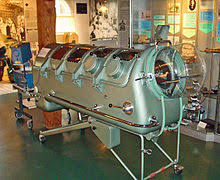
Iron Lungs were used to help polio victims breathe.

ASHLAND, Ky. – Blanche Allen is 87 years older, enjoyed a 35-year career as a nurse and runs her own household.

But 55 years ago, her every breath was produced through an apparatus called an Iron Lung.

Allen is a polio survivor who as a young nurse and mother of two in the early 1960s depended on the Iron Lung to breathe for a month of her life after learning she had contracted polio despite taking the vaccine.

“I was paralyzed,” she said. “They took me to the ER. I was in terrible shape. My sister checked on me before she turned in for the night. It was 11:30 or 12 at night and it felt like there was a 100-pound weight on my neck.”

Allen, who was paralyzed from the neck down, was only the fourth from Boyd County to have contracted the disease at that time. She was one of the first to use an Iron Lung, a machine that resembles a hot water heater.

Polio patients were put inside the machine with only their head sticking out and it mechanically put breath in their lungs.

Allen said she was in and out of it and doesn’t remember much about her time inside the Iron Lung. She was fed through tubes. Her children, girls ages 5 and 11, never saw their mother inside the machine.

“They could hear it (from the hallway) but never saw me in it,” Allen said.

Allen was in the Our Lady of Bellefonte hospital in Greenup County and her doctor, Clarence Haberle, had the Iron Lung sent from King’s Daughters in Ashland.

“I remember they brought it over in a pickup truck,” Allen said.

She said. the day they let her come home, the doctor wheeled her to the car. “He said ‘I never thought I’d see the day you’d go home and go to church every Sunday. He let you live to raise the girls.”

Allen returned to her job as a nurse in the hospital where she was sick and the Iron Lung was in the basement.

“I never went to see it,” she said.

Allen’s family has a history of long lives. Her grandmother lived to be 103 and her sister was 18 days shy of 100.

“Without that Iron Lung, I’d be gone,” she said.

One of the missions of Rotary International is to eradicate polio from the world. A coalition of nine Rotary clubs in the Tri-State area near Ashland will come together Sunday, Oct. 28, for a special day at the Paramount Arts Center.

The film “Breathe,” the true life story of a polio survivor, will be shown on the historic theater’s big screen at 3 p.m. The movie was released in 2017 and tells the story of Robin Cavendish, who contracted polio at 28 and was given only months to live. He survived with the help of his wife and inventor Teddy Hall to escape the hospital ward and devote the rest of his life to helping fellow patients and the disabled.

Polio survivors will be on hand as will Iron Lungs that were for children and adults. Allen plans on coming to the event which also includes a short film called “Polio Survivor Stories” produced by Randy Yohe, a former local news television reporter, and his wife Vickie.

He interviews several polio survivors who tell their story in the film. Ashland residents Trish Hall and Don Setterman and Ann Bryant of Catlettsburg are among those in the video.

Tickets are $10 and proceeds benefit Rotary International’s PolioPlus Fund and be matched 2 to 1 by the Bill and Melinda Gates Foundation which has pledged $450 million to right polio from 2017-2019.

Polio has been eradicated from the United States since 1979. The global fight continues. In 2018, a total of 20 cases was reported in the world. A country must go without a case for three years to be declared polio-free.

Wednesday was World Polio Day.
Tomcat tradition on full display with Larry Conley

Jason Mays, the new Ashland Tomcat basketball coach, is smart enough to understand the role that tradition plays in the community and the program itself.

It was with that in mind that he set up a celebration night with perhaps the greatest Tomcat of them all.

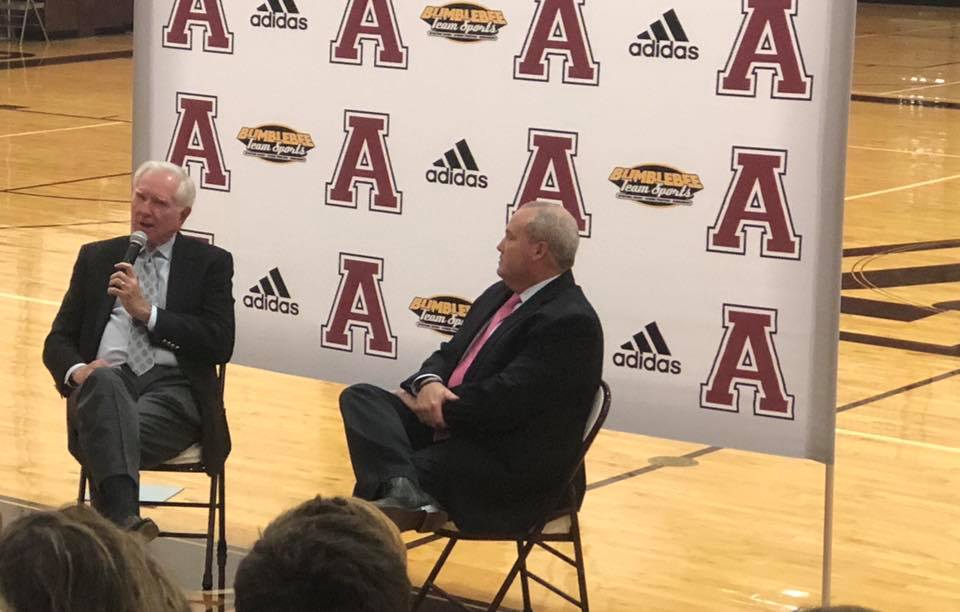
Larry Conley, who was part of the memorable ’61 Tomcats that won a state championship and then practically willed the ’62 Tomcats back to the championship game, was back in front of today’s players Thursday night in an event that Mays hopes can stir the echoes.

Do they remember Larry Conley? Probably not, but their parents and grandparents – not to mention countless other fans who were among more than 100 in attendance – sure did.

For those who don’t remember him as a player surely remembered him as a college basketball television analyst that had an illustrious 42-year broadcasting career. He estimated covering 1,800 basketball games and 600 baseball games and most of those involved SEC teams.

Conley is 73 and still has that slender body that made him a basketball dynamo. The ’61 Tomcats are still remembered as one of Kentucky’s greatest state champions by those who have seen many of them, including former Herald-Leader columnist Billy Reed and former Herald-Leader sportswriter Mike Fields.

You can learn more about that team in my book called “Teamwork” (shameless promotion).

Conley talked about being a gym rat from an early age since his father, George, was the fiery coach of the Tomcats from 1949-54, guiding some of Ashland’s greatest teams and players, including the 1953 team that was ranked No. 1 but upset in the state tournament’s opening round.

Jim Host, a manager on that team, is still convinced the ’53 team was the best of all time. But those in ’61 beg to differ and they have the big trophy as proof that the 36-1 Tomcats team holds that distinction.

Nevertheless, that’s an argument for another day. Both are part of a Tomcat tradition that has few equals.

Conley said he learned his first lesson of discipline during a practice session when as a little tyke he picked up a basketball and began dribbling it when his father was addressing the team. Bad idea, he quickly learned, when his father turned to find out who was interrupting him.

“I learned that day to be quiet whenever the coach is talking,” he said.

Conley was cordial and affable, encouraging the young players to respect what their teammates could do, improve their weakness and take care of business in the classroom. It was great advice.

He also showed reverence for his coaches and none anymore than the late Bob Wright, his coach with the Tomcats who molded these talented players into a team for the ages. Conley talked about the amazing Harold Sargent, who could do anything with a basketball, and how this team was built to win. The top seven players all received Division I scholarships. Six of the seven are still living. Bob Hilton passed away many years ago.

Conley, of course, played for Adolph Rupp but he said that Rupp never saw him until he signed him to play for the Wildcats. Recruitment was different in those days, he said. “If you were a good player in Kentucky it was a given that you were going to Kentucky,” he said.

Wright kept the players letters from colleges until after the season and Conley said he gave him four boxes of letters when his senior season ended.

Conley said he did make a visit to Duke, drawing a groan from the crowd.

He remembered a time when Rupp came up to him and asked a question. “Conley, who is the better coach, me or your high school coach?” Conley said while imitating Rupp’s high-pitched voice. While Conley answered “correctly,” he said it was the “hesitation that got me in trouble.”

“Conley, you son of a gun, you’ve got a lot to learn,” he said was Rupp’s reply, Conley said, mimicking his southern drawl.

He also talked about his broadcasting career and some of the most memorable games, including the 1992 battle between Arkansas and Kentucky in the SEC Tournament. He said Rick Pitino was one of the two or three best coaches he was ever around, that he actually liked Bruce Pearl (more groans) and disliked Dale Brown. He said he eventually got to appreciate Nolan Richardson because of how hard the Razorbacks played for him.

It was a good night with one of the Tomcats finest ambassadors and best-ever players who told the team and audience that he’d try to make it back to watch them play in the Ashland Invitational Tournament.

Kudos to Coach Mays for putting tradition on display by reaching out to Conley for the event. Part of his job, as I’m sure he sees it, is to restore some of that tradition. The Tomcats are currently in the longest stretch between 16th Region championships. They last raised a banner in 2002.