Some storytelling and thoughts from the mind of Mark Maynard.
Author: Mark Maynard
Managing editor of Kentucky Today, the digital newspaper of the Kentucky Baptist Convention, since July 2017. Worked 42 years for The Daily Independent in Ashland, Kentucky, the last 12 as managing editor and editor and the previous 30 in the sports department, including 17 years as sports editor. President of Amy For Africa, a faith-based Christian ministry serving Uganda. I'm a husband to Beth and father to Stephen and Sally, grandfather to Brooks and Addy.
Most of the candidates for the Ashland School Board are familiar names to the community and that is not usual for these races. While my vote does not count in Ashland anymore, I still have an opinion and still care very much about the future of Ashland’s schools and students.
With that in mind, let me introduce you to the least known candidate. His name is Dave Williams, and his agenda is vocational education. His agenda also includes Ashland students who are being limited in their vocational opportunities. The children matter to him.
You may not know his name but please do not mistake that for the passion he carries into this race. I have known Dave casually for several years but became much closer friends the last year I was living in Ashland. We have stayed close for the past two years despite the distance between Ashland and Florence, where I live now.
If you do not know his name, then you have not been to many school board meetings in the past 2-3 years. He has been to more meetings than some board members if that gives you an indication of his insatiable drive. He is like the dog who will not let go of the bone no matter how hard you try to get it from him.
Dave Williams ia a man of integrity and Christian values.
He has researched and studied vocational education opportunities for Ashland, visited and talked with leaders of superior vocational programs in the area, pitched ideas including how to fund, visited Frankfort on multiple occasions to speak with lawmakers and gather information about Ashland and its history with vocational education from more than 50 years ago. He uncovered the original agreement from the State School Board to the Ashland Board of Education concerning vocational education in the early 1970s. The document assured Paul G. Blazer High School students access to the Roberts Drive vocational campus and is potentially still binding if the current BOE works to enforce it. He was relentless in his search for the document, finding it after going through a countless number of boxes. He felt an urge to look in one more box and – Viola! – there it was.
Dave is passionate about the vocational school issue and understands some Ashland students are missing out because of not having the kind of vocational opportunities they need and deserve. Not every student at Ashland, or any school for that matter, is made for college. Some very bright students are made to excel in the trades and need that preparation during middle school and high school. They can take those skills into deeper vocational training after high school and turn it into lucrative jobs, the kind of jobs Ashland needs now and later.
Vocational school gives them a choice and Williams understands that and wants that for Ashland students. He has been a bulldog in school board meetings, speaking as much as the time will allot. Many of his ideas and thoughts have fallen on deaf ears. But his passion remains for the Ashland students who he feels are being forgotten or disadvantaged in their vocational options.
Ashland has an outstanding school system with tremendous teachers at all levels but there’s room for more with vocational training for welders, plumbers, electricians and other trade skills that are not only a necessity but careers.
Wiliams has done a lot of groundwork with his research and has been in one-on-one meetings with lawmakers who hold the purse strings that could make improving the vocational landscape more affordable. It is out there if you look and he will look.
Here is something else noteworthy about Dave Williams. He is a man of integrity and Christian values. If he becomes a board member, your question or request will be heard and considered.
Vote for Dave Williams on Nov. 5. He will serve with passion on every issue that comes in front of the board.
Robbie VanHoose, a stalwart businessman who grew Big Sandy Superstore into a giant in the furniture and appliance industry, is now a Hall of Famer.
VanHoose, a friend to the Ashland community for decades, was one of three new members inducted into the Associated Volume Buyers (AVB) Hall of Fame during the BrandSource convention on Monday in Dallas.
He started out working in his father’s business, learning the ropes in the warehouse. Barely out of his teens, he and a partner, John Stewart, bought the company when Robert VanHoose Sr. decided to retire young and raise horses instead.
Rob VanHoose shares Bible truths with a group in Uganda in June. He has been a big supporter of Amy For Africa.
“The only job I ever had was professional golf ball hunter up until about 8th grade and then my dad put me in the warehouse and that wasn’t all that exciting,” VanHoose said. “I started getting into sales in college. He said, ‘I’ll sell you the company. I know you’re a little young, so I’m going to sell it to you and John Stewart, who was 28, because you need a little maturity. But you can be CEO.’”
VanHoose said “that started the journey” as he and Stewart purchased three stores from his father. “That was 1976 and it was game on.”
The company started out as a local, grew to be a regional powerhouse and is now in six states.
VanHoose, who turned 70 earlier this month, said while he was working “9 to 9 and building a business,” his wife, Sandy, was bringing up their three sons. “She raised three great sons and now she’s a great grandma” to 10 grandchildren, he said.
Rob and wife Sandy, who he counts his biggest blessing.
His wife prefers to stay out of the spotlight even though Robbie has put her in a few television commercials against her better judgment. “I’ve gotten a lot of mileage out of her name being Sandy,” he said.
Meanwhile, Big Sandy Superstore has flourished in its markets with 30 stores selling more than $400 million in appliances and furniture.
“I’d like to say I was that smart or worked that hard, but I wouldn’t be honest if I said that,” he said. “It’s the grace of God. I don’t understand why He blessed us or smiled on us, but I sure do thank Him for His amazing grace.”
Big Sandy Superstore has become a powerhouse brand in the industry. And, thanks to VanHoose’s three sons – Trey, Stephen and Jonathan – it continues to operate as a family business operated out of Ashland.
As his boys were growing up, VanHoose coached or assisted on several AAU basketball teams that competed on high levels. All three sons played at the high school level and Jonathan had an outstanding college career, finishing at Northern Kentucky University.
While most know VanHoose the astute businessman, he has a softer side that isn’t always seen. He has been a man of second chances, hiring countless employees who many others had given up on, and watched them become success stories.
Not only that but he has given generously to Christian causes and missions, including Amy For Africa, and taken multiple trips to Uganda where his heart has melted around the children being educated by AFA. His kindness and love for the Ugandan children has been immeasurable along with his giving to the organization. VanHoose is a faithful member of First Baptist Church in Russell.
“Robbie has a big heart for the Ugandan children and we love and appreciate him so much,” said Amy Compston, the co-founder of AFA. “He’s a natural born leader and has been an important part of this ministry almost from the beginning. I cannot begin to count the number of lives he has touched in Uganda. God has used him in mighty ways.”
Rob has a heart for the children of Uganda, shown here holding hands as they walk through an area known as “The Ghetto
VanHoose is a shrewd businessman who worked daylight to dark building the Big Sandy Superstore brand. As a community partner, he has quietly contributed to causes or situations that are making a difference.
“When I think about my dad. I think about the ultimate competitor with the biggest heart,” said Jonathan, his youngest son. “Growing up, I didn’t fully understand what he was trying to teach us. It wasn’t until I matured that I realized my dad was teaching us that nothing in life will be given to you. That you have to work for everything. The other thing he taught us was to treat people the way we wanted to be treated – the golden rule, which is what Big Sandy was founded upon.
“His faith and his drive are inspiring. The best thing about dad is that he helps a lot of people and has done a lot of things in different communities that he never takes any credit for. He is man of integrity and faith, and I have never seen any circumstance shake that. It’s an honor to call him dad.”
Stephen Vanhoose, the middle son, said his father always pushed them to be the best at anything they did and constantly look for improvement.
Rob’s sons, from left, Stephen, Jonathan and Trey.
“He’s a natural pusher. It started as kids in sports and naturally transferred over to business. When people talk about Kobe and Jordan mentality, he definitely has that, but his commitment to his morals and convictions are what ultimately make him the GOAT and a deserved Hall of Famer.”
VanHoose is certainly generous. When a local high school choir director approached him one December about purchasing music, he sarcastically asked her, “What do I get out of it?”
She said, “I don’t understand what you mean?”
He told her, “Well, they can sing, can’t they? Have them come out to the store on Saturday and sing Christmas carols for a few hours.”
She did and they got the music they needed.
Many who are down on their luck have come to him asking for a second chance. VanHoose has said he would rather be “0 for 20, than 0 for 0” and looked for a reason to give them a chance to succeed vs. no chance at all. While some do not succeed, many have gone on to work there for years, advancing from the warehouse to the sales staff and even beyond.
“Man, over the last 20 years I have seen him grow. Through everything we went through, he really grew and changed,” said Jonathan, who battled his own demons. “(He) Spent time at the prison (witnessing to inmates with friend Rob Barber). Learning and understanding. I think that’s the most impressive thing. He humbled himself when he saw he couldn’t fix me, and it changed him. It’s been really awesome to watch.”
The AVB Hall of Fame was created in 2019 to recognize those who have gone over and above in their service to the industry. The award took a one-year hiatus in 2020 due to the pandemic.
Ashland sure didn’t schedule a cupcake for the christening of the new and improved Clark’s Pump-N-Shop Putnam Stadium on Friday.
Harvest Prep, a Division V powerhouse from Canal Winchester, Ohio, may be one of the toughest home openers in Ashland history. The Warriors are 2-0 this season, dispatching Division I Pickerington Central 24-21 and routing Purcell Marion, 46-8, last week.
The Warriors play for keeps and reside in the same division as our across-the-river neighbors Ironton and Wheelersburg, of whom they have a bit of history.
Harvest Prep fell to Perry 22-8 in the 2023 Ohio Division V championship game and the road to get there included wins over Ironton 20-14 in the quarterfinals and Wheelersburg 22-0 in the semifinals. It was the second win over Wheelersburg, having defeated them 32-16 in the regular season.
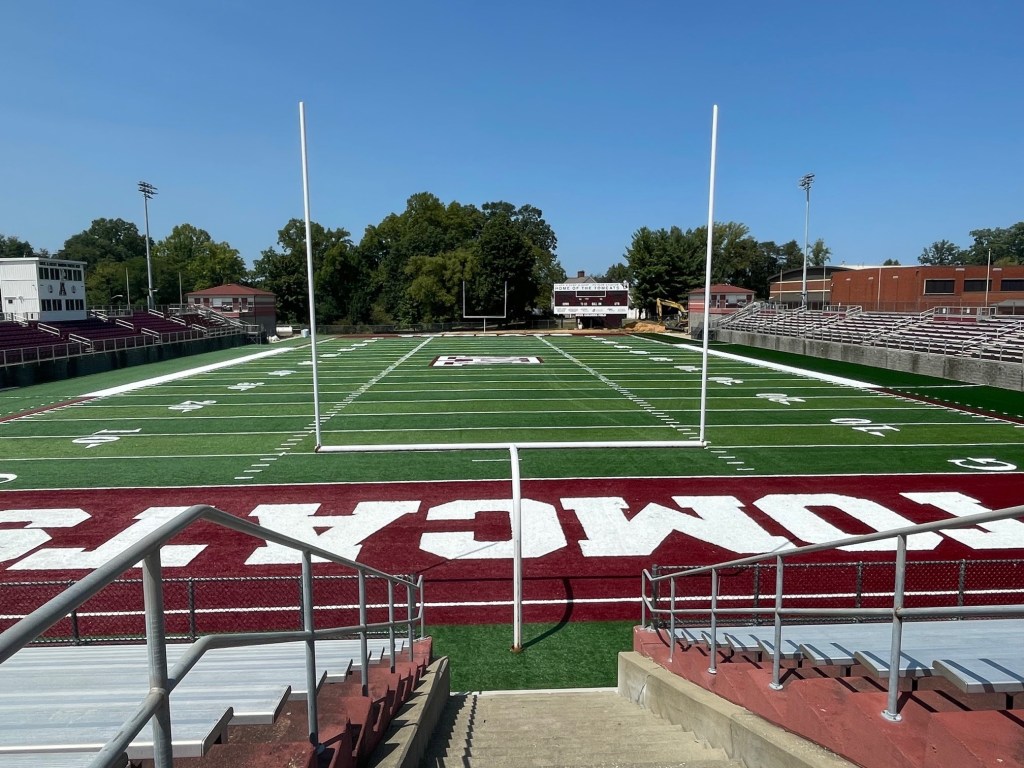
Clark’s Pump-N-Shop Putnam Stadium will unveil its exciting new look and other features on Friday, Sept. 6, against Harvest Prep.
Like the Tomcats, Harvest Prep is a program dripping with tradition. The Warriors are 101-23 over the past 10 seasons, including records of 10-3, 13-1 and 12-2 respectively in the past three seasons.
Milan Smith was the head coach in nine of those 10 seasons, David Howes went 13-1 in 2022 with Ironton providing the only loss, 34-0 in the semifinals.
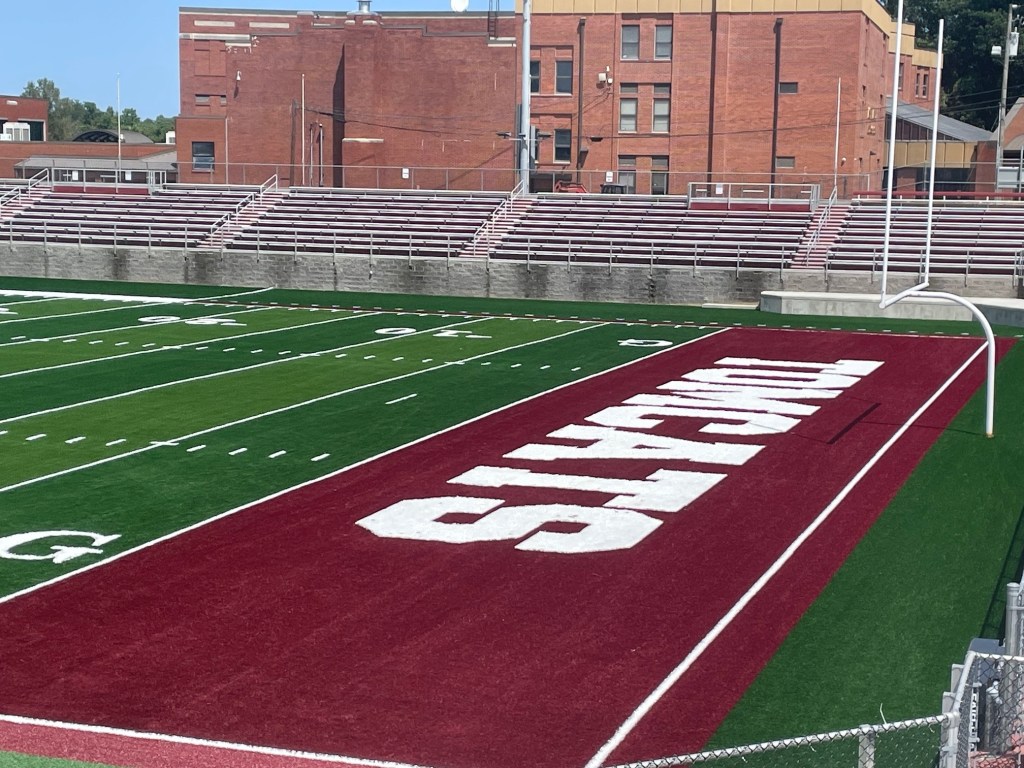
This will be the “third chapter” of Putnam Stadium – the first coming in 1937 with the first game, then the reconstructed stadium in 2014 and now this season with new artificial turf, a Jumbotron scoreboard, new lighting, sound system and more bells and whistles than a one-man band could have in his wildest of dreams.
Here’s a look at nine home openers of significant seasons in Tomcat history. We can add No. 10 on Friday night:
Sept. 18, 1937
The first game in the history of Tomcat Stadium – later to be renamed Putnam Stadium – was a 22-0 shutout win over Ceredo-Kenova, W.Va. Vincent “Moose” Zachem had the first touchdown in stadium history.
The ‘37 Tomcats finished with an unusual 3-3-3 record with all three losses and two ties coming at home. All-State tackle Ralph Felty was a star. Jack Ball ran for 69 yards and Charle “Doc” Stanley gained 36.
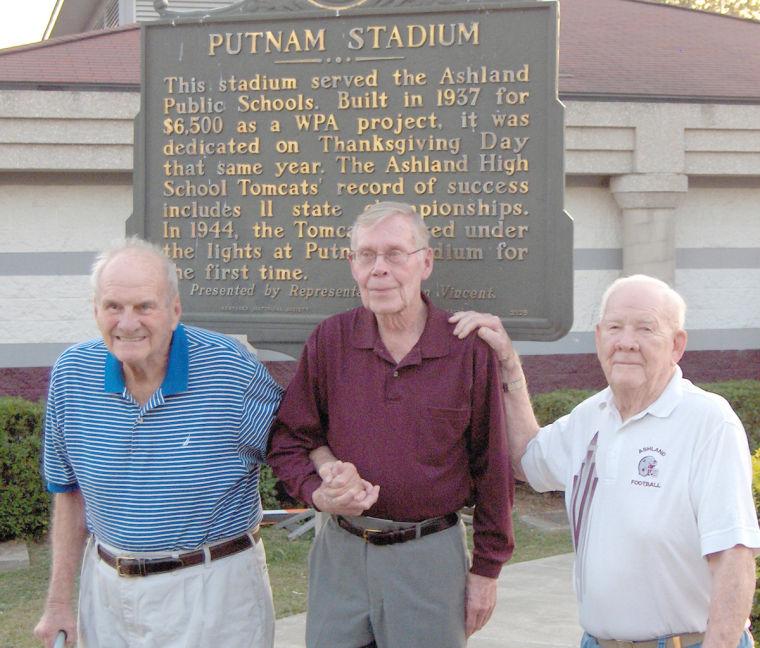
The last three members of the 1937 team: Bun Wilson, Charles “Doc” Stanley and Ralph Felty. All three men have since passed.
The stadium was built with Works Progress Administration (WPA) funds because they were taking much of the land at Armco to prepare for possible war. Ashland asked for some help and WPA poured the concrete creating the seating, locker rooms under the stadium and the Ashland labor did the rest including the ticket office and wooden bleachers. The cost for the stadium was $6,000.
Ernie Chattin was the head coach for the Tomcats. He said during a 1987 interview that there was only a small crowd for the afternoon opener. The stadium did not have lights until 1944.
Sept. 19, 1942
The season started with a bang in what turned out to be an undefeated 10-0 season as the Tomcats drubbed Coal Grove 64-0 with Jim Stith and Paul DeHart scoring two touchdowns apiece.
Ashland defeated Manual on the Louisville powerhouse’s field in mid-November 7-6 to lay claim to the mythical state championship. The Tomcats made sure they stayed undefeated the following week by walloping Russell 70-0.
J.C. Kennard, Rupert “Doc” Rice and Spencer Heaton were among the stars for coach Charles Ramey.
Sept. 6, 1958
Ashland, with the likes of Herb Conley and Dickie Fillmore, smothered Catlettsburg 51-6. Conley rushed for 151 yards and Fillmore gained 104. It would be like that all season for Mr. Inside and Mr. Outside.
The Tomcats finished 10-0-1 with the tie coming against Huntington East in the fourth game of the season. Ashland defeated Richmond Model 34-13 in the Recreation Bowl to close the season.
Herb Conley busts through the line for a big gain during the 1958 season.
Rex Miller was the head coach and Kendall Bocard, Joey Layman and Monte Campbell were other star players.
The high school playoffs started the following year.
Aug. 25, 1967
Ashland was big, strong and ready. Defense dominated Evarts in a 19-0 victory to open the season. Tony Mulvaney gained 89 yards rushing and Steve Scott gained 78.
Mike Johnson makes a play on defense for the 1967 Tomcats.
The Tomcats were a punishing team, finishing 13-1 with the only loss coming to West Virginia power Stonewall Jackson, 13-3, in Putnam Stadium.
Ashland defeated Elizabethtown 19-14 in the Class AA championship game at the Fairgrounds in Louisville on Nov. 24. Paul Hill, Bill Culbertson and Les Lyons were first-team All-State players.
The title was the first official state football championship in school history. Jake Hallum was the head coach.
Aug. 25, 1972
Pierre Harshaw shows his speed on the outside.
Knox Central was no match for Ashland in the season opener as Steve Layman rushed for 122 yards and Jerry Kirk threw for 93 yards.
Defense was the calling card though with only four teams scoring more than one touchdown against the Tomcats, who made it to the state championship before falling to Tates Creek 16-7 in the last game ever played at Stoll Field in Lexington.
Layman, Steve Johnson, David Johnson, Pierre Harshaw, Randy Rice, Kirk, Randy Elkins, Jerry Bentley, Mike Wheeler, Roger Webb and Mike Kimbrell were some of the stars.
Ashland finished 11-2 and earned its way to the championship with a physical 21-6 win over Bryan Station in Putnam Stadium. Herb Conley was the head coach.
Aug. 22, 1975
Just when you thought it was safe to go to Putnam Stadium, here comes JAWS.
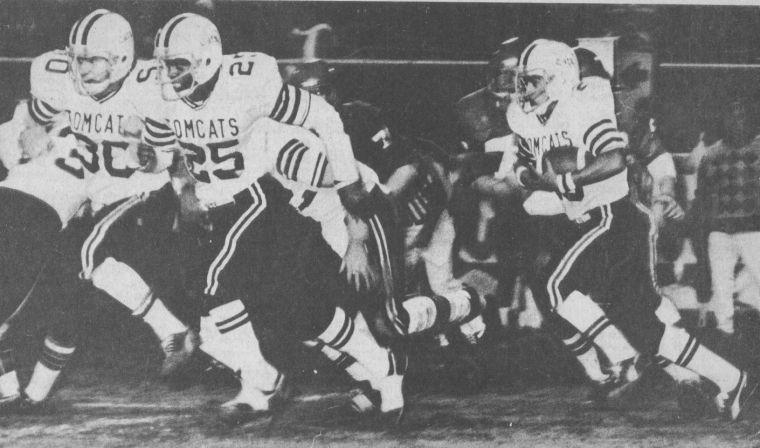
Ashland’s dominating defensive team crushed Johnson Central 47-14 – the first of 14 consecutive victories – as Gary Thomas rushed for 182 yards and three touchdowns and Jeff Slone 108 yards and a TD.
The Tomcats were 7-0 at Putnam Stadium, including a 14-0 victory over Kenny Fritz-led Ironton.
Ashland was the Class AAAA State At-Large champions with a 13-7 win on the road at Paducah Tilghman. The Tomcats became the first team to fly to a game in state history.
Gary Thomas (25) and Jay Shippey (30) lead the way for Jeff Slone in 1975.
St. Xavier blanked Ashland 20-0 the following week for the Class AAAA overall championship.
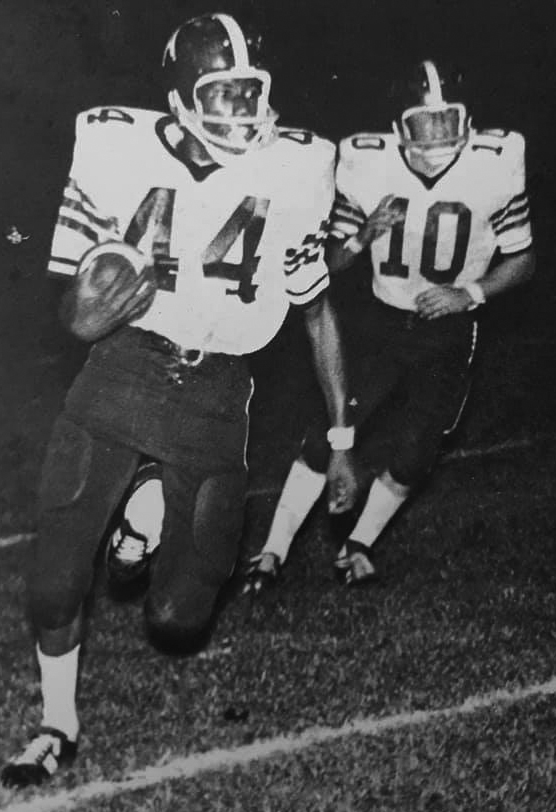
Thomas and Slone were 1,000-yard rushers and Terry Bell, Rick Sang and Thomas were first-team All-State selections. Bell was the state’s Lineman of the Year and Herb Conley the state’s Coach of the Year. The team included Chuck Anderson, Casey Jones, Yancey Ramey and Greg Jackson.
Aug. 17, 1990
Ashland sent an early message that this team was going to be special, smashing Raceland 41-8 behind Juan Thomas, who ran for 103 yards and two touchdowns, and punishing fullback Charlie Johnson who had 84 yards rushing.
Raceland coach Bill Tom Ross predicted greatness for the Tomcats, who finished 14-1 and overwhelmed Lincoln County 35-13 for the Class AAA championship for coach Vic Marsh.
Charlie Johnson provided power in the backfield for the 1990 Tomcats.
Ross said tackling Johnson was “like trying to tackle a rolling manhole cover” as he powered over would-be tacklers all night.
Running backs Thomas, Johnson, Chris Hutt and quarterback David Brown made for a dominating wishbone offense that rushed for more than 5,000 yards. The only blemish was an 18-15 loss to Greenup County in the third game at home.
Aug. 29, 2014
This was the first game of the “new” Putnam Stadium. The old stadium was razed and then it was rebuilt in the same style. The opener was supposed to be the previous Friday but a driving rainstorm flooded the field, postponing it a week.
Ashland outlasted Raceland 41-35 as Quinton Baker rushed for 188 yards and four touchdowns and Jake Long had a 64-yard touchdown run.
The Tomcats finished only 6-5 but did advance to the second round of the playoffs.
Baker rushed for 1,719 yards and 20 touchdowns and was first-team All-State.
Oct. 9, 2020
Keontae Pittman ran for 253 yards and three TDs in his last game as a Tomcat. (Don McReynolds photo)
It was the third game of the season – during COVID – before Ashland played a home game against East Carter. The season didn’t start until the last Friday of September.
The Tomcats crushed the Raiders 54-7 as Brett Mullins threw for 140 yards and two touchdowns with J.T. Garrett hauling in 129 yards and both TDs receiving.
Ashland ran the table, going 11-0 and winning the state championship with a 35-14 victory over Elizabethtown as Keontae Pittman ran for 253 yards and three touchdowns and Hunter Gillum 115 yards and two touchdowns.
Tony Love was the head coach of one of the top defensive teams in Tomcat history.
Greg Jackson looked around Clark’s Pump-N-Shop Putnam Stadium on Friday morning like a proud father.
Seventeen years of labor pains will do that.
Jackson’s vision to make Putnam Stadium the grandest of them all even, when everyone else was telling him that it will never happen, is happening.
Let us count the ways:
Greg Jackson stands with the Clark’s Pump-N-Shop Putnam Stadium behind him. He has watched his 17-year vision come to life.
–A stadium rebuilt with the same look and feel of the original stadium.
–Bucket seat for the new seating.
–A donor corner with a statue of Coach Herb Conley.
–Artificial turf (A big hurdle crossed only with corporate help from Clark’s Pump-N-Shop).
So, shouldn’t that have been enough? Well, no. The VISION was bigger. Read on:
–A banked end zone in the open end of the field with ASHLAND centered in the middle.
–Mesh maroon screens to cover the already weathered concrete along the bottom of the bleachers.
–A granite four-foot Tomcat statue at the top of the stairs on the closed end if the stadium that became another tradition as players touch it before heading onto the fields on Friday nights.
–New lights to replace the aging 30-year-old poles that were showing their age.
–Three new flagpoles to replace the rusted ones and new USA flags, Commonwealth flags and Tomcat flag to hang from them.
And the last piece of this enormous vision? A monster scoreboard with a Jumbotron inside of it and a state-of-the-art sound system that will send Chuck Rist’s voice out for miles and miles.
The new turf at Clark’s Pump-N-Shop Putnam Stadium is eye-popping.
Jackson went to work on that one in May and in only 10 days had secured six anchor advertising sponsors to pay for it. And not only did he have enough for Putnam Stadium but also will be hanging one in Anderson gymnasium. How did he do it all? With determination and relentlessness and a can-do spirit like I have never seen.
If you are looking for a Most Valuable Player for this project, it is obvious who gets all the votes.
Full disclosure: I’ve known Greg a long time and consider him a close friend. What stands out to me is this man’s integrity. He’s a man of his word, a West Point graduate and “Beat Navy” are his two favorite words put together. He is a longtime trusted friend of the community and loves being part of the Tomcat family.
The overwhelming amount of work he has put in on this project says a lot about the man who would not consider anything but the vision that he began putting together 17 years ago and it is about to come to fruition next Friday.
The obstacles and detractors he faced would have scared away a lesser man. He never blinked. As he kept dreaming of more for the stadium, I learned they weren’t dreams in his mind. It was all part of the vision, a vision that he was going to finish.
Superman has X-ray vision. Jackson has Tomcat Vision.
And when you come to Clark’s Pump-N-Shop Putnam Stadium this season, seeing will be believing.









 MARK MY WORDS 2