Unsung heroes: Putnam Stadium caretakers have been remarkable

ASHLAND, Ky. – Steve Conley and Joe McDavid hate the spotlight as much as they love Clark’s Pump-N-Shop Putnam Stadium. And that’s saying something.

They do their jobs with excellence but in such obscurity the only photo available of Conley was from 10 years ago. I was able to muster only a mug shot of McDavid.

Conley and McDavid, like the late Doug Childers before them, have treated the natural surface at the stadium like their own front yards, manicuring every blade of grass it seemed. Those three men have been the unofficial (and unpaid) groundskeepers and caretakers at the home of the Tomcats for more than five decades combined.

Conley has worked at it for more than 20 years and McDavid more than 11 years. Childers did it for 30 years before they came on the scene – enough so that they renamed the surface Doug Childers Field. He was a fine man who cared a great deal for the stadium.

Doug’s sister, Donna Childers Suttle, was a huge fundraiser for the stadium restoration project and served on the committee for several years. She always said that Doug “treated it like it was his own front yard.”

The same could be said for Conley and McDavid who in the spring and summer mowed the grass three times a week. It was a way they could give back to the football program and Tomcat Nation in general. McDavid’s sons, Drew and Daniel, were outstanding Tomcat football players so his attachment came quite naturally.
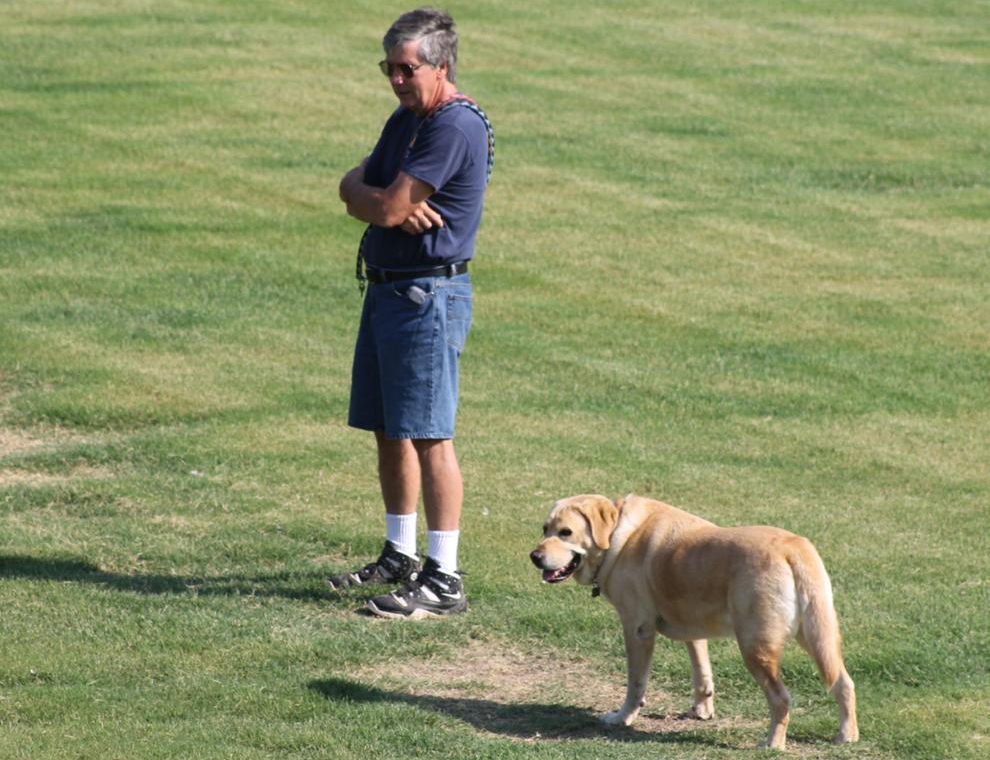
Steve Conley has been the groundskeeper at Putnam Stadium for the past 21 years. He is shown in this photo from 2014.

Conley’s son played basketball but his personal satisfaction came from trying to make it the best stadium in the area. It wasn’t just mowing the grass either. He did the watering, trimmed bushes and was the eyes and ears for Ashland athletic directors Mark Swift and Jim Conway, making sure they knew if there was anything that needed to be fixed, repaired or painted. It is hard telling how many man hours he put in on the stadium.

And still does. Conley can usually be spotted with Greg Jackson, the tireless chairman of the restoration committee that is about to realize the end of a 17-year vision. Conley has been a crucial member of the committee for Jackson, who had to sometimes feel like he was on a deserted island through the long process. But he always had a confidant in Conley.
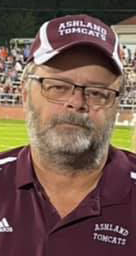
Joe McDavid

Conley has always cared for the stadium and was instrumental in getting the restoration project under way. In 2007, he was working at the Catlettsburg Refinery under supervisor P.J. Stringer, who was also the chairman of the Ashland school board. He showed Stringer the places where the stadium’s structure looked like it was showing its age. Concrete was being chipped away and the underbelly of the stadium was cracking.

It was eye-opening for Stringer, who immediately met with then superintendent Phil Eason and formed a stadium restoration committee.

“We needed to repair Putnam Stadium,” Conley said. “That was our goal when we started. It was never to replace Putnam Stadium.”

However, after hiring some engineers to inspect the stadium, they learned the news was much worse. “They came back and said, ‘You can’t repair this, it has to be replaced.’ That was in the spring or summer of 2008. It was unrepairable,” Conley said in a 2014 story in The Independent.

The committee then started on the long fundraising journey that has seen many ups and downs, including a recession that rocked the economy.

Conley said in that story in 2014 that he would do the groundskeeping “for as long as he was able.” He was 62 years old. Ten years later, and the job was getting too big for the two volunteers who deserve so much credit for how Putnam Stadium has looked every season.

Conley and McDavid took pride in how the stadium looked as fans came through the gates, especially for that first game of the season when you couldn’t tell if it was natural grass or artificial surface, it was so perfect. They went to great lengths, putting in a lot of hours throughout the weeks, to get it in Game Day shape throughout the remainder of the season.

“The commitment level they’ve had has been remarkable, unbelievable to be honest,” Conway said. “They don’t ask for anything and say, ‘Don’t say anything about us. We want to be in the back and do our thing. Thank you for allowing us to be a part.’ You don’t run into people like that.”

Volunteers, which included parents of players from each particular season, put down the paint for the field on Thursday nights. Sometimes there was a lot of help and other times not so much. Each year there was a new group and a new learning curve.

“That has been the monster.” Conway said. “Back in the day, a lot of people were willing to commit time and do those things. The number of people willing to do that is very minimal at best. It’s like always having the same folks working the concession stand. It’s always the same ones, they’re going to do it regardless. But you can’t expect the same folks to be doing it all the time. They’re getting older, they’ve got other things going on in their life with their families.”

With the artificial turf, which was made possible through a sizeable donation from Rick and Brent Clark of Clark’s Pump-N-Shop, Conley and McDavid can sit back and smell the roses. There will also be no more paint parties on Thursday night.

“I know the older generations are upset because the grass surface is going away but people don’t understand how this is going to affect everything,” Conway said. “We will never have to cancel JFL (games) again and we’re not going to have a muddy, sloppy game in November when the stakes are high. It has been needed for quite some time. We finally got there.”

The new Clark’s Pump-N-Shop Putnam Stadium will have its reveal on Sept. 6 when the Tomcats play their first home game of the season against Harvest Prep out of the Columbus area. There have been plenty of spectacular additions, including a giant Jumbotron inside the new scoreboard and a sound system that would make the Rolling Stones blush.

But, if possible, could I suggest one more thing?  

How about a couple of rocking chairs in prime locations on the field for two of the unsung rock stars of the past 20 years of Tomcat football?

Bittersweet ending for CP-1 Hall of Fame during these changing times

ASHLAND, Ky. – It was a bittersweet scene Saturday afternoon as the curtain fell on the last CP-1 Hall of Fame induction ceremony.

There were a lot of handshakes, hugs and photographs on the field. And nobody wanted to leave.

One of the last photographs taken was a group shot of former CP-1 Hall of Fame members in attendance. We instructed those who came to step out onto the field one more time for the photograph. Looking around at this group of 37 men of various ages mingling on the big diamond for maybe one last time kind of got to me.

The photograph was taken, and the ceremony was over, but everybody stuck around for as long as they could. Most of them knew they would likely never be back on this field that had meant so much to them. I witnessed a few of them jogging (limping?) across home plate one more time – and not nearly as fast as I remembered them.

Chris Queen during his induction into the CP-1 Hall of Fame on Saturday, Aug. 24 in Ashland.

Others were swapping stories and selfies, laughing and remembering what it was like to play on CP-1. Even though it looked nothing like it did when they played here – the place got a major facelift from Gary Wright’s generous donation in 2008 – it was still the same to them.

As inductee Tim Holbrook said, he wore steel cleats for the first time on that field and remembered it sure was a long way from home plate to first base. Steve Smith, a catcher and 2024 inductee, said you had to catch a shuttle to track down a wild pitch it was so far from home plate to the backstop.

We lined up everybody and Sasha Bush of the Ashland Beacon climbed up a three-step ladder and took the photograph. It was a keeper. Three rows of baseball heroes. The CP-1 Hall has 100 inductees – make that 101 after a late surprise when they inducted yours truly at the close of Saturday’s ceremony –  and I wish more could have made it. Some of them are no longer with us and some are, well, older.

Five in the CP-1 HOF made it to the major leagues – the late Don Gullett, Brandon Webb, Drew Hall and umpires Charlie Reliford and Greg Gibson. What an accomplishment! Many others who played on CP-1 did so during their youth league years, then high school and American Legion and some in the adult league. Most of them remember the Fourth of July Post 76 American Legion tournament in the park where talent from around the country assembled in Ashland for four days of incredible baseball. It drew enormous crowds.

Donnie Payne during his induction into the CP-1 Hall of Fame on Saturday.

Ashland’s only high school state championship baseball teams called CP-1 its home field, too. That happened from1966-68 and has not come close to happening since. Graduating to the big diamond (nobody called it CP-1 but the newspaper, when it listed schedules for the week) was a big deal coming from the two Little League fields in Ashland that were five blocks apart – the American League on 22nd Street and the National League on 17th Street. It was a fierce rivalry that made everybody better.

Bob Lynch gives a hug to Susie Carter during the CP-1 Hall of Fame ceremonies on Saturday, Aug. 24, 2024.

The park was full of life, full of baseball, from daylight to dark. Coaches would come home from midnight shirts and put their equipment bag on the mound at 7 in the morning. That meant they had the field first for practice the next day.

Baseball has changed a lot in Ashland since the days when playing on the big diamond was special. High school teams have their own fields and youth baseball leagues are nonexistent in Ashland, save for a handful of Little League teams who now have only one league instead of two. There are no Babe Ruth Leagues, Junior Leagues or Senior Leagues. Only one school in the area uses the field regularly now.

For better or worse (and I know which way I lean), travel baseball has become the summer norm. All-star type teams are put together and play in tournaments all over the place during the summer. It must be a slice out of the family budget to spend multiple weekends in hotels and eat out every day.

It was much different than spending the day at the park playing baseball from daylight to dark – some of it organized and some of it sandlot.

I’m sure today’s young players are learning the game through the travel ball experience. They get a lot of swings against different competition. I understand things change and this isn’t the only area that does the travel ball. We also have travel soccer and AAU basketball that has competed for athletes with baseball.

Kids don’t have much time to be kids these days. They probably don’t have much time for backyard Wiffleball either – and that’s a real shame.

The big diamond seems to be fading away, missing the dirt flying and the sounds and sights that come with the game. They were alive again on Saturday with some sweet memories that cannot be taken away.

Unfortunately, CP-1 is more of a shrine to yesterday’s greats than a baseball field where young boys became men before our very eyes.

I wonder how long it might be before the walls come down to make space for something else.

Thirty-seven of the 101 members of the CP-1 Hall of Fame in Ashland after induction ceremonies on Aug. 24, 2024.

The time I interviewed a tree in Central Park

(Originally written in July 2014)

About a dozen days ago, lightning struck the big beech tree in Central Park that was ideally located between the big baseball diamond and the former softball diamond that is now a soccer field.

If our tree could talk, what stories he would tell.

The beech tree was one of the oldest in the park, if not the oldest, but today it’s nothing more than a stump, a memory of better days. It has stood longer than the park itself, probably touching 200 years old and certainly had a life of its own.

It was our own Green Monster in softball, for both fast-pitch and slow-pitch, standing tall in left field and swatting down long fly balls with its giant limbs. If you hit one into the lower branches or into the tip top, it was a ground-rule double. That was the rule you had to live with. The outcome of many games was decided by the towering obstacle in left field. A fence was placed around the field but because of the placement of this tree, other rules had to be put into place. Otherwise, you would have had a home run launching pad.

It’s a wonder when that tree split wide open there weren’t hundreds of softballs popping out of it like a giant pinata. There may have been a few baseballs lodged up there as well. They say the branches grew around a couple of balls that had become lodged.

The big tree that stood in left field of the only softball field was down to a stump after a lightning strike brought it down in July 2014.

On the baseball side, it offered some refreshing shade as only a big tree can do, tucked several feet behind the third-base dugout. Many times, fans would drag one of those park benches over next to it on a particularly steamy day.

If our tree could only talk …

Well, since this is my column, the tree can talk and here’s how an interview with “Woody” might have gone during his older years before the lightning strike that finally took him out.

What are your early recollections of softball and baseball here?

“I was so excited when they finally started building some baseball fields in the park. Besides a few kids playing around me — and those darned dogs — there wasn’t much action when I was a twig growing up. it was probably good, though, because those little boys would have trampled me. As a grew older, it kind of tickled when they ran those little cars and trucks across my roots. But I didn’t mind. They were having fun”

Describe what it was like in the park in those early days?

“Oh my, when they started organizing games here it was so much fun. We had softball in front of me and baseball for as far as my branches could see. They played from sunup until sundown, even when there wasn’t something going on. They would lean up against me and slurp those snow-cones down. I loved it when they spilled them and they soaked down into my roots. The blue ones were my favorites.”

You had a lot of fly balls and foul balls crash into your branches. Did that ever hurt?

“No, it tickled a little, that’s all. I always got a kick out of those power hitters in softball who would get so mad when a ball went sailing and glanced off a leaf. That was only a double, you know. They wanted that home run. I laughed my bark off at them sometimes.”

Who do you remember watching?

“I loved the fast-pitch guys in softball. Bill Selbee was the best I ever saw. You couldn’t even see it when he cut loose. I saw some great games, too. Some of those Ben Williamson teams were some of my favorites. But that state tournament here in 1963 was something else. McClure’s beat Ben Williamson twice, 6-4 and 6-1, to win it all. They even beat Selbee in the second game. A guy named C.I. Burks was nearly unhittable. Those games were so close I lost a few leaves worrying about what would happen. Softball was big in this town you know. Even when they stopped playing fast-pitch, guys like Joe Dillow, Corky Salyers and Steve Crum would whistle balls through my branches. I tell you what, they had some power!”

What about baseball? You had a pretty good vantage point of that too?

“It was so much fun watching those guys grow up from the third-base side of the field. I saw them playing there as little boys, even caught a few glimpses of the Little League field on the corner of 22nd Street, although I wasn’t as tall back 50 years ago as I am today. And, you know, they played grade school baseball on the softball field, too. I loved those guys from the 1950s and 1960s especially and, man, let me tell you, they were good. Those Lynch boys must have grown up with a ball in their hand. Billy Lynch threw the fastest pitches I ever saw and I saw them all, even that (Don) Gullett boy. I’d say him and Bill Lynch were about even. They would make my leaves curl. I don’t think Bill’s brother Bobby ever lost a game on that field, maybe one. I tell you, he was untouchable. Timmy Huff, Johnny Mullins, Bo Carter, Mike Smith … all those guys were such good players on those Ashland teams. People would lean back on my roots and marvel at how well those guys played. I heard a lot of the scouts talking, especially when Bill Lynch was pitching. But, you know, some guys before them were good, too. I remember Jim Host and that big pearly white smile on the mound. That guy owned the plate! Larry Conley, Gary Wright and even a kid named David Carter, who played right over there, they were all good. I’m telling you, I saw some good ones.”

What about later? Any other memories?

“Drew Hall was one of those guys I won’t forget. He was kind of wild but that kid could bring it. He was warming up over here before one game and some pitches got away from him. He nicked a couple of pieces of bark and it hurt a lot worse than any of those softball home runs.

“And don’t forget about Joe Magrane, a kid who came in here from Morehead. Left-hander. Could really bring it, too. I think he made it to the bigs. Brandon Webb was always one of my favorites, too. You knew he was going to make it. So graceful on the mound. Cy Young Award, huh? I’d given one of my left branches to watch him pitch in the big leagues.

“You know, it’s funny. They say Babe Ruth played here one time but, I’m here to tell you, he didn’t. And trust me, I’d know. I’ve been here.”

When they converted the field from softball to soccer what did you think?

“Well, to be honest, I didn’t like it one bit. I grew up from a seedling watching softball. But you know, after watching these little fellas kick a soccer ball around, it was kind of nice in my advanced age to be able to relax and smell the cedar. My branches weren’t as strong as they once were, so it was good to sit back and watch.”

Any final thoughts on your time in the park?

“I’m kind of like these players who came back for that CP-1 Reunion a few weeks back. It was so good seeing them all again, how they’d grown into fine young men. I remember them when they were like twigs. I hope they noticed me while they were here, too. I sure noticed them. I’ll never forget how much they meant to my time in Central Park. There were guys from all eras here and that was good to see. Some of those young guys chased girls around me or played with their little trucks around my roots. I remember them and I always wanted to protect them. Sometimes when it rained, they all huddled around me.  I’ve enjoyed this vantage point longer than I deserved. It was a good, long ride.”

Former CP-1 HOF members invited to take bow at induction ceremony of last class

ASHLAND, Ky. – In less than two weeks, the last CP-1 Ashland Baseball Hall of Fame class will be inducted. The ceremony is Saturday, Aug. 24, at 1 p.m. in front of the big diamond in Central Park.

The committee is asking any former CP-1 Hall of Fame member to come to the ceremony for a final bow and for a photo opportunity together on the big diamond at the conclusion of the event.

The 10 inducted will bring the total to 100 and conclude a project that was started in 2015 by the late David Carter, Gary Wright and Mark Maynard. Wright’s $125,000 donation to renovate the Central Park (CP-1) field in 2008 triggered a movement of memories from the thousands who have put their cleats on that field. It resulted in several CP-1 reunions and a film by Carter that debuted at the Paramount Arts Center and continues to play on KET.

That was before the CP-1 Hall of Fame became a reality where local legends have been recognized. It has taken place every August, except in 2020 when the pandemic kept it from happening.

Former players, coaches and umpires have been enshrined in what has become an emotional ceremony. Be sure to make plans to be at the last CP-1 Hall of Fame ceremony.

Here are the 2024 inductees:

Curt Clevenger: A switch-hitting shortstop who belted home runs from both sides of the plate multiple times while starring for the Tomcats and Post 76. He was a strong defensive player and an outstanding pitcher. An all-around player who later played in college.

Keith Downs: A slugger who hit some tape-measure home runs at CP-1 while playing for Fairview and Post 76 in the mid-1980s. Everything he connected with was hit hard and he found himself in the No. 4 slot in most lineups.

Greg Gibson: While his time was limited at CP-1 diamond, he called some high school and Legion games before moving up the ranks and to the Major Leagues. He enjoyed 24 seasons at the highest level and was behind the plate for Randy Johnson’s perfect game in 2004 and on the crew for the 2011 World Series.

Tim Holbrook: An athletic infielder for Fairview and Post 76 in the late 1970s and later with Stan Musial, he brought a winning attitude every time in stepped on the field. Holbrook was an outstanding fielder and excellent hitter with good speed.

Don Moore: He played outfield for Ashland (1975-77) and Senior Babe Ruth for three years. He was a solid hitter and good fielder. But Moore also was a strong contributor to CP-1 through his skills in communications. Moore was part of cable television broadcasts from the park.

Donnie Payne: A complete player for the Tomcats and Post 76 in the early 1990s who could do it all. Payne was the ace of the staff and an outfielder and shortstop who carried a big bat. He pitched three seasons at Illinois.

Chris Queen: An outstanding athlete, he played for Fairview High School and Post 76 in the 1970s, getting plenty of games at CP-1. A crafty left-handed pitcher and sweet-swinging first baseman went on to play at Marshall University, where he became the team’s closer.

Steve Smith: An outstanding catcher for the Tomcats and Post 76 in the 1980s who went on to play four years at Eastern Kentucky University. Smith once called four consecutive games in the same day for Post 76. Durable catcher with a big bat who never wanted a day off.

Jeff Stanley: A speedy outfielder whose batting stroke was tough on opponents when he played for Ashland and Post 76. He was an MVP of the Fourth of July Tournament in the mid-1980s while patrolling centerfield and went on to play at West Virginia University.

Bob Trimble: He started his baseball career on Ashland’s Little League fields, playing for the back-to-back Ashland National Little League state champions in 1976-77. His time on CP-1 was when he joined Ashland’s Stan Musial teams where he was a devastating hitter and speedy outfielder. He went on to Morehead State where he set several batting records and was All-OVC.

The historic marker at beloved Central Park in Ashland, Ky.

PREVIOUS CP-1 HALL OF FAME SELECTIONS

2015 (12): Brandon Webb, Don Gullett, Bill Lynch, Drew Hall, Charlie Reliford, Jody Hamilton, Dykes Potter, Squire Potter, Bob Simpson, Reecie Banks, Jim Host, Gene Bennett.

2016 (11): Bob Lynch, Steve Rolen, “Big” Ed Hughes, Wayne Workman, Bill Workman, Chuck Dickison, Juan Thomas, Ellis Childers, Clyde Chinn, Marvin Hall, Dan Smith.

2017 (13): J.D. Browne, Bo Carter, Joe Conley, Tim Huff, Mike Smith, Steve Hemlepp, John Mullins, Kevin Gothard, Mike Gothard, Dale Griffith, Nard Pergrem, Jim Speaks, John Thomas.

2018: (14): Don Lentz, Fred Leibee, John Sieweke, Dave Staten, Larry Stevens, Mike Tackett, H.F. Dixon, Ernie Daniels, Larry Castle, David Patton, Greg Swift, Don Allen, Rick Reeves, Frank Wagner. 

2019 (10): T.R. Wright, Robert Wright, Dick Fillmore, Herb Conley, Ed Joseph, Ed Radjunas, Tobey Tolbert, Mike Johnson, Frank Sloan, Darryl Smith

2020: No ceremony because of COVID

2021 (10): Wilson Barrow, Scott Crank, Mike Delaney, Bryan Finkbone, Bill Hammond, French Harmon, Jon Hart, Cabot Keesey, Mark Moore, Mike Tussey.

2022 (10): David Cox, Scott Crawford, Steve Hall, Omar Henry, Greg Jackson, Charlie McDowell, Jason Stein, Mark Swift, Herb Wamsley, Rick Wenning.

2023 (10): John Browning, Marvin Childers, Rodney Clark, David “Smooth” Greene, Rick Lambert, Kevin Neill, Richard “Dick” Smoot, Chris Tussey, Jeff Wilcox, Keith Withrow.