Some storytelling and thoughts from the mind of Mark Maynard.
Author: Mark Maynard
Managing editor of Kentucky Today, the digital newspaper of the Kentucky Baptist Convention, since July 2017. Worked 42 years for The Daily Independent in Ashland, Kentucky, the last 12 as managing editor and editor and the previous 30 in the sports department, including 17 years as sports editor. President of Amy For Africa, a faith-based Christian ministry serving Uganda. I'm a husband to Beth and father to Stephen and Sally, grandfather to Brooks and Addy.
Former Cincinnati Reds’ pitching great Don Gullett, the greatest athlete in northeastern Kentucky history, died Wednesday. He was 73.
There was never a sport that Gullett couldn’t master. He loved them all — at least, baseball, football and basketball.
Gullett is not only the greatest athlete in northeastern Kentucky history but also the greatest three-sport athlete.
Just call him The Natural.
Consider this: Gullett had 17 major college basketball scholarship offers, 35 major college football offers (including Notre Dame, Ohio State and Alabama) and was a projected No. 1 professional baseball draft choice as a senior at McKell High School in 1969.
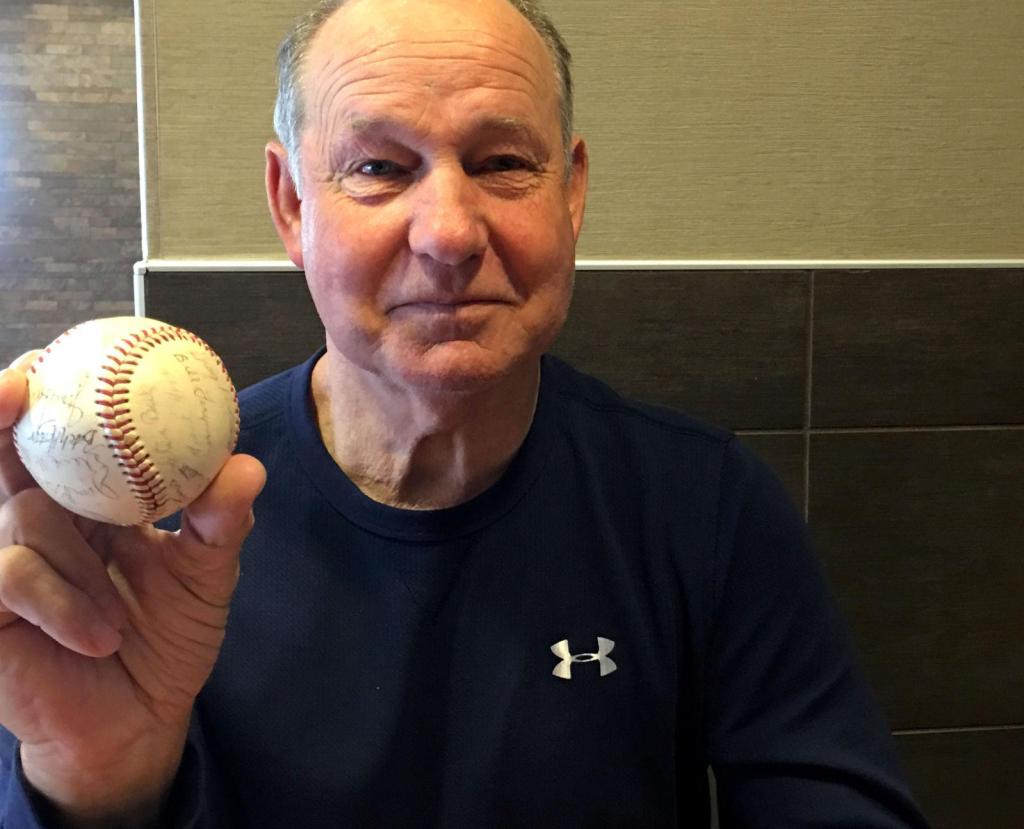
Don Gullett holds a 1969 autographed baseball from his only minor league team.
“I remember playing softball in grade school at Lynn Elementary, out there competing with the older boys. I was in the second grade and playing against sixth- to eighth-graders,” he said.
And he was playing barehanded.
“Walter Willis, who was in the educational field in Greenup, he was the guy who gave me my first glove,’’ Gullett said in a 2014 interview. “I remember that black glove he gave me. He said, ‘Here, you need a glove.’ I was out there barehanded playing softball.”
Gullett wasn’t big for his age either but he was talented for his age.
“I loved it all really,” he said when asked about his favorite sport. “Baseball was the game I first started playing in the second grade. We didn’t have any organized football or basketball, so I played baseball a longer period of time.”
Gullett learned the lessons of sports from his older brother Jack, who never played high school sports but knew how to play them all.
“We’d play backyard community ball — football, basketball, baseball,” Gullett said. “He never played any organized sport at all but he certainly knew a lot about the game and helped me a lot.”
Gullett began playing organized and competitive football and basketball when he became a sixth-grader and fell in love with those sports, too. Gullett was a natural at whatever he did. Gullett is mostly remembered for his blazing fastball that took him to 109 major league victories in an injury-shortened career. But those who played football and basketball against him remember a competitor who was always tough to beat.
Gullett played on two of McKell’s greatest teams in 1967 and 1968. It was during that ‘68 season that McKell trampled Wurtland 72-7 and Gullett scored every point in the game. It was not uncommon for him to score in the upper 30s during basketball games and, of course, there was no more dominating pitcher than Gullett, even as an eighth-grader at Wurtland.
The late Larry Jordan invited the late Malcolm Conley, then the sports editor at the Ashland Daily Independent, to come out and watch this eighth-grade pitching phenom throw. It was that same year that Reds scout Gene Bennett first feasted his eyes on the prized left-hander. He left practically drooling over what he had witnessed.
Gullett’s legend grew throughout his high school days in all sports, but especially in baseball.
Bennett said it was a game between McKell and Portsmouth Clay right before the postseason tournaments in 1969 that secured Gullett’s legacy.
He struck out 20 of 21 Clay batters in the perfect game effort. The last batter bunted the ball back sharply to him and he threw out the runner for the third out.
That sensational effort came with “23 or 24 major league scouts watching,” Gullett said.
His last game in high school was a 1-0 loss to Ashland in the 16th Region Tournament semifinals in Morehead.
Dave Damron had the only hit for the Tomcats, a triple, and he came home on Mike Tackett’s sacrifice fly. Gullett struck out 11 and walked only one in six innings. However, Tomcat pitcher Tim Huff matched Gullett practically pitch for pitch in shutting out the Bulldogs on three hits.
Ashland was a thorn in McKell’s side, although Gullett performed well in big moments.
As a junior in 1967, he had 80 yards rushing and scored all three touchdowns in McKell’s 21-20 loss to the eventual state champions.
As a senior, he scored 21 points in the region basketball tournament against the Tomcats and then pitched the semifinal gem but was on the losing end.
“They had some great teams, championship teams,” Gullett said of the Tomcats. “Two particular individuals, Bobby Lynch and Bill Lynch, those were great baseball players. We met them in Little League and through high school, all the way through. It’s something I’ll always remember. They weren’t the only two guys on the team. They had some really good players.”
By the time he was a senior, Gullett was considered the possible No. 1 overall draft choice in the June amateur draft. He went in the first round with the 14th overall selection to the Cincinnati Reds. Slugger Jeff Burroughs was taken first by the Washington Senators at the urging of the great Ted Williams. The second player chosen was fireballing J.R. Richard by the Astros. He won 107 games with a 3.15 ERA before having his career cut short by heart issues.
However, only two players from the first round had a better WAR (wins above replacement) ranking than Gullett — Richard and Gorman Thomas of the Brewers, who had 268 home runs in a lengthy career.
Gullett won 109 games with the Reds and Yankees, including six World Series appearances. He was on a World Series champion from 1975 to 1978 — two apiece with the Reds and Yankees.
After the 1976 season, he became a free agent, and the Yankees signed him to a six-year contract, totaling $2 million. He was 14-4 in 1977. By July, 1978, his career was over because of a torn rotator cuff. Gullett’s nine-year record was 109-50.
He came bounding into our lives almost 11 years ago as a scared little toy poodle, about two months old with a furry red coat.
Opie was our third dog, proceeded by a black lab named Lucky and a poodle that we had for 17½ years named Mopsy. She was going to be our last dog. The heartbreak of having to put one down that was part of the family for that long is gut-wrenching.
My wife was teaching at the time and the more she went back to our empty home after school, the more she knew another dog was needed for her to get over the grief.
I was her stumbling block. I did not want another dog.
So, she devised a plan.
She talked to me about a red-coated boy poodle that we could name Opie, touching on my love for the “Andy Griffith Show.” Her plan worked. I caved.
She found what she was looking for in Wayne, W.Va., where a woman was breeding poodles. We went to her home and she showed us three babies from the latest litter. Opie was one of them and my wife picked him out of the crowd because he pooped in her hand. It wasn’t much poop but enough of a sign for her that this was our Opie.
We could not take him home yet and the breeder sent us photo updates and invited us to visit until he was old enough to leave his mother.
My wife timed his homecoming so that she would be out of school for the summer. We did a poor job of training Mopsy, but she vowed it would be different with Opie. She may have missed her calling. It wasn’t long before she had Opie doing some simple tricks with treats as rewards. More importantly, he was potty trained in a short amount of time. As she advanced her potty training with him, she draped bells on a string over our doorknob on the back door and taught him to ring them when it was time to go to the bathroom.
Opie was a good dog and very smart. He learned to use the bells when it was time to use the bathroom but also figured out that he could use them just to get out of the house and into our fenced-in backyard to run and play, too.
Opie with Beth, Brooks and Ace (above).
The bells rang a lot at our house.
We called Opie a quirky dog. When he was uncomfortable with a situation, like his ball rolling too close to a table, he scratched vigorously with his back legs. He was friendly with everybody although our daughter’s beagle, who probably was four times bigger than him and had a bark bigger than that, scared him when it came to mealtime.
My wife would get between them, letting Ace know who was in charge. Ace ate out of his bowl and she fed Opie by hand. That then became the norm. Did I mention he was spoiled?
Opie loved his toys and he was familiar with all of them. When we picked up his toys to run the vacuum or pick up before company came, he was not happy. After we returned them to where he liked them, it was like he counted then by touching his nose against each one. He was such a good boy.
His favorite toys were an orange pig ball that squeaked, was soft and would bounce in different directions. The other was a floppy-eared dog he could sling around a room with the shake of his head. When he was young, he loved to play fetch and would fly around the yard at top speed until wearing out.
Opie was a good dog. And boy was he fast!
He loved when people visited and especially loved his second home at my in-laws when we would go out of town. They loved him so much and always told us that Opie was such a good boy.
He had keen senses, especially hearing. When he heard a doorbell ring on television, he sprung up from the couch and raced to the front door. We had a doorbell, but it had not worked since Opie became part of the family. We never understood how he knew to go to the door. One of life’s mysteries. He could hear our car as we pulled into the driveway or hear someone come in the front before anybody else. He was like Radar on “MASH.”
We moved from Ashland to Florence two years ago to be near our grandchildren. We don’t have a fenced-in yard now, so Opie would have to adjust with us. He did. And he and I would take our 25-minute walks around our condo neighborhood. He basked in just being with me. The condo neighbors loved him.
Opie was most definitely my wife’s dog, but he knew who to beg from when food was on the table. I made sure to always have something for him.
He was equally loved by his humans.
We had to say goodbye to Opie on Sunday. He had congestive heart failure and his overall health was in serious decline. Life was not the same for him. The walks had stopped, he wasn’t eating or drinking. He was coughing, sometimes for long periods. It was such a sad day for us. He died on my wife’s lap. We chose to be with him to the end.
Opie was such a good boy.
They say dogs don’t have souls, but looking into those expressive dark eyes often made me wonder.
Our CP-1 Hall of Fame family lost a great one this week with the passing of Jim Speaks, a fireballing pitcher from the 1960s who is on the short list of Ashland’s line of pitching greats.
He was enshrined in our third CP-1 Baseball Hall of Fame class in 2017, putting him as one of the top 30 selected. Few threw it harder than Jim, who made the Tomcats as a freshman while attending Coles Jr. High School. He started on that 1959 team as a right fielder and was the No. 2 pitcher on an outstanding Ashland team.
Speaks excelled as a pitcher the rest of his Tomcat career and led them to the state tournament in 1960 and 1962, his senior season, when Owensboro ended it for Ashland with a 2-0 victory in the opening game. Speaks was the tough-luck losing pitcher in that duel, surrendering an early two-run homer for all the scoring.
He continued to shine for Ashland Post 76 as the ace of the Legion team and had professional scouts checking him out, including the Pittsburgh Pirates.
Speaks’ reputation as a hard thrower started when he pitched for Charles Russell, an elementary school in Ashland. Fear of Jim Speaks on the mound started early.
Jim was one of the best to take the mound in Central Park but, as outstanding as he was on the baseball field, it paled in comparison to the man he became. Jim was a devout Christian who served with a gigantic heart. He spoke to me about the impact my father and mother had on him and others at Second Baptist Church in Ashland when he was growing up. I could not have been prouder of my parents or him.
Jim led a life that was God-honoring and with a servant’s heart. He loved his pastors and followed their leads and never shied away from any assignment that they gave him. He was a trustee at First Baptist Church in Grayson where he served so faithfully for many years.
His fastball that zipped past so many hitters in Ashland some 60 years ago was impressive and memorable. It was a pitch heard more than seen. But the best of Jim Speaks was as a devout Christian, family man and friend to so many in communities where he worked and played. He touched lives and made those around him better.
When Birdell Fish took a call that she would be receiving the Distinguished Tomcat Award at this year’s Ashland Invitational Tournament, she thought it was meant for her youngest son Matt, a former star basketball and football player.
“Dicky Martin called, it was football season and I thought he wanted to talk football,” she said. “He said he wanted to let me know he was on the AIT committee for the selection of the Distinguished Tomcat Award – I’m still thinking Matthew, because he kind of set the place on fire – and he said congratulations to you. We selected you.”
Fish said she had no words. “You got me speechless, which is very unusual for me. It’s an honor, a privilege. I was so humbled.”
The committee made Fish a unanimous selection and it was the right one. She is one of the greatest Ashland Kitten players in history, starring on the first two teams that were allowed to compete again in Kentucky High School Athletic Association sanctioned tournaments in 1974-75 and 1975-76 following the landmark Title IX decision in 1972.
Birdell Fish flanked by her “greatest achievements,” sons Matt and Marcus Thomas.
Fish was a dynamic point guard who led the Kittens to a 48-9 record in those two seasons, including 27-2 her junior year when she averaged 23.3 points per game and was named All-State. She was selected for the East-West All-Stars and Kentucky-Indiana All-Stars following her senior year when she averaged 20 points and 10 rebounds per game, repeating as All-State.
Her humble beginnings started on the mean streets of Ashland where she played against the boys any chance she could. They would put up some plywood, nail a rim to it and hang it on a telephone pole, she said, until the city would come and take it down.
Fish had five brothers, so roughhouse basketball ensued, and she developed her skills while trying to hang with them and their friends. “I didn’t care much about dolls,” she said.
“If my brothers were alive, they would tell you it was them (who showed her how to play),” Fish said. “(Brother) Terry used to get a kick out of telling everybody he taught me everything I knew.”
She grew up in a neighborhood full of kids and much of her athletic ability came naturally. Her father, Dave Fish, was a tremendous basketball player for Booker T. Washington School where he graduated in 1950. “I didn’t realize how good he was,” she said. “I knew he loved playing basketball. My uncle, Cornell (Fish), before he passed away, showed me all these programs and pictures from when they played.”
Birdell Fish played against the boys at recess at Crabbe Elementary because there was no girls team and the girls weren’t allowed to play on the boys teams. She wore shorts under her dress so she could mix it up on the playground with the guys. A sixth-grade teacher once told her it wasn’t proper for a girl to being playing with the boys and the teacher made her stop and sit on the sidelines and watch.
Not understanding why she wasn’t allowed to play, she told her father what happened. “He was pissed,” Fish said. “They had a conversation, and I was allowed to play with the boys again.”
There was no organized basketball for girls in Ashland except for the high school Ashland Kittens team. The Kittens competed even though there were no postseason tournaments. Fish tried out as an eighth-grader but failed to make the cut. She was disheartened but tried again the next year.
This time she made the team, then moved up to sixth man and then into the starting lineup as a freshman. She never sat the bench again.
Her first time playing with and against girls was the tryout as an eighth-grader and then her freshman season. By the time she was a junior, the KHSAA was sanctioning the state tournament again and a new era of girls’ basketball was born nationwide.
Fish’s outstanding guard play was good enough for her to garner statewide attention. She was selected as one of the top four players in the state in the preseason of her junior year. The Kittens were strong with Fish and Sheila Salyer leading the way. Fish said Salyer could have averaged 35 points per game if the had the 3-point shot.
Not only did they not have the 3-pointer, but they played with a boys basketball, not the smaller size ball that is now used. Also, she said, not having women’s officiating hurt the game in the early days. During the seasons when the girls schools played club basketball, they had a 30-second shot clock.
Fish’s scoring and tenacious defense set the tone for coach Linda Meyer’s team. After losing the season opener on the road at Jenkins, the Kittens rattled off 27 consecutive wins before bowing out in the 16th Region finals against Russell, 48-40.
“I still have nightmares watching them jump in my swimming pool,” she said, referring to Ashland’s pool beside the gym. The first two regional tournaments were played at Ashland. The Lady Devils also beat the Kittens her senior season.
The 16th Region was just learning about girls’ basketball, but Fish was among a handful of superstar players including Paula Hatten at Boyd County, Regina Carroll and Peggy Iddings at Russell and Fish and Salyers at Ashland.
During their senior year, two Tomcat football players – Rick Sang and Alan Mayo – were talking smack with Fish and Salyer, saying they would dominate them in a game of 2-on-2. The girls took the challenge and met the boys at an outdoor court.
“We kind of smacked them around a little bit,” she said. “It was all in good fun.”
Fish said she often played games on the courts in Central Park and at Dawson Pool and the boys didn’t take it easy on her there either. She would often pick herself up off the concrete courts after being shoved. It all contributed to making her a great basketball player in later years.
Fish credited Meyers for developing her as a player. “My game grew leaps and bounds,” she said. “She was a good coach but a better teacher of the game. She taught me about the game of basketball, the concepts and the reason why you do what you do. She was so good at teaching you and showing you that.”
Fish’s play at Ashland caught the attention of Morehead State women’s coach Mickey Wells, who signed her and Donna Murphy of Newport to his stellar 1976 class. Murphy was regarded as the top player in the state and Fish was among the top five. It was a class that also included Geri Grigsby of McDowell.
Fish only played one season at Morehead saying she lost her passion for the game. Her father had passed away in the spring of her senior year. That may have led to her losing some desire.
“He was my biggest fan,” she said. “He’d lay off work to watch me play. He’s sit up on the bleachers by himself. Besides Linda Meyers, he was the only voice I could hear.”
Fish said she “lost the heart” for playing and if she could not give it her all, she didn’t want to play. Her only season she roomed with Murphy, saying she was an even better person than a basketball player. Fish said she was the best player she ever played against or with during her career.
Fish said the girls’ game has improved a lot since her playing days in the 1970s.
“There’s not that stigma connected to it like it used to be when I played 45 years ago,” she said. “Now you have (Iowa’s) Caitlin Clark or Paige Buckner from UConn for girls to look up to. My favorite player growing up was Oscar Robertson. The way it’s going now, these girls have so many people to look up to and emulate. It’s amazing for me to watch it unfold.”
Birdell may not know it but she was the role model for many young girls growing up to become Ashland Kittens. Jerry West was part of the NBA logo and Birdell Fish could be part of the Ashland Kitten logo. That’s the impact she had on the program.
Despite all her basketball accomplishments, Fish considers raising her sons, Marcus and Matt, into fine young men was her greatest achievements. Both were outstanding athletes – Marcus in basketball and baseball at Rose Hill and Matt in basketball and football at Ashland.
“They turned out to be really good men,” she said. “When you can say that about your kids, you’ve done something right.”
Birdell will be honored tonight before the Tomcats play Ohio County in the first game of the AIT at 7 p.m.
Distinguished Tomcat Award honorees
2001-Ralph Felty, All-State football player in 1937 for the Tomcats who went on to play in the Rose Bowl for Duke.
2002-Charlie Reliford, major league baseball umpire who is still regarded as the best “rules man” in the game.
2003-Brandon Webb, major league baseball pitcher and the 2006 Cy Young Award winner for the Arizona Diamondbacks.
2004-Bob Wright and the Lynch family, a state championship coach of the famed ’61 Tomcats and a family whose talent – and class – was unmatched in Ashland sports. Billy and Bobby Lynch are two of the greatest athletes to ever wear maroon and white.
2005-Salyers family, Greg, Phil and Bryan, all great basketball players and great people who loved their Tomcats.
2006-Conley family, George, Larry, Joe and Linda. Some of the best of the best be it coaching or playing.
2007-Jerry Henderson, one of the greatest all-around athletes in Tomcat history and one of the greatest gentlemen in Ashland history.
2008-Harold Cole, outstanding basketball coach who knew how to win. He coached in the late 1960s and early 1970s
2009-Dr. Garner Robinson and David Green, who helped Ashland become the state’s first school with certified trainers.
2010-Dr. Loren Ledford, a diehard Tomcat who starred in basketball and was later a passionate supporter and team doctor.
2011-David Payne, Mr. Tomcat. Need more be said? Dirk Payne did more for the Tomcats than anybody on this list, period.
2012-Dicky Martin, The Voice. He is a strong part of the tradition and will fight you if you say anything bad about a Tomcat. He can say it because he’s family. But don’t you try it around him.
2013-Mike Johnson, football and baseball player for the Tomcats who gave much back to Ashland’s youth as a baseball coach.
2014-Herb Alban, a 60-year Tomcat fan who has seen a lot during his 98 years. An amazing man whose life could be a movie.
2015-Steve Gilmore, whose lifetime has revolved around the Tomcats as a coach, teacher, administrator, superintendent and now huge fan as he works as mayor of the city.
2016-Herb Conley, an all-sport athlete and a football coach whose legacy is unmatched. Anybody else have a statue?
2017-Mark Maynard, sports historian and former sports editor and editor of The Daily Independent who has written 11 books, including eight with Tomcat ties.
2018-Vic Marsh, the all-time winningest coach in Ashland Tomcat football history when he retired. Marsh led the Tomcats to the 1990 state championship.
2019-Frank Sloan who coached Ashland teams to regional championships in baseball, girls basketball and soccer.
2020-COVID, no selection.
2021-Marty Thomas, who starred in basketball from 1992-94 when he became all-time scoring king with 1,873 points. He also had the single-game record with 54 points and averaged 27.7, an all-time best, his junior season.
2022-Ashland celebrated two pioneers of its girls basketball program. Linda Conley Meyers was the first girls coach of the modern era and also kept the scoreboard for the boys team. Bill Bradley tallied 405 wins in his 20 seasons on the Kittens sideline and won four 16th Region titles.



 MARK MY WORDS 2