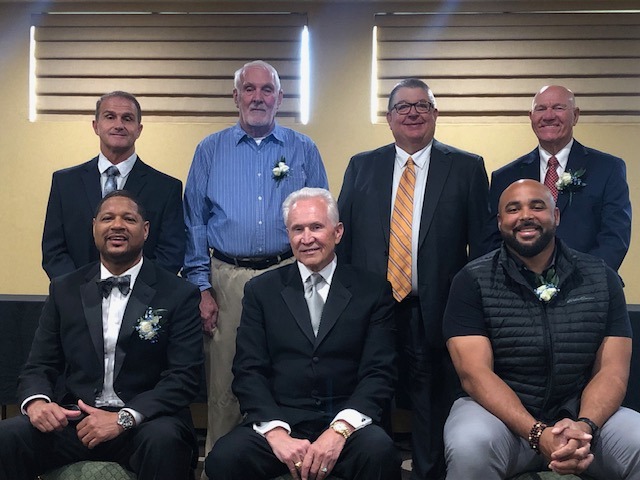
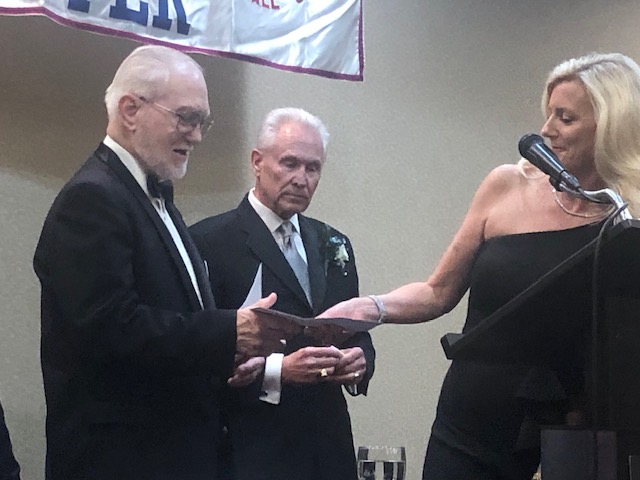
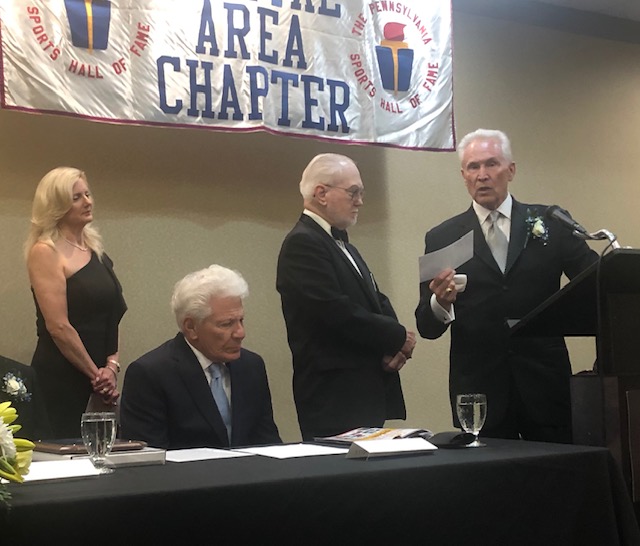
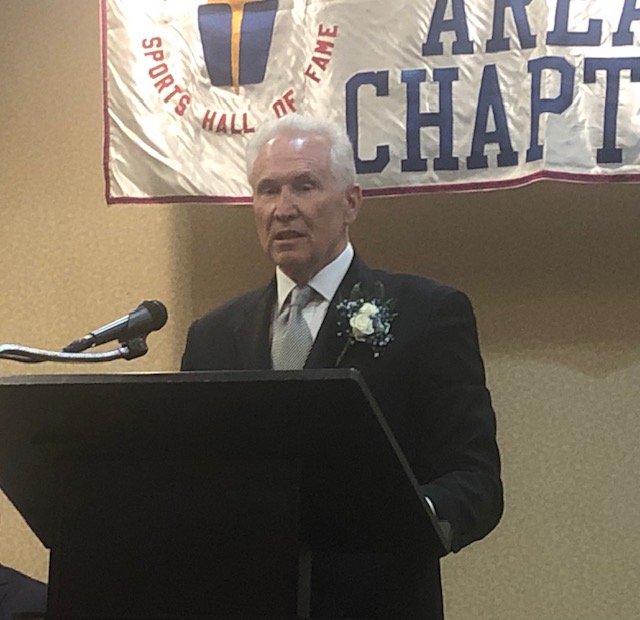
David Sullivan enshrined in Capital Area Chapter Sports Hall of Fame

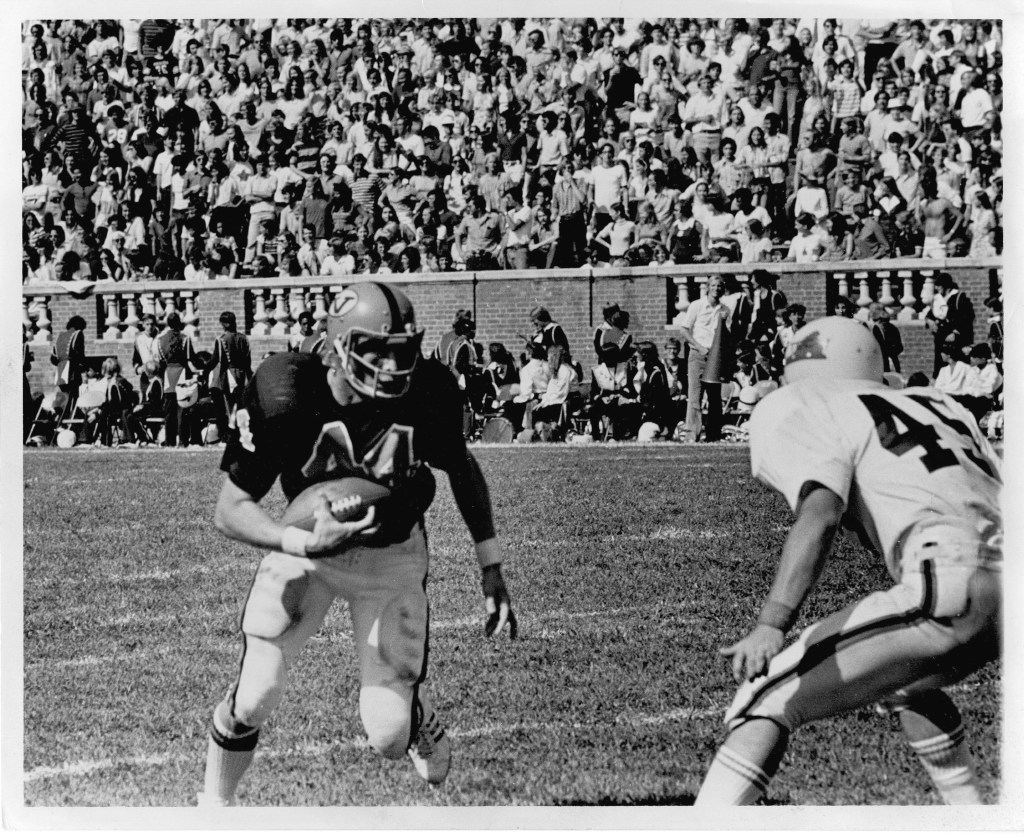
David Sullivan was enshrined in the Capital Area Chapter Sports Hall of Fame in Pennsylvania on June 17. It was a well-deserved and long overdue recognition for a tremendous football player who broke receiving records at the University of Virginia before going on to play two seasons in the National Football League with the Cleveland Browns in 1973 and 1974.

His determination and grit gave him the opportunity to succeed at the highest level of football. That same can-do attitude turned him into a dynamic businessman in the death care business, where he worked tirelessly and with integrity and compassion while carving out an incredible career that would be Hall of Fame worthy in that field.

Sullivan was overlooked by colleges when he was a high school senior who put up big numbers at the receiving position despite his inexperience at the position (he played only one year as a receiver in high school) and size. They forgot to measure the heart. And as people later learned in the business world, underestimate this man at your own risk.

He was 6-foot-1 and 186 pounds as a high school senior, but Virginia saw something in him that made his size a non-issue. Sullivan became a superstar for the Cavaliers, making all-conference first team in the ACC and setting receiving records along the way. Sullivan’s drive separated him from the pack. It did then, and it does now.

His generosity was also on display Saturday when he and wife Sara gave a sizable donation to the student scholarship fund of the Capital Area Chapter Hall of Fame. It didn’t surprise any of us who know the Sullivans that they made a donation. They both have huge hearts and understand the burden that students face in paying for college. It’s merely one more example of how this philanthropic couple helps others. Their spirit of giving is often contagious in the companies that he has spearheaded.

To be honest, Sullivan probably should have been in this Hall of Fame years ago. His credentials were impeccable. And maybe it was because nobody nominated him. But when the time did come, there was no bitterness, only thankfulness. Dave Sullivan accepted the invitation to be part of this incredible Hall of Fame with humbleness and class, and they will have no better friend than Dave Sullivan.

He succeeded in football and business through a strong faith, dedication, and a remarkable belief in himself and his teammates that they could accomplish anything.

Sullivan was one of the greatest overachieving athletes in Harrisburg, Pennsylvania, high school football history and that was only the start of his story.

In his first season as a prep receiver, Sullivan caught 35 passes for 672 yards and five touchdowns during Steelton’s 1967 season. A star was born and he caught the eye of the University of Virginia, which overlooked his frame and looked into the heart. They signed him to a college scholarship, believing they had found a diamond in the rough.

Indeed, they did. Sullivan’s intellect and determination to succeed would take him all the way to the NFL. He proved himself invaluable on the college level, becoming an AP honorable mention All-American and first-team Atlantic Coast Conference wide receiver his senior year at the University of Virginia. Some have called him one of the greatest players in school history. The first-team All-America wide receiver in Sullivan’s senior year was Heisman Trophy winner Johnny Rodgers and at that time they only named one for the first team. He may have moved further up the All-America ladder had the Cavaliers produced a winning season.

Sullivan led the ACC in catches and receiving yards, becoming the only Virginia all-league player that season. He had 51 catches for 662 yards and seven touchdowns – all top marks for Virginia receivers in a single season – despite a revolving door of quarterbacks. He was often the player that opposing defenses tried to take away but his uncanny route-running and good hands overcame many double-teams.

For his career, Sullivan amassed 120 catches for 1,568 yards and 12 touchdowns, the first two setting Virginia records. He played in the Blue-Gray and Senior All-Star Games and began to draw the attention of professional scouts.

Another characteristic for Sullivan was his leadership abilities. Even though he was one of the best receivers in college football in 1972, teammates saw the same man they knew when he entered college. He was humble and generous – traits that would serve him well later in the business world. Sullivan was a winner who he did it within the team concept. He took that same attitude into his professional life after football was no longer an option.

When Sullivan signed out of high school to Virginia, he was only 16 years old. He worked hard in the classroom too, ranking 22nd in a class of 152 in 1968.

By the time he was a senior at Virginia, he was 6-foot and 185 pounds – a far cry from the 155-pound receiver that went mostly unwanted by most major colleges. His size and speed – he ran 40 yards in 4.7 seconds – was under the radar by most pro scouts. But few in college ran routes better or had better hands than Sullivan, giving him a chance to become an NFL player.

Sullivan has been defying odds since he was a slender 115-pound sophomore trying to make the varsity at Steel-High. Two years later, college after college passed on him because he was too small. All except for Virginia, which found a playmaking receiver.

Cleveland took Sullivan late in the 1973 NFL Draft, taking him in the 15th round. That didn’t deter him from believing he could make the team and contribute or even start. He played in seven NFL games, starting three and would have had a much longer career if not for a third knee surgery that proved too much. He caught five passes for 92 yards in his two-year career with the Browns.

In his finest game with the Browns, he caught two passes for 52 yards from Brian Sipe in a 26-16 loss to the Steelers. Sullivan was being defended by Hall of Fame cornerback Mel Blount in that game at Cleveland Stadium in 1974.

His degree from Virginia was in educational psychology, but he quickly learned the business side of the death care business. He liked the competitiveness aspect along with the traits of strong character, integrity and compassion for the customer.

He joined Gibraltar Mausoleum Corp. in Indianapolis in 1977 and rose to become the executive vice president of sales and marketing. He stayed there 18 years. Sullivan has 47 years in the sales and marketing end of the business and formed Saber Management in January 1998.

He was named the 2002 Ernst & Young Heartland, Indiana, Entrepreneur of the Year and led Saber Management to even bigger successes over the next 15 years before selling to Park Lawn Corp. in 2017 for $65 million.

Sullivan is also recognized for his philanthropy. He and his wife have been a consistent and generous donor to the nonprofit Amy For Africa, a Christian organization serving Uganda, since 2014. He has also been involved in many other charities promoting needs for children and others in need through both his business contributions and personal ones.

David Sullivan is an uncommon man who has led a Hall of Fame life from the athletic fields to the business world and beyond.

Jeff Hall one of many players whose life was impacted by the late, great Denny Crum

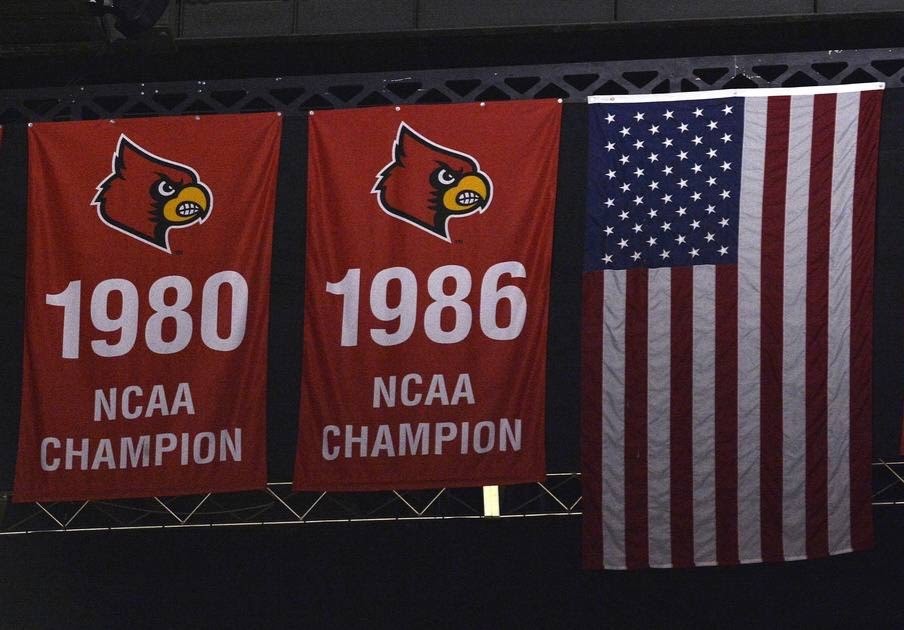
Jeff Hall, a starting guard on Louisville’s 1986 national champions under the late Denny Crum, said his former coach leaves behind a remarkable legacy.

Crum, who died Monday at the age of 86, was nicknamed “Cool Hand Luke” bt former commentator Al McGuire, won two national titles at Louisville during an incredible 30-year Hall of Fame career from 1971-2001. He is one of only 14 coaches in NCAA history to win two or more titles. Six times he guided the Cardinals into the Final Four, including four times in the 1980s. Only five coaches all-time coached more Final Four teams than Crum, who amassed a 675-295 coaching record, including 42-22 in the NCAA tournament.

Hall was a freshman on the 1983 Louisville team that lost to Houston’s Phi Slamma Jamma team with Hakeem Olajuwon and Clyde Drexler in the Final Four. That was the same Houston team that N.C. State stunned in the finals. Louisville reached the NIT final four in 1985 and won it all against Duke in 1986.

“I respected him greatly,” Hall said of Crum. “The first thing that comes to mind, from my perspective, he saw me for the second time and said, ‘You could play down here.’ I’m thankful he had the confidence in me, and I played four years (for Louisville).”

Hall said that trust factor between player and coach only grew during his playing days with the Cardinals. While admitting there were some tense conversations between them, Crum never sugar-coated anything and, more importantly, never lied to him about anything.

“There was a very serious side to Coach,” Hall said. “We had conversations at Louisville and a couple I didn’t want to hear. But there are times when coaches and players lad to lay the cards on the table. I still say, to this day, everything he told me prior to committing to Louisville, while at Louisville and once I graduated at Louisville, he never once lied to me. As a young man, it’s what you hope for and as an older man, it’s what I appreciate.”

Hall had a spectacular career with the Cardinals, scoring 1,294 points and averaging 8.9 points per game while playing in 145 games. He averaged 12.1 as a junior and 10.3 as a senior, shot 51 percent from the field and 81 percent from the foul line in his career. The long-range specialist didn’t have the advantage of the 3-point shot or those numbers would have risen dramatically.

“Coach was one of the old school coaches,” Hall said. “It was ‘Yes you can play or no you cannot play.’ Serious talks you had to have. He provided me the opportunity to play at a high level. Coach was serious, but also fun to be around. He was 80 percent serious, (but) he didn’t mind joking around. We never had a conflict. We had some man-to-player discussions: This is how I want you to fit in, this is what you need to work on. He would definitely break your game down and tell me things I was doing well and things I didn’t do well.”

Hall was recruited out of tiny Fairview High School in eastern Kentucky and the Cardinals came after him hard for two years as did Morehead State University with coach Wayne Martin. Others jumped into the recruiting battle much later, including the University of Kentucky who tried to snatch him up at the end of the recruiting cycle.

“I grew up in eastern Kentucky so, of course, UK was important,” he said. “Louisville recruited me hard for two years, Kentucky recruited me hard for one week. My friends and everybody was yelling at me that I need to go to Kentucky. Why would I do that to go down there and sit for four years? They really didn’t want me.”

During Hall’s playing days at Louisville, a local radio station broadcast the Cardinals’ games so everybody could keep up with him. He even turned some once diehard Kentucky fans into Louisville fans – at least during the time he played for the Cardinals.

Hall said the more difficult decision was turning down Morehead State. “To this day, I love Wayne Martin. My mom loved Wayne Martin and Clem Haskins (then the head coach at WKU) second. Coach Crum didn’t make the top two. I had to go where I felt like there was a need and I had the ability to fill that need for them. I think it worked out pretty well for all of us.”

‘Creative genius’ David E. Carter had insatiable love for baseball

David E. Carter packed a lot of life into his 80 years as the tributes suggest since the news of his passing became public Monday.

Among the tributes was how he once saved a man from drowning and how he served as an inspiration for hundreds, if not thousands, of students, putting them on a career path of success simply by taking the time to share and care.

He grew up in humble means on Indian Run Road in Flatwoods and graduated from Russell High School where his freshman teacher told him he didn’t have what it took to succeed in college. He ended up with college degrees from UK, Syracuse, Ohio University and Harvard Business School. He was told he wasn’t good enough as a writer to publish a book and then he wrote 110 of them. Tell him he couldn’t, and he showed you he could.

A book about his life, You CAN Get There from Here, was written by lifelong friend Don Moore with Carter. It showed how growing up in northeastern Kentucky is not a deterrent to being successful. Carter won seven Emmys and a Clio (the advertising world equivalent to an Oscar) through his advertising agency productions. He was always creating. Longtime friend Keith Kappes said two words described him: “Creative genius.”

His passion for creating separated him from others. He achieved much in a life full of adventures and left behind a treasure trove of film documentaries, books and ideas.

Carter loved researching and mining for information while putting together dozens of documentaries that brought history to life. It was part of his DNA and it gave us some remarkable images to remember and watch over and over.

Some of his best work involved baseball because that is where, aside from family, his passion burned brightest. Baseball was life to him from an early age until his last days of life.

Randy Carpenter, who emotionally said “he was like father and brother to me,” was texting with him until his final days. The text talk was about baseball. “His last text to me ever was April 13. I asked him how he was doing. He said, ‘Very weak and then he said, ‘How about those Tampa Rays?’ The last communication he said to me was: ‘I go to sleep watching MLB every night.’”

Carter brushed shoulders and had conversations with National Baseball Hall of Fame players, including the great Mickey Mantle, Ted Williams and 20 others. He was so proud of the two videos that were recognized by the National Baseball Hall of Fame film festival and reside in Cooperstown. He was also involved with helping the Negro League players who had come to Ashland for reunions in the early 1980s, including a documentary on Lou Dials and developing a set of baseball cards for them.

Moore said baseball was what connected him and Carter the most. When he would visit Carter in Florida, they would take in spring training games in Fort Meyers, home of the Twins and Red Sox. Carter had tickets to both teams, Moore said.

“Diane (his wife) loved baseball as much as he did. I would go down and he would talk about a pitcher and she’d talk about his stats,” Moore said. “They both had a great love for baseball.”

Moore said when he proposed to his wife, Kim, at a Lexington Legends baseball game, he received kudos from his friend. “Dave loved that. He said, ‘That sounds like something I would do!’”

Moore said it was not unusual for Carter to come to town, say let’s go get a hot dog and the pair would end up in Cincinnati watching the Reds. Baseball was always a connector that bonded them.

“Another time when I was in Sanibel, he said, ‘Don’t plan anything this afternoon’ and grabbed two baseball gloves and a ball. We got in the car and went for a drive. We ended up at the Twins’ spring training stadium. He arranged for us to go out on the field and pass baseball and take a few ground balls on the big league diamond.”

Moore said when he retired from Ohio University that Carter told him to go to CP-1 and watch baseball, “the love of my life. He joked and said nobody knows you. You should take a hair dryer and point it toward the pitcher, and they will think you’re a scout. Less than a week later, I had a real speed gun come to me in the mail from David and a baseball hat from the Baseball Hall of Fame. The first time I took it with me (to the park) parents kept staring at me and finally one came over and said, ‘Can I ask who you’re with?’”

The hallowed grounds of Central Park’s big diamond, where Carter played Babe Ruth baseball and made everlasting friendships, was also an important part of his life. In 2008, he went to the park and walked out onto the field just to stand in the dirt around shortstop. By chance, Gary Wright was at the park at the same time. The men knew each other but didn’t know the other was in town. They began talking and remembering how special a place CP-1 was for them so many years ago.

“I thought that was something else,” Carpenter said. “Two adult men drawn to that soil because of how much it meant to them.”

Wright sank $125,000 into the rundown diamond, including having a new press box constructed that is named after his father, T.R. Wright, who spent countless hours at the field coaching baseball in the 1950s and 1960s. He also had new brick dugouts installed. The all-dirt infield was also transformed into a grass infield to complete the facelift making it a gem of a diamond. It was a spectacular field although most teams had already moved away from it. The remake did bring a few games back to the park.

What happened after that was the start of what Carter called the “Ashland CP-1 Movement,” that became annual summer visits for those who played games in the park. Carter turned that heartfelt chatter into a documentary, “Ashland’s Field of Dreams.” The CP-1 Hall of Fame started in 2015 with Carter and Wright selecting the first class of 14 members before handing off those duties. It has continued and celebrates the next class in August, bringing the number to 90. The vision was cast, expanded on and has brought great joy to those whose names are etched on plaques, by class, on the back of the press box.

Carter was proud of the Ashland CP-1 Movement because it brought together three of his loves: Ashland, Central Park and baseball. He will be long remembered for his contributions to Ashland and other areas where his life took him.

Remembering former Tomcat standouts Darryle Kouns and Joe Conley

Two former Ashland Tomcat basketball and baseball standouts, one from the 1950s and another from the 1960s, passed away recently.

Col. (retired) Darryle “Sam” Kouns, who went on to be a star player at West Point Academy for two years and later served as an assistant coach under Bobby Knight, graduated from Ashland High School in 1954. He was part of a third-place finishing Tomcat basketball team in the Sweet Sixteen.

Kouns averaged 8.6 points per game on an Ashland team that included sharpshooter Bill Gray and Jerry Henderson, a duo who did most of the scoring. Kouns matched his career high of 19 points in the consolation win over Adair County in the Sweet Sixteen.

He was also a key player in one of the most unusual games of the year against Olive Hill. Coach Jack Fultz decided the Comets would hold the ball on the high-scoring Tomcats, who managed to hold on and win 25-17. Kouns and Bill Hopkins each scored seven in the unusual victory.

Kouns went to Georgia Tech out of high school and played his freshman season before gaining an appointment to West Point because of his athletic accomplishments. His strong play in basketball and baseball – and later as an assistant basketball coach – earned him a nomination to the Army Sports Hall of Fame.

Kouns played for the Black Knights in the 1957-58 and 1958-59 seasons, averaging 21.8 points and 5.4 rebounds per game. He scored 1,067 points in his West Point career that covered 49 games.

Darryle Kouns, left, with Mark Maynard in February 2022 at a throwback game at the old gymnasium on Lexington Avenue in Ashland.

His best work for the Army came on the battlefields. Kouns served 29 years in the U.S. Army and spent three tours in Vietnam: The first as a company commander of an engineer company. He participated in ground combat patrols, earning a Bronze Star, as well as completing enough aerial work to earn four Air Medals. In 1983, he took part in the invasion of Grenada.

He was selected for the Florida Veterans Hall of Fame Class of 2020. 

Kouns, who was an Elks Sports Day honoree in 1998, was in Ashland last February when a game was played in the Ashland high school gym on Lexington Avenue. Kouns died March 3, 2023. He was 86. His funeral will be Thursday at Steens Funeral Home in Ashland.

Conley was 1,000-point scorer in basketball, member of 3 baseball state champions

Joe Conley, 72, starred in basketball for the Tomcats from 1966-68, scoring 1,007 points in his three-year basketball career that included being a member of 16th Region championship team as a sophomore. He was a key figure on Ashland’s 1967 and 1968 teams that fell to strong Russell teams in the regional finals each year. Conley scored 29 against Russell in the 1968 regional final, a hard-fought 80-75 loss. He was honorable mention All-State in both his junior and senior seasons, teaming in the backcourt with Bobby Lynch.

Conley was also one of only four players on all three state championship baseball teams from 1966 to 1968. Conley made the All-State Tournament team as a senior. He was inducted into the CP-1 Hall of Fame in 2017.

Joe Conley, left, and Charlie Reliford at the CP-1 Hall of Fame ceremonies in 2015 when Reliford was inducted in the first class. Conley was inducted in 2017

He made a game-saving catch in left field during the championship game in 1968 against Southern. Bobby Lynch was pitching and he stepped off the mound and waved Conley back four or five steps. Lynch says it had to be divine intervention because “I never did that in any other game that I can remember.” The move proved prophetic as the next batter drilled a long flyball that Conley raced to catch, tracking it down while sno-coning the ball for the key out. Conley needed every one of those four extra steps to pull off the miraculous catch that helped give the Tomcats their third state championship in a row, a 1-0, 10 inning win over Southern.

Conley umpired minor league professional baseball and was an umpire in high school and a referee in basketball and volleyball. He loved being involved in sports of any kind from player to official.