‘Gentle giant’ Clint Wheeler, former Tomcat star, dies at 77

Clint Wheeler, remembered as a “gentle giant” and one of Ashland Tomcats’ best big men of the 1960s, died Thursday at age 77.

Standing 6-foot-7, Wheeler was a dominant presence for the Tomcats from 1963 to 1966, scoring 1,297 points in three seasons — still among the top 20 in program history. As a senior, he helped lead Ashland to the 16th Region championship and a trip to the Sweet Sixteen, where the Tomcats fell to Louisville Male in the quarterfinals.

Wheeler was also part of what many still consider the greatest game in Ashland Invitational Tournament history — a double-overtime, 94-91 loss to No. 1 Louisville Male during his junior season. Hopes for a rematch at state were dashed when Mt. Sterling upset Ashland, 56-53, in the 1965 regional final — a stunning loss marked by uncharacteristic poor shooting and costly turnovers in the closing minutes.

Clint Wheeler was signed by Kentucky after a stellar career at Ashland in 1966.

At the time, Ashland was ranked fourth in the state and considered a strong contender for the championship under coach Bob Wright, who left for Morehead State after that season.

As a high school senior, under coach Harold Cole, Wheeler averaged 18.2 points per game, finishing with 18 in his final outing — an 82-63 loss to eventual state champion Louisville Male. He had 29 points in the regional semifinals against Rowan County and 21 in the championship win over Russell.

Rupp signs pair of Tomcats

The next year, Wheeler and teammate Benny Spears, a transfer from GreenupMcKell, led the Tomcats back to the top of the region. Both later signed scholarships with legendary UK coach Adolph Rupp — one of only three times Rupp recruited two players from the same high school class.

Clint Wheeler during his playing days at Kentucky.

Neither saw much playing time in Lexington. Spears departed early, while Wheeler stayed despite playing behind UK great Dan Issel. Though his minutes were limited, Wheeler remained part of a top-ranked 1970 Kentucky team that was upset by Jacksonville in the NCAA Tournament. His time in Lexington also helped forge lifelong friendships and professional connections.

A ‘gentle giant’ remembered

Bill Lynch, Wheeler’s teammate and classmate, remembered him fondly: “He was a gentle giant, a great guy, good friend and teammate. Too bad he played behind Mr. Issel.” Lynch’s younger brother, Bob, was a sophomore that year and went on to star for Alabama after breaking into Ashland’s starting lineup after the AIT.

Family ties and faith

Wheeler came from a family deeply connected to the University of Kentucky. His brother, Bill, played football for UK under Paul “Bear” Bryant, and his father served as a UK economics professor. Clint earned his bachelor’s degree from the university before building a successful career in pharmaceutical sales. He also served in the Kentucky National Guard until 1973.

According to his obituary, Wheeler cherished attending UK games with close friends and former teammates Terry Mills and Stan Key.

A devoted husband, father, grandfather, and Christian, Wheeler was a longtime member of Church of the Savior in Nicholasville. He is survived by his wife of 56 years, Carolyn; their son Joshua (Alison); and four grandchildren.

A celebration of life service will be held Tuesday, Nov. 11, at Church of the Savior, 1301 Brannon Road in Nicholasville, with visitation from 10 to 11 a.m. and services beginning at 11.

Dicky Martin Memorial Scholarship being established

Dicky Martin’s voice rang out all over Ashland on the radio for five decades and his death leaves an irreplaceable hole in the Tomcats’ heart.

His family wants that voice to continue in a tangible way through a memorial scholarship. Dicky loved his Tomcats when they were playing and remembered them years later after they had hung up their jersey. He did more for Ashland students than anyone will ever know, putting them on a pedestal long after their playing days.

The Dicky Martin Memorial Scholarship will be a way to say thank you to him for the memorable moments and thrilling calls he gave Ashland fans for 50 years, not to mention the ways he gave back to the program without anyone ever knowing it.

Dicky Martin provided plenty of chills and thrills with his radio broadcasts of Tomcat sports for 50 years.

Donna Suttle is helping the Martin family establish the fund which they hope could be effective by the end of the school year. It would be extended to an Ashland athlete (a particular sport has not been decided).

Suttle manages the Joe Franklin Memorial Scholarship that goes to Tomcat basketball players, the Doug Childers Memorial Scholarship for Tomcat football players and has started the Johnny Mullins Memorial Scholarship that tentatively is going to an Ashland baseball player. The Bill Gammon Scholarship for Tomcat football players is managed through a trust fund established upon his death in 1973.

The Martins are on the ground floor for the latest scholarship opportunity for an Ashland athlete. Guidelines have not been established until some funding has been secured to make sure it has a solid foundation.

What they are asking is for Ashland fans to remember Dicky Martin with a donation to get the scholarship off to a strong start. It is a simple way to say thank you to Dicky for all he did for Tomcat sports. Not only was in the “Voice of the Tomcats” but he essentially was the Tomcat Boosters Club. He did everything he could to make sure Ashland athletes had the very best while representing the Tomcats.

Now his family is asking for help so Dicky’s memory will carry on for decades to come through this scholarship. If you are willing to give, please send a check to Donna Suttles at 1520 Lexington Avenue, Ashland, Ky. 41101. Make the check to: Dicky Martin Memorial Scholarship Fund. You can also Venmo your donation to Whitney Martin.

The family is grateful for the love and compassion shown during his recent passing.

Let’s keep Dicky Martin’s voice alive through this scholarship program.

Dicky Martin’s passing leaves an irreplaceable void in Tomcat sports

The sound coming from the radio was more static than voice — unrecognizable, unfamiliar. It wasn’t what it should have been.

Driving home to northern Kentucky after watching the first quarter of Ashland’s game with Rowan County two weeks ago — on the night the famous JAWS team was being honored — I searched the dial for the Tomcats’ broadcast and finally landed on it.

Or did I?

The announcers were doing a fine job, especially considering Ashland was up 48-0 by halftime. But it wasn’t the same. Because it wasn’t Dicky Martin — the unmistakable voice of the Tomcats — calling the game from the Putnam Stadium press box that bears his and his father’s name.

Dicky Martin provided Ashland with 50 years of radio broadcasting. He passed away Oct. 15.

Dicky wasn’t there because he was in the hospital, locked in the fight of his life — a fight he sadly lost to cancer Wednesday night. Even knowing he wouldn’t be on the air, instinctively turning the dial to find him felt like something that should still work. For half a century, it always had. Entering his 50th season as Ashland’s play-by-play man, he had missed only two games.

I tried to listen. My mind wouldn’t let me. I turned it off.

Ashland is a place steeped in tradition, and Dicky Martin was part of that tradition’s fabric. The Martin family — Dicky and his father, Dick — gave Ashland 73 years of Tomcat broadcasts between them. People like to say no one is irreplaceable. But when it comes to Ashland Tomcat sports, Dicky Martin proved that saying wrong.


Born with a silver microphone

Some people are born with a silver spoon. Dicky was born with a silver microphone.

His father, Dick Martin, moved the family from Huntington to Ashland in 1952 and started broadcasting Tomcat games on WCMI the next year. He was a sharp businessman who understood that community radio needed sports — and that Ashland needed its voice.

Both Martins had a similar style: blunt, passionate, fiercely loyal. They never hesitated to call out poor play or questionable officiating — all through maroon-tinted glasses. Dicky often said, “There’s an on-and-off switch on your radio if you don’t like what you hear.”

He could be hard on the Tomcats, but no one else better be. Criticize his team, and you were taking on family.

Dick Martin became as much an icon as his son would later be. He even served as Ashland’s mayor, but it was his radio work — and his love for the Tomcats — that defined him.

Dicky once laughed recalling a moment from his childhood when his dad waved a handkerchief at a referee. “The ref came over and said, ‘You got something to say?’ Dad said, ‘Here, talk right into the microphone.’”

The referee rolled his eyes and went back to the game. Soon enough, the calls evened out.

That was Dick Martin — unfiltered, bold, and impossible to ignore.


Learning the craft

Dicky learned early that preparation mattered. His parents made him listen to recordings of his voice and work on his diction. “I had that Ashland twang,” he told me once. “They made me pronounce and enunciate until I got it right.”

Few were ever more prepared behind a mic than Dicky Martin. He could deliver a sharp one-liner at just the right moment — often unrehearsed, sometimes regretted, but always memorable.

“It’s humbling,” he said, “that people bring radios to the games just to listen.”

In his early days, his passion sometimes got him in trouble. He was banned once from the Boyd County Middle School gym. Some Tomcat fans didn’t always agree with his takes, but they still listened — often through headsets in the stands, wanting his voice to accompany what they were seeing.

His first broadcast came in 1973 when his father pretended to lose his voice and handed the mic to Dicky during a Raceland–Holy Family game. Dicky had just graduated from Ashland the year before. By 1975, he was the full-time voice of the Tomcats.

The rest, as they say, was history.


A voice shaped by legends

Dicky Martin became emotional when he learned the press box would carry the name of his father and him.

Dicky often said he learned from three of the best: his father, UK legend Cawood Ledford, and Hall of Fame broadcaster Marty Brennaman. “My dad was the best,” he said. “I learned from him, from Cawood, and I love to listen to Marty. He’s the best one living.”

Patterned after greats, yes — but Dicky was one of a kind.

“I’ve mellowed a lot,” he told me a few years ago. “I’m kind of like a fan in a way. When a guy misses a call, the fans go, ‘Oooooooh!’ I just get to do it over the air.”


The “Three D’s” and lasting friendships

This story isn’t complete without mentioning his longtime sidekick, David “Dirk” Payne, who passed away a few years ago. Dicky loved him deeply. “There aren’t many men I love more than him,” he said. “When my dad died, Dirk thought it was me. He had a stroke that day. One day I lost my father and damn near lost Dirk, too.”

Dirk and Dicky on the air were Ashland’s equivalent to Marty and Joe with the Reds. You never wanted to miss a second.

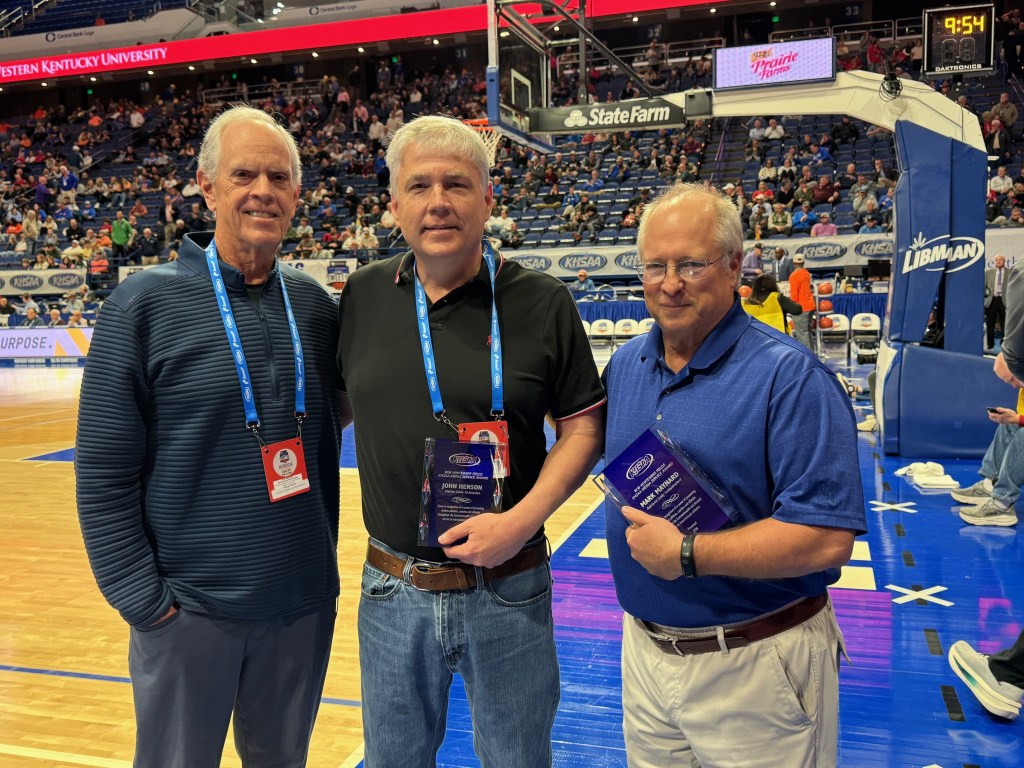
Dicky Martin with some friends from left: Mark Maynard, Greg Jackson, Dicky, Donna Suttle and Steve Conley.

Longtime fan Donna Suttle was another dear friend. She called them the “Three D’s” — Dicky, Dirk and Donna. Her heart is broken now that trio is down to one.

He had many more friends in Ashland. Everybody knew of Dicky Martin and his love for the Tomcats.


Beyond the Tomcats

Dicky’s voice wasn’t confined to Ashland. His career took him to Soldier Field, the Gator Bowl, Ohio State’s “Shoe,” and RFK Stadium while calling games for the semipro West Virginia Rockets. He worked Morehead State basketball games during Wayne Martin’s coaching era, which took him to Madison Square Garden and two NCAA tournaments.

But his heart was always at home.

“My two favorite places are Putnam Stadium and Anderson Gym,” he said. “I love those places.”

He had been to every state basketball tournament since 1976 — and his father took him to his first in 1961, when Ashland won it all. He was just seven years old then, but he never forgot.

Football was his true passion. “I never dreamed I’d be doing this as long as I have,” he said. “But I loved every second of it.”

So did we, Dicky.

So did we.

Dicky Martin often said his favorite place to be was Putnam Stadium where he broadcasted Ashland Tomcat football for 50 years.

1975 JAWS Tomcats clamped down on rival Boyd County in a game with high stakes

In 1975, the stakes for the Boyd County-Ashland football rivalry moved beyond bragging rights. It meant everything. The season was on the line. For the winning team, it meant a trip to the Class AAAA state playoffs. For the losing team, it meant basketball season.

Unlike today’s playoff format, where four teams from each district advance, only the district champion went to the postseason party in 1975. As if it didn’t already mean everything, that made the game even bigger. There were no second chances. It was take-your-breath-away football.

It was played in the last week of the regular season, only adding to the drama that was building since before the season started when fans began comparing the rivals. The game was always big, and the series was tied 5-5 going into the 1975 battle between the Tomcats and Lions. Both came in with outstanding teams and the game was played in Cannonsburg.

They played in the preseason, meeting in a Grid-O-Rama game in Putnam Stadium on a rainy night that ended with Ashland winning 12-0. The teams played only for about a half on a muddy turf, so it wasn’t a true measure of what could be and everybody knew it. But it still added to the discussion throughout the week leading up to the game.

Herb Conley was the architect of the Ashland JAWS Tomcats in 1975.

Boyd County was coming off consecutive seasons where it made the Class AAA playoffs. The Lions were ranked No. 1 in 1974 and were stunned by Middlesboro 28-14 in the opening round. That came after the 1973 season when Boyd County roared into the state championship game before losing 27-8 to Paducah Tilghman at Hanger Field on EKU’s campus.

The Lions had beaten the Tomcats both of those years, albeit by narrow margins – 14-13 in 1973 and 20-8 in 1974. Those were the kind of scores that most fans expected when the bitter rivals met, no matter which team was superior. Ashland’s last win in the series was 24-8 in 1972 with a team that reached the Class AAA finals against Tates Creek, losing 16-7, at Stoll Field in Lexington.

The Boyd County and Ashland programs were recognized and highly respected statewide for their hard-nosed and hard-hitting styles of play.

Ashland went into the 1975 game looking for perfection and a district championship. It could be a historic night with the last undefeated Tomcat team coming in 1958 when Herb Conley was playing. Even that team had a blemish – a tie against Huntington East – in a 10-0-1 season.

Casey Jones was a standout tackle for the Tomcats.

The last undefeated and untied team in Ashland history came in 1942. The JAWS Tomcats were chasing history. They were more interested in making their own legacy in the Tomcat program and knew they had the makings of greatness.

The Ashland-Boyd County games of the 1970s and 1980s were almost always played on the last Friday of the regular season, always had high stakes and always drew a massive number of fans. Everybody in the area was watching and interested In the outcome. It was just that kind of game.

Given the Tomcats proudly using the JAWS nickname for its defense throughout much of the season, Boyd County’s fans decided to have some fun, calling their team the JAWBREAKERS. Electricity was in the air, the fans were packed in on Boyd County’s large home side and the smaller set of bleachers were full for the visiting fans. The hillside on the home side was crowded with a mix of fans too with the expectation that something special could happen no matter which side won.

Ashland came in a confident 10-0 and feeling good after blowing out Covington Catholic 56-14 the week prior. Boyd County was 7-3 and coming off a defensive battle with Russell won with a goal from Mark Rice that provided a 3-0 victory. The Lions had a star running back in James Tackett who was heading to play at West Virginia. He came into the game injured but still played, gaining 58 yards on 10 carries.

The Tomcats were ready and when big Terry Bell, Ashland’s All-State lineman, busted through a hoop coming onto the field it almost sent an instant message.

“Terry came running out there in the front,” remembered tight end Alan Mayo. “Terry, Chuck (Anderson) and Rick (Sang), were our captains. People came running out (behind them) and sprinted to the middle of the field. Everybody in the stadium went quiet. You knew he (Bell) was there and was going to give it his all.”

Mayo figured in setting up the game’s first touchdown. He slipped past the Lions defenders to pull in a catch and ran 41 yards to the Boyd County five. Mayo looked headed for the end zone until Tim Powers tripped him up from behind. But a three-yard run from Gary Thomas set up a two-yard plunge from Jay Shippey for the touchdown. Kevin Ward’s extra point made it 7-0 on Ashland’s first possession.

Terry Bell breaks through the hoop and runs onto the field.

Ashland made it 15-0 early in the second quarter when Jeff Slone finished off a drive with a seven-yard touchdown run. Anderson hit Mayo on the two-point conversion try.

Anderson, the quarterback-linebacker, played a huge role with a 6-for-13 passing performance that included a 20-yard touchdown pass to Sang eight seconds before halftime for a 23-0 lead. Anderson also rushed for 46 yards on 11 carries out of the wishbone.

In the second half, Thomas returned a punt 85 yards for a touchdown and Greg Jackson ran in the two-point conversion to push the margin to 31-0. Anderson later scored on a 13-yard run and the last touchdown, set up by a 25-yard strike from Anderson to Jim Johnson, moved the Tomcats inside the 20. Shippey rumbled into the end zone on a 16-yard run with 2:27 remaining to bring the final score to a whopping 43-0.

Ashland outgained Boyd County 477-175 as the JAWS defense stated its case, clamping down on the Lions from start to finish. Boyd County made it inside Ashland’s 30 only once in the game and that came on the last series. Tackett had a short run and a facemask penalty put the ball on the 22. But any hope of ruining the shutout ended when quarterback Wayne Chaffin was sacked for a 10-yard loss on the last play of the game.

Greg Jackson (27) runs behind Jim Johnson for a big gain.

A 43-0 shutout victory over its biggest rival was enough to put Herb Conley in rare form and he did not hold back his excitement over the victory that was the biggest margin in the series. It also sent Ashland into the state playoffs as the top-ranked team in Class AAAA.

“The best team showed that it was the best tonight. We have the best team in the Tri-State and I can say it now. I’ve kept my mount shut all year, but I can say it now … we’ve beaten them all. This win was especially good after the last two years.”

The perfect season was intact and the victory over Boyd County was sweeter than ever for the Tomcats. But now the fun would begin. Despite being undefeated and ranked No. 1, the Tomcats only had one playoff game in Putnam Stadium. They played at Dixie Heights, home against Lafayette, at Paducah Tilghman and in Louisville against St. Xavier for the state championship.