2019 CP-1 Ashland Baseball Hall of Fame class selected

ASHLAND, Ky. – Ten players and coaches have been selected for enshrinement in the 2019 CP-1 Ashland Baseball Hall of Fame next summer.

Eight players and two coaches make up the fifth class that will be part of the Aug. 24, 2019 ceremony in Central Park.

The 1950s era is well represented with youth league coach T.R. Wright, former Ashland Tomcats players Robert Wright, Dick Fillmore and Herb Conley and former Fairview High standout Ed Joseph.

The 1960s era includes former Ashland Tomcat stars Ed Radjunas, Tobey Tolbert and Mike Johnson.

The 1970s era includes former Ashland Tomcat coach Frank Sloan and Tomcat standout Darryl Smith.

The 10-man class will bring the total to 60 former players, coaches and umpires in the CP-1 Ashland Baseball Hall of Fame that started in 2015. Four more 10-man classes will complete the CP-1 Hall of Fame.

Here’s a closer look at each 2019 inductee:

-T.R. Wright was one of the pioneer youth league coaches, a father figure to many of those players, and was instrumental in establishing the first Babe Ruth League and the first American Legion team in Ashland.

-Robert Wright was a late-1950s all-around athlete who was one of the best hitters and overall players of his era. Former teammates raved about his raw hitting ability.

-Dick Fillmore was a crafty Tomcat shortstop and pitcher and another great all-around athlete in the late 1950s who handled himself well with quickness and quick hands.

-Herb Conley, known more in Tomcat country for football as a player and coach, was also a sturdy third baseman and pitcher in the late 1950s who, of course, hit with power.

-Ed Joseph was a star catcher and hitter for Fairview High School who went on to Eastern Kentucky University where he enjoyed all-league status.

-Ed Radjunas threw the first pitcher in Ashland Little League history in 1955, was a three-year starter at third base for the Tomcats from 1961 to 1963, coached two years of Post 76 American Legion in 1968 and 1969 and also played at Marshall.

-Tobey Tolbert, a state champion hurdler, was a baseball star in his youth league days in Little League and Babe Ruth. He played only his senior season for the Tomcats in 1967 but he was the perfect addition on the second of the three state champions.

-Mike Johnson played on the 1963 Ashland American Little League state champions and was on the 1969 Tomcat state runners-up. He also coached many successful seasons in Ashland Babe Ruth.

-Frank Sloan was an outstanding coach for the Tomcats in several sports, including baseball where he directed two regional championship teams. He also was an All-Area coach in soccer and girls basketball.

-Darryl Smith was an excellent left-handed pitcher for the Tomcats who also carried himself well at the plate in the late 1970s at Ashland before going on to a career at Cumberland College. He joins his brother, Dan, in the CP-1 Hall of Fame.
1940s Tomcat great ‘Doc’ Rice dies at 93

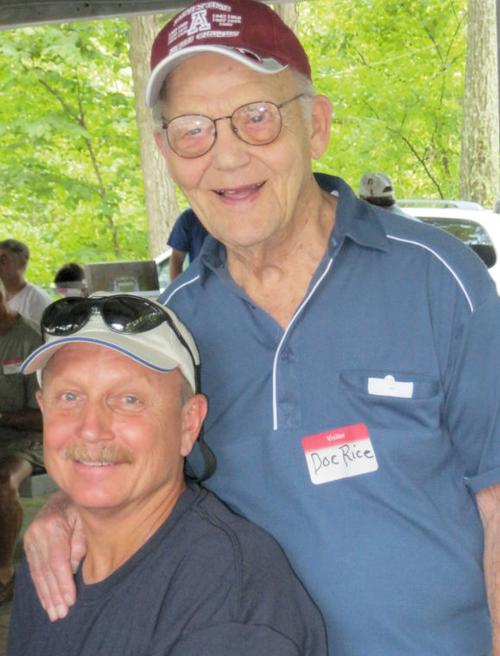
ASHLAND, Ky. – Rupert “Doc” Rice, who put his stamp on Ashland football way back in 1942 as a no-fear running back who bashed opponents with a relentless running style, died on Friday in Lexington.

Rice was the oldest living Tomcat at 93 years of age.

Those 1942 Tomcats were a grand bunch, finishing a 10-0 season with a 70-0 victory over Russell in five-year-old Putnam Stadium. But it was a game the previous week against Manual, a 7-6 road victory for Ashland, that clinched the mythical championship, at least in the mind of the Tomcats.

The only touchdown came when J.C. Kennard returned the second half kickoff for a score, zigging and zagging all the way down the field, remembered Paul DeHart Sr. in a 2013 interview. Jim Stith kicked the extra point.

Rice had a long run to the Manual 5-yard line late in the game to seal the hard-fought victory.

A young man named Charles Ramey was the coach of the Tomcats and he was named Kentucky Coach of the Year in 1942 by the Courier Journal.

The coach of Manual that year was none other than former Ashland Tomcat coach Paul Jenkins, Ramey’s former high school coach in 1933 and dear friend who would later become his son’s godfather.

Ramey left Ashland because of a call to duty with the Marines where he was in World War II battles from 1943 to 1945. Second Lt. Charles Ramey piloted a battalion of armored amtracks and knocked out Japanese battalions who had secretly infiltrated the island of Peleliu.

Rice was one of several members from the 1930s and 1940s classes at Ashland High School – Dick Patrick, Bun Wilson, Jack Nuckols, Rudy Gute and Ralph Felty were some of the others -who fought in the Battle of Okinawa. More than 100,000 Japanese combatants died in that battle, one of the last of World War II.

Doc Rice was a corporal in the Marines. His nickname of “Doc” came because his father was a doctor and it stuck with him for a lifetime.

Back in those days, there weren’t playoff games but Ashland and Glasgow were the only undefeated teams remaining that season. Both put dibs in on the state title.

Doc Rice, who broke three ribs and his nose that season, was one of the reasons why the Tomcats held that status. He was joined in the backfield by Kennard and Spencer Heaton and Ashland dominated opponents with a punishing single-wing attack.

Only three games were even close — 12-7 over Charleston High, 19-6 over Ironton and the win over Manual. Ashland never allowed more than a touchdown in a game and had five shutouts on the way to outscoring foes 341-31.

Doc and Jackie Rice were my neighbors when my family first moved to Grandview Drive in the 1960s. It was sad to hear about Doc’s passing but his Tomcat legacy will live on.

Getting to the core of it

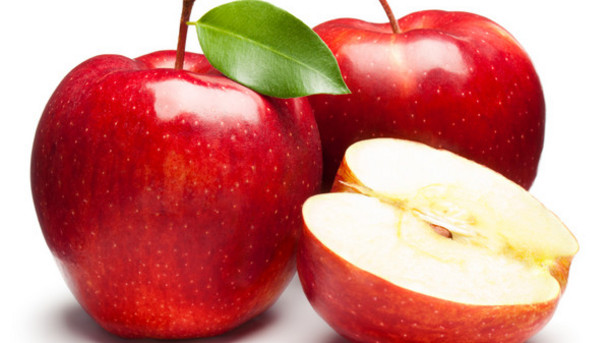
The apple has always been one of my favorite fruits, not to mention a part of my childhood.

I just never knew I was eating it the wrong way all these years.

More on that later.

Apples and I really do go back quite a bit. I’m sure, even as a baby, some of the mushed food prepared for me was apples.

But my real introduction to apples came in our back yard on Grandview Drive. A lot of that area was at one time an apple orchard and many of the apple trees were still fruit bearing and healthy when we moved there, including four or five in our back yard.

That all sounds well and good. You could always find a fresh apple to eat and didn’t have to go to the market or grocery store to purchase it. Just step into the back yard and pluck one off the tree.

We did that often, too, and many times Mom would fry up a mess of those apples. Wow! That was some good eating.

But the worst part about apple trees is all those apples don’t stay on the tree. Remember, we had healthy apple trees and when the clumps got too big for the branches, they fell to the ground.

Have you ever tried to mow the lawn around a bunch of apple trees, where apples have fallen to the ground? Take my advice. Don’t try it. You’ll have smoother rides on a Pogo stick.

And there’s nothing that attracts bees more than a bunch of rotten apples. Those beautiful green apples turned a hideous brown within a few days of hitting the ground.

Before we mowed the lawn, we had to pick up apples. Hundreds of apples. Maybe thousands (OK, hundreds).

We would have garbage bags full of rotten apples by the time we were finished. And then we had to cut the grass where they once laid. It was a monumental task for me and my brother most of the time.

Besides having them at my disposal to eat whenever I wished, that cleanup experience kind of, uh, soured me and my brother on the whole apple experience.

Rotten to the core? Some of them were.

Oh, I still liked them and wouldn’t usually turn down a big Red Delicious or Granny Smith if offered.

I still like them, even if those memories of picking up apples off the ground with a million Yellowjackets buzzing around kind of gives me the heebie-jeebies.

We used to have apple fights in the neighborhood, too. The only thing worse than getting stung by a Yellowjacket sitting inside a rotten apple was getting plunked by one from somebody throwing them at you from about 30 feet. We used garbage can lids as shields, but it was never totally protective (“If you can dodge an apple, you can dodge a ball,” to paraphrase the crazy coach from the “Dodgeball” movie.)

Of course, dodging apples improved my dexterity and firing these apples back maybe enhanced my arm strength and control for pitching in baseball. So there was an upside.

So me and apples, even though we have a history, we’ve been mostly good for each other.

But it wasn’t until this week that I was shown the secret (via the Facebook and the Internet) to how you correctly eat an apple.

Do you eat your apple from the side, like corn on the cob, and throw away the core?

If so, you’re eating it the wrong way.

Go from bottom to top, or top to bottom, and you’ll waste practically nothing but a few seeds. The core of the apple seemingly disappears while you’re eating. I’m not kidding.

I tried it on Monday and it was like solving the Rubik Cube. I ate my apple from bottom to top and, aside from a few seeds (And, relax, it’s not like an apple tree is going to grow in your belly), gulped down the whole piece of fruit. The core was never seen.

I’ve told people this treasure for years and they all are looking at me like I’ve eaten an apple filled with worms.

But I’m telling you, try it.

The average person, when eating an apple the wrong way, throws away roughly 30 percent of the apple. There is no waste, save for a couple of seeds, if you eat it the right way.

Bottoms up — or tops down if you prefer — the next time you bite into a Red Delicious.

Russell Turkey Trot’s mission has not changed over years

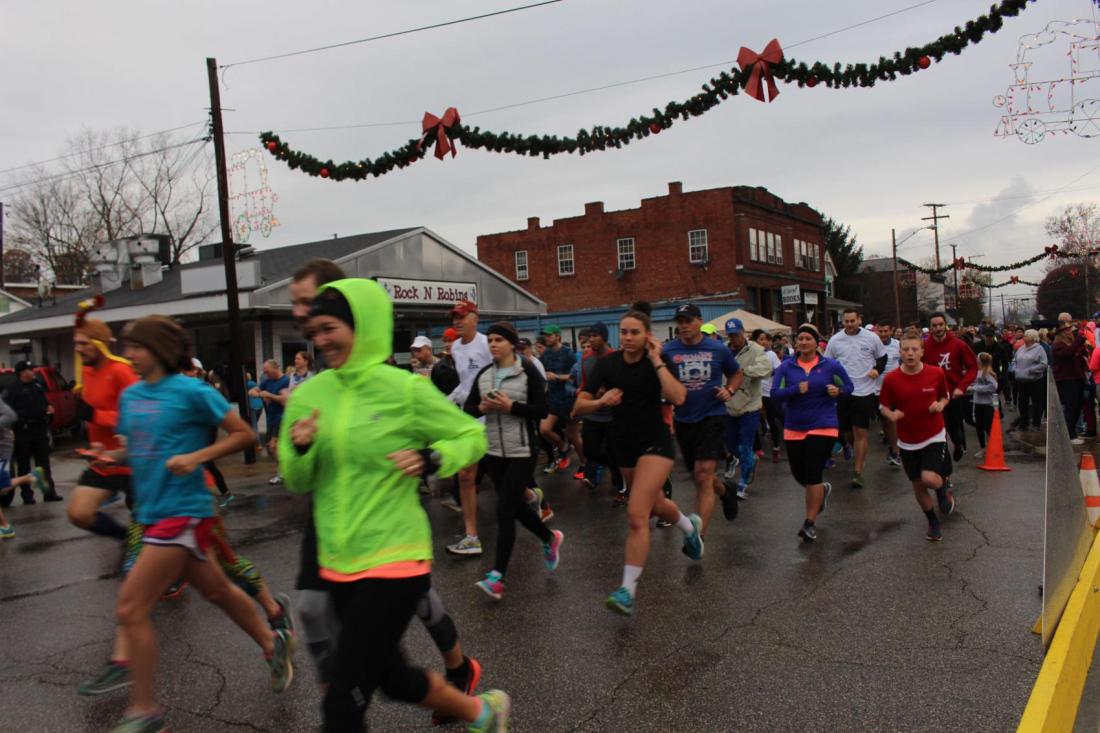
Since the mid-1980s or so, the Turkey Trot in Russell has brought together friends and family for a brisk jog on Thanksgiving morning.

It was started by retired U.S. Magistrate Judge Joe Hood and a few other friends who decided to go for a morning run on the holiday and provide some non-perishable foods for the hungry in the process. It was all in good fun.

My how it’s grown over the last three decades and much of that has been because of Ruthie Lynd’s leadership with the Fellowship of Christian Athletes at Russell High School, who has cared for the run like it’s her own baby for years. Ruthie and husband John are tireless FCA leaders whose hearts are bigger than a 50-pound turkey.

The run has been for fun and fellowship, but it also helped fill the food pantry for Helping Hands in Greenup County. The only entry fee was to bring some food and people turned out by the hundreds to participate in the unofficially timed race.

It was no frills and no guaranteed t-shirt, but it was the biggest 5K in northeastern Kentucky. At its peak, there were more than 800 runners. Last year about 500 braved some cold rain. It became a place for runners to have reunions and families came to watch, run or walk no matter the weather.

The Turkey Trot will go on again Thursday morning but as an official race. There’s a $25 race-day entry fee and Alan Osuch, the guru of 5Ks in this area, will be organizing. You’ll get a t-shirt and the race will be expertly run, timed and insured and there will, of course, be food and trophies like at all Osuch events.

Ruthie learned last year that these downtown runs needed insurance and that costs money, too. The best answer was for an organization that puts on 5Ks to take over running the race. It was the right call.

Some may be upset that it’s no longer a “free event” but any profit that comes from the race still goes to Helping Hands – and runners can still bring cans of food if they want.

Even though it was a “free event,” a lot of time and effort was put into the race by the Lynds and others on the holiday. They did it because they loved it and she will still be front and center, cheering every runner across the finish line like she always did.

It’s understandable that entire families won’t be able to participate because of the entry fee and the numbers may not ever reach the incredible totals of recent years. But hopefully the tradition will continue because it’s a good one and one that has benefited Helping Hands in Greenup County for years, not to mention bringing families to a fun event.

The area should be thankful to have a Turkey Trot for those runners who want to do something cool before the big meal is served later in the day. It showcases downtown Russell and can still be a reunion highlight on Thanksgiving.

A nice run, quality t-shirt and the good feeling of doing something for Helping Hands should trump that entry fee on a day where most of us have more to be thankful for than we deserve.