Jody Hamilton, Kentucky’s greatest high school baseball coach, retiring after 37 seasons

Ever the gentleman, Jody Hamilton walks his wife of 37 years Denise back to her car hand-in-hand after last week’s district tournament. Jody told his West Jessamine players on Sunday that this season will be his last.

ASHLAND, Ky.  – Thirty-seven is enough for No. 37.

Jody Hamilton, who has to be in the conversation as the greatest high school baseball coach in Kentucky history, told his players at West Jessamine High School on Sunday night that this will be his last season. The Colts begin 12th Region tournament play on Monday.

Hamilton, who two years ago was the National High School Athletic Coaches Association’s Coach of the Year and has won state championships at Boyd County in 2001 and West Jessamine in 2015, notched his 938th career victory when West Jessamine defeated East Jessamine 3-2 to win the 46th District title for the seventh year in a row last week.

The Colts are 22-10 and have won seven games in a row, peaking at the right time in typical fashion of Hamilton’s teams. They play Rockcastle County in the regional tournament opener

Hamilton, who has worn No. 37 throughout his playing and coaching careers, cracked into coaching at Raceland, where he endured his only losing season. The Rams were 13-15 in 1986 while playing every single game on the road. Raceland won the district crown in ’86, anyway, and was the home team on the scoreboard for the first time — in 28 total games — in the opening round of the 16th Region Tournament.

Hamilton moved to Boyd County and captured his first of 11 region championship trophies with the Lions in 1988, taking them to the state championship game. Casey Hamilton, Jody’s son, helped bring Boyd County to a state title in 2001. The coach has been at West Jessamine since 2004. The Colts have collected four region crowns (2008, ’10, ’15, ’16) under his leadership.

Winning the state championship and getting attention from college recruiters for his players was always the goal for Hamilton, who  estimated 70 percent of the seniors who played for him found themselves on college rosters.

A 1976 graduate of Ashland, Hamilton enjoyed a tremendous career at Morehead State University that included winning the Ohio Valley Conference Triple Crown before playing for the minor-league Paintsville Yankees. He was with the Yankees on the night that Darryl Strawberry made his professional debut with the Kingsport Mets in Paintsville, Ky. Despite hitting better than .300 for the Yankees, he felt the calling to coach and the rest, as they say, is history.

Hamilton elevated not only the way baseball was played in the 16th Region but brought it to a level the area hadn’t seen since Ashland dominated in the 1960s. He also was responsible for getting the Luther Craig Baseball Complex built at Boyd County with the help of Addington to become the envy of eastern Kentucky. Baseball fields began popping up throughout the region and Boyd County’s showplace was the reason why. As the places to play became special for other teams, the level of play began to rise too. It was either get better or get left behind because Hamilton was in it to win it every year.

His teams became known for excellence throughout the state and  hundreds of his players – and even many who played against him -went on to become college baseball players and later coaches on a number of different levels. Hamilton moved to the highly competitive 12th Region with West Jessamine, but continued to produce baseball that rivaled anybody in the state. He was the ultimate teacher of the game.

Jody Hamilton was among the inaugural selections into the Ashland Baseball CP-1 Hall of Fame in 2015.

By the way, 37 had another significant meaning for No. 37. He and wife Denise have been married for 37 years. They have two children, Casey and Neena, two grandsons and a granddaughter on the way. Jody and Denise also have a healthy bee farm they tend to in Jessamine County.
By George, this Sports Day will be special to me for more than the obvious

For as long as anybody can remember, George Stout has been the chairman of the Elks Sports Day committee.

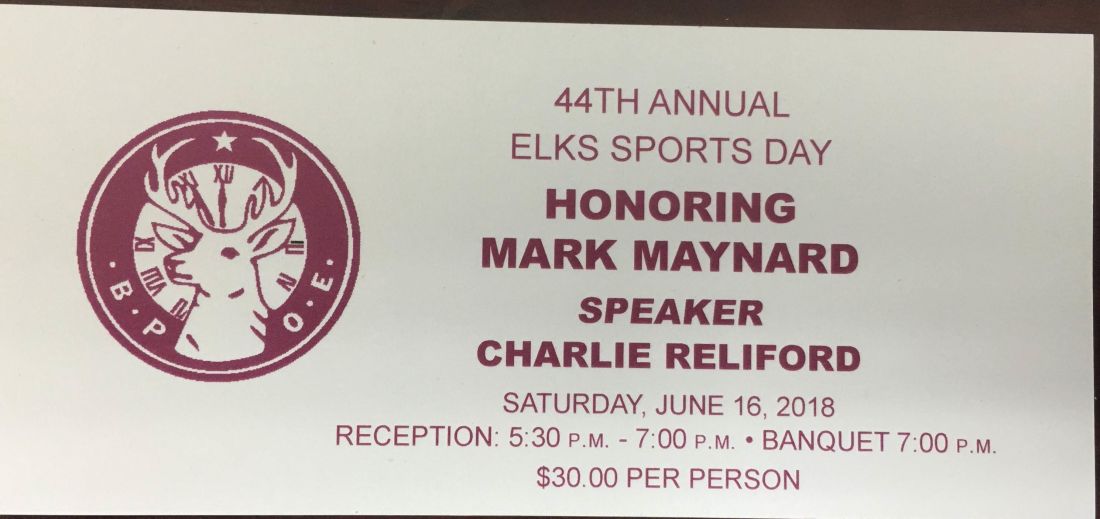
This year, the 44th in the annual summer event, will be his last. I’ve worked alongside George for probably three decades of his planning Sports Day weekends and that makes me being the honoree for the Elks Sports Day on June 16 all the more special. I’m still not convinced that my photograph belongs on that wall of greatness in the Elks Lodge.

Flipping through pages of a scrapbook recognizing the first 16 Sports Day honorees made me realize even more that I’m in elite company. All-Americans, an Olympian, football and basketball greats and coaching legends, a marketing genius, community leaders who impacted hundreds, a Rose Bowl participant, a major league umpire who was a part of two World Series are only a few of the past honorees.

I’m honestly not sure how my photo fits up there with such legendary people. And I’ll tell you another one that deserves a spot somewhere: George Stout. Nobody – and I mean nobody- has done more for this program than him. Anybody who has played a part in Sports Day understands how much George means to the program. He’s a do-it-all machine, organizing everything down to the smallest detail, down to what the person who introduces the honoree is supposed to say word for word. Let me just say this and the Elks know it’s true: Without George Stout’s passion for this program, it would be kaput by now. He has nearly single-handedly kept it alive and we should all be thankful.

George has been around the block. He was witness to the first game ever played in Putnam Stadium and then saw the last one before the walls came down to make way for the “new” Putnam Stadium. He has been a friend to this community longer than I’ve been alive and still drives meals to shut-ins during the club’s Thanksgiving and Christmas feeds.

George deserves a good sendoff. It would be fitting to set the attendance record on his last night as chairman. The program will be a one-day affair with the reception and banquet on the same night. Charlie Reliford, one of the best storytellers you will ever hear and a former Sports Day honoree, is the speaker. If you’ve never heard Charlie speak, you are in for a treat. If you have heard him, you know he’s worth the price of the ticket. Reception food, Elks famous baked steak and Charlie Reliford speaking for $30? It’s worth the price.

I’m not asking for me, although I’d love to see players and coaches I’ve covered through the years in attendance along with my friends and family, but let’s make the last Sports Day that George will be the man a night he will never forget too. I know it will be one that I’ll never forget.

Like George, I was no athlete. I was only a witness to the greatness that has come from the Ashland area. Of the previous 43 honorees, I’ve covered nearly all of them one way or the other and about 27 of them directly. Many of them I didn’t see compete as athletes, but I’ve written about them as part of the glorious history of this area. What an honor that was for me to tell the stories of the great individuals on the wall.

Do I belong up there? I’m not sure but the recognition, while maybe not deserved in my eyes, is humbly appreciated.

We’ll have to get about 250 there for the record. Can we do it Ashland?

June 1 deadline for Putnam Stadium donor wall, commemorative bricks

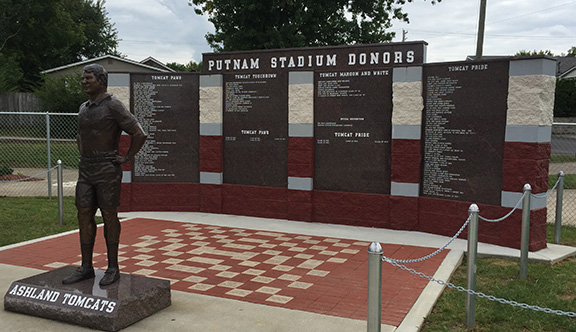
ASHLAND, Ky. – Ashland Tomcat fans who want to have a Donor Wall inscription or a commemorative brick at Putnam Stadium before the start of the 2018 football season have about a month to decide. The deadline to place an order is June 1.

Donor Wall inscriptions come at four levels with costs between $500 and $10,000. Here are the categories:

-Tomcat Touchdown Club: $10,000 or more

-Tomcat Maroon and White Club: $5,000-$9,999

-Tomcat Paws Club: $1,000-$4,999

-Tomcat Pride Club: $500-$999

The commemorative bricks and Donor Wall inscriptions display family names, “In Honor” of or “In Memory” of for family members or friends, teachers, players, band members, cheerleaders, fans, classes, etc.

For a donation of $100 or $175 you can have a brick placed in the Donor’s Corner with an inscription that you choose (name or family name, etc.).

4×8 brick:  $100 (3 lines/20 characters each line (this includes spacing and punctuation)

8×8 brick: $175 (6 lines/20 characters each line (this includes spacing and punctuation)

Complete the order form with inscription and contact information, then send the form and check to: The Putnam Stadium Restoration Foundation P.O. Box 3000 Ashland, KY 41105-3000 or deliver to Donna Childers Suttle at the South Ashland Greenhouse, just a block from Putnam Stadium.

Forms can be found on the stadium website at www.putnamstadium.com

Contributions to the Putnam Stadium Restoration Foundation are deemed charitable under section 170 (b) (1) (A) (vi) of the Internal Revenue code as an organization described in Section 501 (c) 3.  U.S. Federal Tax ID 26-1674277.  Please consult your accountant for any clarifications.


‘Is Mickey Mantle bigger than God?’

One great thing about my job of 42 years at The Daily Independent was the chance encounters with the celebrity world.

For me, it was the sports celebrity world.

The list goes on and on of sports heroes that I’ve been able to interview – Muhammad Ali, Pete Rose, and Michael Jordan, to name a few.

And, oh yes, Mickey Mantle.

The story of my five-minute interview with The Mick is much better than the interview itself.

Mantle, the baseball idol of the 1950s and 1960s, is a name that everybody knows.

It was back in 1989, long after Mantle had retired from baseball as one of its all-time home run leaders. The Mick didn’t just hit home runs, he hit them out of sight. His legend was unprecedented.

While browsing through a magazine at work one day, I began reading an article about the Mickey Mantle-Whitey Ford Fantasy Camp in Fort Lauderdale. At the bottom of the article, there was a number to call. It had a 606 area code and a 474 exchange. That said one thing to me — Grayson, Ky.

The curious reporter in me made the call to the number and on the other line was Wanda Greer, who was the camp director. Dave Carter, who produced the “Ashland’s Field of Dreams” documentary, was actually the one who had a hand in starting the fantasy camp many years ago.

I set up an interview with Wanda and she asked if I’d like to speak with Whitey and Mickey.

Well, uh, absolutely, I told her.

So the wheels were put in motion. She actually gave me Ford’s number and I called him about a day later. We spoke for 15 of 20 minutes about the camp, about Mickey and about Wanda. It was a good interview but The Mick would be what could turn the article from good to great, at least in my estimation.

Wanda said Mickey would be a little harder. She wasn’t going to share his number, which was understandable. And, besides that, Mickey was always on the go, flying here and there, doing autograph signings or whatever. He was Mickey Mantle and that was job enough.

Wanda took my home phone number – these were the days before cell phones — and told me when Mickey was available she’d give me a call.

That was good enough for me. So I waited.

One Sunday night, my wife, 5-year-old son, 2-year-old daughter and I were at church. My wife wasn’t feeling well, so she told me she was taking the kids and going home. We’d driven separately, so that would be fine.

On the way home from church, my wife drove by the Oakview Elementary playground and Stephen, being a 5-year-old, begged her to stop.

“No,” she said, “if we were anywhere right now, it would be in church. The only reason we’re going home is because Mommy doesn’t feel good.”

So that was that. Stephen wasn’t happy about it but understood as much as 5-year-olds understand these things.

Well, lo and behold, when Beth arrived home she got a phone call and Wanda Greer was on the other end. She asked for me and Beth told her I was at church. She told Beth that if there was any way possible, could she have me at the phone in 15 minutes because Mickey Mantle was going to be calling.

Mickey Mantle!


My wife knew I was working on the story and didn’t want me to miss the opportunity. She hurried back to church, with Stephen and Sally in tow, and told someone in the back of the church, in our sound room, to let me know.

He came down the side aisle – I was sitting near the front – and told me. I jumped up and walked out of church and headed for home, excited about the opportunity that awaited.

In the other car, Beth was posed with an interesting question by our 5-year-old: “Mom,” he asked, “Is Mickey Mantle bigger than God?”

Wow! What a zinger. Always quick on her feet, Beth said, “Well, no, but this is different. It’s Daddy’s job. That’s why we got him out of church.”

It turned out, that wouldn’t be when the interview with The Mick happened. Mantle was at an airport and didn’t have time to make the call. Wanda called me and apologized and promised that Mantle would call me at work on Saturday.

That was fine with me. I was working on a Saturday morning – the paper was afternoon back then – with the late Tony Curnutte. Nobody was a bigger baseball fan than Tony. When I told him The Mick was calling today, he was giddy.

I told him that we needed to make sure one of us was always near the phone because I didn’t know when the call would happen. Well, naturally, The Mick called when we were both away from the desk.

Our switchboard operator at the time didn’t look for me because she thought it was a bogus call.

“Somebody saying he was Mickey Mantle called but I knew it couldn’t be him,” she said. “So I hung up on him.”

“What?” I screamed. “That was Mickey Mantle!”

I quickly called Wanda back and told her what had happened. She didn’t know if The Mick would call back but told me to sit right by my desk. I’m sure she had to do some explaining but whatever she said worked.

I told Tony what was happening. He begged me to let him answer the phone so he could say he talked to Mickey Mantle. I agreed.

Ringggggggggg! Ringggggggggg!


Tony, in his most proper and professional voice, cleared his throat and then answered: “Sports, Tony Curnutte.”

The countenance on his face dropped immediately. In subdued tones he said “Yes, uh, I guess. Hang on a minute.”

“It’s not The Mick it’s The Rick,” he said. Rick Greene, a sportswriter for us at the time, wanted to know if I wanted him to cover an American Legion game in the park that afternoon.

“Get him off the phone!” I said.

We both sat quietly. Tony stared at the phone, poised like a cat getting ready to pounce on a mouse.

Ringgggggg! Ringggggggggg!


Tony answered again in professional voice. “Just a minute,” he said firm and proper. This time it was The Mick. He transferred the call to me and on the other line was none other than Mickey Mantle.

The first thing he said to me, in his thick Oklahoma drawl, was: “You sure are a hard guy to get a hold of.”

We both laughed. I was as professional as I could be and we had a brief interview that was cut off when I asked him about Pete Rose and gambling.

“I’m not here to talk about that,” he said.

Good enough. I mean, it was Mickey Mantle.

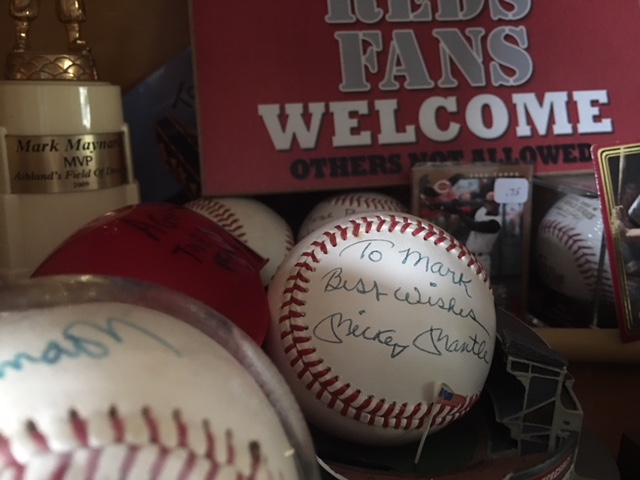
I hung up the phone and the journey had ended. After plugging in Mantle’s quotes in the story, the job was done. The feature ran the following day and Wanda, being so classy, was kind enough to get me an autographed Mickey Mantle baseball. It had “To Mark, best wishes, Mickey Mantle” on it and it still sits today on my mantle at home.

Autographed baseballs that are personalized are worth less on the open market than those that just have the name. But I liked that it was personalized and wouldn’t sell it anyway.

To me, it serves as a reminder of a story worth telling.