How far can a Wiffleball travel? You might be surprised

ASHLAND, Ky. – There were more than 250 home runs that sailed out of the two Wiffleball fields on the corner of 29th Street and Blackburn Avenue on Saturday. Some of them were majestic home runs, drawing oohs and aahs from the dozens who came to watch from their lawn chairs.

At a conservative average of 90 feet per home run – our fences for the Amy For Africa Wiffleball Tournament are about 80 feet – that is 22,500 feet of home runs. That’s 7,500 yards, or 750 football fields of distance.

Truth be told, though, the distance was far greater.

It was 6,000 miles away where the distance will be felt the most, a half a world away in Uganda where the real superstars – Chris and Amy Compston – are guiding the Amy For Africa ministry. The money raised from playing Wiffleball for eight hours goes directly to AFA.

The money raised on Saturday could go to any number of needs including providing tuition for at least five children to attend the AFA Christian Academy for a year. They will receive two meals a day – a luxury that most children in Uganda never see – and be taught about Jesus along with basic educational skills. They learn the importance of following Jesus and keeping Him front and center in their lives. They are the future and that’s what we want future Ugandans to look like.

The school is a lifeline for these children who may never hear the name of Jesus in a positive light in this Muslim-dominated area. But they learn The Truth from the teachers at AFA’s school that was built literally with the Lord’s hand during the time COVID was wrecking the world. It was astounding and breathtakingly beautiful.

Amy For Africa started in 2013 as a one-time fundraiser for several schools in Uganda and has since blossomed into its own organization. Chris and Amy were not able to be at our Wiffleball fundraisier because they were those 6,000 miles talking to people about the saving grace of Jesus. An evangelism team spent the day sharing the good news with the fruit being nearly 50 souls accepting Jesus as their Lord and Savior.

AFA was and continues to be built on prayer. Chris and Amy and son Jarek face daily obstacles in Uganda but with God directing their path no obstacle has been too big to overcome. They can tell you stories that makes the hair stand up on the back of your neck.

Our annual Wiffleball tournament is a lot of fun and blasting a home run well beyond the fence can throw you back in time when backyard games of Wiffleball was all we did. Unity Baptist Church graciously gives us a place to play and transform their side yard into a Wiffleball paradise. Dozens of volunteers made it happen on a beautiful Saturday afternoon, understanding the cause is worth their time that could be spent on a hundred other things.

Brooks Wyatt awaits the pitch as a teammate, Keith Taylor, encourages him at the AFA Wiffleball Tournament Aug. 12, 2023.

More than 120 players, young and old, participated in the tournament and had the best time ever. But don’t forget those Ugandan children who will benefit from the fundraiser. They were the real winners.

Our prayer is that the AFA Christian Academy is raising up a generation of Christian men and women that will have an eternal impact for the sake of the gospel. And if playing a little Wiffleball can further that prayer, then praise God!
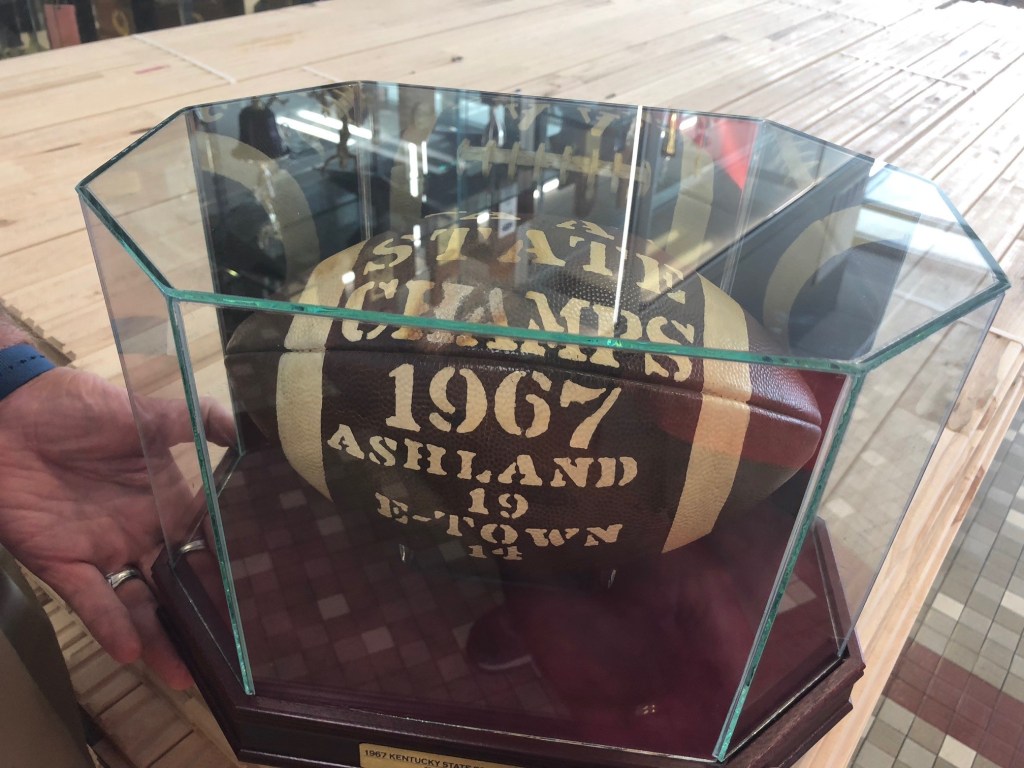
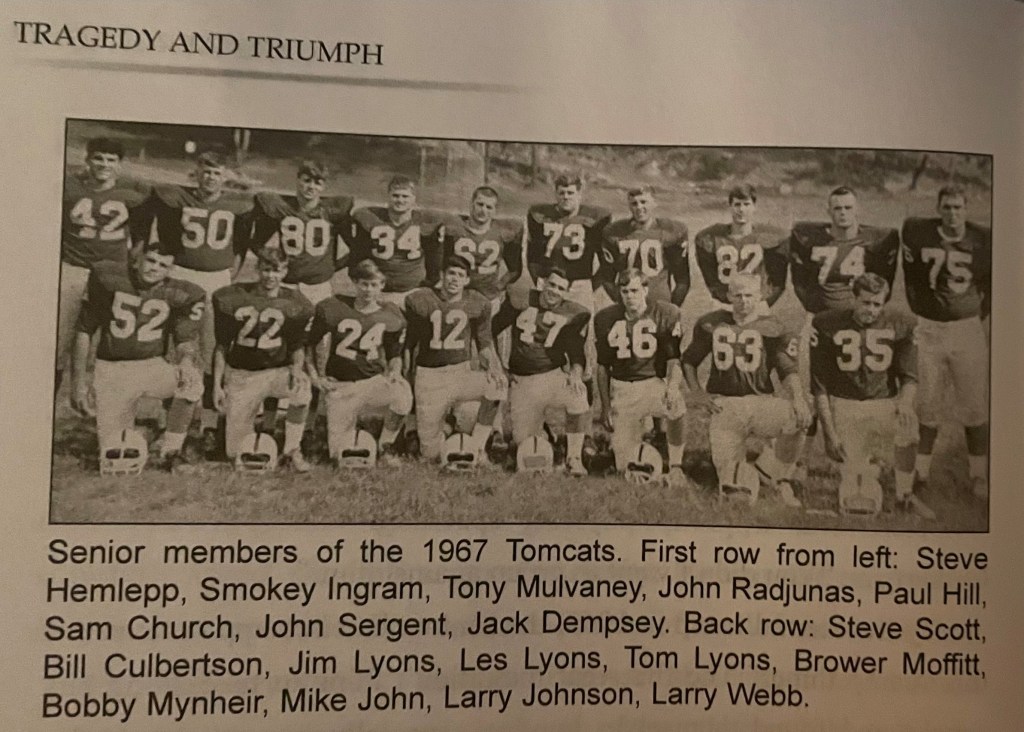
All-State center on 1967 Tomcat state champs remembered as supreme blocker, better person

Dr. Bill Culbertson will be remembered as a life-saving doctor but 56 years ago he was a lineman on one of Ashland’s greatest football teams in 1967.

Culbertson, who died on Saturday morning (Aug. 5) in Paducah, was an All-State center for the Tomcats who finished with a 13-1 record and as the Class AA state champions.

As a football player, teammate John Radjunas said there was none better.

“He always did his job, never missed an assignment or block and never bragged or boasted,” Radjunas, the quarterback for the Tomcats that season, said. “He may have been the best of all of us as a player and person.”

Radjunas said Culbertson used his mind and was a tactician as a blocker. He also knew every blocking assignment of the entire offensive line.

“If we called a sneak, he would always tell me which side to go behind him depending on which way he would block his man,” Radjunas said. “I never knew or remember a bad snap he ever made from the scrimmage line or long snapping.”

On a team full of stars, Radjunas said Culbertson shone the brightest.

“Les Lyons, Paull Hill and Steve Scott were great high school football players and belong in any conversation about all-time Tomcat greats. But if I had to pick one player off our team that belongs on an All-Tomcat Football Team it would be Bill Culbertson. He played both ways and never came out of the game.”

One of Culbertson’s biggest defensive plays came in a memorable 21-20 win over McKell at Putnam Stadium. Culbertson blocked a punt and ran it back 52 yards for a touchdown. He had another TD on a 6-yard interception return against Russell.

With the Tomcats trailing 20-14 late in the game with McKell and Paul Hill’s grinding runs getting them near the goal line, Radjunas audibled and called for a quarterback sneak because of the trust he had in Culbertson’s blocking. He plunged into the end zone behind the big center to tie the game with 1:06 remaining. Hill’s extra point won it 21-20 against the Don Gullett-led Bulldogs.

Culbertson typically dominated whoever was in front of him except for one man -.Harry Lyles of Stonewall Jackson. Lyles was a one-man wrecking crew, totaling 26 tackles, as Stonewall Jackson downed the Tomcats 13-3 in Putnam Stadium. It would be their lone loss. In the book, Tragedy and Triumph, Culbertson recalled trying to block Lyles.

“You could not touch that guy. He played six yards off the ball. Even if I took the angle, he was too quick. That was my black spot for the year. He was definitely best player I played against in high school. You just couldn’t get to him. I remember it was a close game but mostly what I remember about that game is getting beat by Harry Lyles practically every play.”

Culbertson, who was known for his humble personality, said Lyles did the same thing to him as a junior. He believed in giving credit where it was due.

Culbertson, one of eight Tomcats who received a scholarship, went to North Carolina State and started three of the four seasons for the Wolfpack.

He was destined for much more than football though.

Dr. Culbertson was a highly regarded pulmonologist and critical care specialist in Paducah, Kentucky.  Culbertson completed medical school at the University of Louisville and did his residency and fellowship as a pulmonologist at Alabama-Birmingham. He established the Respiratory Disease Clinic in Paducah and was in private practice for four decades.

A memorial service is scheduled for 1 p.m. Saturday at Milner & Orr Funeral Home and Cremation Services of Paducah. Visitation will be from 11 a.m. to 1 p.m. at the funeral home.

Revisiting our ‘Wonder Years’ one tall tale at a time

Hung out in Lexington with some old friends today from my “Wonder Years.” That’s the age between around 12 and 20, the teenage years, when life comes at you like a Nolan Ryan fastball. That’s when we are trying to figure it all out, like girls, how to hit a baseball to opposite field and, did I mention, girls? We didn’t have Google in the 1970s. Life was hard.

We had dudes older who, for lack of a better word, were our mentors. Two of them – Kevin Sutton and Tim Wallin – were at our get-together. Looking back on those “Wonder Years,” I wondered why my little band of brothers were allowed to hang with these guys who were three years older.

My brother was their age and that may have been the connection. Kevin hung out with my brother, who was also three years older. But my brother was more interested in music than sports (he had little interest in sports) and Kevin was leaning more into sports. We assumed that’s how we cracked the circle.

They may have just needed a few more players for whatever game they were playing at Stafford’s Field, our two-sport venue. We always had a handful around the neighborhood, so we could at least give them numbers.

Left: (front to back) Keith Daniel, Bill Hornbuckle, Kevin Sutton. Right: Mark Maynard, Tim Wallin, Mike Staten.

Stafford’s was made for tackle football, a long stretch of ground with a huge tree on one end that served as a goal line.

When it came to playing baseball, the dimensions were tougher because of the narrowness of the lot, but the tree remained important. Hit it into the tree and it was a home run (it took most of us years to put one in that giant tree). Perhaps the biggest and most dangerous obstacle for the baseball field was traffic on the road that ran beside the lot. Kevin collided more than once with cars while going after balls. He came away fine from the collision. I couldn’t always say the same for the cars.

Tackling Kevin was like grabbing onto a runaway freight train and Wallin was like trying to catch a jackrabbit.

We had other “arenas” too. East Jepson Street was perfect for Wiffleball as was Greg Estep’s side yard where we played countless two-on-two games with obstacles like pine trees and a straight-line row of bushes to keep hitters honest. When basketball came around, we had courts at Estep’s driveway and Jerry Henderson’s backyard. No matter what the weather was, we were there when it was basketball season.

We played baseball on what we called the Sand Dunes too. The field was exactly what it sounds like. Nothing but sand. We played until the last ball was lost or the last bat broken (we used wooden bats because that’s all they made). Kevin said he still has a Johnny Bench model bat but it’s not for swinging purposes now. A friend got Bench to autograph it for him and made him a bat holder that he could showcase it on a wall at his home.

Our older friends were good teachers and resourceful. They taught us to not hit the ball on the label. Sometimes we didn’t listen. More than once those guys pounded a nail into a cracked bat and wrapped electric tape around the handle. But once the ball was lost – usually after Kevin or Tim sent it into orbit – the game was over.

The mischievousness in them came out at night as the many stories told Saturday would suggest. I’m not going there to protect the innocent, which these guys were not. They told stories that would make the Myth Busters blush.

It could be that their influence on us was not on the athletic fields. My group, which included the unflappable Bill Hornbuckle, could match them story for story. We won’t go there either because most of what was told would not hold up in court and besides, it has been 50 years since most of our mischief was perpetrated on the streets of Ashland. Surely there is a statute of limitations?

One thing that’s not a wonder is that Kevin and Tim enjoyed long and successful careers in law enforcement in Lexington and Ashland, respectively. I mean, talk about criminal minds!

We laughed and laughed as one story after another was delivered by each of us – Kevin and Tim, Bill, Keith Daniel and Mike Staten, whose backyard was another playground for us. We had another five or six of the old gang invited for our “reunion,” but they could not make it for one reason or another.

It was a day that was good for the soul, reminiscing about our “Wonder Years” in a much simpler time, sharing stories that hadn’t been told for maybe decades and picking up right where we left off.

Jackson’s action brings restoration to Putnam Stadium

Forgive Greg Jackson if you see him taking victory laps around Putnam Stadium.

When the Ashland school board approved and signed a 10-year partnership with Clark’s Pump-N-Shop on Monday, it was the culmination of a goal that Jackson set for himself when the Putnam Stadium Restoration Foundation was formed in 2007.

Clark’s Pump-N-Shop Putnam Stadium, as it will soon be named, will have its own carpet in time for the 2024 season. It’s only part of the second phase, which Jackson has vowed to finish and includes an LED scoreboard, new lighting, a sound system and a banked end zone on the open end of the stadium. Even if the latter projects don’t materialize by 2024, the playing surface will be laid down making Putnam Stadium an even bigger showplace than it is now, and that’s saying something.

And all that has happened through Jackson’s never-say-no attitude. He has remained positive in the face of many obstacles but never wavered from the objective.

Sixteen years ago, the committee was developed with the idea of giving Putnam Stadium a “facelift.” But it wasn’t long until that “facelift” became a long and expensive project of making the home of the Tomcats a viable and safe place to watch football.

Jackson, who was a co-chairman of the committee with Dan Kelly early on, has been at the helm of the program the entire time. He is former Tomcat football player – starring on the famed 1975 “JAWS” team – and a passion like few others for Putnam Stadium. He has seen it from a lot of views, including being a former Tomcat Band parent when daughters Rebecca and Kathryn were members, including one-time president.

The original restoration committee had 13 members but only three remain – Jackson, Blake Holbrook and Steve Conley.

Jackson, a West Point graduate with the leadership chops it takes to lead, has done just that for the committee and Ashland Tomcat fans should be thankful for his diligence and persistence in making a project this huge happen.

Thirteen people were on the original committee and the school board ordered an engineering study to be done on the stadium that was 74 years old at the time. Kelly retired from the school system and left the area and Jackson said not a lot was happening.

Steve Gilmore became Ashland’s new superintendent and still nothing was happening with the stadium. Jackson then took command, calling Gilmore and setting up a meeting.

“I wanted to take the committee and get his commitment to support us and be part of the committee to get this project going again,” Jackson said. “He said yes so I ran with it and the rest is history.”

Jackson got the committee together again and reenergized, assuring them that it was going to get done. He asked for commitment from each one of them to follow his leadership and they all agreed.

The engineering study revealed bad news, calling for the stadium to be torn down. That heartbreaking decision was made to take it down and a plan put in place to rebuild it in the same shape. The teardown and rebuild came after the 2013 season and prior to 2014. They didn’t miss a game, although the 2014 season opener was delayed because of a torrential rainstorm, and some drainage issues, that caused the field to be flooded.

Jackson developed friendships with Tomcat greats John Koskinen and Dave Alban who have been instrumental. Koskinen was a cornerstone donor of the “new” Putnam Stadium and it was the lift that Jackson needed. A longtime friend and leader in the community, Jackson’s influence was greatly felt during the time he guided the committee. As the human resources manager at Marathon Petroleum in Catlettsburg, Jackson was a friendly face to the community. He has been and still is active on many boards in Ashland. Jackson is a face that people trusted and he has been critical as other smaller steps were made with an eye on bringing artificial turf to Putnam Stadium.

Corporate sponsorship seemed to be the answer and the Ashland area has a great one in Clark’s Pump-N-Shop, owned by brothers Rick and Brent Clark and formed by John Clark. When asked about becoming a partner in the project, there was no hesitation from the Clarks. They understand how much Putnam Stadium means to the community and how artificial turf can make it an even more valuable venue for other community events beyond football.

They have a tradition of serving and giving back to the community where the business was built and remains a powerhouse today.

Jackson called on another great Tomcat and one of the world’s foremost marketing gurus in Jim Host to help put together a contract that was appealing to everyone. Much credit should go to the Clarks for stepping up in such a big way and bringing artificial turf to Ashland to tradition-rich Putnam Stadium. The Clarks do a lot in the community that nobody ever knows about, not wanting any credit for their generosity. They stepped up, no question about it.

But over the past 16 years, nobody spent more time, sweated more blood and been more important to this project than Greg Jackson. He waved the Tomcat flag – by the way it was Greg who got the flags with the years of state championship on them that circle the stadium – better than anyone when it came to restoring Putnam Stadium. He was also instrumental, along with former teammate Rick Sang, at setting up the donor corner with the statue of Herb Conley, the all-time Tomcat, in front of it.

Secretly, I think Jackson wants to run just one more down at Putnam Stadium. A few years ago, he and former teammates Chuck Anderson and Dave Early raced from the 50 to the end zone. Jackson, running like he was 17 again, smoked them.

Mind you, Greg Jackson is not done with what he wants to do with Putnam Stadium improvements, holding a list of items if anyone is willing to help.

But the grass sure looks a lot greener these days.