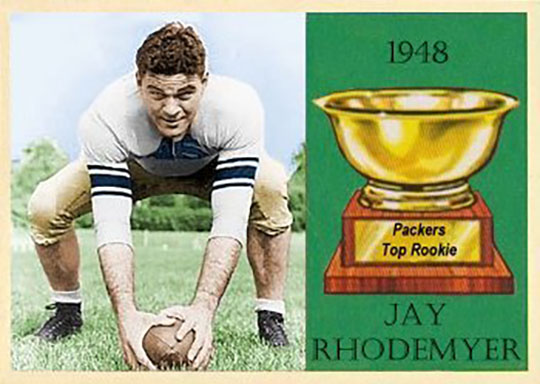
Jay Rhodemyer isn’t a name many Ashland Tomcat fans may recognize today, but they should. The 1940 Ashland graduate may be the most accomplished football player in school history — an All-SEC and third-team All-American center for Bear Bryant at Kentucky and a second-team All-Pro with the Green Bay Packers.
Rhodemyer was a first-team All-State center for a 5–4 Ashland team in 1940 after earning second-team All-State honors as a junior guard. His performance drew the attention of the University of Kentucky, which offered him the opportunity to play college football.
He enrolled at UK in 1942, but when World War II intensified, he left to join the Army Air Corps, serving as a bomber pilot. After the war, Rhodemyer returned to Lexington for the 1946 season — Bryant’s first — and became a cornerstone of the Wildcats’ resurgence. He earned second-team All-SEC honors in 1946 and followed that with first-team All-SEC and third-team All-America recognition in 1947.
He played in the 1947 Blue-Gray Game in Montgomery, Ala., and was named Most Valuable Player of the 1948 College All-Star Game at Soldier Field against the NFL champion Chicago Cardinals. The All-Stars lost 28–0, but Rhodemyer’s stellar performance earned him MVP honors.
Bryant said of Rhodemyer, “He was the doggondest best center I ever coached or have seen.” The Hall of Fame coach made that remark in 1968 after Rhodemyer died of a heart attack at age 45 in Lexington.
Rhodemyer was drafted in the seventh round (51st overall) of the 1948 NFL Draft by the Packers. He played center and linebacker, intercepting five passes and recovering a fumble during his career. Green Bay, then coached by Curly Lambeau, struggled during his tenure — going 3–9 in 1948 and peaking at 6–6 in 1952. He played in 1948, 1949, 1951, and 1952; records do not indicate why he did not play in 1950.
Two future Hall of Fame quarterbacks — Bobby Layne and Y.A. Tittle — were selected in the first round of that 1948 draft.
Rhodemyer, listed at 6-foot-1 and 210 pounds, appeared in 45 NFL games and was named second-team All-Pro by the New York Daily News in 1951. After retiring, he returned to Lexington, where he was part-owner and secretary-treasurer of Thermal Equipment Sales Co. and a member of Calvary Baptist Church. Following a memorial service in Lexington, his body was returned to Ashland for a second service at Steen Funeral Home and burial in Ashland Cemetery.
Arliss Beach and the NFL
Arliss Beach, a record-setting Tomcat running back from the Class of 2002 and a former UK standout, is the only other Ashland alum with NFL ties. He signed with the Green Bay Packers as an undrafted free agent in 2006 and impressed the staff enough to make the active roster. But in the final preseason game against the Cincinnati Bengals, he suffered a high ankle sprain and spent the season on injured reserve. Beach appeared on track for a spot on the 53-man roster before the injury. Green Bay released him the following June.
Beach signed with the Dallas Cowboys in August 2007 but was released before the season. He later joined the Houston Texans’ practice squad in December 2007, signed a futures contract in January 2008, and was waived that May.
At Kentucky, Beach played during a period of coaching turnover and was often underutilized, though he delivered one unforgettable performance against highly ranked Florida. UK lost 24–21, but Beach scored all three Wildcat touchdowns. He finished his UK career with 951 yards and 14 touchdowns.
Beach’s 2001 senior season at Ashland remains one of the greatest in program history: 2,533 rushing yards and 39 touchdowns on just 244 carries (10.4 yards per attempt), including three games over 300 yards. He ended his Tomcat career with 4,711 rushing yards, 62 touchdowns, 5,073 total yards, and 426 points.
Rhodemyer and Beach remain the only Tomcats ever to reach the NFL — one earning second-team All-Pro honors and the other coming agonizingly close to playing in a regular-season game.
For more than 50 years, Gary Kidwell, The Old Right Hander, was the voice and the record-keeper of Lewis County athletics. He hosted the Saturday Morning Sports Program on WKKS and wrote the Sports Corner column in The Lewis County Herald, a weekly tradition that connected generations of readers to the achievements of our student-athletes and kept local sports in front of our community.
Kidwell, 82, passed away at Vanceburg Hills nursing facility after a long journey with dementia.
Gary’s impact on Lewis County reached far beyond a microphone or a byline. Over seven decades, he served as a player, coach, teacher, athletic director, umpire, commissioner, and as a tireless supporter of young people in this county and across northeastern Kentucky.
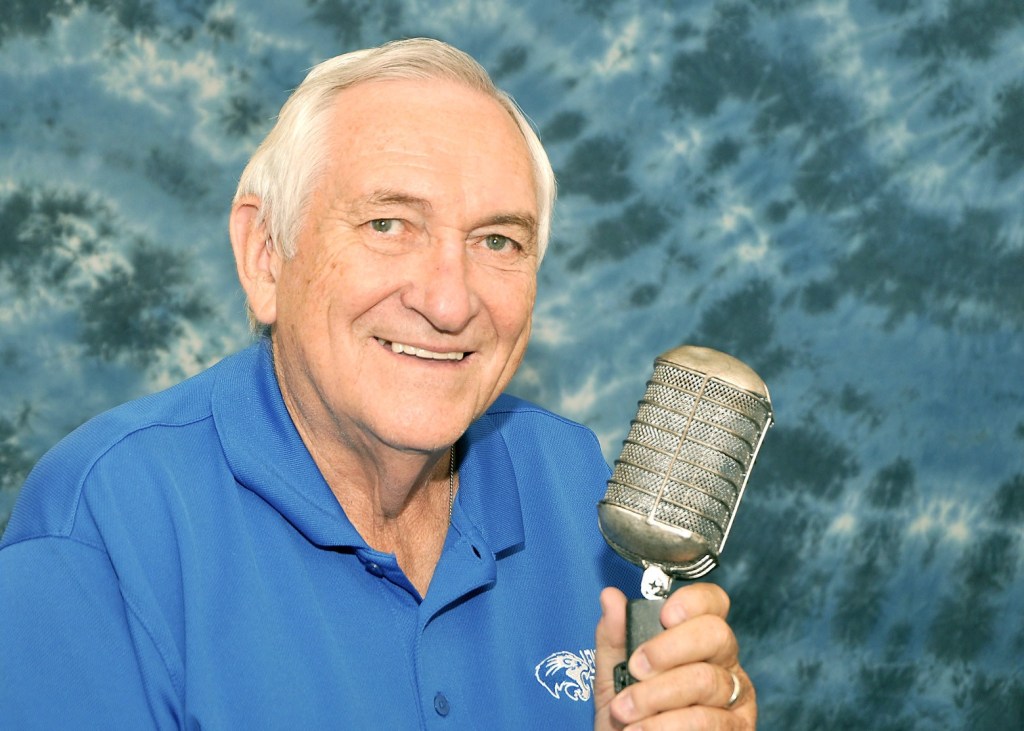
Gary Kidwell was an icon in Lewis County, serving the school system and community for decades. (Photo by Dennis K. Brown, Lewis County Herald)
“Our region has lost a media icon, the Lewis County Lions have lost their biggest fan and best coach, and I have lost a childhood hero as a basketball girl in a neighboring county,” Said State Senator Robin Webb.
“Alice coached the Lewis girls when I played at East,” Webb adds. “They have been mentors, and friends since. I love the Kidwell family and send them love and prayers for comfort.”
Gary Roger Kidwell grew up in the Charters community, played for the Lions in the late 1950s and early 1960s, and later returned home to Lewis County after an early coaching and teaching stint at Millersburg Military Institute.
Beginning in the mid-1960s, Gary taught and coached at Lewis County High School, serving as head basketball coach, head baseball coach, assistant football coach, and later athletic director for nearly two decades.
His baseball teams won hundreds of games, a 10th Region championship and a state quarterfinal appearance in 1977, as well as multiple district titles and an Eastern Kentucky Conference championship.
Lewis County Yearbook Photo of Coach Gary Kidwell.
His basketball teams brought home three straight 62nd District championships in the late 1970s and helped restore pride in Lions basketball. He was instrumental in reviving the football program and helping build up Little League baseball in Lewis County.
After stepping away from the bench, Gary found new ways to serve the sports he loved. He became a respected baseball and softball umpire, working district, regional, and state tournaments and earning recognition as Kentucky High School Umpire of the Year.
He later served as Commissioner of the Eastern Kentucky Conference and as a member of the KHSAA Board of Control, helping guide high school athletics well beyond our county lines.
Gary’s lifetime of work earned him induction into the Kentucky High School Athletic Association Hall of Fame, the National High School Athletic Coaches Association Hall of Fame, the Lewis County High School Athletic Hall of Fame, and honors from his alma mater, Morehead State University.
Those plaques and certificates tell part of the story, but they do not fully capture the late nights, long bus rides, and countless hours he invested in our kids and in this community.
For many in Lewis County, though, the most familiar part of Gary’s legacy was his work behind the microphone and in these pages. Since the mid-1970s, he served as sports editor of The Herald, writing his weekly column, covering games, and keeping alive the memories of decades of Lions athletics.
Each Saturday morning, listeners tuned in to WKKS to hear him talk with coaches and players, swap stories, share scores, and shine a spotlight on local student-athletes.
Gary Kidwell during a timeout in his coaching days.
LCHS Principal Jack Lykins said, “For younger people Gary Kidwell is known as the guy on the radio every Saturday morning. For the majority of us, we know him as coach, athletic director, voice of the Lions, friend and ambassador. No matter where you went in the state, if you told someone you were from Lewis County you always got this response: ‘How is Coach Kidwell doing?’ Those in my generation will always call him ‘Coach.’”
I first knew Gary as a student in the 1970s. Like so many others, I watched and learned from him long before I ever worked with him. Later, as an owner and manager of WKKS and publisher of The Herald, I had the privilege of working beside him for many years.
I learned that Gary never stopped working for the kids of Lewis County. If there was a Lions game being played, he wanted to know the score, who played well, and how their efforts could be recognized.
He had an acute sense of humor and must have known thousands of jokes and one-liners. We shared many long road trips, and we passed the time with sports talk and an endless trading of jokes. One particular trip to cover a game in Indianapolis stands out, several hours each direction of jokes, stories, and more jokes. And he still had more in reserve.
George Plummer, longtime family friend, shared, “I am sad to learn that my friend, the old right hander, Gary Kidwell, has rounded third and headed for home. I always enjoyed all the jokes he could tell. He has attended more ballgames than anyone I can think of. Rest in peace, my friend.”
Mike Edington, close friend and longtime media assistant, said, “Gary was a great friend who has given me many good times going to different sports events. It’s hard to say goodbye to someone who has given me so many good memories.”
Chris Perry, a friend and longtime supporter of West Carter athletics, said, “Our region has truly lost another icon. When you thought of Lewis County basketball, you thought of Gary Kidwell. He poured his heart into coaching the Lions, and when his time on the bench ended, he carried that passion straight to the radio table. He gave himself not only to his own community but to the entire region. I truly enjoyed every conversation we shared. My heart breaks for his wonderful wife, Alice, and their family. There’s comfort in knowing he’s now reunited with Merle.”
Tammy Underwood Alburg, former standout basketball player and coach, reflected on Kidwell’s impact: “I wonder if he ever knew that his own impact went far beyond the edges of the court. He touched my life in so many positive and profound ways—offering wisdom, mentorship, friendship, and laughter. Coach Kidwell really and truly is the poster child for one of a kind. Thank you for the positive impact you had on my life, Coach. Tell Merle I said hi.”
Jimmy Lykins, who was coached by Kidwell and later served as LCHS athletic director said, “He was an ambassador for the youth and Lewis County Athletics wherever he went across the state of Kentucky. He will be remembered for his love of athletics and the ability to connect with people wherever he went. He will leave a huge hole in the hearts of Lewis Countians.”
Local leaders also recognized the magnitude of the loss. Judge Executive George Sparks said, “Lewis County lost a true champion for our young people with the passing of Gary Kidwell. For decades, Gary poured his heart into our schools and our community. Generations of student-athletes knew that if they worked hard and represented Lewis County with pride, Gary would be there to tell their story. We are grateful for his lifetime of service and the example he set.”
Gary had a way of making people feel seen. He celebrated the big wins and the quiet, everyday efforts—the role players, the bench, the coaches, the clock keepers, and the folks who swept the gym floor. He encouraged young people to work hard, represent Lewis County well, and carry themselves with pride.
He loved his family deeply. Gary is survived by his wife of 61 years, Alice Kidwell, and by two daughters, Stacy Kidwell of Morehead and Tai Kidwell Hieneman of Flatwoods. He was preceded in death by their son, Gary Merle Kidwell, who passed away on July 18, 2023.
For all his awards and honors, Gary remained grounded in the place he called home, living just across the highway from Lewis County High Schoo, the Home of the Lions. He often said he was blessed to spend his life doing what he loved—coaching, teaching, umpiring, broadcasting, and writing about sports—and to do it right here in Lewis County.
He never forgot where he came from, and he never stopped giving back to the community that supported him.
“I will always remember Gary as a person who loved Lewis County sports,” said Bill Tom Stone. “He spent years coaching young kids and spreading the word about Lewis County sports everywhere he went. His impact on our community is greater than most will ever realize.”
Lewis County has lost an icon, a teacher, a coach, a broadcaster, and a friend. We have also lost a man who believed, week after week and season after season, that our young people and our community were worth showing up for.
“Gary Kidwell was a Lewis County icon,” said Pastor Tom Cox. “He will be remembered most for his contributions to sports, but he was equally successful as a family man, a valuable church member and a positive influence in his community.”
On behalf of The Lewis County Herald and WKKS, we are honored to have worked beside and along with him. Our thoughts and prayers are with his family, his former players, his colleagues, and the countless people whose lives he touched.
Services will be at 1:00 p.m. Saturday, November 22, 2025, at Vanceburg Christian Church with Pastor Tom Cox Jr. officiating. A fellowship dinner will follow prior to traveling to the burial service at Mound Cemetery in Piketon, Ohio. Visitation will be at the church after 9:00 a.m. Saturday.
Arrangements are under the direction of Gaydos Funeral Home in Vanceburg.
Obituary for Gary Kidwell, 1943-2025
Gary Roger Kidwell, 82, of Vanceburg, passed away peacefully Saturday, November 15, 2025, at Vanceburg Hills, following a long battle with dementia.
A lifelong Lewis Countian, he was born September 20, 1943, at Stricklett, a son of the late Marcus E. (Shirley) Kidwell and Thelma Sapp (Jess) Gulley.
After graduating from Lewis County High School in 1961, Gary pursued a career in education at Morehead State University, earning Bachelor’s, Master’s, and Rank I degrees. While at MSU, Gary met and married his wife of 61 years, Alice Nelson Kidwell, on September 6, 1964.
Gary began his teaching and coaching career at Millersburg Military Institute in 1965. In 1967, he was given the opportunity to return to his home in Lewis County and continue his career, where he would serve the students and athletes of Lewis County Schools for 50 years.
During his time with the Lewis County Schools, “Coach” served in numerous roles. He started out teaching and coaching basketball and baseball and was integral in reviving the football program at LCHS. He later served as athletic director for many years, representing Lewis County on numerous state and national boards. Many Lewis County alumni remember him as the comical driver’s education teacher as he fearlessly taught many young students and members of the community to drive.
Anyone who knew Coach knew his passion for all things sports. He loved his Lewis County Lions, Kentucky Wildcats, Cincinnati Reds, Cincinnati Bengals, and Morehead State Eagles. His dedicated following of his favorite teams led to his long-time interest in sports media. This afforded him countless opportunities to attend and cover games on local, state, and national stages. He was honored to have the chance to cover his Wildcats in bowl games, SEC and NCAA tournaments, the Reds in the World Series, and the MLB All-Star Game in Cincinnati.
But he was most proud of his local media efforts that he used as a platform to promote local student athletes. Gary hosted a weekly sports radio show, “Saturday Morning Sports,” and wrote a weekly sports column in The Lewis County Herald, “Kidwell’s Korner,” and was the “Voice of the Lions” on WKKS Radio for more than 50 years.
If you attended a Sweet Sixteen basketball tournament in the last 60 years, you were sure to see Gary in attendance sharing stories, jokes, and memories with long-time friends from across the state.
Through his many years of service to the sports world, Gary was honored to receive several cherished awards, including induction into five halls of fame: KHSAA–Dawahares Hall of Fame, KABC Court of Honor, NHSCA Hall of Fame, Morehead State University Alumni Hall of Fame, and Lewis County High School Athletic Hall of Fame. He was also named KHSADA Athletic Director of the Year in 1995 and was a top-5 finalist for National Athletic Director of the Year. Gary also enjoyed umpiring softball, advancing to call multiple state championships. A highlight of Gary’s summer for many years was umpiring at the Mike Borders Beagle Classic. He also spent 26 years as commissioner of the Eastern Kentucky Conference.
Aside from sports, Gary’s greatest loves were his children and grandchildren. You could often find him cheering them on from the sidelines, no matter the sport or activity. He was always proud of their accomplishments and never shy to brag on them to others. He always loved the annual Kidwell family vacations and was guaranteed to provide plenty of content for hilarious stories for years to come.
He was the king of one-liners, always cracking a joke and lighting up a room with laughter. Even into his last months, he was attempting to deliver his famous punchlines with a smile on his face.
Gary was of Christian faith and was a devoted member of Vanceburg Christian Church, serving as a deacon for many years.
Survivors include his wife of 61 years, Alice Nelson Kidwell; two daughters, Stacy Anne Kidwell of Morehead and Tai Kidwell Hieneman (Keith) of Flatwoods; one daughter-in-law, Mandy Kidwell of Flatwoods; six grandchildren, Carson Kidwell, Kate Kidwell, Alex Kidwell, Selah Kidwell, Claire Hieneman, and Jack Hieneman; two brothers, Barry Gulley (Cindy) of Whiteburg, Georgia, and Mark Kidwell (Monica) of Pensacola, Florida; four sisters, Tonia Berry (Charles) and Ginger Miller (Gary) of Flemingsburg, Dana Hammonds (David) of Hebron, and Tara Reed (Brian) of Lexington; and his uncle Kenneth Sapp, who was like a brother to him.
In addition to his parents, he was welcomed into Heaven by his beloved son, Gary “Merle” Kidwell, and his grandparents, Hanson and Maggie Sapp and Ashel and Rosa Kidwell.
Services will be at 1:00 p.m. Saturday, November 22, 2025, at Vanceburg Christian Church with Pastor Tom Cox Jr. officiating. A fellowship dinner will follow the service at the church prior to traveling to the burial service at Mound Cemetery in Piketon, Ohio. Visitation will be after 9:00 a.m. Saturday at the church.
Arrangements are under the direction of Gaydos Funeral Home in Vanceburg.
As Gary said and wrote for many years, “This is the old right-hander saying, ‘Have a good week in sports!’”
Steve Dodd, a former Ashland Tomcat basketball standout and a respected high school and college coach, passed away Monday from injuries sustained in an automobile accident last month. He was 70.
Dodd starred for the Tomcats from 1971–73, serving as a key reserve on the 1972 team that was ranked No. 1 in the state but was upset by Russell, 80–75, in the 16th Region championship. Fittingly, 34 years later in 2006, Dodd guided Russell to its first regional title since that very season.
During his six years as the Red Devils’ head coach from 2002–08, Dodd compiled a 98–84 record and reached at least the 16th Region semifinals in five of those seasons before resigning.
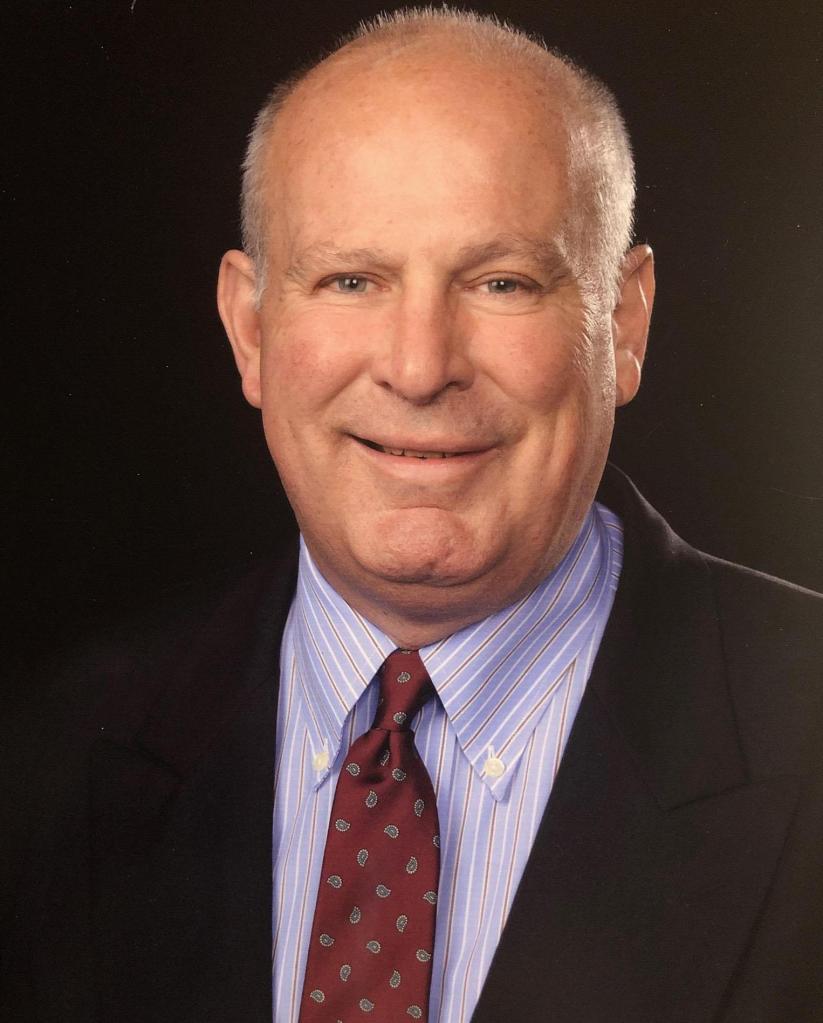
Steve Dodd was a former Ashland Tomcat basketball standout and Hall of Fame NAIA coach.
A 1973 Ashland graduate, Dodd went on to earn a bachelor’s degree in English from Lipscomb University, where he was also a standout player. It’s also where he met Kay, his wife of 48 years. They had a son and daughter.
Soon after graduating, he began his coaching journey as an assistant at Battleground Academy in Franklin, Tenn.—the start of a nearly 50-year coaching career. Dodd’s coaching stops included Alderson Broaddus University, Oklahoma Christian University, Bethel College, and Lindsey Wilson College, where he led the program from 1998–2002 and enjoyed great success. His contributions to the sport earned him induction into the NAIA Hall of Fame.
After his time at Russell, Dodd took over at Hillwood High School in Nashville, leading the Hilltoppers from 2008–19, and most recently coached at Dickson County High School in Dickson, Tenn.
Dodd’s passion for the game went far beyond wins and losses. He was known for shaping young men both on and off the court—a fact reflected in the many heartfelt tributes shared by former players and colleagues Tuesday.
Todd Parsley, who served as Dodd’s assistant coach at Russell, told sportswriter William Adams of the Ashland Daily Independent that coaching alongside him was a privilege.
“I don’t think people knew how much he cared about his players,” Parsley said. “He had kids that would run through walls for him because I just saw the personal side of coach. When kids were having trouble with their home life, he was there helping them. He was far greater than just wins and losses.”
Dodd’s brother, Gary, said coaching was Steve’s lifelong calling. “He had 11 fractured ribs, four fractured vertebrae, and a bad concussion, but when he heard that, it was like, ‘I can pursue this, I can do that,’” Gary said. “He wanted to get back out there at age 70 and have another shot at trying to do that, even for the interim.”
As a player, Dodd was known for his toughness and scoring ability, averaging 15.8 points per game as a senior. That year, Ashland fell to Boyd County twice—first in the 64th District finals, 77–73, and again in the regional championship, 73–64, despite Dodd’s 21- and 22-point efforts. It was the first time Boyd County had beaten Ashland in basketball.
Dodd finished his Tomcat career with 669 points, including a career-high 27 against Fairview.
From his days wearing Ashland’s maroon and white to his decades molding athletes across the country, Steve Dodd left a lasting mark on basketball—and on everyone he coached.
Clint Wheeler, remembered as a “gentle giant” and one of Ashland Tomcats’ best big men of the 1960s, died Thursday at age 77.
Standing 6-foot-7, Wheeler was a dominant presence for the Tomcats from 1963 to 1966, scoring 1,297 points in three seasons — still among the top 20 in program history. As a senior, he helped lead Ashland to the 16th Region championship and a trip to the Sweet Sixteen, where the Tomcats fell to Louisville Male in the quarterfinals.
Wheeler was also part of what many still consider the greatest game in Ashland Invitational Tournament history — a double-overtime, 94-91 loss to No. 1 Louisville Male during his junior season. Hopes for a rematch at state were dashed when Mt. Sterling upset Ashland, 56-53, in the 1965 regional final — a stunning loss marked by uncharacteristic poor shooting and costly turnovers in the closing minutes.
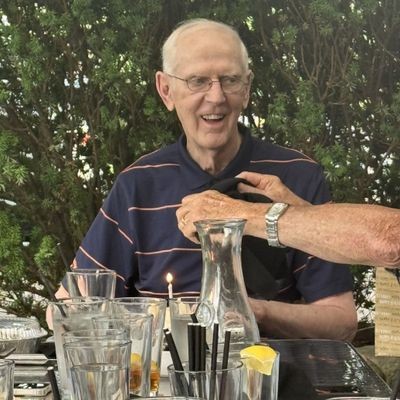
Clint Wheeler was signed by Kentucky after a stellar career at Ashland in 1966.
At the time, Ashland was ranked fourth in the state and considered a strong contender for the championship under coach Bob Wright, who left for Morehead State after that season.
As a high school senior, under coach Harold Cole, Wheeler averaged 18.2 points per game, finishing with 18 in his final outing — an 82-63 loss to eventual state champion Louisville Male. He had 29 points in the regional semifinals against Rowan County and 21 in the championship win over Russell.
Rupp signs pair of Tomcats
The next year, Wheeler and teammate Benny Spears, a transfer from GreenupMcKell, led the Tomcats back to the top of the region. Both later signed scholarships with legendary UK coach Adolph Rupp — one of only three times Rupp recruited two players from the same high school class.
Clint Wheeler during his playing days at Kentucky.
Neither saw much playing time in Lexington. Spears departed early, while Wheeler stayed despite playing behind UK great Dan Issel. Though his minutes were limited, Wheeler remained part of a top-ranked 1970 Kentucky team that was upset by Jacksonville in the NCAA Tournament. His time in Lexington also helped forge lifelong friendships and professional connections.
A ‘gentle giant’ remembered
Bill Lynch, Wheeler’s teammate and classmate, remembered him fondly: “He was a gentle giant, a great guy, good friend and teammate. Too bad he played behind Mr. Issel.” Lynch’s younger brother, Bob, was a sophomore that year and went on to star for Alabama after breaking into Ashland’s starting lineup after the AIT.
Family ties and faith
Wheeler came from a family deeply connected to the University of Kentucky. His brother, Bill, played football for UK under Paul “Bear” Bryant, and his father served as a UK economics professor. Clint earned his bachelor’s degree from the university before building a successful career in pharmaceutical sales. He also served in the Kentucky National Guard until 1973.
According to his obituary, Wheeler cherished attending UK games with close friends and former teammates Terry Mills and Stan Key.
A devoted husband, father, grandfather, and Christian, Wheeler was a longtime member of Church of the Savior in Nicholasville. He is survived by his wife of 56 years, Carolyn; their son Joshua (Alison); and four grandchildren.
A celebration of life service will be held Tuesday, Nov. 11, at Church of the Savior, 1301 Brannon Road in Nicholasville, with visitation from 10 to 11 a.m. and services beginning at 11.





 MARK MY WORDS 2