Former Tomcat football coach Mike Manley dies at 69

Mike Manley, who in his only season as head coach at Ashland in 1980 began a turnaround to a great era of Tomcat football, died Wednesday from heart complications in Naples, Florida.

Manley, 69, had been teaching math at a private school. He suffered a heart attack in a Publix grocery store, was rushed to the hospital but later passed away, according to friends.

He was coaching at Bullitt Central when he applied for the Tomcat coaching position in the winter of 1979. Ashland had suffered three consecutive losing seasons after the first half of the decade had produced some of the Tomcats’ greatest teams under Herb Conley, who took an administrative position after the 1976 season. The natives were restless to say the least.

Manley was a quarterback for Mt. Sterling High School in 1967 where he teamed with receiver Don McReynolds on a team that was the Class A runners-up. He also shared a birthday with McReynolds, who he talked into coming to Ashland with him to coach.

Mt. Sterling defeated McKell and Don Gullett in the 1967 playoffs, with Manley returning a punt for the winning touchdown during a 21-13 victory, and then the Trojans lost to Bardstown 20-13 in the Class A championship – the game before the Tomcats defeated Elizabethtown in the Class AA championship game in Louisville.

Manley left after one season at Ashland to become the offensive coordinator and quarterbacks coach at Morehead State. He was only 29 at the time.

McReynolds, who had been at Fleming County before coming to Ashland, went on to coach through the 1989 season with the Tomcats as an offensive coordinator. Manley’s staff kept only one coach from Mike Holtzapfel’s staff and that was Vic Marsh, who he made the defensive coordinator.

When Manley left for Morehead in the late spring of 1981, Marsh was handed the reins of the program. It turned out to be a great move with Marsh winning more games than any coach in Ashland history. He led the Tomcats to the 1990 state championship which was the last title until the 2020 team broke through in December.
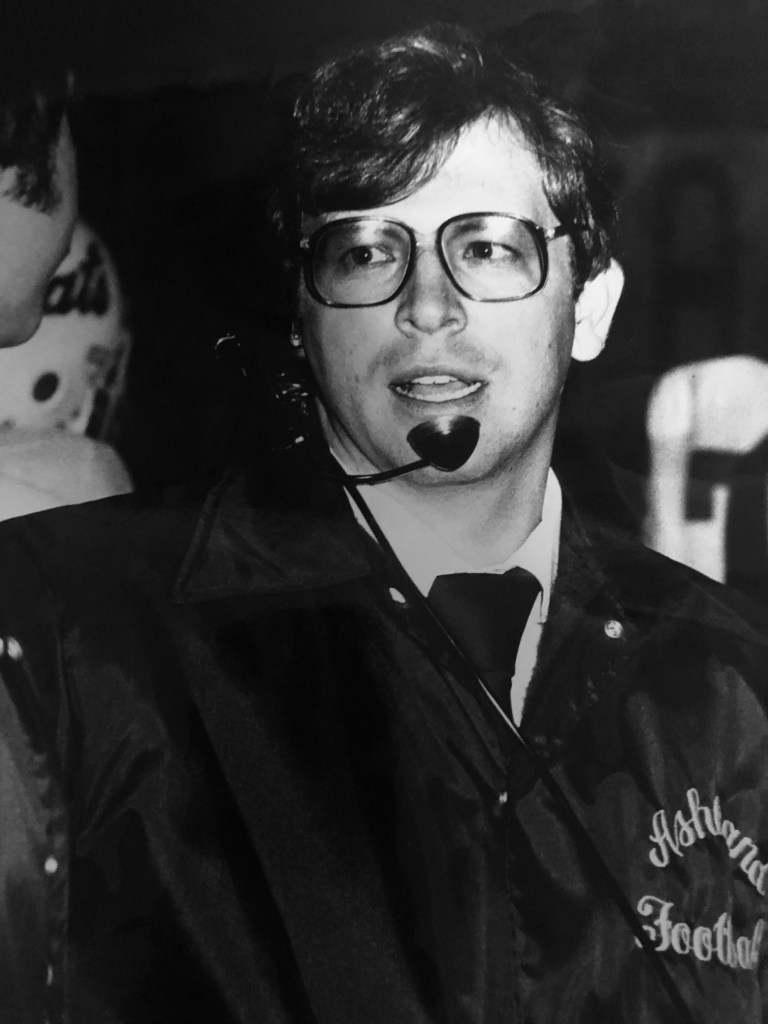
Mike Manley led Ashland to a 9-4 season and into the Class 4A quarterfinals in 1980, his only year as head coach.

Manley also hired Randy Heaberlin, a line coach who also had a long and successful career with the Tomcats as an assistant coach.

Coming off a 1-9 season in 1979 and consecutive 3-7 seasons in 1977 and 1978, the Tomcats needed something positive to happen and Manley became the answer, introducing a wide-open attack led by junior quarterback Scott Crank (1,127 yards passing, 516 rushing) and halfback Dave Hall (1,353 yards, 11 TDs). The 1980 Tomcats also included future major league pitcher Drew Hall, who had 24 catches for 302 yards, lineman Tony Consiglio, future Tomcat quarterback Greg Conley and hard-running Paul McPeek (563 yards, 8 TDs).

“The players loved him,” McReynolds said. “It’s a lot like it is now with Tony (Love). They liked his style.”

The change in culture led to a 9-4 season that ended with a 21-6 loss to Henry Clay in the quarterfinals of the Class 4A playoffs.

McReynolds said Manley called him in December and invited him to come to Ashland to watch the Ashland Invitational Tournament when high-scoring Ervin Stepp and Phelps were playing the Tomcats.

“I told him, ‘We won’t be able to get tickets’ and he said ‘Don’t worry about that,’’’ McReynolds said. “So I told him I’d go with him. He also told me Ashland had a head coaching opening and he might apply for it. I said, ‘They’ll never hire you.’”

Manley left for a meeting in the first quarter of the first game and didn’t return until the fourth quarter was starting, McReynolds said. “He told me he was going to apply and he was going to get the job. He asked me if he did, would I come with him. That’s what brought me to Ashland.”

McReynolds was the offensive coordinator with a seat in the press box but Manley was offensive-minded and liked calling the players.

“I remember the first game against Scott County,” McReynolds said of the 35-0 victory. “I was upstairs and didn’t get to call one play. He was calling everything. I came down after the game madder than a hornet. I told him if he was going to call all the plays, what am I supposed to be doing? I couldn’t get one play called before he’d already sent the play in. We came to an understanding. It got better as the season went along.”

Manley couldn’t resist the lure of coaching in college and when Morehead State called in the spring, he jumped at the opportunity. That opened the Tomcat door for Marsh, who had learned a lot himself coaching on the staff with Manley.

The Tomcats were back on track and winning became the norm under Marsh, who built on the coaching staff with Mark Renfroe.

Manley stayed at Morehead only one season before taking the head coaching position at Anderson College, where he played and graduated from in 1972. He coached at Anderson from 1982 to 1997 where he compiled a 68-86 record. He was named ISAC Coach of the Year in 1993 after leading Anderson to a 10-0 regular season and into the Division III playoffs.

He took a sabbatical from coaching in 1998 and resigned the following spring.

Manley came back to coach girls basketball at Montgomery County later in his career. He wasn’t coaching at the private school where he was teaching in Naples.

Remembering a friend to the end

When you go through life, they say you’re lucky to have even a few good friends.

Friends who understand you.

Friends who share your dreams.

Friends who you can remember tears streaming down your face because of something funny said or something sad that has happened.

I’ve been fortunate in my 63 years on this planet to have a lot of good friends. I have work friends, church friends, ministry friends, sports friends, all kinds of friends.

But 19 years ago on Jan. 17, one of my best friends ever left this world far too early.

I say that because Tony Curnutte was not only my friend. He was a friend to many others, too.

His death, so sudden and so unexpected, caught us all off guard.

It sent shockwaves through the newsroom at The Daily Independent, where Tony worked as a copy editor at the time of his death.

Tony Curnutte with his beautiful wife Karen. Tony died 19 years ago on Jan. 17, 2002.

It sent shockwaves through the religious community, because Tony preached and also took care of the Baptist Student Union at the community college.

It sent shockwaves through the entire community, because he was a beloved and memorable character.

Tony worked on the copy desk for two years but he’s better remembered for his time as a sportswriter, not to mention his quick wit and his rare ability to make you laugh until your sides split.

Jupe Holleran, the alter-ego he transformed to on prank phone calls, literally had us crawling under our desks.

Tony was a performer and he knew how to bring the house down.

He also knew Real Life, a life centered around a deep love of God and his adoring family, wife Karen and daughter Lauren who he loved to the moon and back, as they like to say these days. Tony always felt like he “married up” with Karen, who definitely knew she had a catch, too.

They were great together. Just great.

Tony was a Baptist minister and led the Baptist Student Union at ACTC for years, growing it from only a few people to a standing-room-only crowd nearly every week. Everybody loved Tony.

So when he died on that January day in 2002, a part of us all died with him.

No matter what I put my hands on, Tony was supportive of it. He looked up to me.  We had so much fun together and we had our serious moments, too. I knew him as someone who was a praying person and you can’t have too many friends like that. That was one of the traits that came from his parents, Watt and Connie, who made sure Tony and his sister were grounded in the faith.

We sang in church choirs together, played Strat-O-Matic baseball together, and he was essentially indoctrinated into part of “My Gang” who hung out in my basement. They were friends who gave nobody a free pass.

They called him Nute and that “life experience” with some of my crazy friends, along with his real-life job as a sportswriter for the newspaper, transformed this shy young boy who was afraid of his shadow into a powerful personality who became a missionary in his own hometown area.

And then he was gone. Taken far too soon.

Tony would be proud of how Karen has carried on and how his beautiful daughter has blossomed into such a lovely young lady. He would want your both to be happy in life and not grieve for him.

He would also be proud that Jupe Holleran’s name is still uttered with his own.

Tony loved to get a laugh and he wouldn’t want us crying over his departure from this place.

 If you ever knew him, you’d know that to be true.

 But you will be forever missed TC.

67 years ago, Bevo Francis lit up Ashland Junior College for 116 points

It was in 2012 that the late Clarence “Bevo” Francis’s record of 113 points against Hillsdale (Mich.) College in February 1954 at Jackson (Ohio) High School was broken by Division III star Jack Taylor of Grinnell when he put up 138 points in a game against Faith Baptist.

But Bevo’s 113-point game wasn’t even his best effort. That came against Ashland Junior College on January 9, 1953 when he scored 116 at Community Hall on the Rio Grande campus. That remains on the record books as the NAIA record. It was once the NCAA record too but the organization later decided it would only recognize games against institutions that granted four-year degrees, which AJC did not.

Bevo’s game against AJC brought his scoring mark to 50.7 points per game. He made 47 field goals and 22 free throws. Remember, of course, there was no 3-point shot. Here’s an amazing fact from that game: Bevo scored 55 points in the last 10 minutes after putting only “only” 61 through the first 30 minutes. No other Rio Grande player scored more than a dozen.

Two teammates of Bevo, both who have died, were local players Jack Gossett (Holy Family) and Jim McKenzie (Boyd County). They made sure Bevo got as many touches as possible.

Jeanette McKenzie, widow of Jim, once told me the former teammates always reunited at the Bevo Francis Classic in Rio Grande. Her husband is in the college’s Hall of Fame. “The team is reuniting in heaven,” she said.

Rio Grande went 39-0 in the 1952-53 season, Bevo’s freshman year, while averaging 50.1 points per game. Francis arrived as an unknown but soon took the team to national prominence.

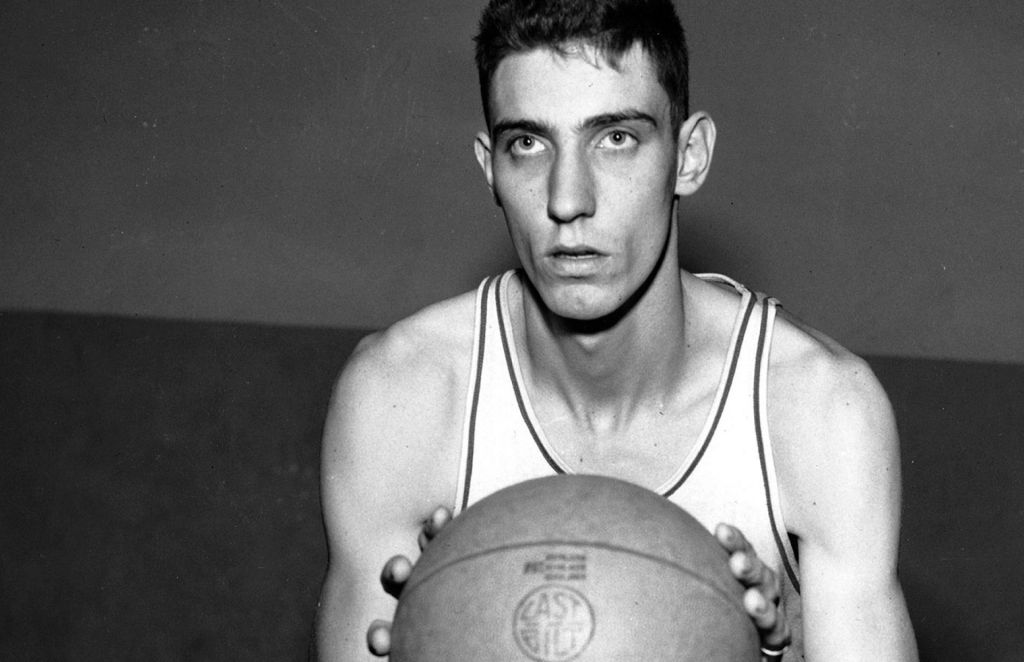
Clarence “Bevo” Francis scored 116 points for Rio Grande in a game with Ashland Junior College on Jan. 9, 1953.

They went on the road for 17 consecutive games after Bevo’s outburst against AJC, playing in several large arenas throughout the eastern United States.

The night after the big game with AJC, Rio Grande played Mayo State Vocational at Paintsville High School. Bevo scored 63 points in a 119-91 victory to set the scoring record at the Paintsville High gym that still stands today. J.R. VanHoose, a sports historian in the Big Sandy area, reported that in a story he wrote for The Daily Independent five years ago.

Rio Grande had a rematch with Ashland later in the season and the Redmen won the game although Bevo didn’t come close to the century mark. AJC “recruited” former Russell High School star “Long” John Thomas to defend him. They enrolled Thomas in classes and immediately got him working with the team.

Rio Grande broke the 100-point mark in 23 games and averaged 101.1 points per game while holding foes to 68.2. They won 39 consecutive games in that 1952-53 season.

Bevo, who died five years ago at the age of 82, was an AP All-American and he established NAIA records for field goals (708), free throws (538), points (1,953) and average (50.1).

Bevo came with coach Newt Oliver to Rio Grande after only one season of high school varsity basketball at Wellsville, Ohio. He averaged 32 points per game. Oliver had played at Rio Grande and was offered the job so he could bring Bevo to the school with him.

Bevo left after two years at Rio Grande to play professionally. He scored 3,272 points and the Redmen were 60-7 in his remarkable two seasons. Bevo outscored entire teams nine times in his career and never fouled out of a game; Oliver had told him to lay back on defense.

Oliver and Bevo signed a package deal with the Boston Whirlwinds, the touring team that played the Harlem Globetrotters.

 “Bevo was a great individual scorer, but he never failed to say that he couldn’t have scored a point if it weren’t for the fact that he had great teammates. He was always concerned about how Rio was doing and was a fantastic supporter for 60-plus years,” said Jeff Lanham, the AD at the University of Rio Grande.

In his second season with the then-Redmen, Bevo was enough of a celebrity that his coach took the Rio Grande program on a barnstorming tour that included trips to Villanova, Providence, Miami (Fla.), North Carolina State, Wake Forest and Creighton. Rio Grande also played in both Madison Square Garden and the Boston Garden. The money that the program received for those games helped keep the college out of financial ruin.

Here’s how big Bevo Francis was. Creighton actually postponed its game against Rio Grande after he was injured, giving the star scorer a chance to get healthy. He scored 41 points in a loss to the Bluejays.

Everybody came to watch Bevo score the ball, which he did like nobody else.

The case for 1975 JAWS Tomcats being called state champions

For the past 45 years, the Ashland Tomcats JAWS football team has endured the painful necessity of defending its 14-1 championship season.

By now, the fiercest supporters of the notion have developed a bit of a chip (boulder?) when the subject pops up when listing Tomcat championship seasons in stories or on t-shirts.

They defend it as fiercely as they did the goal line back in 1975 when it wasn’t safe to be an opponent in Putnam Stadium. It was one of the hardest-hitting defenses anybody could ever remember. Even some of the oldest old-timers, who played before facemasks were a thing, agreed that this team smelled blood in the water. Opponents were just so much chum.

“Those guys,” said the late great Ralph Felty, an All-State lineman from 1937, “they could play with us. Most of these teams, they couldn’t carry our jocks.”

Felty played when boys were men and talk was cheap. He knew tough when he saw it and this JAWS team was tough, the personification of their tougher-than-nails coach, 34-year-old Herb Conley, whose statue is on the Putnam Stadium concourse.

Their JAWS defense was named after the blockbuster movie of the same name. It seemed fitting and everybody was all about it. Even the band learned the dramatic JAWS song. You know the one, when the shark was about to attack. Duunnn dunnn… duuuunnnn duun… duuunnnnnnnn dun dun dun dun dun dun dun dun dun dun dunnnnnnnnnnn dunnnn. The newspaper did a feature on the defense and took photographs of the players holding the large movie letters on a hillside. Vintage stuff. It’s all part of the legacy.

These Tomcats, who put together the first undefeated regular season since 1958 and the last until the this season, were still practicing when the Reds and Red Sox were staging the greatest World Series ever played.

Ashland’s 14th consecutive victory – the most in school history in a single season – came on a cold November Friday night in Paducah, practically on the opposite end of our elongated state, in a 13-7 victory that came after Gary Thomas went off tackle and sped 85 yards for a touchdown to break a 7-7 deadlock in the fourth quarter. The game was so far away that the Tomcats chartered a plane for the morning of the game and then flew home the next day. It came with a $10,000 price tag that the Tomcat Boosters came up with in a few days.

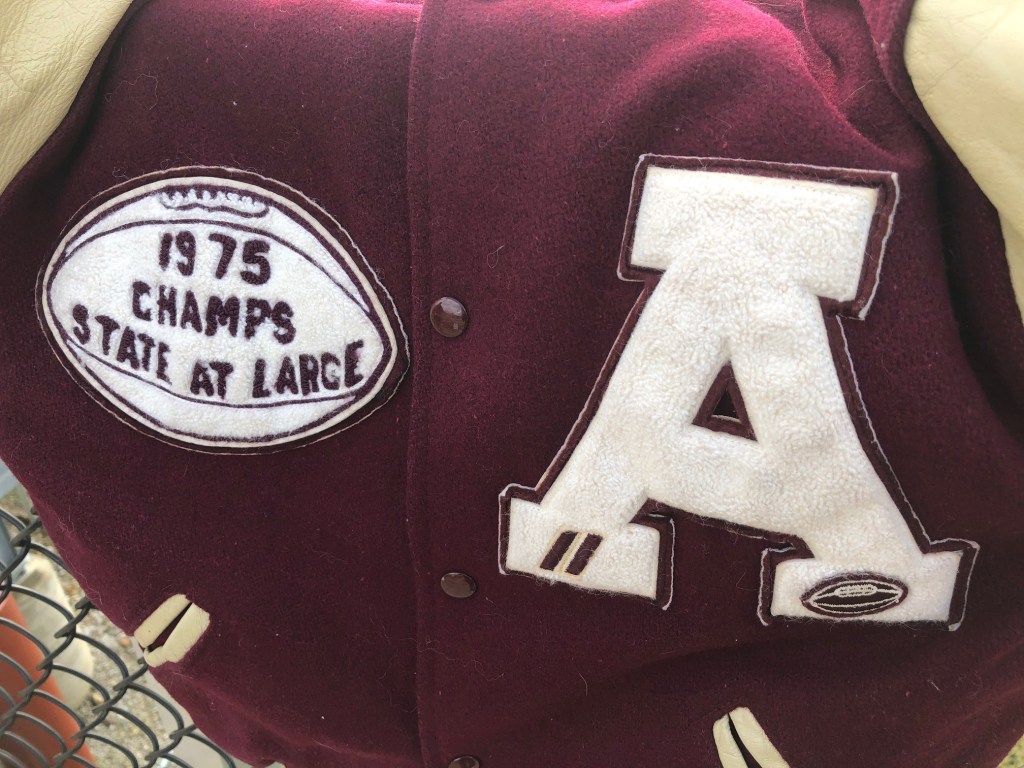
They needed an extra seat for the trophy on the ride home. It was shaped like the state of Kentucky and the brass plaque on the front read: KHSAA 1975 STATE AT LARGE CHAMPIONS.

The sportswriters of that day – not just in Ashland but those from Louisville, Lexington and Paducah – called it the 4A State championship game. St. Xavier won the 4A Jefferson County championship game. The showdown was set between the Tomcats and St. X.

The win over Paducah was the second of three playoff games on the road for Ashland despite being the highest ranked team among Class AAAA schools outside Louisville. The first postseason win came against Dixie Heights, located along the Ohio River in frozen northern Kentucky on one of the coldest nights anyone can ever remember, and then came the only home game of the playoffs, a win over Lafayette, before the trip to Paducah.

The Tomcats don’t apologize for losing 20-0 to St. Xavier – another road game, this one in Louisville – in the Class AAAA overall state championship game. They lost a numbers game as much as they lost a football game on that December afternoon in Louisville. Sure it hurt to lose, they had been conditioned to do nothing but win, and they played St. X as well as anybody had all season. But they were overwhelmed by numbers.

Conley said the Tomcats could have taken his top 15 against their top 15 and won seven of 10 games. But the odds were not in Ashland’s favor. St. X rolled out 104 players dressed in green-and-gold like the Green Bay Packers. They came out for pregame warmups and encircled the entire field while the Tomcats were warming up with about half that many players. St. X had a fresh 11 for offense, defense, special teams and it became too much, eventually wearing them down.

So what’s their argument? Didn’t they lose the state championship game?

Well, yes and no. They lost to St. X , yes, but there’s a trophy in the lobby of Anderson gym that has state champion on it that backs up their argument of being the State At-Large champion of 1975. The trophy doesn’t say semifinalist or state runner-up. It says State At-Large Champion.

Here is some background on making the case for calling the Ashland 1975 JAWS football team state champions.

Back in February 1975, the Board of Controls for the Kentucky High School Athletic Association met and a four-class system for football was put into place.

Class AAAA was the largest division and it consisted of the schools in Jefferson County, except for Kentucky Country Day and Beth Haven, and all other member schools with an enrollment of 1,000 or more in grades 10-12.

In northeastern Kentucky, three schools fit that formula – Ashland, Boyd County and Greenup County. Those schools formed a district and the champion – and only the champion – would advance to the playoffs.

From 1959 to 1974, the KHSAA used a three-class system. All schools in Jefferson County, which includes the state’s largest city of Louisville, were placed in Class AAA regardless of enrollment. The remaining schools in the state were in Class AA or Class A based on enrollment.

The change in classification to add Class AAAA in 1975 was the first time the Louisville schools would be playing somebody besides one of their own for the championship.

They made separate divisions in Class AAAA – a state at-large division that included every school except Jefferson County and another one for Jefferson County schools only. Those divisions would each come up with a state champion and then those champions would meet in a sort of Super Bowl of Kentucky, or what was called the overall Class AAAA state championship.

The Tomcats were the first team from within the state to play a Jefferson County/Louisville school in a championship football game.

The Class AAA crowns could belong to nobody except Louisville teams because nobody else in the state was in that classification except them from 1959 to 1974. For instance, when Ashland won the Class AA crown in 1967 over Elizabethtown, the Class AAA title that year went to Louisville Flaget, which defeated Thomas Jefferson 21-0. Could the 67 Tomcats have beaten Flaget? Maybe, but we’ll never know. They didn’t have to play them.

If Ashland’s 1975 season had stopped with Paducah for the Class AAAA State At-Large title, like had happened the previous 16 years in the playoffs, the Tomcats would have completed the perfect 14-0 season. Their legacy would be complete but the loss to St. X tainted the perfect season.

The quasi-four class system lasted until 1986 with the two separate Class AAAA champions. Greenup County was the State At-Large champion in 1977 and the Musketeers have a trophy to prove it as well after defeating Henderson County 13-12. They lost the falling week to Trinity, 28-7, in the Kentucky Super Bowl.

The Jefferson County champion won nine of the 12 “Super Bowls” before the system was changed again. Henry Clay defeated DeSales 20-7 in 1981 to become the first time the State At-Large champion won the overall Class AAAA championship.

Ten other teams, besides Ashland and Greenup County, were Class AAAA State At-Large champions or Class AAAA Jefferson County champions, but not the overall champion. They included Henderson County (1976), Tates Creek (1978), Henry Clay (1979), Paducah Tilghman (1980), DeSales (1981) Southern (1982), Owensboro (1983), Ballard (1984), Lafayette (1985) and Boone County (1986).

They didn’t win their last game, but they did win a state or Jefferson County championship – it says so right on the trophy – whether it’s “officially” recognized or not.  I realize it’s easier to have one champion for each classification for each year but that’s not how it was explained 45 years ago when Louisville and the rest of Kentucky began playing against each other for football championships.

Maybe, for history’s sake, it’s time for the KHSAA to add those pioneer Class AAAA State At-Large and Jefferson County champions to their own list somewhere in the record book.

As for how Ashland celebrates its own football heritage, let’s start adding 1975 to the list of state champions without apologies, asterisks or explanations. I mean, really guys, who doesn’t like a state champion?

Case closed.