A night they would never forget

(This is a chapter from the book Tragedy and Triumph about the 1967 Ashland football season. It was written in 2012).

The week of the state championship game was an exciting one in Ashland. The community was buzzing about the Tomcats as families began to prepare for Thanksgiving on Thursday and a trip to Louisville on Friday for the big game against Elizabethtown. It was an unusually damp and cold fall in Ashland and would continue to be in the days leading up to the finals.

Ashland was used to playing in the mud and muck with precipitation coming practically every Friday night throughout the season. The Tomcats were actually good “mudders” and some of the students thought they even played better in the mud.

“The muddier, the better,” said Cathy Goble, a senior majorette in the band. “I’ve never seen anything like it. It seemed like it rained every Friday night.”

Coach Jake Hallum was always big on family and he wanted to make sure the team was able to eat Thanksgiving dinner with their families on the eve of the state championship. They practiced early that morning, putting in some final game preparations and working on special teams, before being dismissed. The next day, he told them, they would eat a pre-game meal together at Paul G. Blazer High School at 11:30 a.m. and leave for Louisville around 1:30 p.m. It was about a four-hour drive to Louisville since the interstate didn’t yet come all the way to Ashland.

The Tomcats had a good week of practice and a lot of hype in the newspapers. Both teams maybe had to have a bit of a swollen head from the accolades that were being showered down on them from the opposing coaches.

Vince Hancock, coach of 12-0 Elizabethtown, called the Tomcats “the most underrated team the state has ever seen … they’re so big they could be mistaken for a college team. Belfry’s coach (Al Vipperman) told me Ashland is the best high school team he’s ever seen.”

Elizabethtown and Ashland were ranked only No. 8 and No. 9, respectively, in the final Associated Press regular-season poll. Obviously both the Panthers and Tomcats, a combined 24-1, came into the championship a bit underrated. There was only one poll in those days with all the classes combined. Most of the teams that were ahead of E-Town and Ashland were in the higher Class AAA division, which was made up of Louisville schools.

But nobody expected either of these teams to be in the championship game. It was shaping up as a dandy with Elizabethtown’s speed vs. Ashland’s strength. Hallum said E-Town reminded him of Harrison County except “maybe faster. They will probably be the best team we have played. They are a tremendous football team which does everything well.”

What the Panthers did best was utilize their skill players in a wide-open offense that was triggered by quarterback Gary Inman. E-Town was a big ahead of its time with a nice mixture of passing and running. Fullback-linebacker A.C. Thompson, a 5-foot-9, 185-pound senior, averaged five yards  a carry. He was considered the team’s best overall football player. While much of the attention was focused on a high-powered offense that averaged 37 points per game, it was the defense that was even more impressive. The Panthers had given up two touchdowns in a game only once all season, during a 55-12 victory over Shelbyville. Opponents averaged less than a touchdown in a dozen games.

Those were similar averages that Harrison County was putting up before coming to Ashland in the opening week of the playoffs. Hallum said the Panthers were even better than the Thorobreds, a team he said the Tomcats may have only beaten 1 in 10 times.

Inman was a three-year starter and two of the speedy backs, tailback Joe Welch and wingback David VanMeter, averaged 10 and 7 yards per carry, respectively.

E-Town’s soft schedule had come under some scrutiny but playoff victories over Henry Clay (30-0) and Mayfield (14-6) proved to most that it did belong in the finals. It didn’t matter what anybody thought anyway. The Tomcats and Panthers were in the championship game whether anyone thought they deserved to be there or not.

The talking was over. It was time to play.

On the day of the game, the Tomcat players started coming to the Blazer campus earlier than the 11:30 meal time. They were liked caged animals, ready for the long drive to Louisville and even more ready to play for a state championship. Only a few weeks earlier the Tomcats played Louisville Western on the road, winning 29-0. That successful trip was still fresh in their minds and put positive thoughts in their mind for the road ahead.

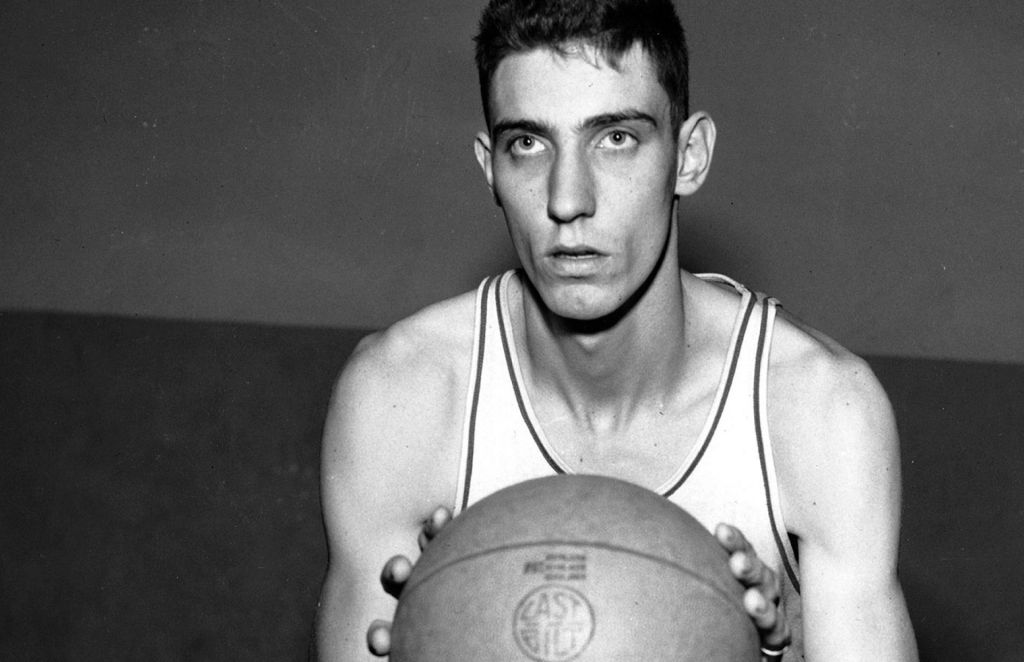
Little did they know that as they were arriving for the pre-game meal, the car accident that would take a classmate’s life had already happened. Joe Franklin was killed that morning around Farmer’s when the yellow Chevy Supersport he was driving collided with a truck. Franklin died at the scene and four other students  – three basketball players and a manager – managed to survive but were injured.

Franklin was popular in school and a former football player who had been the junior varsity quarterback in 1966 and even went to Camp Arrowhead in Hallum’s first season. He chose to quit football to concentrate his efforts on basketball, the sport where he excelled the most. Franklin most likely would have been a two-year starter for the Tomcats basketball team. They won the 16th Region title in what would have been his senior year of 1969 and reached the state semifinals.

The game plan was set for Friday night but the game plan for preparation would make some drastic changes after the coaches heard the tragic news about Franklin on a planned rest stop break in Mount Sterling. They talked about what to do and it was assistant coach Herb Conley who insisted they not tell the team the horrible news.

“It was definitely the right thing to do,” reflected Hallum nearly 45 years later. “It was tough to do, but it was the right thing. I remember being at the rest area. We told them we needed to get on to Louisville.”

While on the bus, only the coaches knew what had transpired. The players were focusing in on the task at hand. There was safety on the bus but once they unloaded, the coaches had to keep everyone with any knowledge of the accident away from the players. That meant nobody could be around them.

Once they pulled into the Fairgrounds Stadium, they hurried them to the locker room even though the original plan had been to watch the first half of the Class A championship game “to get a feel for the atmosphere.” That plan was out the window. If the Tomcats went into the stands, they would surely hear the news from fans who already knew. The assistant coaches guarded the door to the dressing room, making sure nobody got in. It was breaking news in Ashland even before the team left for Louisville but word didn’t travel instantly like it does today. There were no cell phones or Smartphones with text messaging capabilities, no instant access to the Internet – there wasn’t even an Internet at all. The coaches knew, if they were careful enough, they could keep the players focused on the game and away from the horrible news that could affect how they played.

Ashland’s team happened to be on the side of the Fairgrounds Stadium field that didn’t have stands behind it. Toward the end of the game, though, some fans lined up behind them and Hallum suspected that the news got relayed to a few players. Forty-five years later, several of the players said they had found out during the game.

However, even if they knew, it didn’t affect their play, at least not in the first half.

The Tomcats threatened to turn the state championship game into a rout by building a 19-0 halftime lead. The offensive line – center Bill Culbertson, guards Larry Johnson and Tom Lyons, tackles John Burton and Les Lyons and tight ends Jim Lyons and Russell Jones – were blowing open huge holes for Steve Scott, Tony Mulvaney and Paul Hill.

Hill, who had played sparingly since the regular season ended because of a knee injury, was back in the lineup and running strong again. Quarterback John Radjunas worked the ball-control offense to near perfection. The Tomcats ran 45 of the 62 offensive plays in the first half with short-yardage runs that kept the football out of E-Town’s hands.

Ashland liked nothing better than to ram the ball down the opponent’s throat. “Nobody could play power football any better than us,” Les Lyons said.

Scott, Hill and Les Lyons made pounding runs at the E-Town defense, which was almost helpless to stop the Tomcats, who had 177 yards rushing before intermission.

Ashland marched 59 yards on 13 players after taking the opening kickoff to assume control of the game. Hill’s 12-yard burst out off a block from tackle Les Lyons was a key play. Radjunas completed a pair of passes for 20 yards, including a 16-yard gain to Robbie Keeton, and scored the touchdown on a one-yard sneak behind the ever steady Culbertson. Hill’s extra point kick was to the left and the Tomcats led 6-0 with 7:48 left in the first quarter.

The play that Lyons brought in from the sideline was supposed to go to him but Radjunas changed it to a quarterback sneak. “When I first became a fullback, I fumbled a lot,” Lyons said. “When I was a junior, I got in against Catlettsburg to run the ball and dropped it twice near the goal-line. I took the play in and said, ‘Belly 6 Johnny.’ He said, ‘Oh no. We can’t take a chance on fumbling down here. Quarterback sneak.’’’

Ashland was on the move again on its second possession, this time driving 68 yards on 12 players to make it 12-0. Scott went over from six yards out on the option after left end. Hill’s kick for the extra point again sailed left. Meanwhile, the Tomcats’ defense was putting the clamps on a highly explosive E-Town offense. But mostly, the game of keepaway was what was keeping the Panthers at bay.

A 65-yard drive, this one on nine plays, brought Ashland its final touchdown just 1:29 before halftime. This time the Tomcats used some play-action passes for some big gains. Radjunas connected on a pair of passes for 32 years. The payoff was a 22-yard pitched to the speedy Mulvaney, who dashed to the end zone to make it 18-0. This time Hill connected on the extra point to make it 19-0.

The game was played in perfect conditions – at least as far as the Tomcats were concerned. It was a chilly and rainy night and players were covered in mud. Hancock believed the rain may have hampered E-Town during the first half. “The rain got us mentally down before we even started because we rely so much on our speed and quickness,” Hancock told reporters afterward. “We needed to pass to do well, but the kids just made up their minds in the second half to forget about the weather and play football. I’m proud of them.:

Ashland majorette Cathy Goble remembers coming out of her boots when it was stuck down in the mud. The but the game fit Ashland’s style perfectly. The Tomcats were doing what they do best – controlling the football and playing physically on defense.

E-Town’s first-half numbers were staggering: the Panthers had only three yards rushing and 16 passing.

But it was a different team that came out in the second half.

Elizabethtown got back into the game in a hurry, scoring two touchdowns in a 38-second span. From that point it was iup to the defenses in a championship game that had fans from both teams buzzing.

Safety Rick Ricketts ignited the explosion by returning an Ashland punt 48 yards to the 25 early in the third quarter. Inman, who was 1-for-8 passing in the first half, completed three for 16 yards on the short drive that ended when he swept right for a touchdown from four yards out. He also added the conversion run (then worth only one point) to pull the Panthers within 19-7.

The slippery football gave E-Town a huge break a few seconds later. The ball popped out of Scott’s hands while he was attempting to field the kick. It squirted forward and was recovered by E-Town’s Larry Daniels on the 35.

Ricketts gained 14 yards – the Panthers’ longest run from scrimmage – and Inman connected on a pass to Jim Hartman to the 10. The flanker took it the rest of the way in to complete a 21-yard touchdown play. Inman’s second conversion run made it 19-14 with 3:32 left in the third quarter.

E-Town had dominated the third quarter like Ashland had the first half, running 28 plays to the Tomcats’ nine in the quarter. The drama was just beginning.

The Panthers were on the move again early in the fourth quarter, going from the 50 to the Ashland 25. However, an Inman pass was intercepted by Hill on the 20. Hill said it was actually a wrong read on his part but when he turned, the pass came right to him and he cradled it softly. On the play prior, Radjunas had intercepted a pass but it was nullified by a penalty.

“I was pretty discouraged then,” Radjunas told The Courier-Journal after the game. “But Hill saved us on the next play.”

Hill said he was expecting a screen pass, which the Panthers had executed perfectly in two earlier scoring drives. “But I just cut across the field and there was the ball. I just tried not to drop it. It was like a gift from heaven.:

The clock showed 10:36 remaining at that stage and that’s when Ashland launched its last time-consuming march. While it didn’t result in points, it did chew up most of the time. The Tomcats grudgingly gave up possession on the E-Town 10-yard line with only 1:53 remaining.

Inman, who was 15 of 25 for 151 yards in the second half, completed three passes for 34 yards but the big play was one that goes down statistically as an incompletion. But it could have been a game-changer or probably a game-winner.

With the seconds running out and the ball on Elizabethtown’s 30, fleet-footed Joe Welch managed to get completely behind the Ashland secondary on the latter’s 35. Inman had time to throw but the pass, which had touchdown written all over it, was overthrown by about five yards. It felt harmlessly incomplete and the Tomcats – and especially Radjunas, who had been beaten on the play – breathed a sign of relief.

“This is the greatest win I’ve ever had,” Radjunas said. Then he rhetorically asked, “What did Coach Hallum do to change Ashland into a power? He created enthusiasm in our football program. Before we came down there, there were signs all over town encouraging us.”

Jim Lyons, the fine blocking tight end, was thrilled to have a part of the championship, too. “We set our goal to win this thing two years ago when Coach Hallum first came to Ashland. It’s hard to believe it’s ours now.”

With that, Hallum called all the players over to huddle up around him and then told them the grim news about Joe Franklin’s death. The celebration that had ensued on the field and spilled into the dressing room was finished. There was nothing but stone silence, except for the shuffling of cleats on the concrete floor as the Tomcats took off their uniforms, some for the last time.

They had won the game they wanted to win but a friend’s shocking death made it all seem so hollow.

It would indeed be a night they would never forget.

Tomcats put on memorable performance

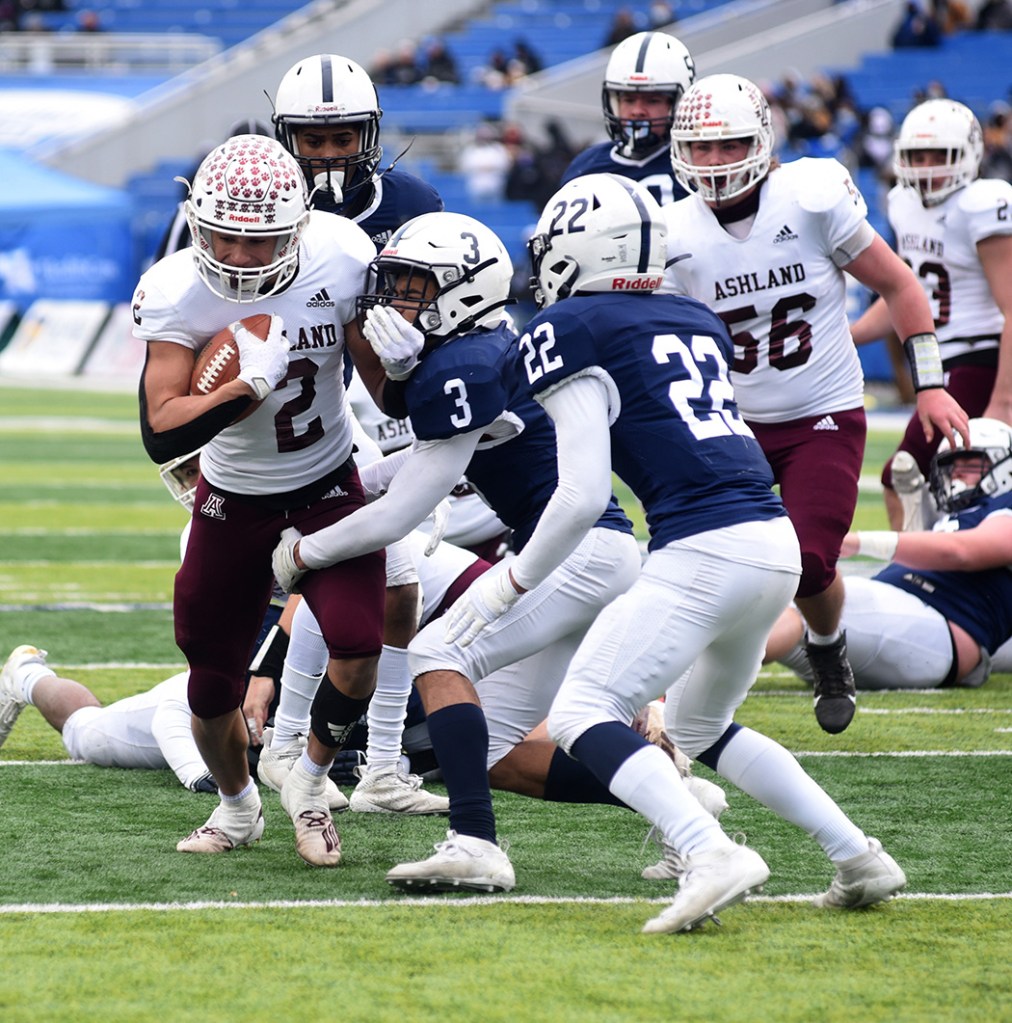
In a year when COVID has taken so much from us, the Ashland Tomcat football team gave so much back.

They overcame every foe and a pandemic.

They are going back to the state championship game for the first time in thirty long years when one of the greatest backfields in Ashland history was simply the best team in Kentucky in 1990.

Now we have another team who will be compared with the great ones in Tomcat history.

Ashland had some outstanding teams over the past 30 years and they have supplied a lot of enjoyment to the fans who show up on Friday nights for what has become an community tradition. You go to the game even if you never know who won. That’s because most of the time it’s the Tomcats who do win. They have 21 consecutive victories in Putnam Stadium after Friday night.

But this year was different. Not many fans were allowed in Putnam Stadium and for those who dared to come, your temperature was taken and your mask in place before walking through the gates. The Tomcats, like everybody else, played in front of practically empty stadiums every week. When they traveled, they did so in multiple buses because social distancing was necessary. They wore masks all week, stayed in their “bubble,” stuck together and overcame opponents and a pandemic. Games were cancelled when an outbreak – or even one player – tested posted for COVID. And many wondered if this season was even going to finish.

And then it did. They persevered like no other team in Tomcat history has ever had to persevere. They did everything they could to stay healthy and clear of COVID. And now they’ve made history, with one more step to go next Saturday morning against Elizabethtown in the Class 3A state championship game.

My advice to Ashland’s players going into the semifinal game with Belfry on Friday night was “to be memorable.” You don’t want to go through all that they’ve been through with COVID and not be remembered. The c-word they want to be known for is champion.

The Tomcats took a step in that direction Friday with a 10-3 victory over Belfry in a game that would delight any defensive coach. It was Big Boy football on a big stage and the Tomcats are most certainly unforgettable now.

Every Ashland team that has won in the final four stage – and even the 88 team that lost in the semifinals – were dominant on defense. That has been the secret sauce.

–In 1967, Ashland shut out Belfry 42-0 in a wipeout.

–Ashland’s 1972 team defeated Bryan Station 21-6 in one of the hardest-hitting games anybody can ever remember.

–The 75 JAWS team went across the state to defeat Paducah Tilghman 13-7.

–The 88 Tomcats, a 17-point underdog, held Covington Catholic scoreless through regulation before losing 6-0 in overtime.

–And the 1990 team, despite some great running ability, needed a huge stop late in the game to subdue Bell County 19-14.

Defense wins championship. It’s true and it got these Tomcats to the championship game, too.

Seeing the joy on the faces of the players and parents on the field following the game Friday was something special. It reminded me of 1990 when everybody in Ashland seemingly stormed the field after the Tomcats clinched the first trip to the finals in 15 years.

The only difference Friday night? A lot more selfies – they weren’t a thing in 1990 – and the fans weren’t allowed to swarm the field. I was surprised they minded all-star PA man Chuck Rist’s announcement, but they sure did (maybe he has more clout than I thought?). They continued to cheer from the stands and there was a lot of them in Putnam Stadium – and the vast majority had their cheers muffled and glasses fogged with masks.

Ashland is going where only four other Tomcat teams have ever gone next Saturday morning at Kroger Field. They join the 1967, 1972, 1975 and 1990 teams as state finalists. The next step will be to join 1967 and 1990 as winners of the ultimate prize in Kentucky high school football.

But there’s more. These Tomcats can finish undefeated and that hasn’t happened since Herb Conley and Dick Fillmore were running up and down the field in 1958 for a 10-0-1 team.

Ashland won the Recreation Bowl in the last game of the season in ’58 and that was it as the season ended. The Kentucky High School Athletic Association started the playoff format the following year.

So it has been 62 years since the last unbeaten team and 78 years since the last undefeated AND untied team. That would be the 1942 Tomcats, who are regarded as a state champion in Ashland history anyway.

The heroes were so many on Friday night they could have handed out game balls by the dozens. I wouldn’t know where to begin.

Except for one person: Tony Love. The Tomcats’ head coach now joins some elite company beside Jake Hallum, Herb Conley and Vic Marsh. Now that’s a club worth admiring.

Congratulations Tomcats, one more to go.

#BeMemorable

Tomcats can find motivation, lessons for success in their past

This is an anniversary season for Ashland Tomcat football.

Thirty years ago, a team directed by coach Vic March steamrolled through opponent after opponent en route to a 14-1 record and the Class AAA state championship.

Forty-five years ago, a team with the nickname “JAWS” terrorized football fields throughout the state en route to the Class AAAA State At-Large championship.

Five years ago, Ashland’s 2015 football team was given the privilege of a step back into the time capsule when about a dozen members of the JAWS team and Coach Herb Conley paid a visit to the locker room before the Tomcats took the field to play George Washington.

Coach Herb Conley addresses Ashland’s 2015 football team before a game against George Washington. His words ring true today as the Tomcats prepare to take on Belfry in the 2020 state semifinals in Putnam Stadium.

West Point grads Greg Jackson and Chuck Anderson spoke first to the Tomcat players who were dressed and ready for action. They talked about commitment and unselfishness and how they’d practically give their left arm for another chance to play in Putnam Stadium.

Anderson, who served 32 years in the military and rose to the rank of general, commanded attention quickly when he immediately told them to “Put your eyes on me.”

Nobody was looking down, shuffling feet or doing anything but listening to “The General” offer advice and make wishes of his own. “What I wouldn’t give for one more game …”

Jackson told them that three running backs were there — Gary Thomas, Jeff Slone and himself — and how their favorite part of the game was blocking for each other. It didn’t matter who got the yards as long as the job got done, he said. It was the lesson on unselfishness.

Jackson’s short speech was good, showing the kind of discipline that has served him well on the football field and throughout life to a management position at Marathon.

Lessons were learned in football and applied in life.

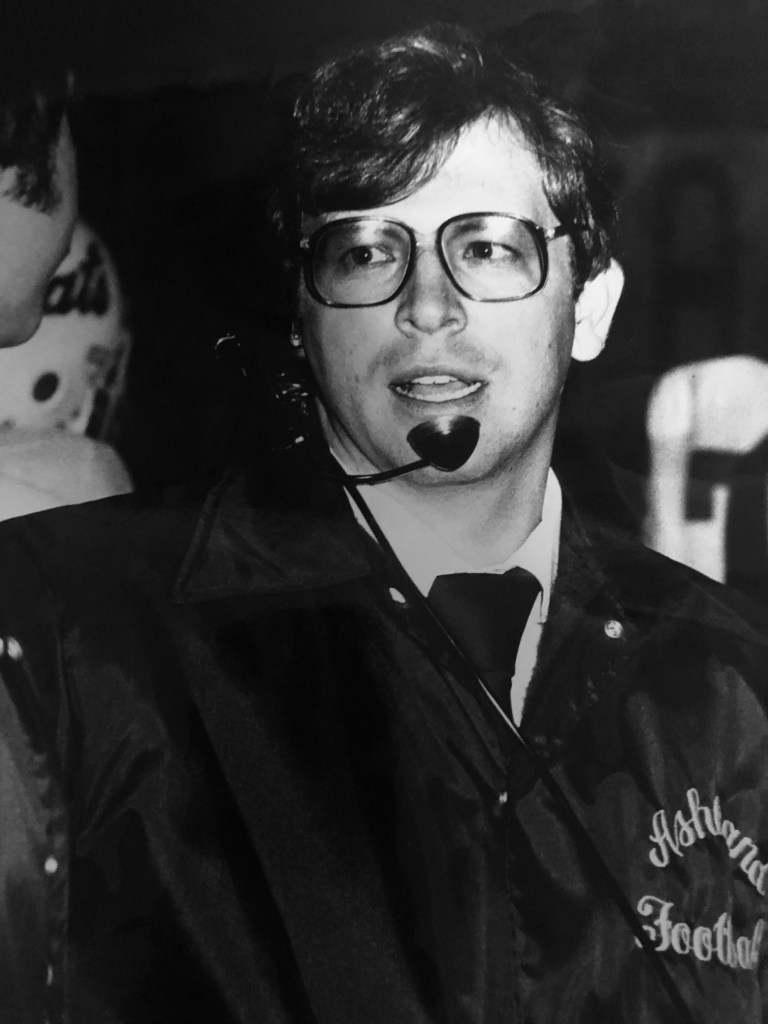
But when it came Coach Conley’s turn to address the team it was clearly a throwback to 1975 when the fiery coach took this JAWS team to the top of high school football in Kentucky. Those Tomcats took on the attitude and character of their coach and these Tomcats could take a lesson from their playbook.

You can ask anyone who heard him: Coach Conley still has that competitive fire burning in his belly, he has the mannerism that motivators possess and that desire to bring out the best in people with a single sentence or look.

The roomful of Tomcats didn’t take their eyes off him — they wouldn’t dare — as his speech grew louder and louder and louder. When Coach Conley talks, he does it with his eyes too and when the eyes began to squint and the wrinkle came out above the bridge of his nose, I knew this giant of coaching was back in form. It may have been 39 years ago — his last year of coaching at Ashland was 1976 — since Conley addressed a group of Tomcats before a game.

It was surreal watching this man who is so admired and idolized by his former players deliver a message to this young Tomcat team. He is old enough to be a grandfather to most of them but what was coming from inside of him was pure blood-and-guts coach. I wish every team in the area had the opportunity to hear him.

His JAWS players were standing behind him and sweat was starting to bead up on their own now (mostly) bald heads. They’d gotten all lathered up before by similar messages from Coach Conley before football games and you could almost see the fire building inside them with every word he spoke.

“I was ready to go out and run sprints,” Jackson said.

“He had me ready to play,” said Terry Bell, the best defensive player in Kentucky in 1975.

The last thing he told them: “I believe in you.”

With that, the team stood up in unison, clapping and yelling as the JAWS Tomcats exited the locker room with their coach.

I hope it’s a moment they remember and treasure and don’t take for granted. Ashland’s version of Knute Rockne was in the house one more time.

Maybe the 2020 Tomcats can learn a lesson from this as well as they prepare to make history Friday night against Belfry.

Tomcats only semifinal loss came in epic 1988 performance

Ashland has a record of success when making it to the final four of the Kentucky high school football playoffs.

In state semifinal games, the Tomcats are 4-1 overall and 3-1 in Putnam Stadium since the playoffs were introduced by the Kentucky High School Athletic Association in 1959.

That one loss back in 1988 remains one of the greatest ever played in 83-year-old Putnam Stadium. Covington Catholic came to Ashland with a No. 1 ranking and 12-1 record. They left – make that escaped – with a 6-0 overtime victory and a healthy respect for Tomcat football.

Putnam Stadium was the site for four of Ashland’s five previous semifinal appearances.

Covington Catholic was a prohibitive 17-point favorite, a northern Kentucky powerhouse that came in with a slick passing attack that devoured opponents. Nobody gave the Tomcats much of a chance.

What happened on that cold November Friday night in 1988 was, well, chilling, the stuff of goosebumps and legends. The Tomcats battled the Colonels to a scoreless tie in regulation before dropping the tear-your-heart-out loss in overtime. While a haunting defeat for the 1988 Tomcats of coach Vic Marsh, it’s one of the classics of Putnam Stadium. It remains one the fans still talk about today.

Those Tomcats didn’t listen to the pre-game lunch-counter talk. These Tomcats may want to stay off social media this week.

The game with Covington Catholic in ’88 was supposed to be a mismatch. The Colonels were high-powered with quarterback Paul Hladon expected to make it look easy for the defending state champions.

If Ashland had any chance, it would be because of a battering-ram offense that had carried the Tomcats most of the season. It included running back Mike Johnson, who that season would become Ashland’s all-time leading rusher.

But on this night, it was a defense designed by assistant coaches Don McReynolds, Steve Salyers and David Arthur that befuddled the Colonels. It was a mix of zone looks and was predicated on a fierce pass rush. And it worked. An uncomfortable Hladon completed only 4 of 22 passes for 28 yards. It wasn’t all Hladon’s fault. Some of his throws were rushed but his receivers also dropped many passes after some jarring hits from Ashland’s secondary, namely Jason Hall and David Hicks, who had two interceptions and made an early statement with a thunderous hit on a receiver who dared to come over the middle on the first play.

By the end of the game, the receivers were hearing the footsteps of Hall and Hicks when a football was thrown their way.

Marsh’s coaching trademark was preparation, and it was the most prepared Tomcat team that I can ever remember. They were ready and they were motivated to win, not just play a good game against a team that frankly had superior talent. That kind of mental preparation was the only way the Tomcats were going to compete with Covington Catholic. They weren’t the more talented team, so they had to be the more physical team. Friday’s game with Belfry with be another test of toughness for these Tomcats.

Mark Maynard


Marsh’s coaching trademark was preparation, and it was the most prepared Tomcat team that I can ever remember. They were ready and they were motivated to win, not just play a good game against a team that frankly had superior talent.

That kind of mental preparation was the only way the Tomcats were going to compete with Covington Catholic. They weren’t the more talented team, so they had to be the more physical team. Friday’s game with Belfry with be another test of toughness for these Tomcats.

Hladon left the game knowing the Colonels were fortunate to go home with a victory. “I’ll tell you, Ashland Paul Blazer deserved to win,” he said.

The game may be the most exciting scoreless football ever played in Putnam Stadium.

Zeroes dominated the scoreboard but on the field there were blocked punts, blocked field goal tries, a touchdown called back by penalty, long runs, big losses, passes dropped, passes intercepted, fumbles, a goal-line stand, critical penalties, great decisions, bad decisions and gutsy decisions.

The only score came on Dan Ruh’s 10-yard run on a draw play in overtime.

Ashland had taken possession first in overtime and got to the four on two runs by Mike Johnson before Hicks, the quarterback, was dropped for a two-yard loss. That left it up to Charlie Johnson’s foot and Roger Werner blocked the sophomore’s 22-yard field goal try.

When Covington Catholic took possession for its overtime opportunity, Charlie Johnson chased Hladon back to the 23 and looked to have him corralled for a sack when the quarterback flung a pass out of bounds in the vicinity of a receiver.

On the next play, Ruh went up the middle, did some stutter steps to avoid the first wave of tacklers, cut left and went into the end zone.

Ruh, excited with the win, spiked the ball. The officials threw a flag, but unless it was going to be marked off on the kickoff of the state title game, it was meaningless.

Ashland’s players stood frozen on the field and it wasn’t because of the November chill. Their emotions were chilled. This roller-coaster ride of a game was over.

Ashland had its chances to win the game in regulation with only seconds remaining. Stopped at the Covington Catholic 12 with only nine seconds to play, the Tomcats called a timeout. Johnson tried a 27-yard field goal that was slightly wide left, but an illegal procedure penalty gave the Tomcats a five-yard setback but another try for the win, much to the protest of the Colonels’ sidelines. Again though, Johnson’s kick, this time from 34 yards out, was wide left and regulation ended 0-0.

Covington Catholic had a chance in the fourth quarter, but a goal-line stand by the Tomcats kept the shutout. The Colonels had a first-and-goal from the 3-yard line. The first two plays were one-yard gains and then fullback Chris Penn was stopped twice for no gain. Ashland’s fans in the end zone went wild. Everybody who was at this game was into the game. For the Tomcat fans who had invested so deeply, that’s what made losing so much tougher.

But the 1988 state semifinal game, even though a loss, will be forever remembered by those same fans.

Covington Catholic went on to repeat as state champions, defeating Paducah Tilghman 30-24 in overtime.

Two years later, the sophomores on this Ashland team, including Charlie Johnson, would win a 19-14 semifinal game with Bell County in Putnam Stadium on the way to the 1990 state championship.

Ask them today and they’ll proudly tell you about both games, each considered an epic in Ashland’s proud history.