John Tuttle, who was an assistant coach on Ashland coach Herb Conley’s last two staffs in 1975 and 1976, died Tuesday in Indialantic, Fla. He was 76.
As a young man in his early 20s, Tuttle’s 40-year education journey started in the Ashland Independent School System. He coached football for seven years in the Ashland system, starting at Putnam Jr. High and advancing to the high school level in 1975 when the Tomcats beloved JAWS team went 14-1. He also was on the staff in 1976 during a 9-3 season and stayed on when Mike Holtzapfel took over the head coaching reins at Ashland from 1977-79.
He was also a highly respected high school basketball referee in Kentucky, many times partnering with Bill Burch.
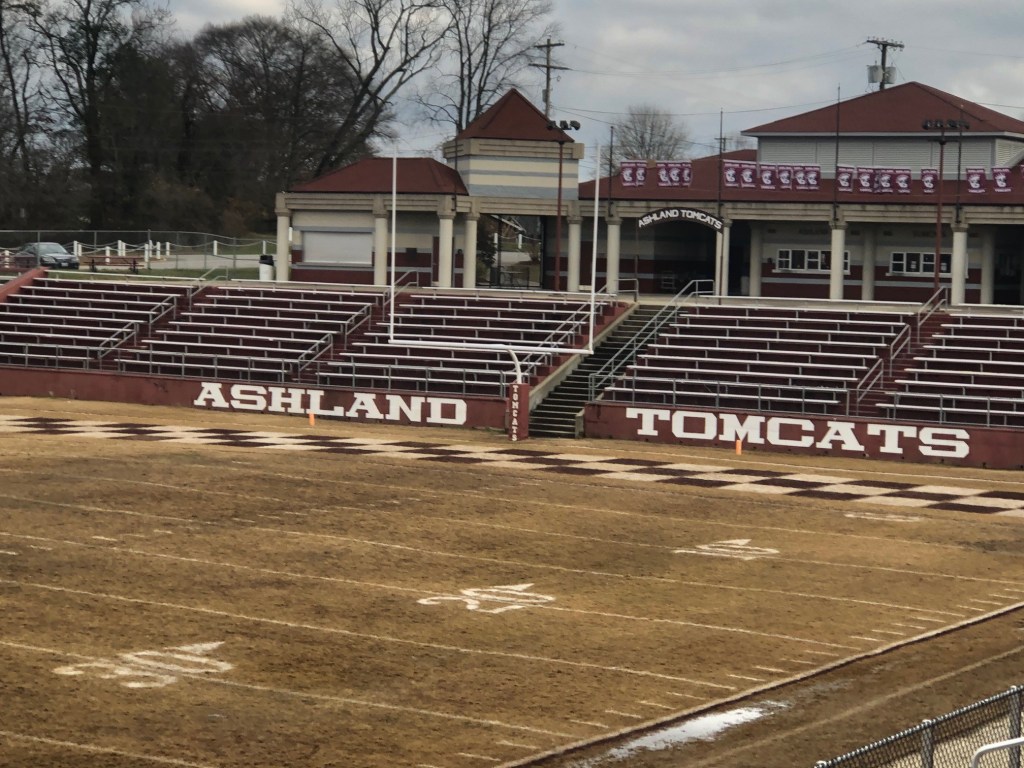
Putnam Stadium, home of the Tomcats.
Tuttle was lured to Florida by friend John Thomas, a former star baseball player at Ashland, in 1980. Thomas was coaching in Florida and Tuttle followed him there to coach football and baseball at Palm Bay High School where he became the assistant principal in charge of discipline.
He would stay in education for 40 years and won a state championship in the Sunshine State in baseball in 1985 for Palm Bay.
He was also an assistant principal at Cocoa Beach High School and was a principal at Mila Elementary, Southwest Middle School and Bayside High. He was instrumental in designing Heritage High School before retiring after four decades in education.
Tuttle keep officiating basketball and appeared in several Florida state championship games as referee. Also, an avid golfer, he could shoot his age and share a hole-in-one plaque with his son, Lance, and grandson, Cole, at Spessard Holland Golf Course.
He was from Winchester, Ky., and was married to his high school sweetheart, Karlene, for 55 years. Tuttle is survived by his wife and son and 10 grandchildren.
Services are Tuesday at Melbourne Church of Christ in Melbourne, Fla.
Mason Branham was the constant in the landscape of Greenup County sports. He was the Everywhere Man, showing up seemingly at several places at the same time with camera and notepad in hand and a pen or pencil behind the ear.
Yet he was also unassuming, wishing to remain far from the spotlight and he blended in like the orange in Raceland uniforms. He reserved the spotlight for Greenup County’s young athletes, the one man they could all rally around and appreciate. It mattered not who won or lost, if you were boy or girl, if your team was good or bad. Mason was there, snapping photos, taking notes, making memories.
Anybody who ever played anything in Greenup County knew Mason, the Everywhere Man. There may have been a game-winning touchdown in Raceland and a game-saving tackle in Russell at the same time yet, somehow, someway, Mason had a photograph of both plays. He was uncanny that way.
Mason Branham, a longtime weekly newspaperman in Greenup County, died last week at 76.
It was with much sadness that I read of his recent passing. It closed another chapter on weekly newspapers. If there was ever a Hall of Fame devoted to weekly newspapermen, Mason would have surely been a charter member. I’m not sure how many years he crafted his trade while working first in Carter County and much of his career in Greenup County at weekly newspapers, but he was around when I started at The Daily Independent and when I left the ADI in 2018 and the area in 2022, doing his thing better than anybody ever did. He is irreplaceable.
We had a great relationship, with a lot in common. Both of us loved what we did (and I still do). But I’m not sure anybody anywhere loved what he did more than Mason Branham. It was never for personal praise though. He did not put bylines on his stories or credit lines on his photographs. He was just there. Reporting at meetings, keeping statistics at games and providing thousands upon thousands of photographs of those events over the years.
Mason marched to his own drumbeat, that’s for sure, but he had a love for Greenup County like few others and the schools in that area should put him in their hall of fames posthumously. He deserves that much.
I had many conversations with Mason and he was always enlightening and extremely smart. I did not realize until reading his obituary that he was the valedictorian at Olive Hill High School in 1966 and knew so much history about Carter County and Greenup County. Mason could have done a lot of things in life but he chose journalism, or maybe it chose him. Either way, it was a love affair for a lifetime.
He did not get rich or famous working for weekly newspapers but that was never a goal for him. Mason was there for the pure joy of it, for the chase of getting that key photograph or for writing about that game-winning play. He was a welcome sight at any gymnasium, football field, baseball field, soccer pitch, Little League game or anything else when he arrived with camera, notepad and a pen behind his ear.
Mason was also a man of strong faith and he regularly delivered meals for Greenup County Meals on Wheels. He did that job without fanfare too because he was not doing it for recognition but to be a servant. His life was full of servant-like activities. Members of Beech Street Christian Church are serving as pallbearers. That says a lot about the man as well.
Mason will be laid to rest this week but his kindness and good deeds throughout an illustrious career will not be forgotten by the lives he touched from behind the lens. Whether it was the photographs from the County Fair or the countless Little League games, or the meals that he carried to households of senior citizens, Mason was there.
Before leading the Ashland Tomcats’ football program to 78 victories in 10 seasons from 2003-2012, Leon Hart spent a dozen years in propelling the Eastern Kentucky University offense as an assistant coach under legendary Roy Kidd that included the 1979 and 1982 national championship seasons and the 1980 and 1981 national runner-up seasons – an incredible four-year span illustrating EKU’s dominance in Division I-AA.
Hart is one of seven individuals who will be inducted into the EKU Athletics Hall of Fame on Oct. 11 at the EKU Center for the Arts.
Hart coached wide receivers, running backs and quarterbacks, and then served as offensive coordinator from 1981-88. While he was an EKU assistant, the Colonels won two national titles (1979 and 1982) and finished as the national runner-up twice (1980 and 1981). Hart also helped EKU make the playoffs in 1983, 1984, 1986, 1987 and 1988.
In 1985, EKU missed the playoffs, but the team went 8-3 and closed out the season with 45-21 rout of Louisville. The Colonels compiled an overall record of 120-37-2 in his 13-year stint on the staff, which included eight OVC titles to go along with the two national titles and two national runners-up finishes.
Leon Hart guided Ashland to 78 victories in 10 seasons as head coach.
He came to the Tomcats in 2003 and put high-tech offenses on the field throughout his tenure where he had six seasons of nine victories and made the playoffs in all but one of his 10 seasons.
Hart led Ashland into the state quarterfinals in 2003 and 2004. Three of his last four seasons with the Tomcats resulted in nine victories. He had a 9-9 record in the postseason while often being matched against northern Kentucky powers.
Hart finished his Tomcat coaching career with a 78-40 record, which is the third-most victories in Ashland history behind Vic Marsh (112) and Tony Love (81).
Besides his elite coaching ability on the football field, he was also a tremendous special education teacher in the Ashland school system.
The 2025 EKU HOF class includes: Soufiane Bouchikhi (track/cross country, 2010-14), Billy Burton (men’s basketball, 1968-72), Ernest Dalton (track/cross country, 1959-63), Leon Hart (football, 1976-88), Leanna Pittsenbarger (softball, 2012-15), John Revere (football, 1972-76) and Mark Sandy (administration, 2005-15, 2019-20). The entire 2004-05 women’s basketball team will be inducted as a team of distinction.
Leon Hart’s teams at Ashland from 2003-2012 were prolific and wide open on offense. The Tomcats were regular postseason participants.
This fall one of Ashland’s most beloved and feared football teams will celebrate a golden anniversary.
Ashland’s 1975 JAWS team struck fear in opponents throughout the state with a defense that lived up to its nickname.
Elks Sports Day honoree Greg Jackson, who is best known as a community champion and the ramrod behind the rebuild of Putnam Stadium, was an outside linebacker on the famed defense that led to a 14-1 season.
Jackson was a two-sport star for the Tomcats, also serving as a captain and starting third baseman on consecutive regional championship teams.
Even after suffering a broken foot in the first game of the football season, a game where he fought through the pain in the first half and rushed for 95 yards and a touchdown against Johnson Central. His foot swelled up so much at halftime he could not stand. He came back four games later, returning to the outside linebacker position on defense but was used less on offense.
Greg Jackson, left, gets a hug from Steve Conley, who worked beside him during the rebuild of Clark’s Pump-N-Shop Putnam Stadium.
Jackson’s speed and strength made him a natural for outside linebacker in the 4-4 scheme.
Although his carries were limited because of the foot injury, Jackson still rushed for 350 yards and was second on the team in yards per carry at 8.1.
Jackson was replaced in the backfield by Jeff Slone, who went on to have a 1,000-yard rushing season on a team that also had a 1,700-yard rusher in Gary Thomas and a bulldozing fullback in Jay Shippey. The quarterback, Chuck Anderson, doubled as one of the toughest middle linebackers in the state.
Jackson was still used in the backfield and had some valuable runs during the Tomcats’ playoff stretch including a touchdown against Lafayette in a 21-6 victory. He put Ashland ahead 7-0 on a fourth down, four-yard scoring run in an eventual 13-7 victory over Paducah Tilghman in the Class AAAA State At-Large championship game in Paducah.
Thomas broke a 7-7 deadlock with a 74-yard scamper late in the fourth quarter that put Ashland in the Class AAAA Super Bowl against Jefferson County champion St. Xavier.
Rick Sang hauls in a touchdown pass. He was one of the top athletes on the 1975 JAWS team starting both ways and punter on the way to being selected All-State.
“There were a lot of what ifs in that Paducah game,” Jackson said. “As coach (Herb) Conley has said to me, ‘I remember that play because the first three times (assistant) coach (Bill Tom) Ross wanted to run it up the gut and we weren’t getting anything.’ And a great call, Chuck had the fake to Gary and the linebacker would at least be stymied for split second. We were strong to our right and I knew it was going left. I see the end zone. It’s clear halfway between the pitch and the end zone. I feel like something just trips my foot. I got the video about 15 years ago. I always thought, and never knew for sure, until I looked at the video. When I looked at it, the defensive end got sucked in to Chuck, which is why Chuck pitched it to me. That’s the option. The defensive end recovered, and he dove and did swipe the bottom of my foot.” But Jackson made it to the end zone for his third touchdown of the season and second in the postseason.
That was the first year that the Kentucky High School Athletic Association instituted the Super Bowl type setup for the state’s largest class. The State At-Large champion, which included the biggest schools in the state outside of Louisville, played the Jefferson County champion for the overall Class AAAA title. Both Ashland and St. Xavier have trophies that say state champion, but St. Xavier has another one with overall champion in 1975. The KHSAA lists them as the sole champion in 1975. They scrapped that setup after eight years.
Terry Bell was a force on the offensive and defensive lines for the Ashland JAWS team in 1975. He was first-team All-State and named the top lineman in the state.
The Tomcats missed some scoring opportunities in the first half and still played St. Xavier to a near deadlock. The Tigers led 7-0 at the half and their depth – St. Xavier had separate offensive and defensive units – was simply too much to overcome and Ashland fell 20-0 in Louisville. St. Xavier’s strong senior class had not lost since they were freshmen.
Whether state champion or not, the beloved JAWS team remains one of the favorite and best remembered teams in Tomcat history. Coach Conley, who was an assistant on Ashland’s 1967 Class AA state championship team, said this to reporters after the game in 1975. “You can say whatever you want to, but this has just been a great year for us. These kids have given their all. They have done everything we have asked them to do. I think they’re better than the state champions of 1967. We beat everybody in the state but Louisville, and we didn’t have to play Louisville in ’67.”
In baseball, the Tomcats were regional champions in Jackson’s junior and senior seasons. He was inducted into the CP-1 Hall of Fame in 2022.
A born leader who graduated from the U.S. Military Academy at West Point in 1980, Jackson is also a community champion who has served on countless boards and is a leader at his church. Jackson also played on freshmen football and baseball teams at West Point. He served six years in the Army after graduating.
He went there with classmate and teammate, Chuck Anderson, a past Sports Day honoree, who went on to a career in the Army that saw him rise to become a Two-Star General. Anderson will introduce Jackson at the Sports Day banquet on June 14 at the Elks Lodge where tickets are on sale for $30. The event is open to the public, not just Elks members, which is a popular misconception. Mark Maynard, also a former Sports Day honoree, is the featured speaker.
Beyond playing, Jackson served as an assistant coach for Ashland Kittens softball for eight seasons, including six regional champions, and was president of the Tomcat Band Booster Club for one year and active for eight years when his daughters were in band. He also was a youth softball, baseball, football, and basketball coach when his three children were young.
All that while working 34 years in Human Resources with Ashland Oil and Marathon Petroleum Corporation and serving on a dozen community boards.
However, his claim to community fame may be the long hours and dedicated work he did as the chairman of the Putnam Stadium Restoration committee from the beginning in 2008 to the completion last fall.



 MARK MY WORDS 2