Darryl Smith will be remembered for all the right reasons

The news that Darryl Smith had died while taking his morning walk on Monday was hard to process. He was a former Ashland Tomcat two-sport standout about the time I was trying to figure out this sportswriting business. I’ve written numerous stories about him through the years when he was an athlete, a coach and a highly successful college basketball referee. I always considered him a friend.

Darryl Smith during the 2019 CP-1 Hall of Fame induction in Ashland’s Central Park.

He was an outstanding athlete in baseball and basketball and an even better person. He came from good stock, and one of the best Tomcat families in history. The late John and Rhoda Smith had five sons – David, Doug, Darryl, Daniel and Deron – and the Ashland community benefitted from having this fine family in the area for reasons far beyond sports. People like the Smiths were building blocks of great communities.

Darryl was a crafty left-handed pitcher, and he turned around at the plate and batted righthanded. He was good at both. He also was on back-to-back 16th Region basketball championship teams in coach Paul Patterson’s first two seasons as head coach.

But baseball was where it was for Smith, who went to Cumberland College to pitch.

After college, Smith signed on to coach Mike Tussey’s inaugural Stan Musial team in 1982 and played every summer through 1986 where he was a dominating pitcher and first base with a powerful bat.

Smith delivers his speech at the CP-1 Hall of Fame in 2019.

He hung up playing for coaching as he became a mentor for baseball players in Boyd County when he coached Catlettsburg Post 224’s Legion team, including winning a state championship in 1988.

For all that, Darryl Smith was an easy choice as one of the 101 people to be inducted into the CP-1 Hall of Fame. He was in the 2019 class. I remember calling him to tell him the news and he was so excited and honored. It was something he never expected and appreciated so much. Darryl would join his younger brother, Daniel, in the CP-1 Hall of Fame.

He was living in Jacksonville, Fla., and I asked him if attending the August ceremony would be a problem and he said, absolutely not, he would be there. Smith came that sunny afternoon and so did his parents. They were so proud of him and the rest of his athletic siblings.

Of course, travel wasn’t a problem for Smith. He was used to that after more than a decade of being a college basketball referee and, naturally, a good one. He rose through those ranks rather quickly and that was no surprise to anyone who knew him.

Jody Hamilton, a former teammate on the Tomcats, called him a great teammate. Jody also had superlatives about the Smith family, which was all about the Tomcats.

“Darryl was much like his dad. Never panicked, calm with strong presence,” Hamilton said.

The entire infield of the 1976 Tomcats baseball team – Smith (pitcher), Herb Wamsley (catcher), Mark Swift (second base), Greg Jackson (third base), Don Allen (shortstop) and Hamilton (first base) – are in the CP-1 Hall of Fame along with their coach, Frank Sloan. They were regional champions.

Teammates like these all raved about the competitiveness and quiet confidence that was a part of Smith’s DNA as an athlete. He was a winner who played the game the right way.
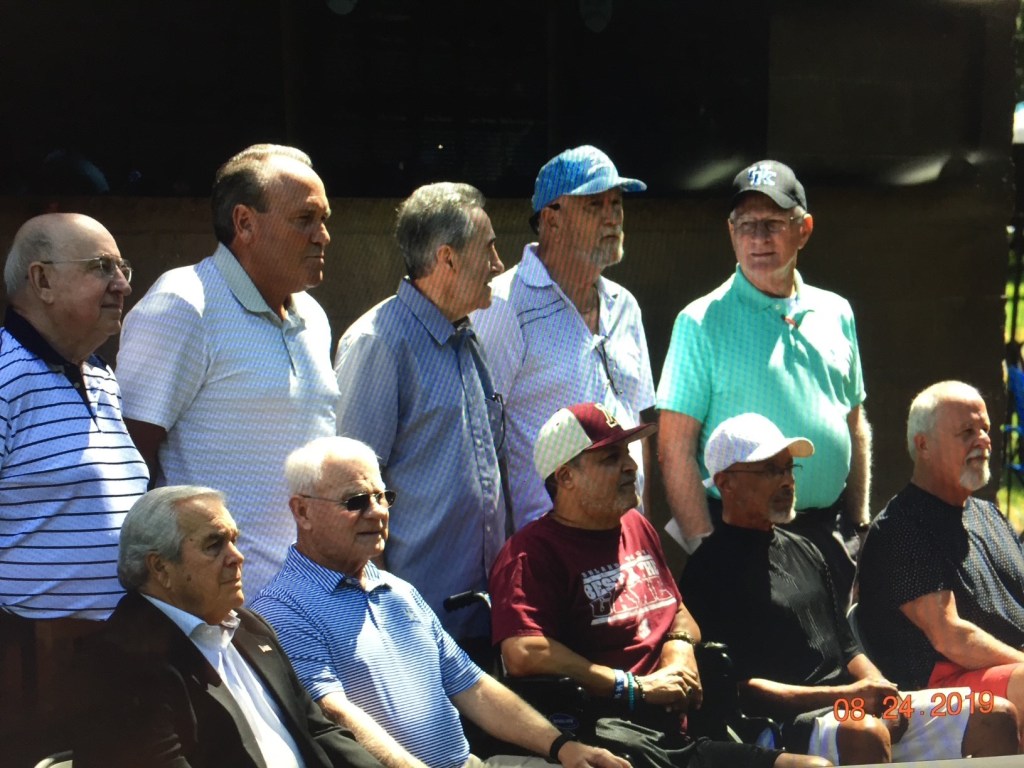
Darryl Smith, back row second from left, along with the other inductees in the 2019 CP-1 Hall of Fame.

Smith was a role player for Patterson because that’s what everyone did for the coach who never lost a game to a 16th Region opponent in his four seasons. During his senior year, he was surrounded with great talent – Jeff Kovach, Jim Harkins, Mark and Greg Swift, Dale Dummitt, Don Allen and others. That 1977 team went 30-2 and reached the state semifinals before losing to Louisville Valley in Freedom Hall.

Smith had several games in double figures and led the Tomcats twice with 14 against Ironton in a hard-fought win and 18 on Senior Night against Montgomery County. But he was mostly in there for rebounds, screening and defense. That was the Patterson way.

Darryl Smith with Colin Porter, a former Tomcat star and current Liberty University senior guard.

As a college basketball referee, he would often cross paths with players who had ties to the 16th Region. He 2010, he was officiating a game where Paul Patterson was coaching at Taylor University. Scott Gill, a former Russell High star and son Ashland grad David Gill, was playing for Taylor. He posed for a photo with them afterward.

Last Thanksgiving, he met former Tomcat point guard Colin Porter and his mother, Hilary, in the lobby of the hotel where Liberty University was playing. Darryl, who was officiating the tournament Liberty was participating in, was always affable.

Darryl Smith, who graduated from Ashland In 1977, will be remembered for a long time for how he carried himself as an athlete, a coach and in life. His death leaves a void for his family and friends that is hard to fill. He is gone far too soon.
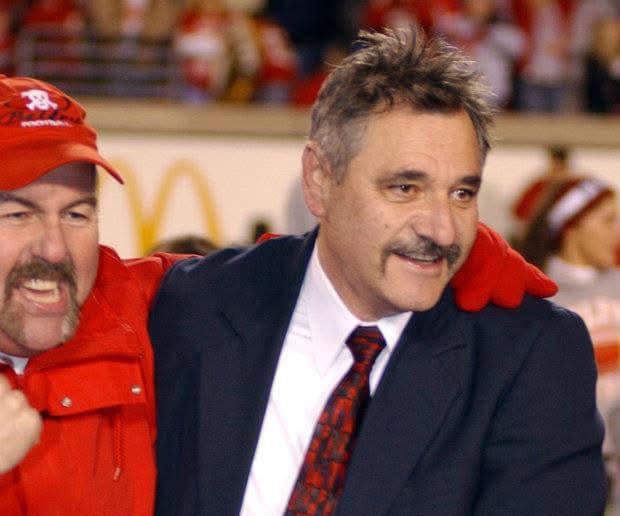
Coach Haywood’s life wasn’t just football. He was a guiding light for others.

The late great Philip Haywood was a mountain mover, putting that brand of football on the Kentucky high school football stage in magnificent ways throughout a brilliant career. During a 50-year coaching career, he amassed eight state championships, six runner-up finishes and an astounding 491 victories – more than any coach in Kentucky high school history – while serving as the head coach at Prestonsburg (nine seasons) and Belfry (41).

Fifty-years!

His passing on Wednesday doesn’t just leave a void, it leaves a deep hole in the heart of the Pond Creek community – and the Kentucky high school football community for that matter – that will be impossible to replace. I’m certain they are in shock that he’s gone. When I saw the report on Wednesday afternoon that he had died, it literally took my breath away. Even knowing that he was in a serious accident with severe injuries from a car accident a few days earlier, I was not expecting that news. Not Coach Haywood. He was going to recover and be fine. Such a good, good man.

It wasn’t just his football coaching skills that made him extraordinary. His interpersonal skills with players, teachers, sportswriters and anybody that crossed his path made him a master of communications. You walked away from any conversations with Coach Haywood feeling better about yourself because that’s how he affected people and that was his aim.

Coach Philip Haywood was successful in football and life. (Photo by Joshua Ball)

It was never about him. “How are you doing? How is your family?” and on and on the questions would go. We would eventually get around to football, which he loved to talk about, too. “How are the Tomcats doing?” he would ask me even if I was calling him about an upcoming game with Russell.

After serving as an assistant coach for three years at Tates Creek and Meade County, he took his first head coaching assignment at Prestonsburg, his alma mater, in 1975. That’s also the year I started working for the Ashland Daily Independent. Over the next few years, as he was building on an incredible coaching resume, I was learning the ropes of a sportswriter.

Prestonsburg was on the edge of our coverage area and, being at the bottom of the food chain in the sports department, that’s where I was to begin. I can remember interviewing him even then and coming away thinking how likeable he was. And I’m sure he had to answer (endure?) some dumb questions from this still green-behind-the-ears aspiring journalist.

We spoke off and on throughout his Prestonsburg tenure. Not often but often enough that we knew each other. If he didn’t answer the phone himself, he always called me back even though the ADI wasn’t really the paper of Prestonsburg. We might have sent a few hundred copies to that part of the Big Sandy area. Our reach mostly stopped around Paintsville (I had a good relationship with the great Walter Brugh, too).

Over the years both of our careers were moving. When he took over at Belfry High School in 1984, I had moved up the ladder and mostly covered the bigger schools in the closer part of our coverage area – Russell, Boyd County and Ashland.

Coach Haywood and I spoke on occasion, especially for some incredible battles with Russell and coach Ivan McGlone. They were important games and always a great chess match between Hall of Fame coaches. They were usually defense-dominated games with a conversion or extra point deciding the outcome.

Win or lose, both of those coaches were humble. They may have been disappointed if defeat came but understood how the game was played, and life was more than what happened on Friday nights. They were incredible men who offered life lessons to players during good times and bad. Both offered such dynamic insight into life even on the hardest of days.

Coach Haywood and I continued to be friends as our careers continued. I began covering more of Ashland games and eventually became the sports editor in 1989. That came during Haywood’s building of Belfry’s great program.

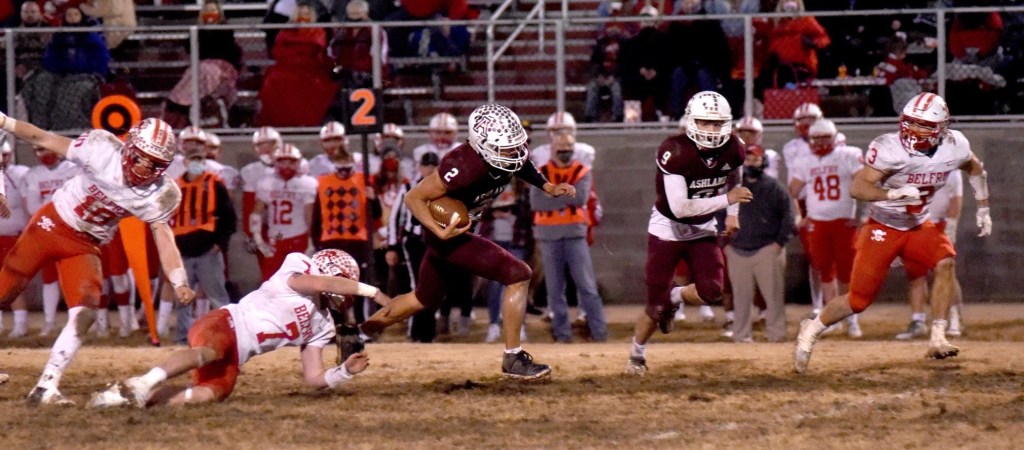
Belfry and Ashland knocked heads a lot during his time – 16 games to be exact. The Tomcats got the better of him in 12 of those, including a state semifinal game in 2020 at Putnam Stadium when Ashland won 10-3 on the way to the Class 3A state championship.

Keontae Pittman races for a 17-yard gain against Belfry in the 2020 state semifinals at Putnam Stadium. The Tomcats won 10-3 and won the Class 3A title a week later. (Photo by Don McReynolds)

He always had a healthy respect for the Tomcats and during many of our conversations he said just that to me. That may date back to his first coaching job as an assistant coach at Tates Creek for Roy Walton in 1972. The Creekers defeated Ashland 16-7 in the state championship that season in the last game ever played at UK’s Stoll Field. That Tomcat team never got the lasting respect they deserved but that’s a column for another day.

It might also be because of a conversation he had once with Herb Conley, who came over to his bus after a Tomcat game, put his hand on his shoulder and told him he was a great coach and was going to have a great career. Haywood never forgot the gesture.

Walton was a mentor for Haywood right down to the reason he wore a coat and tie on the sidelines every Friday night. Walton told him coaching on Friday nights was like going to the symphony so why not dress up. Tates Creek was 13-0 in that 1972 season.

Ashland was 4-3 at Belfry when Haywood was coaching and 8-1 in Putnam Stadium with the defeat (31-14) coming in 1989. That was the year before the Tomcats won the Class 4A title in 1990, which included a 35-20 victory at Belfry after the Tomcats had fallen behind at the half.

There were some important battles between Russell and Belfry over the years as well. Games that meant state championship appearances for the winner.

He carried so much respect for Ashland and Russell as I suspect he did for any opponent he was preparing to play. That’s just how he rolled. Respect the game, respect the opponent.

But Coach Haywood knew at the end of the day there were things a lot more important than a football game. He instilled that notion in his players, modeling what a Christian should be, showing these young men the importance of a relationship with Jesus. They didn’t have to look far for a role model that would not steer them wrong.

I cannot imagine what the Belfry community is experiencing right now. The word “loss” isn’t enough. Irreplaceable comes to mind. Greatness comes to mind. But not loss, because Coach Haywood was never about that word. It was always gain for him. Even in defeat there was something to be learned. He found a way to learn and teach even on the hardest days. He is teaching now that this is how you live and there is a reward. “Well done good and faithful servant” is what he heard Wednesday. And it wasn’t for his 491 victories and eight state championships. It was for a life that led others to Jesus. There is no bigger victory.