LEXINGTON, Ky. – Jody Hamilton, whose remarkable 41-year high school baseball coaching career includes 1,038 victories, two state championships and National Coach of the Year recognition, is part of the Dawahares’ Kentucky High Schol Athletic Association 2026 Hall of Fame class.
Hamilton, a 1976 graduate of Ashland, won state championships at Boyd County in 2001 and West Jessamine in 2015. He also captured the All-A State title in 2024 at Owensboro Catholic and was the All-A runnerup at that school in 2025.
Hamilton was at Boyd County and West Jessamine for 16 years apiece and at Raceland for four years. This spring will be his fifth season at Owensboro Catholic,
He became only the fifth coach in Kentucky history to reach 1,000 victories, crossing that milestone in 2024. He is the only coach with state championships at two different schools.
The top four coaches on the Kentucky win list accomplished their 1,000-plus victories while coaching at the same school. All-time wins leader Mac Whitaker is still coaching at Harrison County and Bill Krumplebeck of Covington Catholic retired after last season.
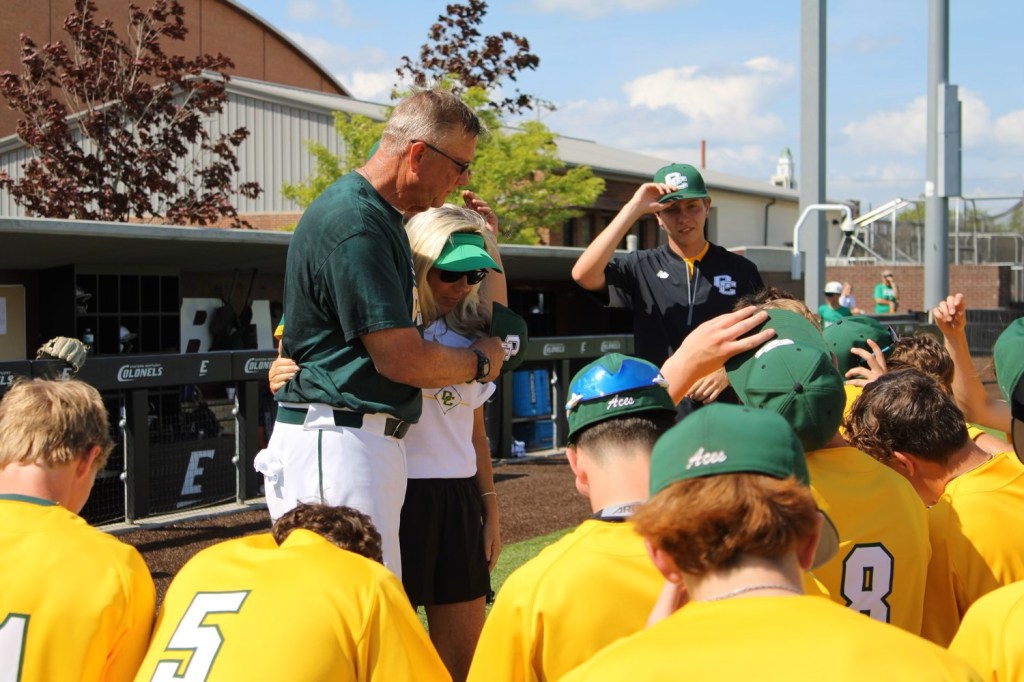
Jody Hamilton with wife Denise after Owensboro Catholic captured the All-A state title in 2024.
Taking his place in the KHSAA Hall of Fame is an honor that is well deserved for one of the best high school baseball coaches in Kentucky history. He has helped countless players – his own and rivals alike – to college scholarships and was largely responsible for elevating baseball programs through the 16th Region during a dominating run there from 1987 to 2002.
Programs were forced to improve facilities and skills to try and keep pace with the Lions who were also state runnerups twice under Hamilton.
Hamilton, who is still the head coach at Owensboro Catholic, was the 2016 National High School Coaches Association Coach of the Year. He was a charter member in the Kentucky High School Coaches Hall of Fame, the 2016 NHSCA Coach of the Year and the Kentucky High School Baseball Coaches Association Coach of the Year in 2001 and 2015.
He was also a charter member of the Ashland Baseball CP-1 Hall of Fame in 2015 and is a member of the Morehead State Athletic Hall of Fame after an illustrious playing career that included being named Ohio Valley Conference Player of the Year after winning the league Triple Crown in 1977. His 49 career home run record stood until being eclipsed in 2024.
Jody played one year professionally for the Paintsville Yankees, including debuting the same night that Darryl Strawberry did for the Kingsport Mets.
Despite a successful first season in pro ball where he hit better than .300 with the prospects of moving up in the Yankee organization, he decided to embark on a coaching career that has been full of highlights. His career began as the head coach at Raceland High School in 1983. He later moved to Boyd County, then West Jessamine and is currently at Owensboro Catholic.
Jody Hamilton led West Jessamine to the 2015 state championship.
Hamilton coached golf from 2007-2010 where his teams were four-year regional champions and finished third at state in 2010 and seventh in 2009 at West Jessamine. He served as an assistant football coach at Raceland and West Jessamine in a career defined by success.
He endured only one losing season in his career, going 15-17 in his last year at Raceland in 1986 when every game was played on the road. Raceland won the district crown in ’86, anyway, and was the home team on the scoreboard for the first time — in 28 total games — in the opening round of the 16th Region Tournament.
Hamilton moved to Boyd County and captured his first of 11 region championship trophies with the Lions in 1988, taking them to the state championship game. Casey Hamilton, Jody’s son, helped bring Boyd County to a state title in 2001. He started at West Jessamine in 2004 and the Colts collected four region crowns (2008, ’10, ’15, ’16) under his leadership. He has two regional titles at Owensboro Catholic.
Winning the state championship and getting attention from college recruiters for his players was always the goal for Hamilton, who estimated 70 percent of the seniors who played for him found themselves on college rosters.
The secret sauce for Hamilton’s teams have been pitching and defense. All but “one or maybe two” of his starting catchers throughout his 41 seasons have gone on to play college baseball. Two of his pitchers at Boyd County, Jason Keyser and Casey Davis, were drafted in the eighth and ninth rounds, respectively. He has helped more than 125 players find a place to play in college.
Hamilton operated a baseball school while coaching at Boyd County and one of the pupils was Brandon Webb, a future Cy Young Award winner for the Arizona Diamondbacks. Webb was 10 when his father, Phil, took him to Hamilton. He worked with him for five years before telling him he had to stop because Webb would soon be pitching for Ashland, Boyd County’s biggest rival.
“I said, ‘Brandon, here’s what’s going to happen. I have to stop giving you lessons because, if I keep giving you lessons, you’re going to beat me. People aren’t going to like that. If I don’t keep giving you lessons, I’m going to recruit you, and then I’m going to get fired.’”
In an unusual twist, Webb never faced Boyd County as a Tomcat. Coaches held their top pitchers during the regular season for a potential district matchup. Ashland and Boyd County never drew in the first round through his junior year. Webb’s senior season was cut short by an injury.
“How many coaches can say they gave lessons to a Cy Young winner?” Hamilton asked.
Jody and wife, Denise, have two grown children and several grandchildren and live on a farm in the Owensboro area.
An Ashland native who cut his baseball teeth in his hometown was elected to the Kentucky Baseball Coaches Hall of Fame on Friday night.
Roger Robinson, a 1984 graduate of Ashland where he played for Frank Sloan, was recognized for building the Bethlehem baseball program for nearly 20 seasons. He has accumulated 327 victories despite being the smallest school in the Fifth Region. That’s an average of 20 wins per season in a program that, before his arrival, had only one district tournament victory.
He has changed the attitude and expectations for Bethlehem since taking over in 2007. That’s 18 seasons in 19 years with the COVID year included when no games were played. He starts season No. 20 in the spring.
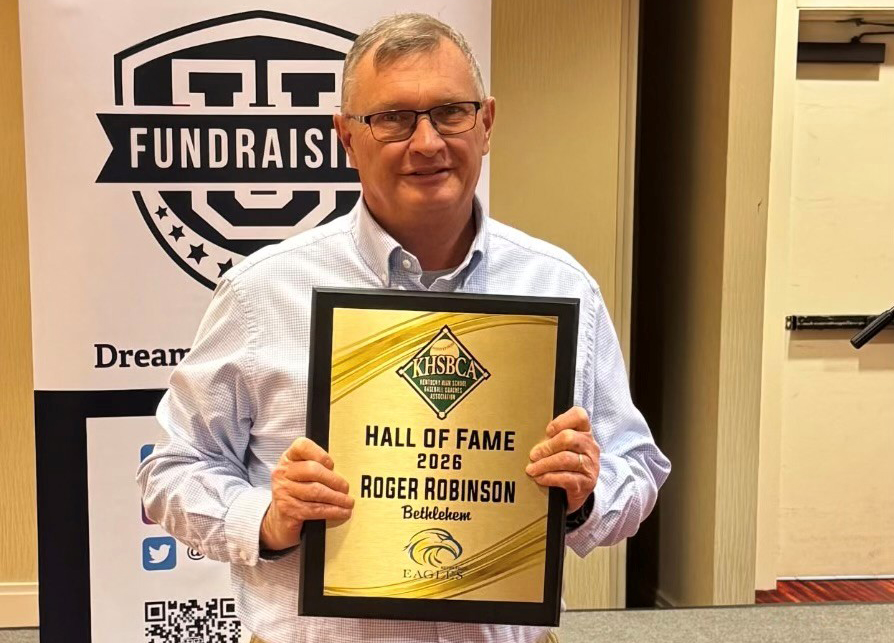
Ashland native and Bethlehem High School coach Roger Robinson was inducted into the Kentucky High School Baseball Coaches Association Hall of Fame on Friday, Jan. 16, 2026.
Bethlehem, a private school, has a boy-girl enrollment of about 300 so his pool of players to choose from is around 150. Compare that with Central Hardin Elizabethtown and Taylor County who have enrollment in the thousands, and it has been an uphill battle, Robinson said.
However, he guided them to the regional championship game in 2013, falling to perennial power Elizabethtown 2-1. He was named Fifth Region Coach of the Year that season.
“That’s as close as we’ve been to winning the region but historically, we go to the region (since his arrival) every year,” said Robinson, who also credited longtime assistant Billy Lyons with the program’s success.
Robinson’s baseball knowledge comes through some good genes. His father, also named Roger Robinson, was a highly successful youth league baseball coach in Ashland for many years. He coached in Little League (major and minor), Babe Ruth and Senior Babe Ruth. The elder Robinson was on the ground floor of getting Babe Ruth baseball started in Ashland in the 1950s.
Roger played for his father throughout his youth career and said the experience was a great one.
“A couple of stories I can think about dad and baseball and the differences of then and now, back when he was coach, they got the practice field on first-come, first-serve basis,” he said. “He’d work the midnight shift at Armco, get off work at 6 a.m. and take the bat bag and put it on the diamond. We’d have early-morning practices.”
It was a baseball family for the Robinsons. Roger’s late mother, Margie, learned to keep the scorebook for her husband and his little sister, Jill, learned how to spend her free time at the ballpark, too.
When Roger Sr. was coaching Armco in the Senior Babe Ruth, Roger Dean was a batboy from 4 years old to 8, taking in the experience of being at the ballfield and around some elite Ashland players. Five decades later, the love of the game has not faded and he’s still on the ballfield.
He has translated that into a successful high school coaching career at Bethlehem. As a professional, he was a physical therapist until he retired. Now he helps with medical assistance for high school teams.
His wife, Cindy, attended private schools and they enrolled their four children at Bethlehem. Roger watched the team play when his boys were young and it wasn’t always pretty. He became an assistant coach and a year later was promoted to the head coach and the rest is history, including have both of his son play for him – like father, like son.
They have won the All “A” regional tournament four times.
“It was a start-from-nothing kind of process,” he said. “A lot of fundraising, an indoor facility and a much nicer field than they used to have made a difference. One of the things I’m most proud of is that we have a full varsity, junior varsity and freshmen teams. To have teams on all three levels for a school our size is tremendous.”
Robinson started the Bethlehem Prep Baseball Program that develops players from K-8th grade for students attending a Bethlehem feeder school.
In his speech on Friday, Robinson said it’s not all about wins and losses at Bethlehem.
“The biggest reason I got into coaching, and one of the things that drives me, and the person I thank most is our Lord and Savior Jesus Christ,” he said. “I’m trying to represent the Lord when I’m out on that field. It’s what we try to do every time we play at Bethlehem. That is the reason I continue to coach.”
Hearing some of the other speeches about their playing days, Robinson said he once pitched a no-hitter as an 8-year-old on the Foodland Rockets that drew some laughs.
“What I didn’t tell them was I walked 17 and gave up 15 runs,” he said.
Roger played for the White Sox in Ashland American, the Eagles in Babe Ruth, the Tomcats in high school and for Post 76 under Frank Wagner and Paul Reeves.
Robinson thanked his father, his coach throughout his youth baseball days, for instilling in him a love for the game.
“He certainly doesn’t agree with all my philosophies, but that’s OK, he will learn,” Robinson said.
He also thanked his wife for putting up with him and always being supportive. Besides the four grown children, he also has seven grandboys so that means more coaching in his future.
“I had them in the (batting) cage yesterday,” he said.
For more than 50 years, Gary Kidwell, The Old Right Hander, was the voice and the record-keeper of Lewis County athletics. He hosted the Saturday Morning Sports Program on WKKS and wrote the Sports Corner column in The Lewis County Herald, a weekly tradition that connected generations of readers to the achievements of our student-athletes and kept local sports in front of our community.
Kidwell, 82, passed away at Vanceburg Hills nursing facility after a long journey with dementia.
Gary’s impact on Lewis County reached far beyond a microphone or a byline. Over seven decades, he served as a player, coach, teacher, athletic director, umpire, commissioner, and as a tireless supporter of young people in this county and across northeastern Kentucky.
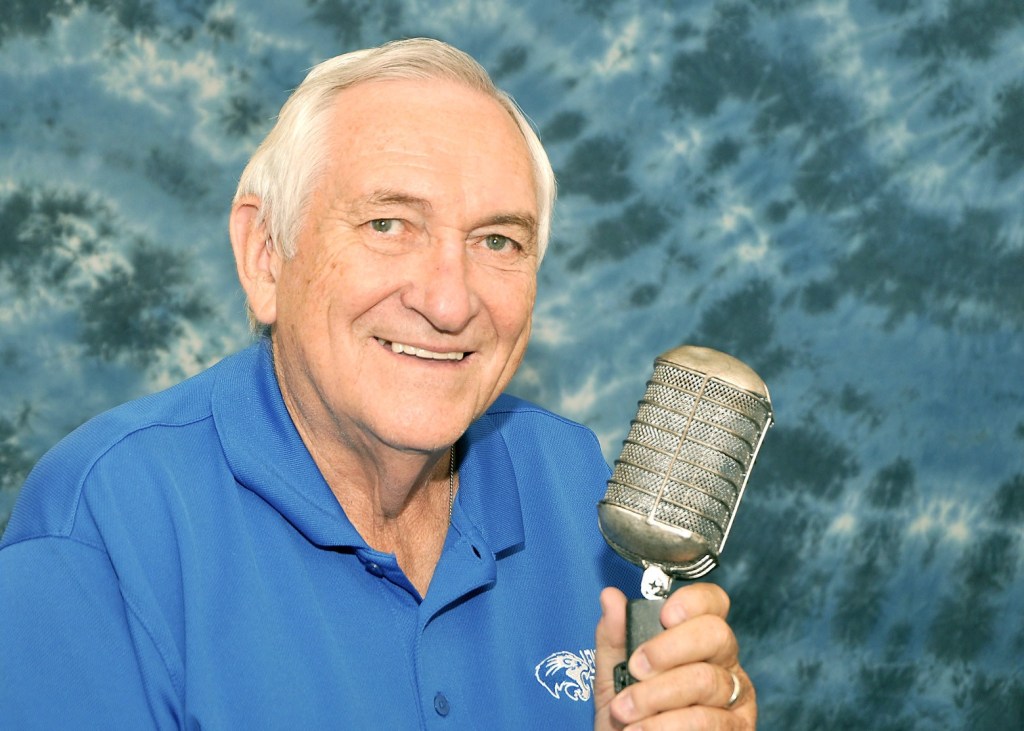
Gary Kidwell was an icon in Lewis County, serving the school system and community for decades. (Photo by Dennis K. Brown, Lewis County Herald)
“Our region has lost a media icon, the Lewis County Lions have lost their biggest fan and best coach, and I have lost a childhood hero as a basketball girl in a neighboring county,” Said State Senator Robin Webb.
“Alice coached the Lewis girls when I played at East,” Webb adds. “They have been mentors, and friends since. I love the Kidwell family and send them love and prayers for comfort.”
Gary Roger Kidwell grew up in the Charters community, played for the Lions in the late 1950s and early 1960s, and later returned home to Lewis County after an early coaching and teaching stint at Millersburg Military Institute.
Beginning in the mid-1960s, Gary taught and coached at Lewis County High School, serving as head basketball coach, head baseball coach, assistant football coach, and later athletic director for nearly two decades.
His baseball teams won hundreds of games, a 10th Region championship and a state quarterfinal appearance in 1977, as well as multiple district titles and an Eastern Kentucky Conference championship.
Lewis County Yearbook Photo of Coach Gary Kidwell.
His basketball teams brought home three straight 62nd District championships in the late 1970s and helped restore pride in Lions basketball. He was instrumental in reviving the football program and helping build up Little League baseball in Lewis County.
After stepping away from the bench, Gary found new ways to serve the sports he loved. He became a respected baseball and softball umpire, working district, regional, and state tournaments and earning recognition as Kentucky High School Umpire of the Year.
He later served as Commissioner of the Eastern Kentucky Conference and as a member of the KHSAA Board of Control, helping guide high school athletics well beyond our county lines.
Gary’s lifetime of work earned him induction into the Kentucky High School Athletic Association Hall of Fame, the National High School Athletic Coaches Association Hall of Fame, the Lewis County High School Athletic Hall of Fame, and honors from his alma mater, Morehead State University.
Those plaques and certificates tell part of the story, but they do not fully capture the late nights, long bus rides, and countless hours he invested in our kids and in this community.
For many in Lewis County, though, the most familiar part of Gary’s legacy was his work behind the microphone and in these pages. Since the mid-1970s, he served as sports editor of The Herald, writing his weekly column, covering games, and keeping alive the memories of decades of Lions athletics.
Each Saturday morning, listeners tuned in to WKKS to hear him talk with coaches and players, swap stories, share scores, and shine a spotlight on local student-athletes.
Gary Kidwell during a timeout in his coaching days.
LCHS Principal Jack Lykins said, “For younger people Gary Kidwell is known as the guy on the radio every Saturday morning. For the majority of us, we know him as coach, athletic director, voice of the Lions, friend and ambassador. No matter where you went in the state, if you told someone you were from Lewis County you always got this response: ‘How is Coach Kidwell doing?’ Those in my generation will always call him ‘Coach.’”
I first knew Gary as a student in the 1970s. Like so many others, I watched and learned from him long before I ever worked with him. Later, as an owner and manager of WKKS and publisher of The Herald, I had the privilege of working beside him for many years.
I learned that Gary never stopped working for the kids of Lewis County. If there was a Lions game being played, he wanted to know the score, who played well, and how their efforts could be recognized.
He had an acute sense of humor and must have known thousands of jokes and one-liners. We shared many long road trips, and we passed the time with sports talk and an endless trading of jokes. One particular trip to cover a game in Indianapolis stands out, several hours each direction of jokes, stories, and more jokes. And he still had more in reserve.
George Plummer, longtime family friend, shared, “I am sad to learn that my friend, the old right hander, Gary Kidwell, has rounded third and headed for home. I always enjoyed all the jokes he could tell. He has attended more ballgames than anyone I can think of. Rest in peace, my friend.”
Mike Edington, close friend and longtime media assistant, said, “Gary was a great friend who has given me many good times going to different sports events. It’s hard to say goodbye to someone who has given me so many good memories.”
Chris Perry, a friend and longtime supporter of West Carter athletics, said, “Our region has truly lost another icon. When you thought of Lewis County basketball, you thought of Gary Kidwell. He poured his heart into coaching the Lions, and when his time on the bench ended, he carried that passion straight to the radio table. He gave himself not only to his own community but to the entire region. I truly enjoyed every conversation we shared. My heart breaks for his wonderful wife, Alice, and their family. There’s comfort in knowing he’s now reunited with Merle.”
Tammy Underwood Alburg, former standout basketball player and coach, reflected on Kidwell’s impact: “I wonder if he ever knew that his own impact went far beyond the edges of the court. He touched my life in so many positive and profound ways—offering wisdom, mentorship, friendship, and laughter. Coach Kidwell really and truly is the poster child for one of a kind. Thank you for the positive impact you had on my life, Coach. Tell Merle I said hi.”
Jimmy Lykins, who was coached by Kidwell and later served as LCHS athletic director said, “He was an ambassador for the youth and Lewis County Athletics wherever he went across the state of Kentucky. He will be remembered for his love of athletics and the ability to connect with people wherever he went. He will leave a huge hole in the hearts of Lewis Countians.”
Local leaders also recognized the magnitude of the loss. Judge Executive George Sparks said, “Lewis County lost a true champion for our young people with the passing of Gary Kidwell. For decades, Gary poured his heart into our schools and our community. Generations of student-athletes knew that if they worked hard and represented Lewis County with pride, Gary would be there to tell their story. We are grateful for his lifetime of service and the example he set.”
Gary had a way of making people feel seen. He celebrated the big wins and the quiet, everyday efforts—the role players, the bench, the coaches, the clock keepers, and the folks who swept the gym floor. He encouraged young people to work hard, represent Lewis County well, and carry themselves with pride.
He loved his family deeply. Gary is survived by his wife of 61 years, Alice Kidwell, and by two daughters, Stacy Kidwell of Morehead and Tai Kidwell Hieneman of Flatwoods. He was preceded in death by their son, Gary Merle Kidwell, who passed away on July 18, 2023.
For all his awards and honors, Gary remained grounded in the place he called home, living just across the highway from Lewis County High Schoo, the Home of the Lions. He often said he was blessed to spend his life doing what he loved—coaching, teaching, umpiring, broadcasting, and writing about sports—and to do it right here in Lewis County.
He never forgot where he came from, and he never stopped giving back to the community that supported him.
“I will always remember Gary as a person who loved Lewis County sports,” said Bill Tom Stone. “He spent years coaching young kids and spreading the word about Lewis County sports everywhere he went. His impact on our community is greater than most will ever realize.”
Lewis County has lost an icon, a teacher, a coach, a broadcaster, and a friend. We have also lost a man who believed, week after week and season after season, that our young people and our community were worth showing up for.
“Gary Kidwell was a Lewis County icon,” said Pastor Tom Cox. “He will be remembered most for his contributions to sports, but he was equally successful as a family man, a valuable church member and a positive influence in his community.”
On behalf of The Lewis County Herald and WKKS, we are honored to have worked beside and along with him. Our thoughts and prayers are with his family, his former players, his colleagues, and the countless people whose lives he touched.
Services will be at 1:00 p.m. Saturday, November 22, 2025, at Vanceburg Christian Church with Pastor Tom Cox Jr. officiating. A fellowship dinner will follow prior to traveling to the burial service at Mound Cemetery in Piketon, Ohio. Visitation will be at the church after 9:00 a.m. Saturday.
Arrangements are under the direction of Gaydos Funeral Home in Vanceburg.
Obituary for Gary Kidwell, 1943-2025
Gary Roger Kidwell, 82, of Vanceburg, passed away peacefully Saturday, November 15, 2025, at Vanceburg Hills, following a long battle with dementia.
A lifelong Lewis Countian, he was born September 20, 1943, at Stricklett, a son of the late Marcus E. (Shirley) Kidwell and Thelma Sapp (Jess) Gulley.
After graduating from Lewis County High School in 1961, Gary pursued a career in education at Morehead State University, earning Bachelor’s, Master’s, and Rank I degrees. While at MSU, Gary met and married his wife of 61 years, Alice Nelson Kidwell, on September 6, 1964.
Gary began his teaching and coaching career at Millersburg Military Institute in 1965. In 1967, he was given the opportunity to return to his home in Lewis County and continue his career, where he would serve the students and athletes of Lewis County Schools for 50 years.
During his time with the Lewis County Schools, “Coach” served in numerous roles. He started out teaching and coaching basketball and baseball and was integral in reviving the football program at LCHS. He later served as athletic director for many years, representing Lewis County on numerous state and national boards. Many Lewis County alumni remember him as the comical driver’s education teacher as he fearlessly taught many young students and members of the community to drive.
Anyone who knew Coach knew his passion for all things sports. He loved his Lewis County Lions, Kentucky Wildcats, Cincinnati Reds, Cincinnati Bengals, and Morehead State Eagles. His dedicated following of his favorite teams led to his long-time interest in sports media. This afforded him countless opportunities to attend and cover games on local, state, and national stages. He was honored to have the chance to cover his Wildcats in bowl games, SEC and NCAA tournaments, the Reds in the World Series, and the MLB All-Star Game in Cincinnati.
But he was most proud of his local media efforts that he used as a platform to promote local student athletes. Gary hosted a weekly sports radio show, “Saturday Morning Sports,” and wrote a weekly sports column in The Lewis County Herald, “Kidwell’s Korner,” and was the “Voice of the Lions” on WKKS Radio for more than 50 years.
If you attended a Sweet Sixteen basketball tournament in the last 60 years, you were sure to see Gary in attendance sharing stories, jokes, and memories with long-time friends from across the state.
Through his many years of service to the sports world, Gary was honored to receive several cherished awards, including induction into five halls of fame: KHSAA–Dawahares Hall of Fame, KABC Court of Honor, NHSCA Hall of Fame, Morehead State University Alumni Hall of Fame, and Lewis County High School Athletic Hall of Fame. He was also named KHSADA Athletic Director of the Year in 1995 and was a top-5 finalist for National Athletic Director of the Year. Gary also enjoyed umpiring softball, advancing to call multiple state championships. A highlight of Gary’s summer for many years was umpiring at the Mike Borders Beagle Classic. He also spent 26 years as commissioner of the Eastern Kentucky Conference.
Aside from sports, Gary’s greatest loves were his children and grandchildren. You could often find him cheering them on from the sidelines, no matter the sport or activity. He was always proud of their accomplishments and never shy to brag on them to others. He always loved the annual Kidwell family vacations and was guaranteed to provide plenty of content for hilarious stories for years to come.
He was the king of one-liners, always cracking a joke and lighting up a room with laughter. Even into his last months, he was attempting to deliver his famous punchlines with a smile on his face.
Gary was of Christian faith and was a devoted member of Vanceburg Christian Church, serving as a deacon for many years.
Survivors include his wife of 61 years, Alice Nelson Kidwell; two daughters, Stacy Anne Kidwell of Morehead and Tai Kidwell Hieneman (Keith) of Flatwoods; one daughter-in-law, Mandy Kidwell of Flatwoods; six grandchildren, Carson Kidwell, Kate Kidwell, Alex Kidwell, Selah Kidwell, Claire Hieneman, and Jack Hieneman; two brothers, Barry Gulley (Cindy) of Whiteburg, Georgia, and Mark Kidwell (Monica) of Pensacola, Florida; four sisters, Tonia Berry (Charles) and Ginger Miller (Gary) of Flemingsburg, Dana Hammonds (David) of Hebron, and Tara Reed (Brian) of Lexington; and his uncle Kenneth Sapp, who was like a brother to him.
In addition to his parents, he was welcomed into Heaven by his beloved son, Gary “Merle” Kidwell, and his grandparents, Hanson and Maggie Sapp and Ashel and Rosa Kidwell.
Services will be at 1:00 p.m. Saturday, November 22, 2025, at Vanceburg Christian Church with Pastor Tom Cox Jr. officiating. A fellowship dinner will follow the service at the church prior to traveling to the burial service at Mound Cemetery in Piketon, Ohio. Visitation will be after 9:00 a.m. Saturday at the church.
Arrangements are under the direction of Gaydos Funeral Home in Vanceburg.
As Gary said and wrote for many years, “This is the old right-hander saying, ‘Have a good week in sports!’”
Leonard “Shorty” Blanton, who coached the Ashland Tomcats baseball team for only three years but his legacy includes a state championship in 1968 and state runner-up finish in 1969, died in Florida on Aug. 30. He was 94.
Blanton took over the Tomcats’ baseball job in 1968 after Zeke Meyers had led Ashland to back-to-back state titles in 1966 and 1967. Meyers, who took an administration position at Marshall University following his time in Ashland, went 47-4 in two seasons including a perfect 25-0 in 1967.
Even though the cupboard was hardly bare, who wanted to replace that coaching legend?
Blanton told me a few years ago in an interview for the book Tomcat Dynasty he got the job because “no one else wanted it.” During those days the principal selected the coaches for the so-called “minor” sports of track and baseball. He appointed Blanton to be the baseball coach.
A good football coach at several levels in the Ashland system, including the junior varsity coach the year the Tomcats won the state title in 1967 and the head coach at Coles Jr. High in 1971, Blanton admittedly didn’t have a wealth of baseball knowledge and had never coached the sport on any level. And now he was taking over the two-time defending state champions with a wealth of returning players, including Bobby Lynch, John Mullins, Steve Hemlepp, Fred Leibee, Tim Huff, Bo Carter, Dave Staten and Mike Tackett. These days people would be knocking each other over to get that job.
Leonard “Shorty” Blanton celebrates after winning the 1968 state baseball championship as coach for the Ashland Tomcats. It was the third consecutive title for the Tomcats.
Lynch and Hemlepp were like unofficial assistant coaches and knew the team better than anyone. Blanton said he welcomed their suggestions and knew these Tomcats were not just good at baseball, they were good at winning.
It proved to be true as those Tomcats became Kentucky’s first program to win three consecutive state championships. It did not happen again until Pleasure Ridge Park won it from 1994-96.
Blanton said the players taught him a lot about baseball and were “easy to coach.”
The ’68 champions finished 23-3 and surrendered only one run in three games in the state tournament. Lynch won two of those games, including being the winning pitcher in the finals for the second time in three years. If not for a strange scoring decision, he would have been the winning pitcher in all three championship games.
But what Blanton did with the ’69 team was the most surprising. He took them back to the state tournament and reached the finals where they dropped a 1-0 decision to Owensboro in heartbreaking fashion.
In the state championship game against Owensboro, a pair of errors brought home the winning run – and only run of the game – in the bottom of the seventh inning. There may have been three errors since the baserunner was thought to have missed third. Ashland never protested. Leonard talked about that play nearly 50 years later.
“Someone told me the runner didn’t even touch third base,” he said. “I missed it and none of my boys saw it either. Who knows? The umpire may not have noticed either. I guess we’ll never know.”
The Tomcats finished 19-4 including a 1-0 victory over Don Gullett-led McKell in the regional semifinals in Morehead. Ashland had only one hit in the game, a triple from Dave Damron who then scored the game’s only run on Tackett’s sacrifice fly. Gullett struck out 11 and allowed the lone hit but Huff outdueled him.
“Those guys were outstanding, some of the best in the state, and they knew how to win, too,” Blanton said. “It’s a shame it turned out like it did.”
Blanton was not planning on coming back for the 1970 season after that stinging loss and announced in the newspaper that Steve Gilmore would be replacing him. But that didn’t happen until the following year. Blanton coached the Tomcats to a 12-10 season in 1970, losing in the regional finals to Russell.
He finished his high school coaching career with a 54-17 record. Not bad for somebody who admitted having limited baseball coaching knowledge when he took the job.
Blanton was much more than a good coach, though. He was a fine Christian gentleman, husband and father and a friendly and popular man in Ashland. His wife, Ada, who died in 2020, was a beautiful lady and powerful singer who was crowned Mrs. Kentucky in 1968. She represented the state along with the 1968 Miss Kentucky and Col. Harland Sanders of Kentucky Fried Chicken fame on the Kentucky state float during the inauguration parade for President Richard Nixon in Washington, D.C., in 1968.
Shorty and Ada sang together in church at Unity Baptist and in local dramas and musicals. They have a son, Ted Blanton, who played on Ashland’s 1967 state football championship team.
Blanton was born in 1931 and graduated from Ashland High School in 1949. He played on the Tomcats’ 1946-1948 football teams. He rushed for 339 yards and had 152 yards receiving while scoring five touchdowns on a 5-4-1 team in ’48 that was ranked No. 3 in the final AP state poll. The losses and tie came to four out-of-state teams (Charleston, Stonewall Jackson, Huntington High, Ironton and Portsmouth).



 MARK MY WORDS 2