Humble Gary Wright’s impact was far-reaching to the end

Gary Wright was an accomplished man, although his humble nature kept many people from fully realizing just how much he had achieved.

He was a tremendous businessman and entrepreneur who, after obtaining his master’s degree from Xavier University in Cincinnati, established the Southwestern College of Business in the Cincinnati area. By the time he retired to St. Pete Beach, Florida, in 2004, the college had grown to five locations.

Gary was successful in family life, too. He was married to Jean for 54 years and cared deeply for his daughters, Christine and Holly. Family was of utmost importance to him.

He was also a two-sport star at Ashland High School, starting at second base as a freshman in 1957 through the 1960 spring season. He would walk from Coles Junior High to practice during an era when it was unheard of for freshman to even make the varsity team. Most sophomores never saw a spot on a varsity roster. Gary was invited to try out because he was that good.
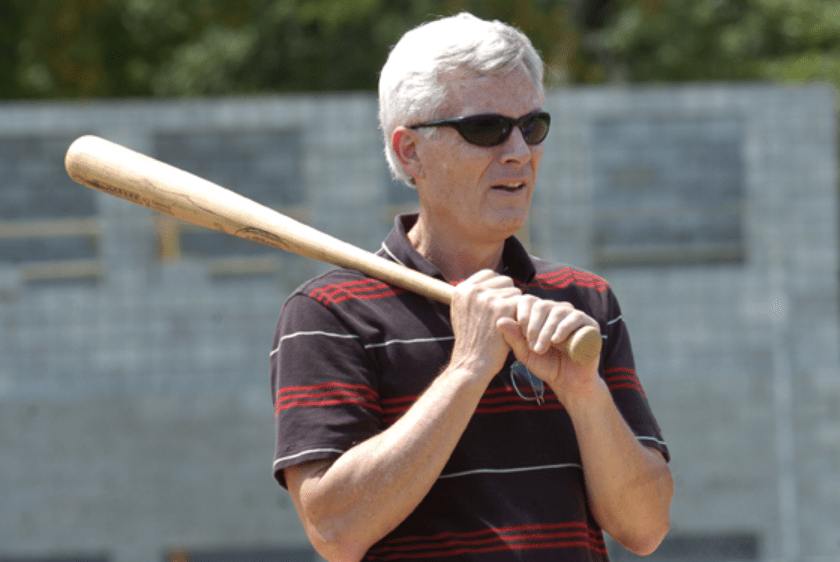
Gary Wright, a former Ashland Tomcat baseball and basketball star, started the CP-1 movement with a donation to renovate the big diamond at Central Park in 2008. Through his generosity, hundreds were able to relive their baseball memories.

And then there was basketball. He played two years and helped coach Bob Wright’s first team at Ashland in 1960 win the 16th Region title and earn a berth in the Sweet Sixteen, where a first-round loss to Maysville ended the campaign. His teammates included Larry Conley, Harold Sargent, Gene Smith and the other stars from the 1961 state championship team.

He was instrumental in getting them to the Sweet Sixteen in 1960, scoring double figures in four of his final seven games and making the All-District team.

The two-sport athlete was good enough to earn a scholarship to Centre College, where he played both sports for four years while earning his undergraduate degree. Gary’s love of sports was paying off handsomely.

Among Gary’s many attributes was his love of family, friends and teammates. He also loved growing up in Ashland with his brothers, Robert and Tony, and with a mother (Geneva) and father (T.R.) who did what they could to help their boys succeed. All three brothers were good athletes, and that upbringing helped set Gary on a path that would serve him well.

He cherished his days in Ashland during the 1950s. Like many boys of that time, Central Park was his playground, a place where all worries went away, where skills were learned and then showcased on the big diamond they called CP-1. His father knew how important it was to get boys started young, putting together Pony League teams, taking them all over to play. He had a hand in bringing Babe Ruth baseball and American Legion baseball to town.

T.R. Wright coached his son — and many other boys — during the 1950s and helped lay the groundwork for a tremendous youth baseball program that brought state and even national acclaim to Ashland. He did it on the fields at Central Park, and the cathedral of them all was CP-1. It was called that because of the newspaper. When they ran the list of schedules for the week, they listed the fields as CP-1 and CP-2, which was later mostly used for softball and now soccer.

With Gary’s career established and retirement just beginning, he returned to Ashland in 2008 and visited that big diamond again. He ran onto the field, breathed in the air, ran his fingers through the sand, and the memories of those good days flooded his mind. He could picture scooping up the grounder – and a handful of sand – or delivering the game-winning hit with the crack of bat – not the ping we hear now. He could see how pleased his father was with all the boys as they practiced what he had preached.

Gary was overwhelmed by the emotions that came from his visit, and in true Gary Wright fashion, he did something about it. The field was badly in need of renovation, but talk wasn’t going to make that happen. He put $125,000 behind a renovation project that included a new press box named in his father’s honor.

That same day, when Gary visited his old playing grounds, he ran into his friend David Carter, who had similar experiences at CP-1. Together, they began what was coined the “CP-1 Movement,” and boy, did it ever move.

There were annual reunions for former players, coaches, umpires and fans who remembered playing on that diamond.

Carter, an entrepreneur himself, had the vision for a documentary. He put together “Ashland’s Field of Dreams,” and it aired on KET. It was so well done that it continues to air every year. Interviews with people who played at the park brought out raw emotion, and Carter, who passed away a couple of years ago, captured it brilliantly.

The reunions eventually evolved into the CP-1 Hall of Fame. That is when I became intimately involved, spearheading the event from 2015 through 2024, when 101 former players, coaches, umpires and one sportswriter were recognized each August.

It became a summer event that everybody looked forward to — a time for the reunion of teams and the reliving of days gone by. Treasured memories spilled out around that field again. There were tales of long home runs, bad hops in the sandy infield and the short right-field fence that gave us some cheap home runs.

You could almost see the kid come out in these men who may have played there decades earlier.

It never would have happened without Gary Wright’s compassion for what he had experienced there and his wildly generous donation that helped turn what had become a rundown baseball field into a showcase. When the old players came home, they could not believe their eyes.

This wasn’t the first time Gary’s generosity brought joy through baseball. His name adorns the baseball field at Centre College to this day.

But Gary was much more than a generous and kind man. He gave of himself — not just his money — to projects he cared deeply about helping. When I told him about a Christian ministry called Amy for Africa that was educating children in Uganda, he sent a large donation. Nobody asked him for it.

He simply wanted to make an impact wherever he could, and he had a soft spot for children.

You only get so many chances in life to make a difference, and it’s not always about finances. If you counted Gary Wright as a friend — and anybody who ever met him did — consider yourself fortunate.

His life had the kind of meaning everybody chases. He modeled a compassionate life in every way. How could he make his hometown — and, for that matter, the world — better? He did it with action, with thought and with confidence.

What he did by starting the CP-1 Movement brought joy to countless people. He stirred an abundance of memories and gave those who often thought they had been forgotten one more chance to be in the spotlight.

But not once did he want that spotlight on himself.

It was never about him.

It was always about others.

I loved calling him and talking about how the latest class of the CP-1 Hall of Fame reacted to the celebration — how some were overcome with emotion, choking back tears while giving their induction speeches.

“Chills!” he would say to me.

Gary died on August 20 at the age of 84 after a courageous battle with Parkinson’s. There will be no memorial service, per his wishes.

Gary Wright stayed humble to the end, but his impact will not be forgotten.
Having a ball: Tom Clay gets a surprise gift with some Cincinnati Reds history to it

When Tom Clay pulled into a gas station the other day he got a surprise – and he said it wasn’t that he had to “give my first born to get a gallon of gas.”

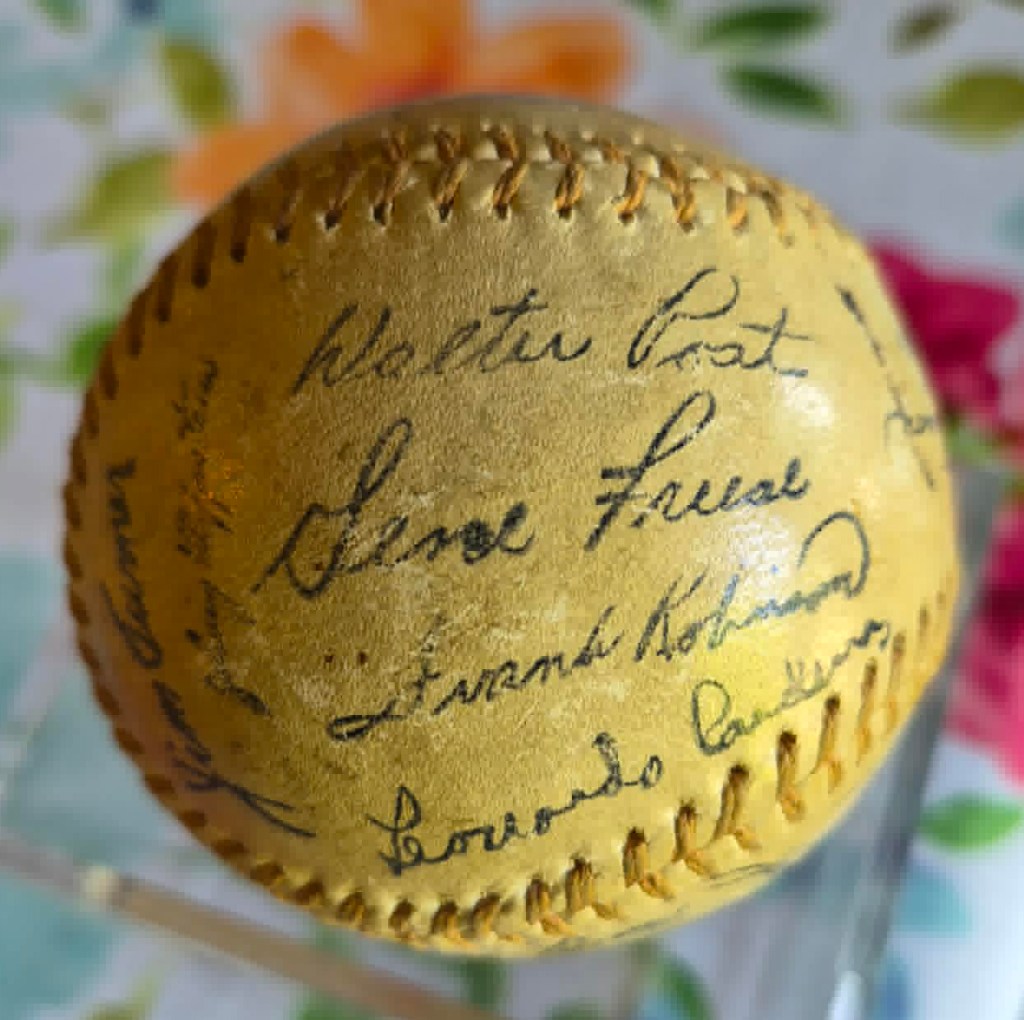
There were five or six bikers around, trying to get respite from the rain. A man came over to him and, without introducing himself, said “I’ve got something I want you to have. I figured it was a fish net or lure or something. Then he said, ‘I have a signed baseball for the entire Cincinnati Reds baseball team from the early 1960s. I wanna give it to you.’”

Clay said, “Can you give me a lottery ticket, too?”

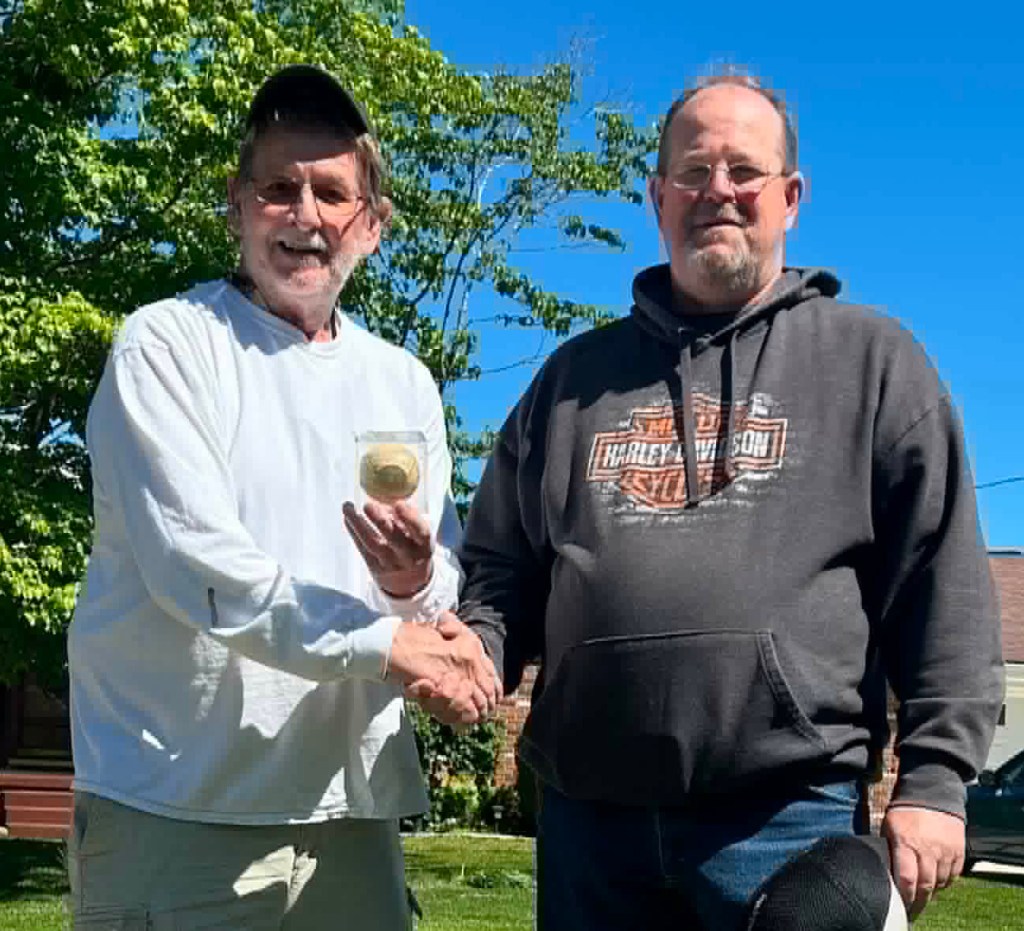
The man was Brent Dickison, who grew up across the road from Clay’s grandfather. Dickison, now 56, told Clay he had received the baseball years ago while playing outside as a child.

Tom Clay with Brent Dickison, who gave him a baseball that Tom’s grandfather had given him years ago from the 1962 Cincinnati Reds.

“Clay said Dickison told him my grandfather came outside with the baseball and wanted to give it to him,” Clay said.

The story only deepened the mystery.

“The surprise to me is, I don’t think my grandpa is a Reds’ fan,” Clay said. “Shelby Jean, his sister, she is a Reds’ fan. Shelby took her older brother, Randy, to Crosley Field. If the ball came from there, I don’t know. I know dad went to Crosley Field and took his mother. I don’t recall the ball being on the mantle or anything.”

A few days later, Dickison tracked Clay down again and handed over the baseball.

Hall of Famer Frank Robinson’s signature came be seen on this 1962 Reds’ team ball

That’s when the detective work began.

Clay started comparing signatures against old Reds rosters and quickly realized the ball wasn’t from the 1961 National League pennant-winning team, as he first suspected. The giveaway was pitcher Jim Maloney’s signature. Maloney was a rookie in 1962, and the rest of the names lined up with that season’s roster.

The baseball includes signatures from Reds legends such as Frank Robinson, Vada Pinson, Joe Nuxhall and manager Fred Hutchinson. Despite being yellowed with age, Clay said the ball remains in remarkably good condition for being 64 years old.

Being a fan of “Antique Roadshow,” Clay naturally looked into what the baseball might be worth. Thanks in part to the Robinson and Hutchinson signatures, he found estimates ranging from $750 to $1,000.

“Of course, that’s if you can find somebody who will give you that much for it,” Clay said.

The baseball also led to a little good-natured family humor.

Clay told his mother about the discovery, and she had her own response.

“Does this make up for me throwing away all your ball cards?” she told him.

Clay said he appreciated Dickison thinking enough of him to return the baseball after all these years. Not many people stop at a gas station and leave with a piece of family history.

And even with today’s prices, that’s worth more than a gallon of gas.

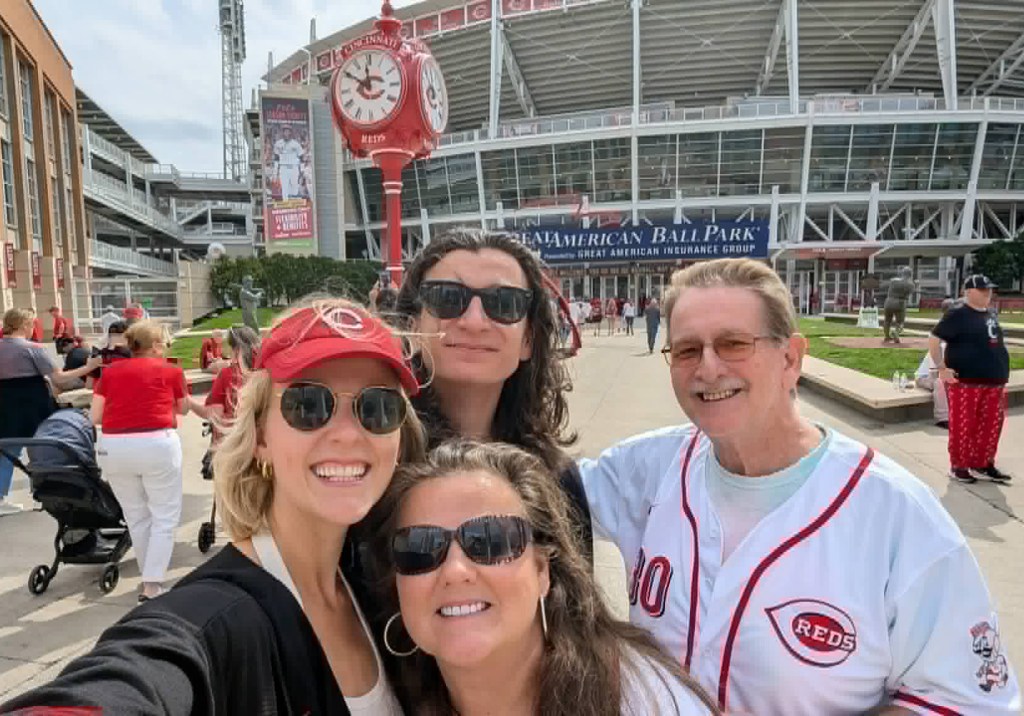
Tom Clay with family members at a Reds’ game this season.

Jody Hamilton part of 2026  Dawahares’ KHSAA Hall of Fame class

LEXINGTON, Ky. – Jody Hamilton, whose remarkable 41-year high school baseball coaching career includes 1,038 victories, two state championships and National Coach of the Year recognition, is part of the Dawahares’ Kentucky High Schol Athletic Association 2026 Hall of Fame class.

Hamilton, a 1976 graduate of Ashland, won state championships at Boyd County in 2001 and West Jessamine in 2015. He also captured the All-A State title in 2024 at Owensboro Catholic and was the All-A runnerup at that school in 2025.

Hamilton was at Boyd County and West Jessamine for 16 years apiece and at Raceland for four years. This spring will be his fifth season at Owensboro Catholic,

He became only the fifth coach in Kentucky history to reach 1,000 victories, crossing that milestone in 2024. He is the only coach with state championships at two different schools.

The top four coaches on the Kentucky win list accomplished their 1,000-plus victories while coaching at the same school. All-time wins leader Mac Whitaker is still coaching at Harrison County and Bill Krumplebeck of Covington Catholic retired after last season. 

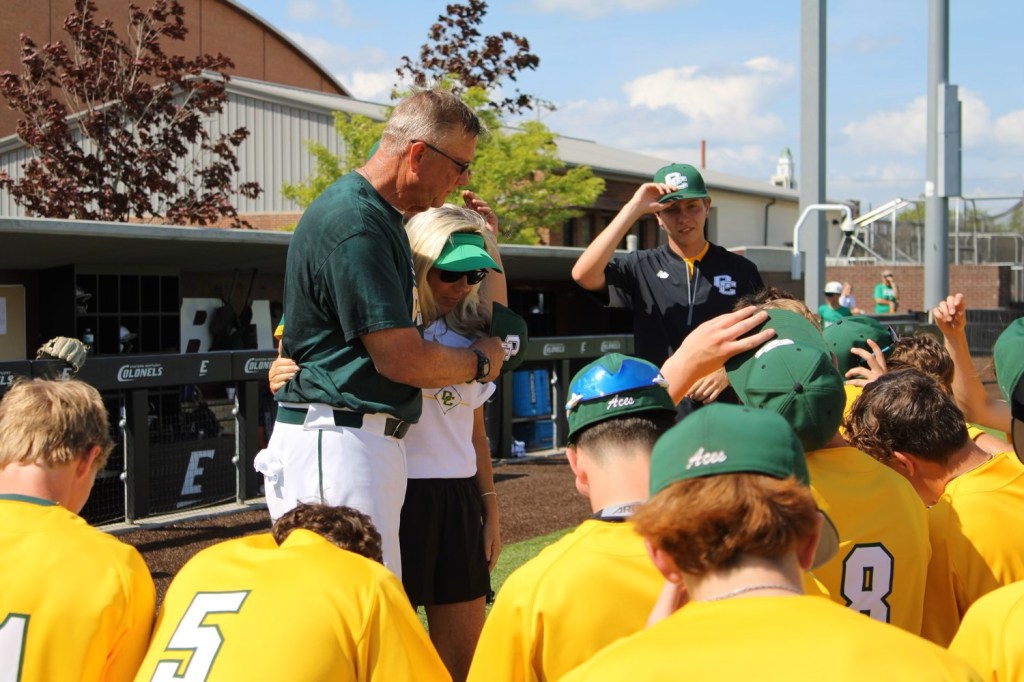
Jody Hamilton with wife Denise after Owensboro Catholic captured the All-A state title in 2024.

Taking his place in the KHSAA Hall of Fame is an honor that is well deserved for one of the best high school baseball coaches in Kentucky history. He has helped countless players – his own and rivals alike – to college scholarships and was largely responsible for elevating baseball programs through the 16th Region during a dominating run there from 1987 to 2002.

Programs were forced to improve facilities and skills to try and keep pace with the Lions who were also state runnerups twice under Hamilton.

Hamilton, who is still the head coach at Owensboro Catholic, was the 2016 National High School Coaches Association Coach of the Year. He was a charter member in the Kentucky High School Coaches Hall of Fame, the 2016 NHSCA Coach of the Year and the Kentucky High School Baseball Coaches Association Coach of the Year in 2001 and 2015.

He was also a charter member of the Ashland Baseball CP-1 Hall of Fame in 2015 and is a member of the Morehead State Athletic Hall of Fame after an illustrious playing career that included being named Ohio Valley Conference Player of the Year after winning the league Triple Crown in 1977. His 49 career home run record stood until being eclipsed in 2024.

Jody played one year professionally for the Paintsville Yankees, including debuting the same night that Darryl Strawberry did for the Kingsport Mets.

Despite a successful first season in pro ball where he hit better than .300 with the prospects of moving up in the Yankee organization, he decided to embark on a coaching career that has been full of highlights. His career began as the head coach at Raceland High School in 1983. He later moved to Boyd County, then West Jessamine and is currently at Owensboro Catholic.

Jody Hamilton led West Jessamine to the 2015 state championship.

Hamilton coached golf from 2007-2010 where his teams were four-year regional champions and finished third at state in 2010 and seventh in 2009 at West Jessamine. He served as an assistant football coach at Raceland and West Jessamine in a career defined by success.

He endured only one losing season in his career, going 15-17 in his last year at Raceland in 1986 when every game was played on the road. Raceland won the district crown in ’86, anyway, and was the home team on the scoreboard for the first time — in 28 total games — in the opening round of the 16th Region Tournament.

Hamilton moved to Boyd County and captured his first of 11 region championship trophies with the Lions in 1988, taking them to the state championship game. Casey Hamilton, Jody’s son, helped bring Boyd County to a state title in 2001. He started at West Jessamine in 2004 and the Colts collected four region crowns (2008, ’10, ’15, ’16) under his leadership. He has two regional titles at Owensboro Catholic.

Winning the state championship and getting attention from college recruiters for his players was always the goal for Hamilton, who estimated 70 percent of the seniors who played for him found themselves on college rosters.

The secret sauce for Hamilton’s teams have been pitching and defense. All but “one or maybe two” of his starting catchers throughout his 41 seasons have gone on to play college baseball. Two of his pitchers at Boyd County, Jason Keyser and Casey Davis, were drafted in the eighth and ninth rounds, respectively. He has helped more than 125 players find a place to play in college.

Hamilton operated a baseball school while coaching at Boyd County and one of the pupils was Brandon Webb, a future Cy Young Award winner for the Arizona Diamondbacks. Webb was 10 when his father, Phil, took him to Hamilton. He worked with him for five years before telling him he had to stop because Webb would soon be pitching for Ashland, Boyd County’s biggest rival.

“I said, ‘Brandon, here’s what’s going to happen. I have to stop giving you lessons because, if I keep giving you lessons, you’re going to beat me. People aren’t going to like that. If I don’t keep giving you lessons, I’m going to recruit you, and then I’m going to get fired.’”

In an unusual twist, Webb never faced Boyd County as a Tomcat. Coaches held their top pitchers during the regular season for a potential district matchup. Ashland and Boyd County never drew in the first round through his junior year. Webb’s senior season was cut short by an injury.

“How many coaches can say they gave lessons to a Cy Young winner?” Hamilton asked.

Jody and wife, Denise, have two grown children and several grandchildren and live on a farm in the Owensboro area.

Roger that: Robinson takes Ashland ties with him into baseball coaches Hall of Fame

An Ashland native who cut his baseball teeth in his hometown was elected to the Kentucky Baseball Coaches Hall of Fame on Friday night.

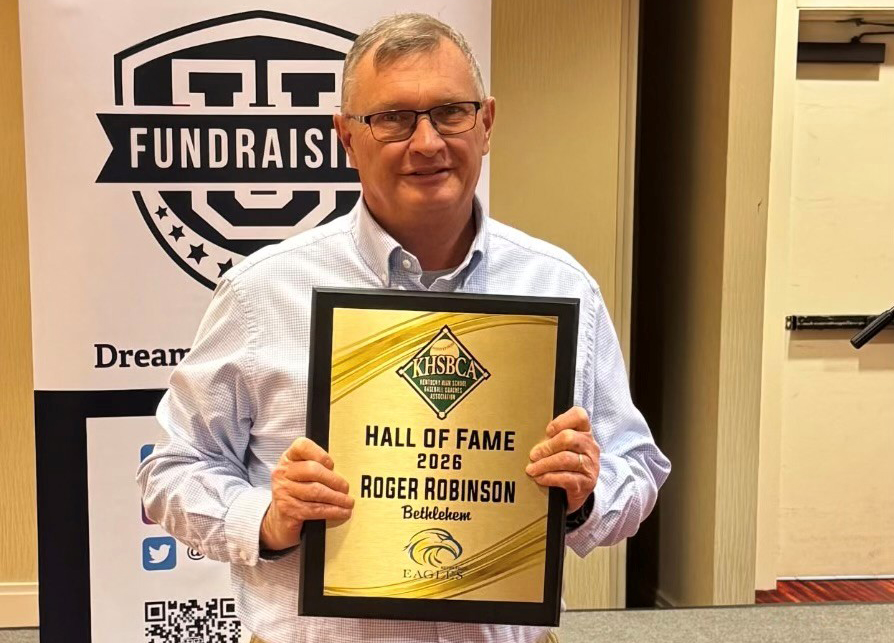
Roger Robinson, a 1984 graduate of Ashland where he played for Frank Sloan, was recognized for building the Bethlehem baseball program for nearly 20 seasons. He has accumulated 327 victories despite being the smallest school in the Fifth Region. That’s an average of 20 wins per season in a program that, before his arrival, had only one district tournament victory.

He has changed the attitude and expectations for Bethlehem since taking over in 2007. That’s 18 seasons in 19 years with the COVID year included when no games were played. He starts season No. 20 in the spring.

Ashland native and Bethlehem High School coach Roger Robinson was inducted into the Kentucky High School Baseball Coaches Association Hall of Fame on Friday, Jan. 16, 2026.

Bethlehem, a private school, has a boy-girl enrollment of about 300 so his pool of players to choose from is around 150. Compare that with Central Hardin Elizabethtown and Taylor County who have enrollment in the thousands, and it has been an uphill battle, Robinson said.

However, he guided them to the regional championship game in 2013, falling to perennial power Elizabethtown 2-1. He was named Fifth Region Coach of the Year that season.

“That’s as close as we’ve been to winning the region but historically, we go to the region (since his arrival) every year,” said Robinson, who also credited longtime assistant Billy Lyons with the program’s success.

Robinson’s baseball knowledge comes through some good genes. His father, also named Roger Robinson, was a highly successful youth league baseball coach in Ashland for many years. He coached in Little League (major and minor), Babe Ruth and Senior Babe Ruth. The elder Robinson was on the ground floor of getting Babe Ruth baseball started in Ashland in the 1950s.

Roger played for his father throughout his youth career and said the experience was a great one.

“A couple of stories I can think about dad and baseball and the differences of then and now, back when he was coach, they got the practice field on first-come, first-serve basis,” he said. “He’d work the midnight shift at Armco, get off work at 6 a.m. and take the bat bag and put it on the diamond. We’d have early-morning practices.”

It was a baseball family for the Robinsons. Roger’s late mother, Margie, learned to keep the scorebook for her husband and his little sister, Jill, learned how to spend her free time at the ballpark, too.

When Roger Sr. was coaching Armco in the Senior Babe Ruth, Roger Dean was a batboy from 4 years old to 8, taking in the experience of being at the ballfield and around some elite Ashland players. Five decades later, the love of the game has not faded and he’s still on the ballfield.

He has translated that into a successful high school coaching career at Bethlehem. As a professional, he was a physical therapist until he retired. Now he helps with medical assistance for high school teams.

His wife, Cindy, attended private schools and they enrolled their four children at Bethlehem. Roger watched the team play when his boys were young and it wasn’t always pretty. He became an assistant coach and a year later was promoted to the head coach and the rest is history, including have both of his son play for him – like father, like son.

They have won the All “A” regional tournament four times.

“It was a start-from-nothing kind of process,” he said. “A lot of fundraising, an indoor facility and a much nicer field than they used to have made a difference. One of the things I’m most proud of is that we have a full varsity, junior varsity and freshmen teams. To have teams on all three levels for a school our size is tremendous.”

Robinson started the Bethlehem Prep Baseball Program that develops players from K-8th grade for students attending a Bethlehem feeder school.

In his speech on Friday, Robinson said it’s not all about wins and losses at Bethlehem.

“The biggest reason I got into coaching, and one of the things that drives me, and the person I thank most is our Lord and Savior Jesus Christ,” he said. “I’m trying to represent the Lord when I’m out on that field. It’s what we try to do every time we play at Bethlehem. That is the reason I continue to coach.”

Hearing some of the other speeches about their playing days, Robinson said he once pitched a no-hitter as an 8-year-old on the Foodland Rockets that drew some laughs.

“What I didn’t tell them was I walked 17 and gave up 15 runs,” he said.

Roger played for the White Sox in Ashland American, the Eagles in Babe Ruth, the Tomcats in high school and for Post 76 under Frank Wagner and Paul Reeves.

Robinson thanked his father, his coach throughout his youth baseball days, for instilling in him a love for the game.

“He certainly doesn’t agree with all my philosophies, but that’s OK, he will learn,” Robinson said.

He also thanked his wife for putting up with him and always being supportive. Besides the four grown children, he also has seven grandboys so that means more coaching in his future.

“I had them in the (batting) cage yesterday,” he said.