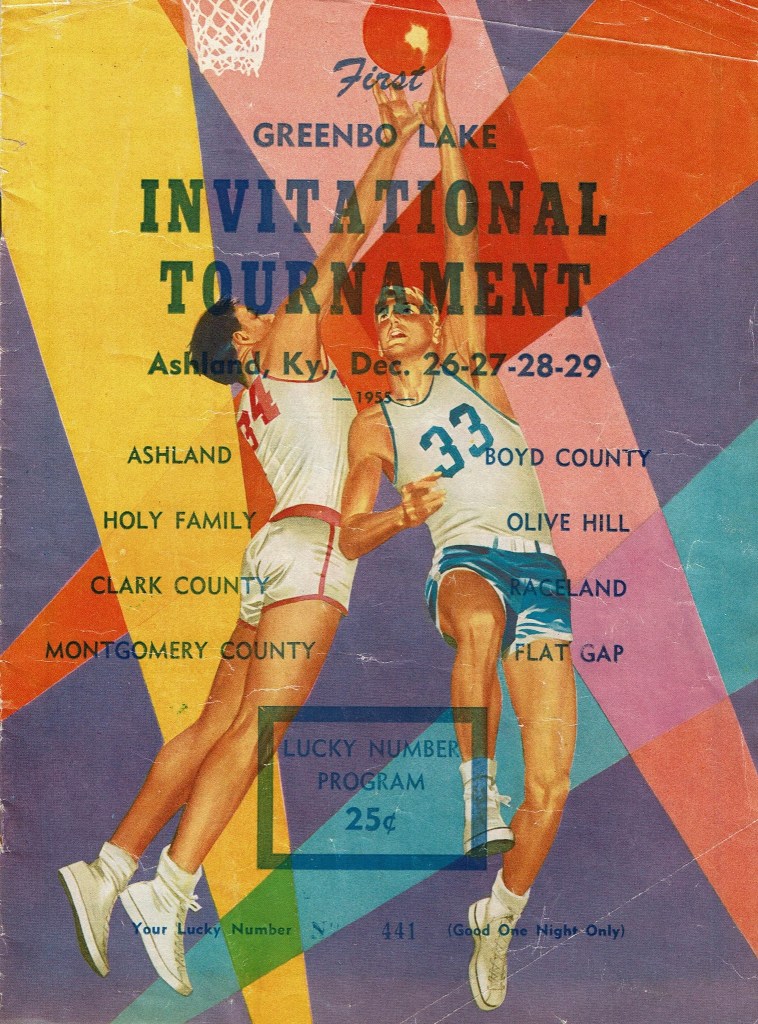
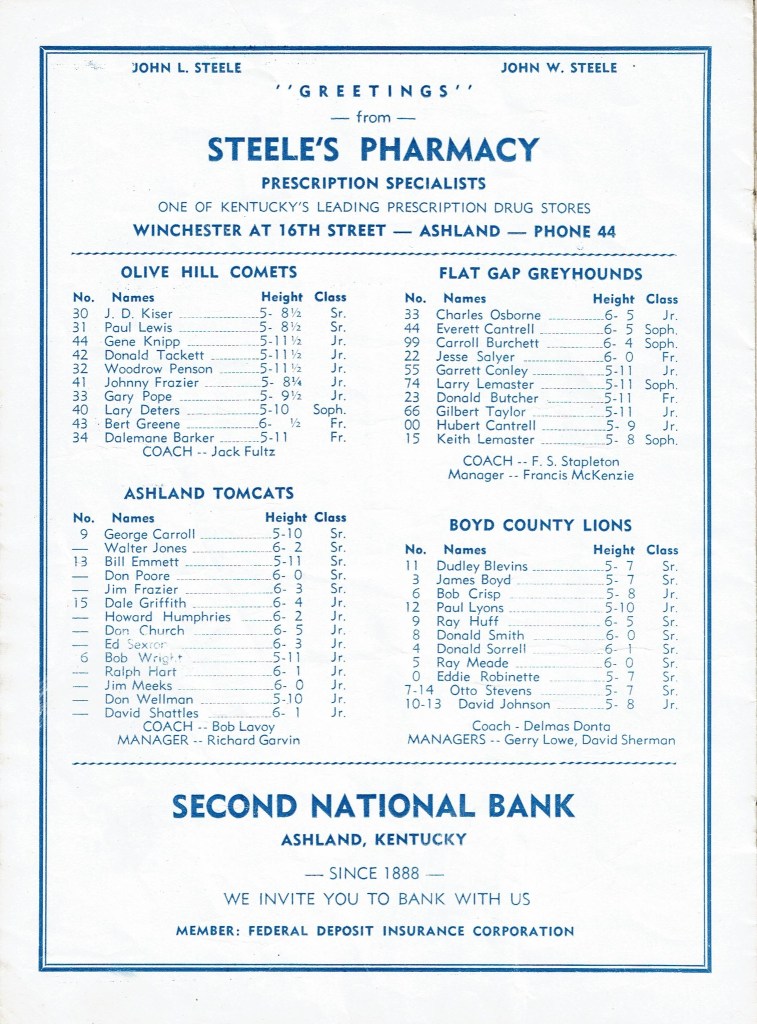
Ashland’s first game in the Ashland Invitational Tournament – originally called the Greenbo Lake Invitational – took place on Dec. 27,1955 at the Ashland Armory against Raceland.
George Carroll poured in 24 points, and it was only a sign of things to come for the little guard with the dead-eye shooting touch. The Tomcats defeated Raceland 66-47 in the opening game.
Carroll scored 35 as Ashland defeated Holy Family 79-66 in the semifinals and then the Tomcats upended Flat Gap and the great Charlie Osborne, 72-66, in the first championship with Carroll scoring 39.
That’s 98 points in three games, a nearly 33 points per game average, from the senior guard.
Here are the scores from the first tournament:
Opening round
Olive Hill 77, Clark County 61
Ashland 66, Raceland 47
Flat Gap 96, Montgomery County 78
Holy Family 88, Boyd County 67
Semifinals
Flat Gap 62, Olive Hill 56
Ashland 79, Holy Family 66
Championship
Ashland 72, Flat Gap 66
It was a star-studded tournament that came about because of ADI sports editor John McGill. Here is how some of the postseason honors for players in the AIT that first season.
Kenny Meyer of Montgomery County, All-State second team.
Charlie Osborne of Flat Gap, All-State second team.
George Carroll of Ashland, All-State third team.
J.D. Kiser of Olive Hill, All-State third team.
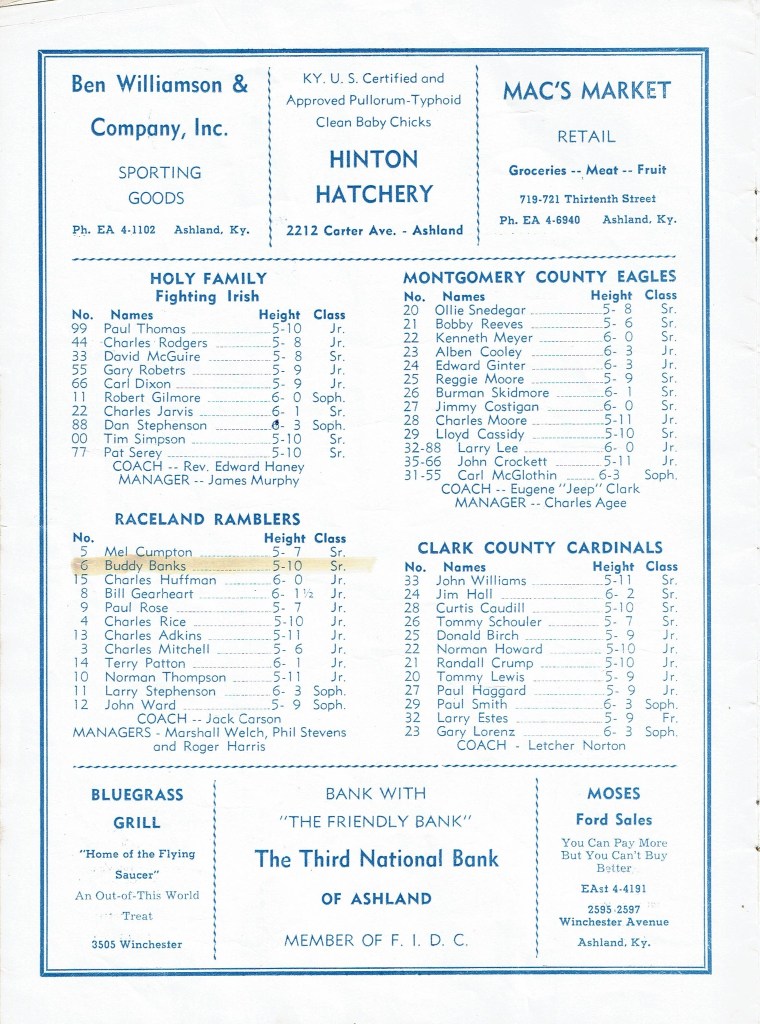
Bill Emmett of Ashland, Buddy Banks of Raceland and Bert Greene of Olive Hill were All State Honorable Mention.
The tournament was called the Ashland Holiday Tournament the second year before becoming the Ashland Invitational Tournament in the third year.
The Ashland Armory was good for Carroll later when he put 52 points on Carr Creek in a game thar preceded the Harlem Globetrotters putting on a show for a packed house of 1,500.
The Tomcats won the game 98-90 in an old-fashioned shootout. It featured Carr and Bobby Ray Shepherd from Kingdom Come. He transferred to Carr Creek and was probably the key to them winning the 1956 state championship a month after playing Ashland. Shepherd was a strong center known for his natural strength, like lifting 100-pound sacks of corn with ease.
His move in 1954-55 from Kingdom Come’s Wildcats to Carr Creek was likely a recruiting issue but due to economic reasons, given his coal-miner family. But he was a big reason the Indians won the crown that March
Two other important people crammed their way into the Armory to watch – Kentucky coaches Adolph Rupp and Harry Lancaster who came to scout Shepherd and got an eyeful from Carroll, too.
The game was played there because it was a preliminary game to the Harlem Globetrotters and basketball magician Meadowlark Lemon. The Globetrotters came out to watch the Ashland-Carr Creek game when they heard the fans stomping and cheering.
What everybody saw was the amazing Carroll scoring what was then a Tomcat record 52 points. He made shots from every conceivable angle as the Tomcats knocked off sixth-ranked Carr Creek. The two-team total of 188 was also an Ashland High School record at the time.
Carroll’s 52-point outburst stood as the Ashland record until Marty Thomas broke it in 1993 with 54 points in the 121-33 win over Jellico, Tenn., that also represents the most points scored by a Tomcat team. Carroll’s total pushed him past Bill Gray’s 48 points in the district win over Wurtland in 1954.
It was an age of basketball when the object was more to outscore the opponent than stop them. Most teams stayed back in 2-3 zone defenses and tried to outrun the opponent in racehorse-style games.
A big reason for that was the coming of age of the jump shot. It had been around just long enough for teams to have players almost perfect it. Ashland had its share of shooters during that time — Earl “Brother” Adkins, Gray and Carroll among them. The fans were eating it up.
Holy Family had Fred Simpson and later his brother, Tim, putting in points from deep outside.
Some of Carroll’s teammates included Don Church, Don Wellman, Dale Griffith, Howard Humphreys and Bill Emmett. Church was a rebounder supreme for the Tomcats who never minded feeding it back out to Carroll, who could stop on a dime from behind the circle and pop them in.
The 5-foot-10 Carroll scored in double figures every game in the 1955-56 season and finished with a 24.3 scoring average. Ashland finished 20-9 after losing to Mt. Sterling in the regional semifinals.
Remember, of course, this was all 30 years before the 3-point line came into being. Carroll and Gray were both bombers from well behind what is now the 3-point arc.
The Globetrotters were so entertained by the Ashland-Carr Creek game that when a reporter came up to talk to them, Meadowlark Lemon told them they needed to talk to those boys. “I’ve never seen a game anything like this,” he said. “These boys are the stars tonight.”
The Globetrotters came out and put on a show for the 1,500 who had jammed their way into the armory. But they couldn’t outscore Ashland or Carr Creek, recording a 74-69 win over the Honolulu Surfriders in a game marked more by showmanship than anything else. The newspaper report said the fans especially howled when the Trotters warmed up with the invisible ball routine.
For more than 50 years, Gary Kidwell, The Old Right Hander, was the voice and the record-keeper of Lewis County athletics. He hosted the Saturday Morning Sports Program on WKKS and wrote the Sports Corner column in The Lewis County Herald, a weekly tradition that connected generations of readers to the achievements of our student-athletes and kept local sports in front of our community.
Kidwell, 82, passed away at Vanceburg Hills nursing facility after a long journey with dementia.
Gary’s impact on Lewis County reached far beyond a microphone or a byline. Over seven decades, he served as a player, coach, teacher, athletic director, umpire, commissioner, and as a tireless supporter of young people in this county and across northeastern Kentucky.
Gary Kidwell was an icon in Lewis County, serving the school system and community for decades. (Photo by Dennis K. Brown, Lewis County Herald)
“Our region has lost a media icon, the Lewis County Lions have lost their biggest fan and best coach, and I have lost a childhood hero as a basketball girl in a neighboring county,” Said State Senator Robin Webb.
“Alice coached the Lewis girls when I played at East,” Webb adds. “They have been mentors, and friends since. I love the Kidwell family and send them love and prayers for comfort.”
Gary Roger Kidwell grew up in the Charters community, played for the Lions in the late 1950s and early 1960s, and later returned home to Lewis County after an early coaching and teaching stint at Millersburg Military Institute.
Beginning in the mid-1960s, Gary taught and coached at Lewis County High School, serving as head basketball coach, head baseball coach, assistant football coach, and later athletic director for nearly two decades.
His baseball teams won hundreds of games, a 10th Region championship and a state quarterfinal appearance in 1977, as well as multiple district titles and an Eastern Kentucky Conference championship.
Lewis County Yearbook Photo of Coach Gary Kidwell.
His basketball teams brought home three straight 62nd District championships in the late 1970s and helped restore pride in Lions basketball. He was instrumental in reviving the football program and helping build up Little League baseball in Lewis County.
After stepping away from the bench, Gary found new ways to serve the sports he loved. He became a respected baseball and softball umpire, working district, regional, and state tournaments and earning recognition as Kentucky High School Umpire of the Year.
He later served as Commissioner of the Eastern Kentucky Conference and as a member of the KHSAA Board of Control, helping guide high school athletics well beyond our county lines.
Gary’s lifetime of work earned him induction into the Kentucky High School Athletic Association Hall of Fame, the National High School Athletic Coaches Association Hall of Fame, the Lewis County High School Athletic Hall of Fame, and honors from his alma mater, Morehead State University.
Those plaques and certificates tell part of the story, but they do not fully capture the late nights, long bus rides, and countless hours he invested in our kids and in this community.
For many in Lewis County, though, the most familiar part of Gary’s legacy was his work behind the microphone and in these pages. Since the mid-1970s, he served as sports editor of The Herald, writing his weekly column, covering games, and keeping alive the memories of decades of Lions athletics.
Each Saturday morning, listeners tuned in to WKKS to hear him talk with coaches and players, swap stories, share scores, and shine a spotlight on local student-athletes.
Gary Kidwell during a timeout in his coaching days.
LCHS Principal Jack Lykins said, “For younger people Gary Kidwell is known as the guy on the radio every Saturday morning. For the majority of us, we know him as coach, athletic director, voice of the Lions, friend and ambassador. No matter where you went in the state, if you told someone you were from Lewis County you always got this response: ‘How is Coach Kidwell doing?’ Those in my generation will always call him ‘Coach.’”
I first knew Gary as a student in the 1970s. Like so many others, I watched and learned from him long before I ever worked with him. Later, as an owner and manager of WKKS and publisher of The Herald, I had the privilege of working beside him for many years.
I learned that Gary never stopped working for the kids of Lewis County. If there was a Lions game being played, he wanted to know the score, who played well, and how their efforts could be recognized.
He had an acute sense of humor and must have known thousands of jokes and one-liners. We shared many long road trips, and we passed the time with sports talk and an endless trading of jokes. One particular trip to cover a game in Indianapolis stands out, several hours each direction of jokes, stories, and more jokes. And he still had more in reserve.
George Plummer, longtime family friend, shared, “I am sad to learn that my friend, the old right hander, Gary Kidwell, has rounded third and headed for home. I always enjoyed all the jokes he could tell. He has attended more ballgames than anyone I can think of. Rest in peace, my friend.”
Mike Edington, close friend and longtime media assistant, said, “Gary was a great friend who has given me many good times going to different sports events. It’s hard to say goodbye to someone who has given me so many good memories.”
Chris Perry, a friend and longtime supporter of West Carter athletics, said, “Our region has truly lost another icon. When you thought of Lewis County basketball, you thought of Gary Kidwell. He poured his heart into coaching the Lions, and when his time on the bench ended, he carried that passion straight to the radio table. He gave himself not only to his own community but to the entire region. I truly enjoyed every conversation we shared. My heart breaks for his wonderful wife, Alice, and their family. There’s comfort in knowing he’s now reunited with Merle.”
Tammy Underwood Alburg, former standout basketball player and coach, reflected on Kidwell’s impact: “I wonder if he ever knew that his own impact went far beyond the edges of the court. He touched my life in so many positive and profound ways—offering wisdom, mentorship, friendship, and laughter. Coach Kidwell really and truly is the poster child for one of a kind. Thank you for the positive impact you had on my life, Coach. Tell Merle I said hi.”
Jimmy Lykins, who was coached by Kidwell and later served as LCHS athletic director said, “He was an ambassador for the youth and Lewis County Athletics wherever he went across the state of Kentucky. He will be remembered for his love of athletics and the ability to connect with people wherever he went. He will leave a huge hole in the hearts of Lewis Countians.”
Local leaders also recognized the magnitude of the loss. Judge Executive George Sparks said, “Lewis County lost a true champion for our young people with the passing of Gary Kidwell. For decades, Gary poured his heart into our schools and our community. Generations of student-athletes knew that if they worked hard and represented Lewis County with pride, Gary would be there to tell their story. We are grateful for his lifetime of service and the example he set.”
Gary had a way of making people feel seen. He celebrated the big wins and the quiet, everyday efforts—the role players, the bench, the coaches, the clock keepers, and the folks who swept the gym floor. He encouraged young people to work hard, represent Lewis County well, and carry themselves with pride.
He loved his family deeply. Gary is survived by his wife of 61 years, Alice Kidwell, and by two daughters, Stacy Kidwell of Morehead and Tai Kidwell Hieneman of Flatwoods. He was preceded in death by their son, Gary Merle Kidwell, who passed away on July 18, 2023.
For all his awards and honors, Gary remained grounded in the place he called home, living just across the highway from Lewis County High Schoo, the Home of the Lions. He often said he was blessed to spend his life doing what he loved—coaching, teaching, umpiring, broadcasting, and writing about sports—and to do it right here in Lewis County.
He never forgot where he came from, and he never stopped giving back to the community that supported him.
“I will always remember Gary as a person who loved Lewis County sports,” said Bill Tom Stone. “He spent years coaching young kids and spreading the word about Lewis County sports everywhere he went. His impact on our community is greater than most will ever realize.”
Lewis County has lost an icon, a teacher, a coach, a broadcaster, and a friend. We have also lost a man who believed, week after week and season after season, that our young people and our community were worth showing up for.
“Gary Kidwell was a Lewis County icon,” said Pastor Tom Cox. “He will be remembered most for his contributions to sports, but he was equally successful as a family man, a valuable church member and a positive influence in his community.”
On behalf of The Lewis County Herald and WKKS, we are honored to have worked beside and along with him. Our thoughts and prayers are with his family, his former players, his colleagues, and the countless people whose lives he touched.
Services will be at 1:00 p.m. Saturday, November 22, 2025, at Vanceburg Christian Church with Pastor Tom Cox Jr. officiating. A fellowship dinner will follow prior to traveling to the burial service at Mound Cemetery in Piketon, Ohio. Visitation will be at the church after 9:00 a.m. Saturday.
Arrangements are under the direction of Gaydos Funeral Home in Vanceburg.
Obituary for Gary Kidwell, 1943-2025
Gary Roger Kidwell, 82, of Vanceburg, passed away peacefully Saturday, November 15, 2025, at Vanceburg Hills, following a long battle with dementia.
A lifelong Lewis Countian, he was born September 20, 1943, at Stricklett, a son of the late Marcus E. (Shirley) Kidwell and Thelma Sapp (Jess) Gulley.
After graduating from Lewis County High School in 1961, Gary pursued a career in education at Morehead State University, earning Bachelor’s, Master’s, and Rank I degrees. While at MSU, Gary met and married his wife of 61 years, Alice Nelson Kidwell, on September 6, 1964.
Gary began his teaching and coaching career at Millersburg Military Institute in 1965. In 1967, he was given the opportunity to return to his home in Lewis County and continue his career, where he would serve the students and athletes of Lewis County Schools for 50 years.
During his time with the Lewis County Schools, “Coach” served in numerous roles. He started out teaching and coaching basketball and baseball and was integral in reviving the football program at LCHS. He later served as athletic director for many years, representing Lewis County on numerous state and national boards. Many Lewis County alumni remember him as the comical driver’s education teacher as he fearlessly taught many young students and members of the community to drive.
Anyone who knew Coach knew his passion for all things sports. He loved his Lewis County Lions, Kentucky Wildcats, Cincinnati Reds, Cincinnati Bengals, and Morehead State Eagles. His dedicated following of his favorite teams led to his long-time interest in sports media. This afforded him countless opportunities to attend and cover games on local, state, and national stages. He was honored to have the chance to cover his Wildcats in bowl games, SEC and NCAA tournaments, the Reds in the World Series, and the MLB All-Star Game in Cincinnati.
But he was most proud of his local media efforts that he used as a platform to promote local student athletes. Gary hosted a weekly sports radio show, “Saturday Morning Sports,” and wrote a weekly sports column in The Lewis County Herald, “Kidwell’s Korner,” and was the “Voice of the Lions” on WKKS Radio for more than 50 years.
If you attended a Sweet Sixteen basketball tournament in the last 60 years, you were sure to see Gary in attendance sharing stories, jokes, and memories with long-time friends from across the state.
Through his many years of service to the sports world, Gary was honored to receive several cherished awards, including induction into five halls of fame: KHSAA–Dawahares Hall of Fame, KABC Court of Honor, NHSCA Hall of Fame, Morehead State University Alumni Hall of Fame, and Lewis County High School Athletic Hall of Fame. He was also named KHSADA Athletic Director of the Year in 1995 and was a top-5 finalist for National Athletic Director of the Year. Gary also enjoyed umpiring softball, advancing to call multiple state championships. A highlight of Gary’s summer for many years was umpiring at the Mike Borders Beagle Classic. He also spent 26 years as commissioner of the Eastern Kentucky Conference.
Aside from sports, Gary’s greatest loves were his children and grandchildren. You could often find him cheering them on from the sidelines, no matter the sport or activity. He was always proud of their accomplishments and never shy to brag on them to others. He always loved the annual Kidwell family vacations and was guaranteed to provide plenty of content for hilarious stories for years to come.
He was the king of one-liners, always cracking a joke and lighting up a room with laughter. Even into his last months, he was attempting to deliver his famous punchlines with a smile on his face.
Gary was of Christian faith and was a devoted member of Vanceburg Christian Church, serving as a deacon for many years.
Survivors include his wife of 61 years, Alice Nelson Kidwell; two daughters, Stacy Anne Kidwell of Morehead and Tai Kidwell Hieneman (Keith) of Flatwoods; one daughter-in-law, Mandy Kidwell of Flatwoods; six grandchildren, Carson Kidwell, Kate Kidwell, Alex Kidwell, Selah Kidwell, Claire Hieneman, and Jack Hieneman; two brothers, Barry Gulley (Cindy) of Whiteburg, Georgia, and Mark Kidwell (Monica) of Pensacola, Florida; four sisters, Tonia Berry (Charles) and Ginger Miller (Gary) of Flemingsburg, Dana Hammonds (David) of Hebron, and Tara Reed (Brian) of Lexington; and his uncle Kenneth Sapp, who was like a brother to him.
In addition to his parents, he was welcomed into Heaven by his beloved son, Gary “Merle” Kidwell, and his grandparents, Hanson and Maggie Sapp and Ashel and Rosa Kidwell.
Services will be at 1:00 p.m. Saturday, November 22, 2025, at Vanceburg Christian Church with Pastor Tom Cox Jr. officiating. A fellowship dinner will follow the service at the church prior to traveling to the burial service at Mound Cemetery in Piketon, Ohio. Visitation will be after 9:00 a.m. Saturday at the church.
Arrangements are under the direction of Gaydos Funeral Home in Vanceburg.
As Gary said and wrote for many years, “This is the old right-hander saying, ‘Have a good week in sports!’”
Steve Dodd, a former Ashland Tomcat basketball standout and a respected high school and college coach, passed away Monday from injuries sustained in an automobile accident last month. He was 70.
Dodd starred for the Tomcats from 1971–73, serving as a key reserve on the 1972 team that was ranked No. 1 in the state but was upset by Russell, 80–75, in the 16th Region championship. Fittingly, 34 years later in 2006, Dodd guided Russell to its first regional title since that very season.
During his six years as the Red Devils’ head coach from 2002–08, Dodd compiled a 98–84 record and reached at least the 16th Region semifinals in five of those seasons before resigning.
Steve Dodd was a former Ashland Tomcat basketball standout and Hall of Fame NAIA coach.
A 1973 Ashland graduate, Dodd went on to earn a bachelor’s degree in English from Lipscomb University, where he was also a standout player. It’s also where he met Kay, his wife of 48 years. They had a son and daughter.
Soon after graduating, he began his coaching journey as an assistant at Battleground Academy in Franklin, Tenn.—the start of a nearly 50-year coaching career. Dodd’s coaching stops included Alderson Broaddus University, Oklahoma Christian University, Bethel College, and Lindsey Wilson College, where he led the program from 1998–2002 and enjoyed great success. His contributions to the sport earned him induction into the NAIA Hall of Fame.
After his time at Russell, Dodd took over at Hillwood High School in Nashville, leading the Hilltoppers from 2008–19, and most recently coached at Dickson County High School in Dickson, Tenn.
Dodd’s passion for the game went far beyond wins and losses. He was known for shaping young men both on and off the court—a fact reflected in the many heartfelt tributes shared by former players and colleagues Tuesday.
Todd Parsley, who served as Dodd’s assistant coach at Russell, told sportswriter William Adams of the Ashland Daily Independent that coaching alongside him was a privilege.
“I don’t think people knew how much he cared about his players,” Parsley said. “He had kids that would run through walls for him because I just saw the personal side of coach. When kids were having trouble with their home life, he was there helping them. He was far greater than just wins and losses.”
Dodd’s brother, Gary, said coaching was Steve’s lifelong calling. “He had 11 fractured ribs, four fractured vertebrae, and a bad concussion, but when he heard that, it was like, ‘I can pursue this, I can do that,’” Gary said. “He wanted to get back out there at age 70 and have another shot at trying to do that, even for the interim.”
As a player, Dodd was known for his toughness and scoring ability, averaging 15.8 points per game as a senior. That year, Ashland fell to Boyd County twice—first in the 64th District finals, 77–73, and again in the regional championship, 73–64, despite Dodd’s 21- and 22-point efforts. It was the first time Boyd County had beaten Ashland in basketball.
Dodd finished his Tomcat career with 669 points, including a career-high 27 against Fairview.
From his days wearing Ashland’s maroon and white to his decades molding athletes across the country, Steve Dodd left a lasting mark on basketball—and on everyone he coached.
The blockbuster movie “JAWS” came out in the summer of 1975 and frightened viewers who were so traumatized they barely dipped their toes in the ocean.
That summer, Herb Conley took his family to Mrytle Beach, an annual pilgrimage for the family. They would set up at a campground and make daily trips to the beach. The three boys – Greg, Shawn and Jeff – were all under 10 and braver than their mother Janice wanted them to be.
Each day they went a little further into the ocean and Janice told Herb she was not comfortable with how daring the boys were becoming.
Herb had an idea. He remembered there was a movie about sharks that had just come out and he took his young family to the movies to watch “JAWS.” The boys sat wide-eyed through the terrifying movie. Let’s just say Janice did not have to worry about the boys getting too far out into the ocean because they barely got back in the water at all the rest of the trip.
Terry Bell breaks through the hoop leading the 1975 Ashland football team onto the field before a playoff game.
“JAWS” had made an impact on Herb Conley, but it would not be the last one for Ashland’s veteran head football coach.
Living up to the JAWS nickname
He returned to Ashland refreshed and looking forward to the 1975 football season. Conley was anticipating a good season given that it was a strong senior class and some of them would be entering their third year of either starting or playing a lot.
It was a season built for success with a combination of speed, size and power. They were developed very much in the image of their coach – hard-nosed, hard-hitting and determined (afraid?) not to make their coach proud. Herb Conley commanded respect as a player, as an assistant coach and as the head coach. He was in his eighth season as the Tomcats’ head coach and a group that he believed was as good as any since the 1971 and 1972 seasons.
When Conley met with his assistant coaches before the season, he mentioned how his boys were scared to death after watching “JAWS” at the beach. Conley mentioned the possibility of naming the defense “JAWS” mostly as a joke. But coaches Mike Holtzapfel and Bill Tom Ross loved the idea.
Rick Sang waits for the play call from head coach Herb Conley, left, and assistant coach Bill Tom ross during Ashland’s 1975 season.
Conley was less sure it was a good idea because, as he put it, sometimes those things backfire on you. But Holtzapfel and Ross would not let it go, and Conley told them only if the team could prove it. That is also what they told the players, who were excited about naming the defense after the terrifying shark from the movie.
It took one game for Conley to be convinced that this “JAWS” nickname might be a good thing. The Tomcats blasted Johnson Central 41-14 in the opener at Putnam Stadium and hard-hitting Chuck Anderson knocked the Golden Eagles’ quarterback out of the game with a crunching hit that also knocked the breath out of him.
When Coach Conley went out on the field to check on him, Anderson could barely breathe but he practically begged his coach to let the team be “JAWS.” Conley pulled him up by the belt and helped his biggest hitter off the field. He would return to the game, but Johnson Central’s quarterback would not.
It became clear that it was no longer safe to go on the football field if the “JAWS” defense was the opponent.
The Tomcats kept it to themselves until after the second week of the season when they defeated top-ranked Bryan Station, 22-12, with another big hit from Anderson spurring a brilliant defensive effort.
Terry Bell was selected the top offensive lineman in Kentucky in 1975.
He knocked a would-be tackler unconscious with a block that sprung Rick Sang for a touchdown on a punt return that put Ashland ahead 12-0. It also set the tone not only for that game but the season.
Eventually, the media at the time got word about the “JAWS” defense and the Tomcat band even learned the memorable music from the movie when the shark was about to attack. Fans brought plastic sharks to the games and the businesses in town were prompting “JAWS” defense on their signs.
Everybody bought in, especially the team.
Make a wish(bone): A dominating offense
Ashland rattled off win after win during the regular season and went into the playoffs unblemished and ranked No. 1 in Class AAAA – then the biggest classification in the state. They demoralized teams on defense and dominated them on offense, too, with a vaunted wishbone offense.
Gary Thomas, only a junior, rushed for more than 1,700 yards and Jeff Slone surpassed 1,000 yards. Jay Shippey and Jim Johnson shared fullback duties, Anderson was the quarterback and Greg Jackson split time in the backfield, overcoming a broken foot that cost him a few games.
Quarterback Chuck Anderson (12) and tackle Raymond Hicks.
Sang was a top athlete as a tight end, return man and punter and the offensive line was ferocious with Terry Bell leading the way. He was voted as the Best Offensive Lineman in Kentucky. Bell was joined on the line by center Terry Lewis, guard Yancey Ramey and tackles Casey Jones and Raymond Hicks.
Shippey and Johnson were punishing runners and Thomas, Slone and Jackson ran like gazelles. Conley said his halfbacks were some of the best blockers he had during his coaching career. Split end Dougie Paige, all 115 pounds of him, could put players twice his size on the ground in downfield blocking. Keith Hillman, a speedy receiver, also played some at split end.
A trip to the movies just what was needed
Ashland had no losses during the regular season, but the team escaped one Friday night against Huntington High, winning 12-6 despite losing three fumbles to improve to 6-0. The players knew it was not their best effort and dreaded practice the following Monday.
Conley said he sensed something was wrong and that the team was playing tired. He told the coaches that instead of a brutal practice, he was taking the players to the movie on Monday to watch “the Towering Inferno,” starring O.J. Simpson, at Midtown Cinema. The players were stunned when they arrived ready for practice and were told to keep their street clothes on and get on the bus. Conley had instructed Hank Hillman of the Boosters Club to reserve the theater – complete with drinks and popcorn – for the team.
It was just what they needed. They came back fresh the next Friday, hammering a good Belfry team 47-7. The fire was reignited.
Ashland closed the regular season at 11-0 with a 43-0 victory over rival Boyd County that wrapped up the district and put them in the postseason. Back then, only district champions advanced to the playoffs. Boyd County had won the previous two seasons against the Tomcats and wanted to spoil their undefeated season. But the Lions were no match for them in at the time was the most lopsided loss in the series.
The playoffs beckon and a flight to remember
Even though the Tomcats were ranked No. 1 and undefeated, their first playoff game was on the road at Dixie Heights in one of the coldest games anybody can remember. After a sluggish first half, a halftime butt-chewing from their head coach got everybody’s attention and Ashland won 36-6. He had captains Sang, Bell and Anderson stand in front of mirrors in the locker room and told them to look into the mirror and ask themselves if they gave their best effort. The rest of the team was watching, and they got the message.
Doug Paige gets the play from coaches Bill Tom Ross, left, and Herb Conley.
Years later, Sang confessed that he thought he had given his best effort but stared into the mirror anyway. Coach Conley called Sang into his class on the following Monday and told him, “Hey Rick, we watched the film, and you really didn’t play that bad.”
They followed that with a win over Lafayette, 21-6, at Putnam Stadium to advance to the Class AAAA State At-Large championship in Paducah.
The Tomcats were in for a long trip on the other side of the state. But before the Lafayette game was even finished, plans were made to fly to Paducah and the Tomcats became the first team in Kentucky high school history to charter a flight to a game. Ashland was an eight-hour bus ride from Paducah but only a short flight. The Boosters Club raised the money, and the team flew on the day of the game.
Jim Johnson (41) leads the blocking for Greg Jackson.
Many of the players were making their first plane flight and it was a quiet trip with nobody saying anything. It was only five years since the horrific Marshall University plane crash,
The flight kept their legs fresh for Paducah and Thomas broke a 7-7 deadlock with a 75-yard touchdown run with three minutes to play that gave the Tomcats a 13-7 victory and a spot in the overall state championship game against Jefferson County champion St. Xavier.
St. Xavier was undefeated and loaded with talent. The Tigers had 11 different players on offense and defense and that depth wore down the Tomcats, who lost 20-0 after a tight first half, trailing only 6-0 with Ashland missing at least two good scoring opportunities. It would be the only loss in a 14-1 season, but the 1975 Tomcats have remained one of the most beloved teams in Ashland history.
On Oct. 3, the Tomcats 1975 JAWS team will be recognized at Clark’s Pump-N-Shop Putnam Stadium on their 50th anniversary.





 MARK MY WORDS 2