RIP Mike Johnson, Tomcat Legend

Mike Johnson was an iconic figure in Ashland sports. He played on state championship teams in Little League (1963) and high school football (1967) and was on Ashland’s state baseball runners-up in 1969. He was the first honoree in the Coaching Legends of the now defunct Ashland Junior/Senior League, named a Distinguished Tomcat in 2013 and a CP-1 Hall of Fame member in 2019.

Johnson was practically an institution in Ashland Babe Ruth, coaching the Reds for 19 seasons. Former players sought him out long after their playing days were over. They often came back and thanked him for inspiring them.

What better testimony can there be for a coach?

Johnson told me once the when the players would come back to see him that he would do a double-take because the boys who were 13 to 15 years old when he coached them were now grown men. But if they told him their name, he remembered them and could recall details they may not even recall.
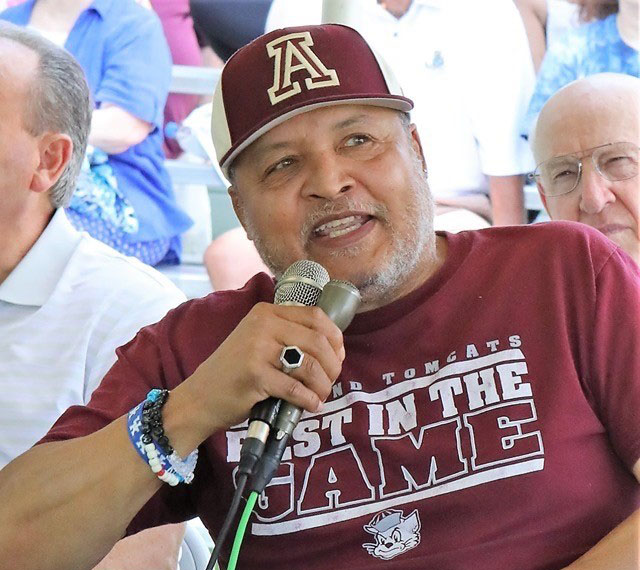
Mike Johnson during the 2019 CP-1 Hall of Fame induction ceremony in Central Park.

And they sure loved him and the impact he had on their lives.

Johnson has a passion for Ashland youth baseball that carried on for more than 50 years, starting back in his Little League days in the early 1960s. It was a turbulent time for African-Americans and it was during Johnson’s days as a Little League All-Star that he his eyes were first opened to prejudice.

Johnson was a member of the Ashland American 1963 Little League team that would eventually become state champions and came within one victory of making it to the Little League World Series. They played the State Tournament in Lexington and the Ashland team stayed at a motel that would not allow the team’s two Black players – Charlie Jackson and Johnson – to get in the swimming pool.

“On the last day before we left, I dove into that pool with all my clothes on,” Johnson said with a grin in an interview with me.

After the team won its first game in the State Tournament, he remembered the coaches wanted to treat the players to something special. They tossed around ideas like bowling and swimming before settling on a game of miniature golf because there was a course just down from where they were staying.

“I’d never played miniature golf in my life,” Johnson said. “I was looking forward to it. Everybody was excited.”

The team went together to the course and grabbed a club. But the owner stopped Jackson and Johnson from picking one up, telling the coaches that those two boys wouldn’t be allowed to play.

The team decided if their two friends weren’t welcome, they weren’t staying. It was a unanimous decision.

“Growing up in the ‘60s for a black kid was kind of rough,” Johnson said. “Sports was kind of a relief.”

While Johnson learned about prejudice during that trip to Lexington, he also learned about friendship and respect.

“It meant a lot to us that our teammates and coaches stood behind us,” he said. “They wouldn’t do anything or go anywhere that we couldn’t go.”

He said it also may have inspired the Ashland American All-Stars, who went on to win the State Tournament.

“I think it made us play harder, I really do,” Johnson said.

Johnson later played on a Babe Ruth state champion and was a starting cornerback on Ashland’s 1967 state championship football team and was the quarterback on coach Herb Conley’s first Tomcat team in 1968.

His oldest son, Mike Jr., was an all-around athlete and one of the greatest running backs in Tomcat history. He’s now a (track) state champion coach too at Mercer County and an outstanding assistant football coach. A younger son, Charlie, was a member of Ashland’s 1990 state championship team making them the only father-son duos to win state football titles in Tomcat history. His daughter Angie was a tremendous high school and college basketball player and college coach at Georgia and Florida State. He and Anyetta, his wife of 54 years, had reason to be proud.

His speeches to All-Star teams always underscored Ashland’s tradition and how much fun it is to ride the fire truck after winning a state championship. He was a man who knew through life experiences in this Tomcat town that riding the fire truck meant you were something special.

Johnson coached many All-Star teams during his 19 years and, while he never won a state championship, the players left with good memories. Players always liked playing for Johnson because he was fair and he made the game fun. He expected the players to give him their best effort every time and they knew it. I had the honor of coaching with him during my son’s three years on Babe Ruth All-Star teams. I learned so much about coaching and even more about him. He was an inspiration.

His coaching skills were not limited to baseball. He was a constant with the Ashland Junior Football League as well. If you can coach, coach. This man could coach.

And If not for some health issues that were eventually too much to overcome, he might have never stopped coaching.

But Mike Johnson left an imprint on Ashland sports that has few equals. He will always be a Tomcat Legend.
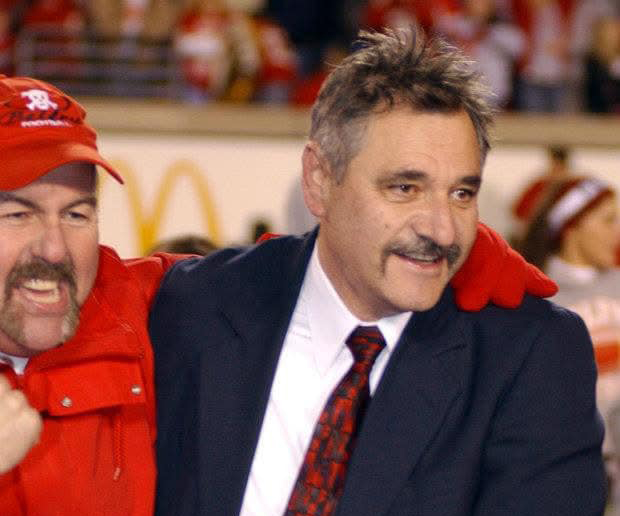
Coach Haywood’s life wasn’t just football. He was a guiding light for others.

The late great Philip Haywood was a mountain mover, putting that brand of football on the Kentucky high school football stage in magnificent ways throughout a brilliant career. During a 50-year coaching career, he amassed eight state championships, six runner-up finishes and an astounding 491 victories – more than any coach in Kentucky high school history – while serving as the head coach at Prestonsburg (nine seasons) and Belfry (41).

Fifty-years!

His passing on Wednesday doesn’t just leave a void, it leaves a deep hole in the heart of the Pond Creek community – and the Kentucky high school football community for that matter – that will be impossible to replace. I’m certain they are in shock that he’s gone. When I saw the report on Wednesday afternoon that he had died, it literally took my breath away. Even knowing that he was in a serious accident with severe injuries from a car accident a few days earlier, I was not expecting that news. Not Coach Haywood. He was going to recover and be fine. Such a good, good man.

It wasn’t just his football coaching skills that made him extraordinary. His interpersonal skills with players, teachers, sportswriters and anybody that crossed his path made him a master of communications. You walked away from any conversations with Coach Haywood feeling better about yourself because that’s how he affected people and that was his aim.

Coach Philip Haywood was successful in football and life. (Photo by Joshua Ball)

It was never about him. “How are you doing? How is your family?” and on and on the questions would go. We would eventually get around to football, which he loved to talk about, too. “How are the Tomcats doing?” he would ask me even if I was calling him about an upcoming game with Russell.

After serving as an assistant coach for three years at Tates Creek and Meade County, he took his first head coaching assignment at Prestonsburg, his alma mater, in 1975. That’s also the year I started working for the Ashland Daily Independent. Over the next few years, as he was building on an incredible coaching resume, I was learning the ropes of a sportswriter.

Prestonsburg was on the edge of our coverage area and, being at the bottom of the food chain in the sports department, that’s where I was to begin. I can remember interviewing him even then and coming away thinking how likeable he was. And I’m sure he had to answer (endure?) some dumb questions from this still green-behind-the-ears aspiring journalist.

We spoke off and on throughout his Prestonsburg tenure. Not often but often enough that we knew each other. If he didn’t answer the phone himself, he always called me back even though the ADI wasn’t really the paper of Prestonsburg. We might have sent a few hundred copies to that part of the Big Sandy area. Our reach mostly stopped around Paintsville (I had a good relationship with the great Walter Brugh, too).

Over the years both of our careers were moving. When he took over at Belfry High School in 1984, I had moved up the ladder and mostly covered the bigger schools in the closer part of our coverage area – Russell, Boyd County and Ashland.

Coach Haywood and I spoke on occasion, especially for some incredible battles with Russell and coach Ivan McGlone. They were important games and always a great chess match between Hall of Fame coaches. They were usually defense-dominated games with a conversion or extra point deciding the outcome.

Win or lose, both of those coaches were humble. They may have been disappointed if defeat came but understood how the game was played, and life was more than what happened on Friday nights. They were incredible men who offered life lessons to players during good times and bad. Both offered such dynamic insight into life even on the hardest of days.

Coach Haywood and I continued to be friends as our careers continued. I began covering more of Ashland games and eventually became the sports editor in 1989. That came during Haywood’s building of Belfry’s great program.

Belfry and Ashland knocked heads a lot during his time – 16 games to be exact. The Tomcats got the better of him in 12 of those, including a state semifinal game in 2020 at Putnam Stadium when Ashland won 10-3 on the way to the Class 3A state championship.

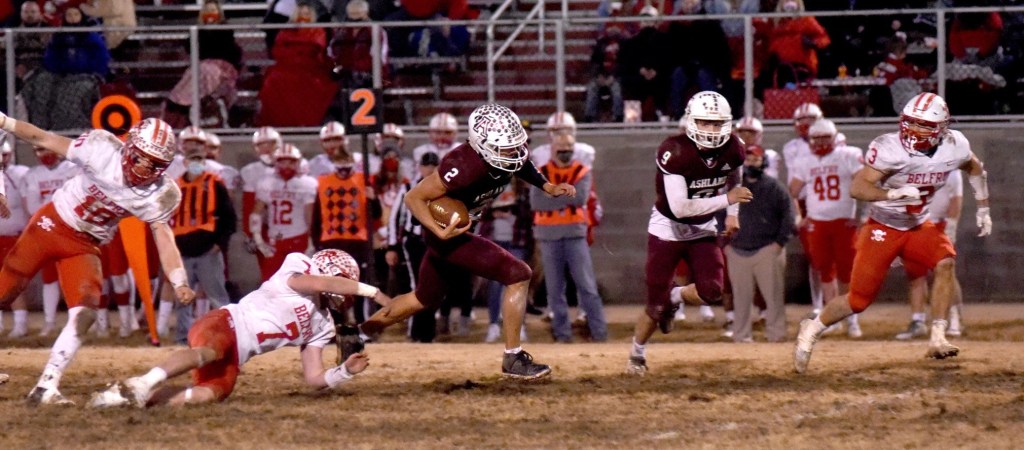
Keontae Pittman races for a 17-yard gain against Belfry in the 2020 state semifinals at Putnam Stadium. The Tomcats won 10-3 and won the Class 3A title a week later. (Photo by Don McReynolds)

He always had a healthy respect for the Tomcats and during many of our conversations he said just that to me. That may date back to his first coaching job as an assistant coach at Tates Creek for Roy Walton in 1972. The Creekers defeated Ashland 16-7 in the state championship that season in the last game ever played at UK’s Stoll Field. That Tomcat team never got the lasting respect they deserved but that’s a column for another day.

It might also be because of a conversation he had once with Herb Conley, who came over to his bus after a Tomcat game, put his hand on his shoulder and told him he was a great coach and was going to have a great career. Haywood never forgot the gesture.

Walton was a mentor for Haywood right down to the reason he wore a coat and tie on the sidelines every Friday night. Walton told him coaching on Friday nights was like going to the symphony so why not dress up. Tates Creek was 13-0 in that 1972 season.

Ashland was 4-3 at Belfry when Haywood was coaching and 8-1 in Putnam Stadium with the defeat (31-14) coming in 1989. That was the year before the Tomcats won the Class 4A title in 1990, which included a 35-20 victory at Belfry after the Tomcats had fallen behind at the half.

There were some important battles between Russell and Belfry over the years as well. Games that meant state championship appearances for the winner.

He carried so much respect for Ashland and Russell as I suspect he did for any opponent he was preparing to play. That’s just how he rolled. Respect the game, respect the opponent.

But Coach Haywood knew at the end of the day there were things a lot more important than a football game. He instilled that notion in his players, modeling what a Christian should be, showing these young men the importance of a relationship with Jesus. They didn’t have to look far for a role model that would not steer them wrong.

I cannot imagine what the Belfry community is experiencing right now. The word “loss” isn’t enough. Irreplaceable comes to mind. Greatness comes to mind. But not loss, because Coach Haywood was never about that word. It was always gain for him. Even in defeat there was something to be learned. He found a way to learn and teach even on the hardest days. He is teaching now that this is how you live and there is a reward. “Well done good and faithful servant” is what he heard Wednesday. And it wasn’t for his 491 victories and eight state championships. It was for a life that led others to Jesus. There is no bigger victory.