Here is some Ashland Tomcat football history with some kick to it

There have been three sets of goalposts in the 89-year history of Putnam Stadium. The first ones were shaped like an H and that were the standard from 1937 to at least 1972 (still researching that one). There have been two sets of the t-shaped goalposts – the first coming in 1974 when the goalposts were moved from the goal line to the back of the end zone – and the second when the renovation took place following the 2013 season.

That set of goal posts are the same ones being used now and were donated by Rick and Jana Sang. They have one of the goal posts from 1974-2013 in pieces and would like to give it a good home somewhere. It needs some work done to put it back together again. Somewhere outside Putnam Stadium might be a good place for this great piece of history.

Some quick research revealed unusual statistics concerning field goals and the Putnam Stadium goalposts who, if they could talk, may remember the field goals missed more than the ones that were made. I may try and set up that interview later.

One of Ashland’s most famous field goals didn’t happen in a home game. That one belonged to John Paul Walters, AKA “The Toe,” who kicked a game-winning field goal against Ironton in a 3-0 victory at Beechwood Stadium in 1950. It was the only field goal of his career, but it was a big one. He did connect on a dozen extra points.

Walters’ game-winning kick from 15 yards out grazed the crossbar before tricking over. He used a square-toed shoe and he had to practically beg coach Charlie Eblen he could make it. The kick became so famous that it was rumored someone had offered him $500 for his cleats. Walters told me that was “misleading because they’d have sure got it.”

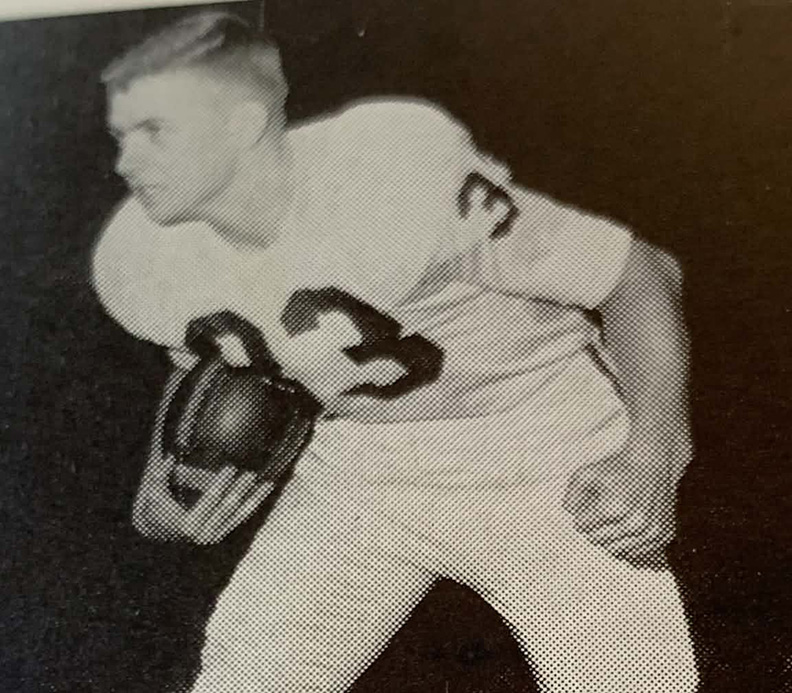
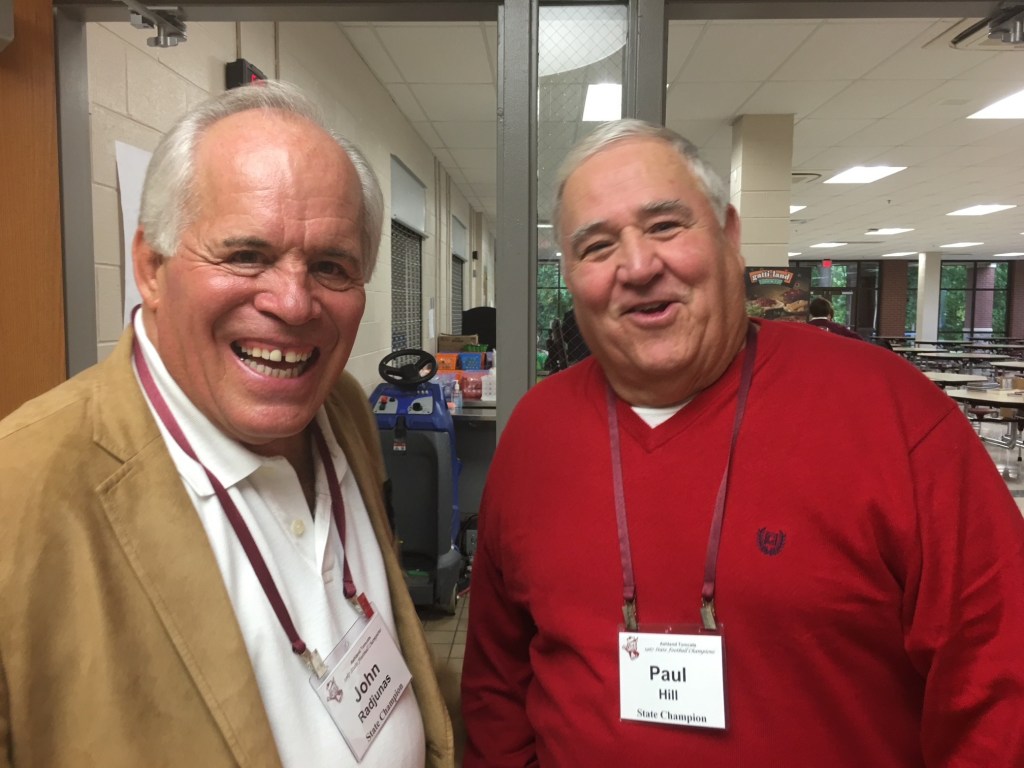
Paul Hill (kicker) and John Radjunas (holder) were part of the first field goal in Putnam Stadium history.

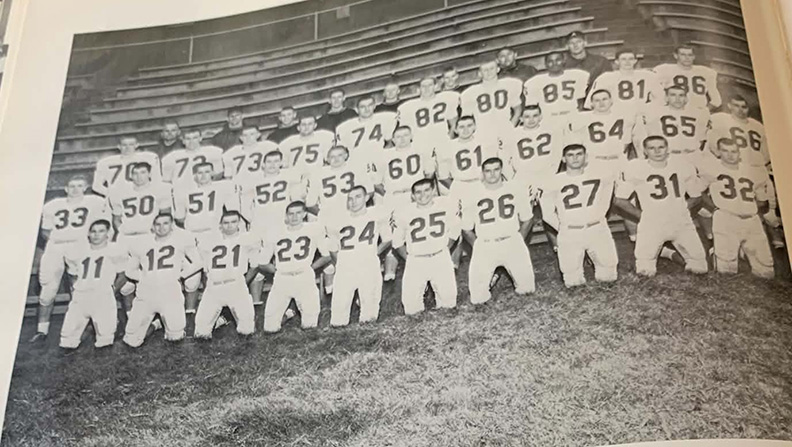
But the FIRST field goal made in Putnam Stadium didn’t come in the 1930s, 1940s or even the 1950s. It came during the state championship season of 1967 when Paul Hill connected on 24-yard field goal against Stonewall Jackson. It put the Tomcats ahead 3-0 in an eventual 13-3 loss. That was the only defeat in a 13-1 Class AA championship season.

Now, there were some extra point kicks in that 30-year span from 1937 to 1967 but that was the first field goal at Putnam Stadium. Hill was a straight-on kicker who tied the top of his cleat back to make a good kicking surface.

Here’s another inside story: The Tomcats didn’t have a kicker in coach Jake Hallum’s first season in 1966 when Hill and John Radjunas were juniors. They talked about it and decided they would sneak into Putnam Stadium and practice during the spring prior to the 1967 season. Whoever would make the first field goal would be the kicker and the other would be the holder.

But when they started to practice, Hill decided he would kick until he made one and settle the issue quicker. When he missed, he told Radjunas he was “bigger and meaner and he was going to get another turn.”

Radjunas was anything but stupid so he “allowed” Hill to have enough mulligans before he eventually made one.

That took hours and Speed Bailey, the Putnam Jr. High School janitor, spotted them on the field and chased them off. He lived in the white house that used to sit just outside the end zone. But the persistent duo kept trying to improve their skills (and increase their chances of having their name in the newspaper) so they kept sneaking into the stadium and Speed was there to shoo them off. He eventually went to Hallum and figured that would be the end of that stunt. But Hallum liked the idea and gave them keys to the stadium and a bag full of footballs.

They did a few more times but with the thrill of sneaking into the stadium gone, so was most of the fun.

Nearly 60 yards later, Hill still remembers making that 24-yard field goal against Stonewall Jackson. He had made his first one in the second game of the season against Boyd County, a 25-yard field goal in Cannonsburg.

It wasn’t the field goal that was most memorable about the Stonewall Jackson game to Hill though. It’s the nightmarish memory of Harry “Sugar Bear” Lyles, the dynamic Stonewall linebacker who was all over Putnam Stadium for 26 tackles.

“I’m an old man and I ain’t never forgot that man,” Hill said. “I’ve never seen anything like him.”

Hill didn’t have any professional kicking instruction except for a conversation with Bubby Payne, a former kicker for Ashland who played at UK years prior. Soccer-style had not arrived in America, so it was a straight-on approach. He ran a shoestring around the back of his shoe and then through his first single clean on the front of the shoe. He then pulled the string as tight as he could to force his ankle to be locked in a better kicking position. Hill did that regularly for kickoffs and many of them reached the goal line.

Hill remembers missing some field goals with line drive kicks that crashed into the crossbar and came right back at him. “I came up short,” he said. “Story of my life.”

Hill’s last field goal came against Covington Catholic the week after the Stonewall Jackson game and it was also at Putnam Stadium.

His most important kick though may have come in a 21-20 victory over McKell at Putnam Stadium. The extra point on the last touchdown provided the winning margin in one of Ashland’s toughest games of the season besides Stonewall Jackson.

Ashland was trailing 20-14 in the fourth quarter when Radjunas famously told Coach Hallum before the game-winning drive to save a timeout so Paul could have time to tie up his shoe. He did and then boomed it through the uprights for the narrow win in what Hill called “the best game we ever won.”

Don Gullett scored three touchdowns and ran for 88 yards in the game for McKell. Hill said his best play was chasing down Gullett and he told Don’s brother, Jack, about it later in life.

“Donnie’s pretty quick but I ran him down before he could score another touchdown that would have beaten us,” he told Jack.

“You couldn’t run him down!’ Jack shot back.

“I could if I had the angle and I did.”

Paul’s nephew, Clayton Hill, was a soccer star for the Tomcats and the kicker for the 1990 state champions. He didn’t have a field goal, but he did make 42 extra points. That Tomcat team went for it on most fourth downs.

The kicker with the most field goals, at least through the 2020 season, was Preston Freeman with nine over two years and seven in the 2006 season. He was another outstanding soccer player.

Jim Ward in 1965 used the dropkick to kick a dozen extra points but no field goals.

The first field goal in Ashland Tomcat history came in 1919 but I don’t have a name. The next came in 1923 by Wilfrey Wolfrey, who booted two including one that provided a 3-0 road victory over Millersburg Military Institute. He also made one at Armco Field in a 51-0 win over Paris.

Tyler Rowland not just right choice but the only choice as Ashland Tomcats’ new radio ‘Voice’

Tyler Rowland did such a superb job calling Ashland Tomcat sports on the radio late last fall and throughout the spring that Thursday’s announcement naming him the new “Voice of the Tomcats” came as no surprise.

Kindred Communications, which has carried Tomcat sports broadcasts for several years, announced in a press release that it would continue its partnership with Ashland athletics. Later in the release came the news that Rowland had been named the new “Voice of the Tomcats,” succeeding the late, great Dicky Martin.

From a news perspective, Kindred Communications may have buried the lead.

Rowland is a bona fide broadcasting talent on the rise. Last basketball season, he inherited one of the toughest assignments in the 16th Region when he stepped behind the microphone following the tragic passing of Martin, a broadcasting icon whose voice became synonymous with Ashland athletics.

Who could replace Dicky Martin? The truth is, nobody.

Tyler Rowland is now the “official” new Voice of the Ashland Tomcats.

But if there was one obvious choice, it was Rowland.

He brings the same meticulous preparation and genuine passion that made Martin respected throughout Kentucky. While no one could duplicate Martin’s unique style, Rowland has developed a voice and approach of his own that Tomcat fans quickly embraced.

When the opportunity came, Rowland didn’t just seize it—he sprinted with it.

A 2006 Ashland graduate, Rowland played football under Leon Hart. He considered Martin both a mentor and a friend. He credits Martin for teaching him the craft of broadcasting and eagerly absorbed every lesson.

Rowland began working alongside Martin in 2020, assisting with the radio broadcast of Ashland’s 35-14 victory over Elizabethtown in the Class 3A state championship game in Lexington.

“Dicky is a dear, treasured friend,” Rowland said. “Dicky guided me in so many ways and I think is right up there with Cawood Ledford and Marty Brennaman.”

Determined to sharpen his skills, Rowland sought broadcasting opportunities wherever he could find them, including calling football and basketball games for West Virginia State during the 2024-25 season. He’s also done summer league basketball games for the past few years, always looking to refine those God-given broadcasting skills.

His love for sports—and for the Tomcats—dates back to his elementary school days at Oakview. He recalls his sixth-grade year as a turning point when he played organized basketball for Steve Reliford.

“My passion for sports stems because of that year and how much I developed socially and what I learned from it,” he said. “Steve believed in me at a time I didn’t come close to believing in myself.”

Later, as a freshman, classmate Joe Smith encouraged him to try football.

“So I did,” he said. “Played for Leon Hart for his first three seasons and enjoyed that.”

As a sixth-grader, Rowland could never have imagined that one day he would occupy the play-by-play seat for Ashland Tomcat football and basketball. He probably didn’t even realize the Tomcats were on the radio.

Today, he has become the permanent voice of one of Kentucky’s proudest athletic traditions.

And the best part? He’s only going to get better.

Rowland is a consummate professional. Give him a listen. In an era when many Ashland games are available on television through My Town TV—a service many fans appreciate—it’s easy to overlook the experience of listening on the radio. But if you tune in, you’ll quickly discover that Rowland has a gift for painting vivid word pictures of the action, occasionally mixed with the kind of colorful editorial observations that made Dicky Martin so memorable.

As Ashland athletic director Jim Conway so accurately said in the release, “the future sounds great.”

Kindred’s announcement confirmed that Tomcat games will once again air on 97.9 FM this season. But the biggest news wasn’t the frequency.

It was that Tyler Rowland is now the permanent Voice of the Tomcats.

He wasn’t handed the job.

He earned it.

Herb Conley was a Tomcat for the ages

Herb Conley was the kind of man communities are built on and sustained by — tough, faithful, loyal and unwavering in his convictions. He was, in every sense, a man’s man, but also a steady friend, a devoted husband, and a guiding presence to generations who needed one. And in Ashland, he will forever stand as a Tomcat for the ages.

His passing Tuesday night leaves a void that won’t soon be filled. It is a sad day for Tomcats everywhere. But for Conley, it was also a day of fulfillment. He lived with a deep and abiding faith in Jesus Christ, one he didn’t keep to himself. He shared it often — especially with his former players — and in his final chapter, he embraced that calling even more, becoming, as some would say, an “overnight evangelist.” He stepped into eternity with what he believed was the ultimate victory, holding fast to the promise of 2 Corinthians 5:8.

There is comfort, too, in knowing what that moment meant to him. He was reunited with Janice, his wife and the love of his life. That reunion was something he spoke of in his final days, a hope that eased the weight of goodbye. No more pain. No more suffering. Only peace.

Conley’s story began in South Ashland, where he grew up admiring the great Tomcat teams of the 1950s. As a boy, he looked up to players whose names echoed through the community, never knowing he would one day join — and redefine — that legacy. When he broke onto the varsity roster as a sophomore in 1956, it was almost unheard of. But once he stepped on the field, he never stepped off. That moment sparked a three-year run that culminated in an undefeated 1958 season, a feat that stood unmatched for more than six decades.

He carried that same drive into his playing career beyond high school and later into coaching, where his true imprint was made. Herb Conley didn’t just coach football — he shaped men. His philosophy was simple and unmistakable: get tough. His teams reflected him — physical, relentless and unyielding. When you played against an Ashland team under Conley, you didn’t forget it by Monday morning.

Herb Conley’s legacy and connection with Tomcat football is everlasting.

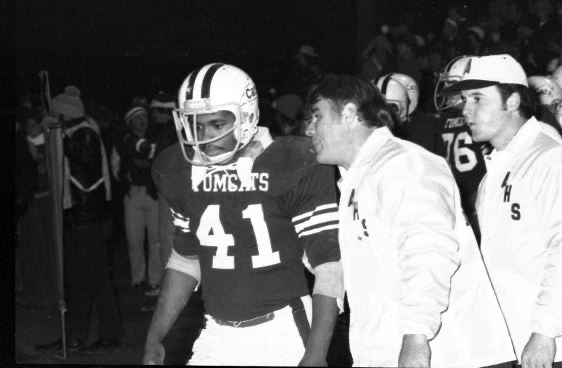
From his early days as an assistant to his tenure as head coach from 1968 to 1976, Conley built a program rooted in grit. His teams earned respect across the state, highlighted by a runner-up finish in 1972 and a championship run in 1975. That same year, he was named Kentucky’s Coach of the Year — a fitting recognition for a man whose teams mirrored his identity.

But his influence didn’t stop on the field. Conley stepped away from coaching to invest in his family, raising his three sons with Janice, whom he often called “my inspiration.” Even in education, first as an assistant principal and later as a principal, he carried the same standard. Discipline, accountability and respect weren’t optional — they were expected. And whether you were a student, teacher, or player, you understood quickly that he meant every word.

There was an edge to him, no doubt. A certain look, a scrunch of the nose, and you knew you were in for it. But beneath that toughness was consistency — and a desire to bring out the best in people, whether they appreciated it in the moment or not.

In Ashland, his legacy is etched in more than memory. It stands in bronze at Putnam Stadium, overlooking the field he loved in a familiar stance — watchful, commanding, present. It is a fitting tribute, but even that can’t fully capture what he meant to the program and the community.

If there were a Mount Rushmore for Ashland, Herb Conley would be the first name carved in stone.

He lived every role imaginable — player, coach, mentor, administrator, father, grandfather, fan. His influence stretched across generations, touching lives in ways that statistics and records never could.

Some legacies fade with time. His won’t.

Because in Ashland, and in the hearts of those who knew him, Herb Conley isn’t just remembered.

He endures.

Bert Johnson ranks among Tomcat football’s all-time greats

Any list of the greatest athletes in Ashland High School history must include Bert Edward Johnson. A standout for the Tomcats before continuing his career at the University of Kentucky and later in the NFL, Johnson left a lasting legacy at every level he played.

Johnson’s high school career unfolded during the Great Depression, before Putnam Stadium existed. From 1930 to 1932, he starred as a dynamic running back, scoring 247 points while earning All-State honors twice and All-South recognition as a senior. Ashland captured state titles in all three of those seasons and was even named the nation’s top team in 1931. The Tomcats went 10-0 in both 1930 and 1931 and 8-2 in 1932.

Despite the rarity of sophomores seeing playing time, Johnson not only played but started in the backfield alongside standout Eck Allen. Known for his explosive acceleration, he contributed as a running back, quarterback and punter.

David Patton, a 1950s star in baseball and basketball for the Tomcats and a former college basketball coach, was a nephew of Johnson’s. He provided the cartoon from The Cats Pause printed in 1977.

During Johnson’s three-year tenure, Ashland compiled a 28-2 record, claiming three mythical state championships and the 1931 national title. His 30-game totals are remarkable:

  • 2,700 rushing yards on 245 carries (11.0 yards per carry)
  • 46 rushing touchdowns
  • 56 completions on 87 attempts for 945 yards and 15 touchdowns
  • 5 receptions for 144 yards and one touchdown

Johnson often delivered his best performances against Louisville teams. In October 1930, Ashland traveled by train to face unbeaten Louisville Manual and returned with a stunning 91-0 victory. Back home, fans gathered on 17th Street outside The Daily Independent, cheering as scores were relayed via ticker-tape from a second-floor window.

The following year, Ashland again traveled to Louisville and defeated Male, a top contender, 31-6. Johnson rushed for 194 yards, while teammate Glenn Overley added 170 in a dominant showing. Later that season, the Tomcats crushed Decatur, Georgia, 85-6 in the Southern Bowl, with Johnson setting career highs of 213 rushing yards and 37 points. National polls later crowned Ashland the best team in the country.

In 1932, Johnson quarterbacked one of the most dramatic games in program history. Ashland’s 66-game unbeaten streak (62-0-4) ended in a heartbreaking 19-13 loss to Erie East, Pennsylvania. After tying the game late and setting up for a final drive, a pass by Johnson was intercepted and returned for a touchdown as time expired. It was Ashland’s first loss since 1925, leaving players and fans stunned.

The Tomcats’ only other defeat that season was a 7-6 loss to Huntington High, but they remained unbeaten against Kentucky opponents and still claimed the state title.

Johnson’s high school success drew national attention, but he chose to stay close to home and attend the University of Kentucky. There, he lettered in football from 1934 to 1936 and briefly played basketball, scoring two points in a single appearance during the 1934-35 season.

Nicknamed “Man o’ War” for his burst off the line, Johnson’s standout college performance came in 1934 against Alabama, when he scored both of Kentucky’s touchdowns in a 34-14 loss. That Alabama team would go on to an undefeated season capped by a Rose Bowl victory. Johnson became Kentucky’s second All-Southeastern Conference selection, earning the honor as a sophomore.

He went on to play six seasons in the NFL, suiting up for Brooklyn, the Chicago Bears under legendary coach George Halas, the Chicago Cardinals and the Philadelphia Eagles. Among his highlights were a pair of 50-yard runs—one with the Bears and another in an exhibition game for Brooklyn in Louisville.

Athletic success ran in the family. His son, Phil Johnson, later played basketball for Kentucky from 1956 to 1959, appearing in 64 games.

Bert Johnson passed away in 1993 at the age of 81. He was the third inductee into the Ashland Sports Hall of Fame, selected by the late John McGill. His legacy remains firmly cemented among the greatest in Tomcat football history.