Ashland learned a lot about itself – and how a JAWS nickname might just stick – in the second week of the 1975 season.
Of all the regular-season games that season, none carried more weight than a battle with Bryan Station in Putnam Stadium. It was the season opener for the Defenders, who boasted of having more pure speed than any team in Kentucky and the writers and broadcasters who voted in the Associated Press poll agreed they were the team to beat. Bryan Station was ranked No. 1 in Class AAAA, the largest classification and the same one where Ashland was placed.
Ashland had a game against under its belt against Johnson Central, a 47-14 victory when they rushed for 523 yards rushing on 39 attempts – an astounding 13.4 per carry average. The Tomcats scored the first four times they touched the ball and had the town buzzing about the potential. The defense surrendered 3-8 yards rushing, although substitutes played much of the second half.
Players nor coaches were publicly talking about the JAWS name for the defense. Not yet anyway. The players knew it was being considered, and liked the idea, but coach Herb Conley wasn’t sure it was a great idea given how nicknames can backfire. But after the showing against Bryan Station, even had admitted it had some merit.
These weren’t Baby Sharks. They were man-eaters.
The Defenders had 15 players who ran the 40 in 4.8 or less – an enormous number of skilled running backs and receivers. Conley said the reports he had on them was they had “speed to burn” and that there are three good teams in Lexington and they are all in Bryan Station – the first, second and third teams. That may have been some “coach-speak” but it was clear this team was born to run.
Ashland’s team speed was good but it wasn’t in that neighborhood.
But Putnam Stadium became a shark tank for the Defenders, who lost three fumbles and was tackled in its own backfield for minus yardage 16 times. Bryan Station rushed for only 103 yards in 41 attempts and was held to a scant five yards in the first quarter. They passed for 114 yards but it wasn’t enough in what turned out to be a 22-12 defeat.
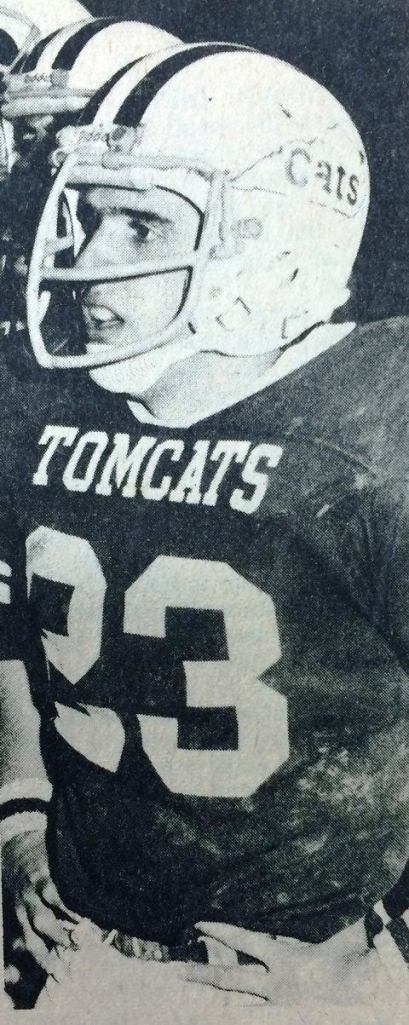
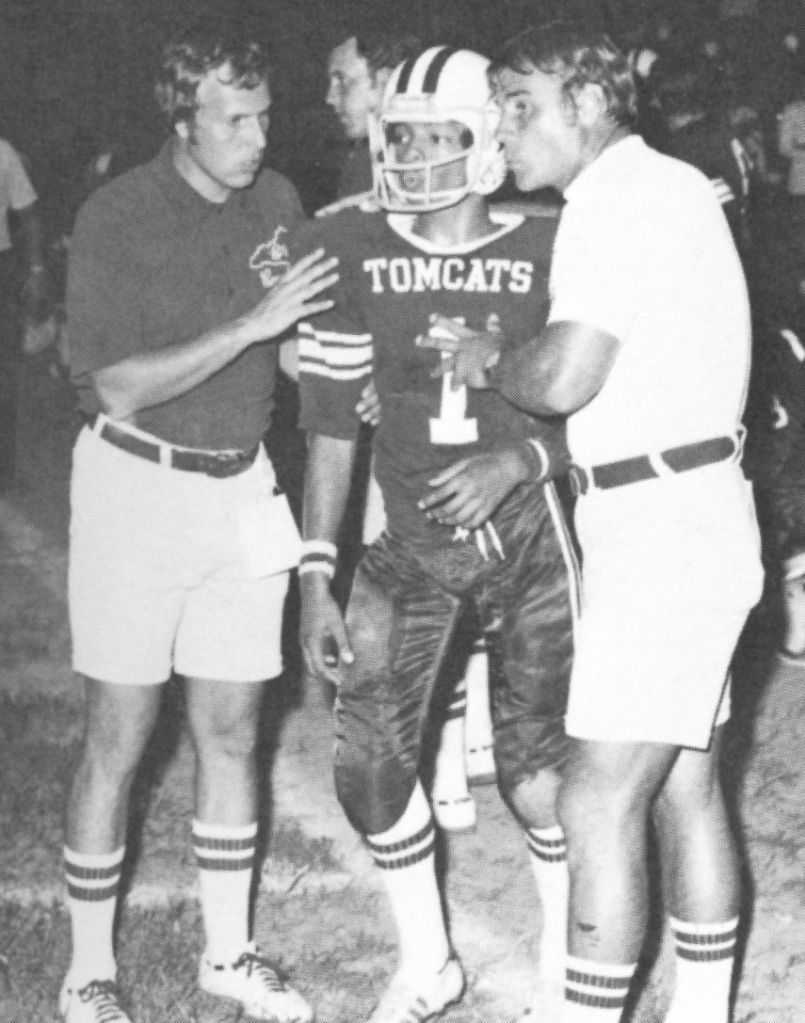
Rick Sang with Ashland coach Herb Conley, left, and assistant Bill Tom Ross.
Ashland’s offense was good enough and the defense provided some points, too, getting a safety in the first quarter when Gary Thomas made a tackle in the end zone. The first fumble recovery set up the first Tomcat touchdown and an 8-0 lead that stood up as the halftime score. Jeff Slone took it in from four yards out, running behind a hole opened up by Terry Bell and Casey Jones on Ashland’s big offensive line.
But the play that was the backbreaker for the Defenders came early in the third quarter.
Thomas gathered in a punt at the Ashland 43, headed left and slipped a handoff to Rick Sang who, after some shifty moves to shake a couple of tacklers, scooted 57 yards for a touchdown. A bone-chilling block from Chuck Anderson in front of the Ashland sideline was what many remember. Bryan Station’s Eddie Coles was moving in on Sang at midfield but when he reached the Ashland 43, Anderson clocked him, sending his helmet flying in the air and leaving him motionless. Coles never saw Anderson coming. Video shows Anderson was a noseguard, wrestled with the Defenders center, and then he sprinted downfield to see if he could make a block, and boy did he ever. It also left Sang all alone at that end of the field. Kevin Ward’s extra point made it 15-0 with 10:16 to play in the third quarter.
Conley said at the time he thought Anderson had literally knocked his head off. “I thought he had killed him,” he said. “I mean it, I thought that was his head (and not his helmet).”
At the time, Ashland referred to hard tackles or blocks as “Bad Cat,” an award that went to the player making the big hit. Conley said of the block, “If I’ve ever seen a Bad Cat at Putnam Stadium, that was it. He nailed that man.”
It was a stunning play and further fueled the idea that this JAWS nickname was going to stick around.
Jeff Slone was a 1,000-yard rusher for the Tomcats.
The Tomcats’ last touchdown came near the end of the third quarter with Thomas zipping 27 yards behind a huge hole on the left side. Ward’s kick made it 22-0. That touchdown was set up on a 5-yard run from Jeff Slone on fourth-and-three at the Defenders 32. Slone, behind a thunderous block from Bell, found a hole and got the first down to the 27. Thomas took it from there.
After the game, Defenders coach Terry Clark told Conley that Bell “was definitely All-State” after he dominated line play in the game. Anderson’s play at linebacker and Sang’s overall play were also lauded by Conley.
Ashland, which played only 16 players, began to tire in the fourth quarter and Bryan Station took advantage, scoring a pair of touchdowns to set the final margin.
The victory propelled the Tomcats to 2-0 and they moved to No. 1 in the Class AAAA poll the next week and that’s where they remained throughout the regular season where they finished 11-0 on the way to the 14-1 season.
While Ashland’s 43-0 victory over Boyd County in the last game of the regular season clinched the district championship and was more important than the Bryan Station victory in a lot of ways, still ranks behind the win in Week 2. That was the night the Defenders came to town and found out the JAWS defense was no joke. It sent a message statewide, too, that Ashland was for real and could challenge for the Class AAAA crown.
Terry Bell said going to a postseason award ceremony in Lexington after the 1975 high school football season didn’t interest him.
But at the urging of Ashland coach Herb Conley – and insistence of Bell’s mother – he went.
“I didn’t want to go down there,” Bell said. “Coach Conley talked to mom and them. They made me go. I was sitting there with Coach Conley, (assistant) coach (Mike) Holtzapfel, (assistant) coach (Bill Tom) Ross and (teammate) Casey (Jones). They announced the award for Lineman of the Year and said my name. They said: ‘Terry Bell of Ashland Blazer.’ I was surprised. I never expected it.”
The award meant a lot to Bell – not for his ego but because he understood the work it took to achieve it. He tragically lost the award in a house fire.
Bell, a two-way starter, was chosen as the “Lineman of the Year” in the entire state of Kentucky following his impressive play with the 1975 Ashland JAWS football team that finished 14-1, with the only loss coming 20-0 to undefeated St. Xavier in what was the first time a Jefferson County team played a team from within the rest of the state for the Class 4A championship, a new classification at the time.Even with that defeat, the 1975 JAWS team is one of the most beloved in Tomcat history. They have a 50th reunion celebration on Friday at the Clark’s Pump-N-Shop Putnam Stadium.
Terry Bell was the state’s Lineman of the Year after Ashland’s 14-1 season in 1975. He was also All-State in AP and the Courier Journal.
When it came to intimidation and toughness, Terry Bell was very much made in the image of his head coach and everybody knew it.
“Terry was silent, but he was probably the baddest of the Tomcats,” said Rick Sang, an All-State receiver for the Tomcats in 1975. “They gave the Bad Cat award for big hits every week but everybody on that team knew who the Bad Cat was, and it was Terry Bell. It was kind of unspoken, but they wouldn’t mess with Terry Bell. I’d be shocked if anybody didn’t agree with that.”
That Bell was there with Jones, who may have been a nominee for the top lineman award himself, was a statement as to how good Ashland’s line play was in 1975. Bell was a captain along with quarterback Chuck Anderson and Sang.
‘THEY WERE THE REASON WHY WE WON’
Bell was a guard and Jones a tackle on the Tomcats’ right side to propel a wishbone offense that terrorized opponents as much as the defense that carried the JAWS nickname of the blockbuster movie that had people afraid to go to the beach. The formula for what made Ashland’s 1975 team so memorable was Football 101: They knew how to block and tackle.
“He and Casey both were so good, it’s hard to say which one was better,” said Alan Mayo, a senior tight end and outside linebacker in 1975. “They were the reason why we won. The things we won with were defense and offensive line. You can find skill players out of 1,200 kids in school.”
Casey Jones (73) and Terry Bell (67) wait for instruction from inside linebacker Chuck Anderson.
Bell’s “Lineman of the Year” recognition was representative of all classes – from Class A to Class 4A – and it made him one of the most decorated linemen in Tomcat history. He was first-team All-State offensive guard by The Courier Journal (coaches vote) and the Associated Press (media vote) and made All-Area (The Daily Independent). The state’s “Lineman of the Year” award has not continued so there is some uniqueness to it as well. That same night, Herb Conley was named as the state’s Coach of the Year – the only time an Ashland coach has captured that award statewide.
It was a big night for the Tomcats and one that Bell has been able to carry with him for 50 years – except that’s not in his character to talk about himself. He’d rather talk about his teammates and appreciates how fans still remember them with great respect and fondest of memories.
Raymond Hicks, left, and Yancey Ramey were powerful offensive linemen.
Jones, who lined up beside him, was tremendous as well. He went to the University of Kentucky on scholarship and did as much as anyone to keep the wishbone machine in motion. And great line play did not end with Bell and Jones. There were also center Terry Lewis, guard Yancey Ramey, tackle Raymond Hicks and Sam Nunley and David Early, who added important depth.“Terry Lewis was the rock,” Bell said. “He was the anchor. I always respected him. He did his job. Yancey, you knew he was going to do it then you had Raymond. We went all the way through school together, starting with the Wylie Bulldogs. Raymond wasn’t big but he was tall, and he could block.”
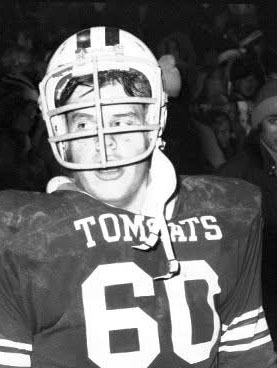
Terry Lewis was a center and the anchor of the offensive line, said Terry Bell.
Mayo said Lewis had an often-overlookd quickness about him. “Terry could snap the ball onehanded, and he had quick feet. He was moving as he snapped the ball. He couldn’t beat you with sheer size and strength, but he was proficient and quick. Coach Conley ran all those counters with everything we did. Our timing was impeccable by the time those guys were seniors.”
The tight ends – Sang and Mayo – and wide receivers Keith Hillman and Doug Paige were outstanding blockers, too, as were the running backs who all picked off defensive backs down the field, resulting in long carries and breakaway touchdowns.
“One thing about us,” Bell said, “everybody could block.”
The outside running lanes for halfbacks Gary Thomas, Jeff Slone and Greg Jackson were wide open while Anderson, who was as much bulldozer as quarterback, and fullbacks Jim Johnson and Jay Shippey made opponents pay with hard runs up the middle and off tackle.
BELL CREDITS MIKE HOLTZAPFEL FOR BUILDING TOMCATS’ LINE
When it came to the offensive line play, Bell said one important ingredient made it all mesh – line coach Mike Holtzapfel who played at Notre Dame and carried a similar toughness and no-nonsense attitude as Coach Conley, was the architect. He also called the defensive line and linebacker signals. Ross was the secondary coach.
“We had a helluva coach in him,” Bell said of Holtzapfel. “He was all right. He had his ways, but he made us learn and we learned. He knew so much about the line play and taught us so much. We became a great line because of him. He got out the old Notre Dame stuff.”
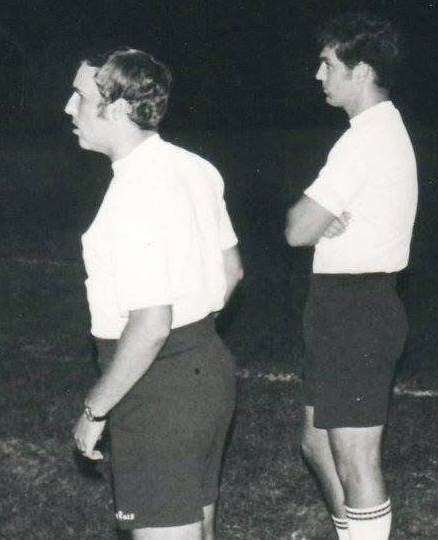
Assistant coaches Bill Tom Ross, left, and Mike Holtzapfel.
Holtzapfel would replace Conley as the head coach after the 1976 season and led Ashland for three seasons.
What the Tomcats had for that 1975 season was a veteran offensive line with four of the five interior linemen returning as starters in the 1974 season. That included Bell, although he missed a lot of his junior season due to a knee injury in a Sept. 13 game against Franklin County. He was clipped from behind while blocking on an interception return.
The injury did not require surgery, but it did mean two months of rehabilitation. Bell made it back for the last game of the season against Boyd County. Meanwhile, the rest of the linemen that would make the JAWS team special were gaining valuable experience. Terry Fish was the only starting senior lineman for the 1974 team.
Bell was healthy again going into the offseason and came back better and bigger for the 1975 season. “l played the whole season, all 15 games,” he said. “They taped my knee up every game; used three to four rolls of tape. Between Coach Conley and coach Holtzapfel, they get it on and got it tight,” he said.
Jackson said Bell set the example of hard work equaling success, coming back from the injury stronger than ever.
“He was not only a big lineman, he was one of the fastest linemen I have ever seen. As a running back, he is the one you wanted blocking for you. He would open holes you could take a truck through. They all worked so well as a set of linemen which made our jobs much simpler.”
As for his speed, Bell was clocked at 4.8 in the 40 – a fast time for a running back and an extremely quick time for a lineman.
Bell carried an intimidating presence even walking the hallways at the high school, often seen wearing a bandana. However, he could be a gentle giant and was seen as a protector to some in his class. He was a rare athlete who had speed and athleticism to go along with his power. He could dunk a basketball and was freakishly strong.
‘JUST A NATURALLY GIFTED ATHLETE’
Sang said the first time he met Bell was when they were in physical education class at Coles Junior High. “He grabs me and picks me up with one arm, has me leaning up against the wall. I thought, ‘Nobody except my dad can do that.’ He was just having fun. He wandered off and did something else. What a strong human being. He could jump and he could run, and he was quick, too. He could move laterally, fill in the gaps and he could run you down too. Just a naturally gifted athlete.”
Bell said the JAWS theme on the season made it fun and he can vividly recall the games and said the 22-12 win over No. 1 Bryan Station in the second week of the season was the springboard for what was to come. He said wins over Ironton with Kenny Fritz, Russell and Boyd County were all memorable moments. He also recalled the Class 4A State At-Large championship game at Paducah Tilghman, the flight – his first for him along with many teammates – to get there, and Gary Thomas breaking free on a 74-yard touchdown to win that game 13-7. “I remember seeing Gary’s back, and that was a good thing,” Bell said. And, of course, the St. Xavier game in Louisville in the overall Class 4A championship game.
“I told somebody years ago if we could have played that game in Ashland, it might have been different because it’s a different atmosphere,” he said. “They never had to leave Louisville, and we had to fly to one of our games and played all but one (in the playoffs) on the road. I’d liked to have played them in Putnam Stadium.”
Depth was also a factor, he said. “There were so many of them. They had different players on offense and defense, special teams, everything. It was a tough loss.”
SNAPPING FOR FUTURE NFL GREAT PHIL SIMMS
Bell was a college prospect and he signed with Morehead State and coach Wayne Chapman. He played noseguard as a freshman and was switched to center his sophomore season before a knee injury ended his career.
Bell said he promised his mother he would stay two years and after the knee injury and a trip to the Cleveland Clinic, he decided that was enough. His hips and knee still bother him to this day, he said. Bell came home and graduated from vocational school.
Marshall talked to him and Kentucky came into the Ashland locker room after the game with St. Xavier and offered him a chance to play but would not guarantee a full scholarship. Bell said he signed with Morehead and was the center for quarterback Phil Simms’ sophomore season.
Bell said Simms and Anderson, his high school quarterback, had similar work ethic when it came to preparation. They studied film regularly and came to games ready to deliver, Bell said. He said Morehead State receivers would have Xs on their chests from catching Simms’ passes. Simms, of course, became a first-round NFL draft choice with the New York Giants and eventually was a winning quarterback in the Super Bowl.
A CHANCE TO PLAY FOR ROY KIDD AT EASTERN KENTUCKY?
Sang, who signed and played for four years at Eastern Kentucky, was on a recruiting visit to meet with coach Roy Kidd after the 1975 season. When he introduced himself to Kidd, the response from the Hall of Fame coach was “Where’s Terry Bell? Didn’t he come with you?” Kidd apparently wanted Kidd and Sang to both become Colonels. He left the room, made a phone call and learned that Bell had committed to Morehead. Kidd came back into the room seething,
It made for an uncomfortable visit although Sang was offered and had an outstanding career at EKU as a punter and tight end/wide receiver. He was on the 1979 Division I-AA national championship team and later was an assistant coach on EKU’s 1982 national champions.
Bell said he never talked to EKU coaches but did attend a game. Morehead State extended an offer and Bell accepted it.
During Bell’s freshman season at MSU, he lined up at noseguard opposite EKU center Roosevelt Kelly, an All-America center who was drafted into the NFL, and held his own against him, Sang said.
BELL GIVES SHOUTOUT TO TOMCATS’ 1972 STATE RUNNERUPS
Bell said while he appreciates the accolades that are heaped on the JAWS Tomcats, he feels bad for the 1972 Tomcats that were the Class AAA runner-up to Tates Creek who is seldom remembered or mentioned. His brother, Dwight, was on that team, he said, and he remembers the family going to Stoll Field in Lexington for the championship game that the Tomcats lost 16-7.
Bell said he modeled his game after a lineman from that team – All-State guard Steve Justice – and often wondered how the 1972 and 1975 offensive lines compared. Coach Conley has been asked but often shies away from any comparisons for understandable reasons. But strong line play was a common denominator for his best teams.
“They had a great team and a great line like we did,” Bell said of the ’72 team. “I always felt bad because they didn’t get as much recognition as we do. It doesn’t seem right.”
Leonard “Shorty” Blanton, who coached the Ashland Tomcats baseball team for only three years but his legacy includes a state championship in 1968 and state runner-up finish in 1969, died in Florida on Aug. 30. He was 94.
Blanton took over the Tomcats’ baseball job in 1968 after Zeke Meyers had led Ashland to back-to-back state titles in 1966 and 1967. Meyers, who took an administration position at Marshall University following his time in Ashland, went 47-4 in two seasons including a perfect 25-0 in 1967.
Even though the cupboard was hardly bare, who wanted to replace that coaching legend?
Blanton told me a few years ago in an interview for the book Tomcat Dynasty he got the job because “no one else wanted it.” During those days the principal selected the coaches for the so-called “minor” sports of track and baseball. He appointed Blanton to be the baseball coach.
A good football coach at several levels in the Ashland system, including the junior varsity coach the year the Tomcats won the state title in 1967 and the head coach at Coles Jr. High in 1971, Blanton admittedly didn’t have a wealth of baseball knowledge and had never coached the sport on any level. And now he was taking over the two-time defending state champions with a wealth of returning players, including Bobby Lynch, John Mullins, Steve Hemlepp, Fred Leibee, Tim Huff, Bo Carter, Dave Staten and Mike Tackett. These days people would be knocking each other over to get that job.
Leonard “Shorty” Blanton celebrates after winning the 1968 state baseball championship as coach for the Ashland Tomcats. It was the third consecutive title for the Tomcats.
Lynch and Hemlepp were like unofficial assistant coaches and knew the team better than anyone. Blanton said he welcomed their suggestions and knew these Tomcats were not just good at baseball, they were good at winning.
It proved to be true as those Tomcats became Kentucky’s first program to win three consecutive state championships. It did not happen again until Pleasure Ridge Park won it from 1994-96.
Blanton said the players taught him a lot about baseball and were “easy to coach.”
The ’68 champions finished 23-3 and surrendered only one run in three games in the state tournament. Lynch won two of those games, including being the winning pitcher in the finals for the second time in three years. If not for a strange scoring decision, he would have been the winning pitcher in all three championship games.
But what Blanton did with the ’69 team was the most surprising. He took them back to the state tournament and reached the finals where they dropped a 1-0 decision to Owensboro in heartbreaking fashion.
In the state championship game against Owensboro, a pair of errors brought home the winning run – and only run of the game – in the bottom of the seventh inning. There may have been three errors since the baserunner was thought to have missed third. Ashland never protested. Leonard talked about that play nearly 50 years later.
“Someone told me the runner didn’t even touch third base,” he said. “I missed it and none of my boys saw it either. Who knows? The umpire may not have noticed either. I guess we’ll never know.”
The Tomcats finished 19-4 including a 1-0 victory over Don Gullett-led McKell in the regional semifinals in Morehead. Ashland had only one hit in the game, a triple from Dave Damron who then scored the game’s only run on Tackett’s sacrifice fly. Gullett struck out 11 and allowed the lone hit but Huff outdueled him.
“Those guys were outstanding, some of the best in the state, and they knew how to win, too,” Blanton said. “It’s a shame it turned out like it did.”
Blanton was not planning on coming back for the 1970 season after that stinging loss and announced in the newspaper that Steve Gilmore would be replacing him. But that didn’t happen until the following year. Blanton coached the Tomcats to a 12-10 season in 1970, losing in the regional finals to Russell.
He finished his high school coaching career with a 54-17 record. Not bad for somebody who admitted having limited baseball coaching knowledge when he took the job.
Blanton was much more than a good coach, though. He was a fine Christian gentleman, husband and father and a friendly and popular man in Ashland. His wife, Ada, who died in 2020, was a beautiful lady and powerful singer who was crowned Mrs. Kentucky in 1968. She represented the state along with the 1968 Miss Kentucky and Col. Harland Sanders of Kentucky Fried Chicken fame on the Kentucky state float during the inauguration parade for President Richard Nixon in Washington, D.C., in 1968.
Shorty and Ada sang together in church at Unity Baptist and in local dramas and musicals. They have a son, Ted Blanton, who played on Ashland’s 1967 state football championship team.
Blanton was born in 1931 and graduated from Ashland High School in 1949. He played on the Tomcats’ 1946-1948 football teams. He rushed for 339 yards and had 152 yards receiving while scoring five touchdowns on a 5-4-1 team in ’48 that was ranked No. 3 in the final AP state poll. The losses and tie came to four out-of-state teams (Charleston, Stonewall Jackson, Huntington High, Ironton and Portsmouth).
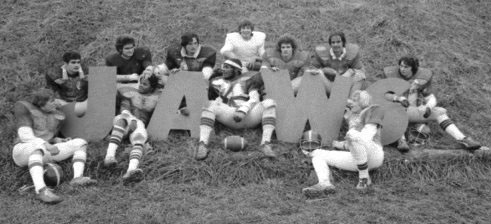
The blockbuster movie “JAWS” came out in the summer of 1975 and frightened viewers who were so traumatized they barely dipped their toes in the ocean.
That summer, Herb Conley took his family to Mrytle Beach, an annual pilgrimage for the family. They would set up at a campground and make daily trips to the beach. The three boys – Greg, Shawn and Jeff – were all under 10 and braver than their mother Janice wanted them to be.
Each day they went a little further into the ocean and Janice told Herb she was not comfortable with how daring the boys were becoming.
Herb had an idea. He remembered there was a movie about sharks that had just come out and he took his young family to the movies to watch “JAWS.” The boys sat wide-eyed through the terrifying movie. Let’s just say Janice did not have to worry about the boys getting too far out into the ocean because they barely got back in the water at all the rest of the trip.
Terry Bell breaks through the hoop leading the 1975 Ashland football team onto the field before a playoff game.
“JAWS” had made an impact on Herb Conley, but it would not be the last one for Ashland’s veteran head football coach.
Living up to the JAWS nickname
He returned to Ashland refreshed and looking forward to the 1975 football season. Conley was anticipating a good season given that it was a strong senior class and some of them would be entering their third year of either starting or playing a lot.
It was a season built for success with a combination of speed, size and power. They were developed very much in the image of their coach – hard-nosed, hard-hitting and determined (afraid?) not to make their coach proud. Herb Conley commanded respect as a player, as an assistant coach and as the head coach. He was in his eighth season as the Tomcats’ head coach and a group that he believed was as good as any since the 1971 and 1972 seasons.
When Conley met with his assistant coaches before the season, he mentioned how his boys were scared to death after watching “JAWS” at the beach. Conley mentioned the possibility of naming the defense “JAWS” mostly as a joke. But coaches Mike Holtzapfel and Bill Tom Ross loved the idea.
Rick Sang waits for the play call from head coach Herb Conley, left, and assistant coach Bill Tom ross during Ashland’s 1975 season.
Conley was less sure it was a good idea because, as he put it, sometimes those things backfire on you. But Holtzapfel and Ross would not let it go, and Conley told them only if the team could prove it. That is also what they told the players, who were excited about naming the defense after the terrifying shark from the movie.
It took one game for Conley to be convinced that this “JAWS” nickname might be a good thing. The Tomcats blasted Johnson Central 41-14 in the opener at Putnam Stadium and hard-hitting Chuck Anderson knocked the Golden Eagles’ quarterback out of the game with a crunching hit that also knocked the breath out of him.
When Coach Conley went out on the field to check on him, Anderson could barely breathe but he practically begged his coach to let the team be “JAWS.” Conley pulled him up by the belt and helped his biggest hitter off the field. He would return to the game, but Johnson Central’s quarterback would not.
It became clear that it was no longer safe to go on the football field if the “JAWS” defense was the opponent.
The Tomcats kept it to themselves until after the second week of the season when they defeated top-ranked Bryan Station, 22-12, with another big hit from Anderson spurring a brilliant defensive effort.
Terry Bell was selected the top offensive lineman in Kentucky in 1975.
He knocked a would-be tackler unconscious with a block that sprung Rick Sang for a touchdown on a punt return that put Ashland ahead 12-0. It also set the tone not only for that game but the season.
Eventually, the media at the time got word about the “JAWS” defense and the Tomcat band even learned the memorable music from the movie when the shark was about to attack. Fans brought plastic sharks to the games and the businesses in town were prompting “JAWS” defense on their signs.
Everybody bought in, especially the team.
Make a wish(bone): A dominating offense
Ashland rattled off win after win during the regular season and went into the playoffs unblemished and ranked No. 1 in Class AAAA – then the biggest classification in the state. They demoralized teams on defense and dominated them on offense, too, with a vaunted wishbone offense.
Gary Thomas, only a junior, rushed for more than 1,700 yards and Jeff Slone surpassed 1,000 yards. Jay Shippey and Jim Johnson shared fullback duties, Anderson was the quarterback and Greg Jackson split time in the backfield, overcoming a broken foot that cost him a few games.
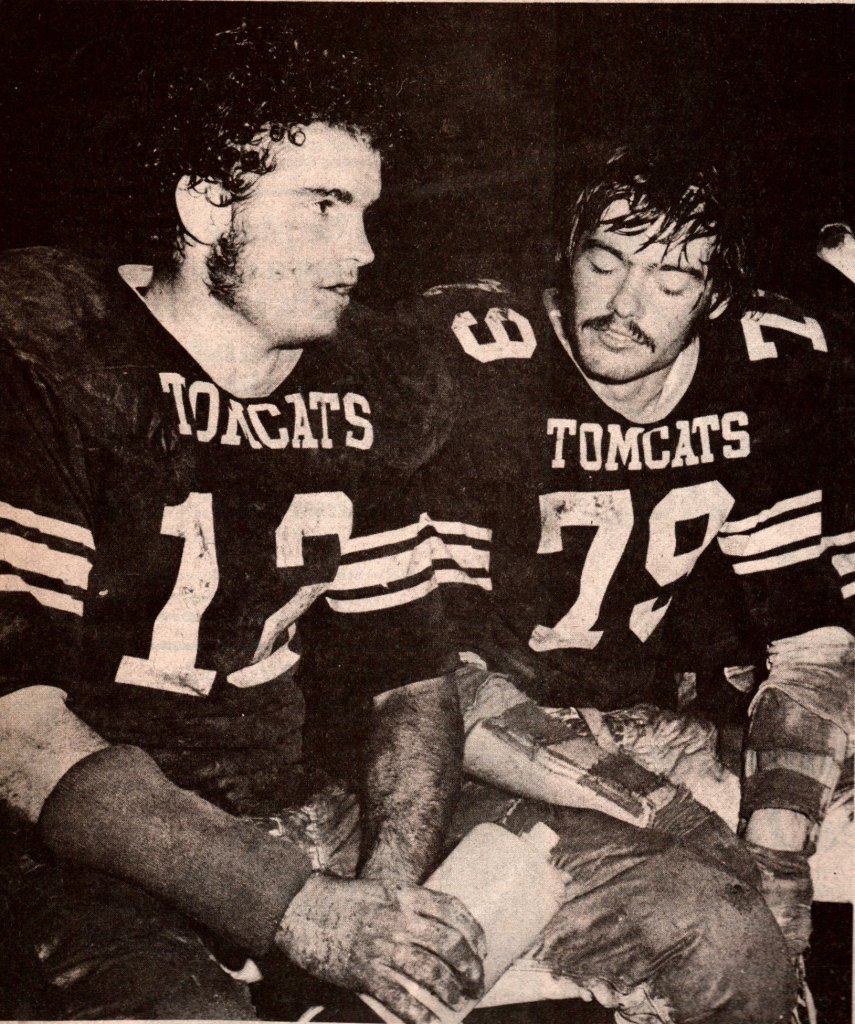
Quarterback Chuck Anderson (12) and tackle Raymond Hicks.
Sang was a top athlete as a tight end, return man and punter and the offensive line was ferocious with Terry Bell leading the way. He was voted as the Best Offensive Lineman in Kentucky. Bell was joined on the line by center Terry Lewis, guard Yancey Ramey and tackles Casey Jones and Raymond Hicks.
Shippey and Johnson were punishing runners and Thomas, Slone and Jackson ran like gazelles. Conley said his halfbacks were some of the best blockers he had during his coaching career. Split end Dougie Paige, all 115 pounds of him, could put players twice his size on the ground in downfield blocking. Keith Hillman, a speedy receiver, also played some at split end.
A trip to the movies just what was needed
Ashland had no losses during the regular season, but the team escaped one Friday night against Huntington High, winning 12-6 despite losing three fumbles to improve to 6-0. The players knew it was not their best effort and dreaded practice the following Monday.
Conley said he sensed something was wrong and that the team was playing tired. He told the coaches that instead of a brutal practice, he was taking the players to the movie on Monday to watch “the Towering Inferno,” starring O.J. Simpson, at Midtown Cinema. The players were stunned when they arrived ready for practice and were told to keep their street clothes on and get on the bus. Conley had instructed Hank Hillman of the Boosters Club to reserve the theater – complete with drinks and popcorn – for the team.
It was just what they needed. They came back fresh the next Friday, hammering a good Belfry team 47-7. The fire was reignited.
Ashland closed the regular season at 11-0 with a 43-0 victory over rival Boyd County that wrapped up the district and put them in the postseason. Back then, only district champions advanced to the playoffs. Boyd County had won the previous two seasons against the Tomcats and wanted to spoil their undefeated season. But the Lions were no match for them in at the time was the most lopsided loss in the series.
The playoffs beckon and a flight to remember
Even though the Tomcats were ranked No. 1 and undefeated, their first playoff game was on the road at Dixie Heights in one of the coldest games anybody can remember. After a sluggish first half, a halftime butt-chewing from their head coach got everybody’s attention and Ashland won 36-6. He had captains Sang, Bell and Anderson stand in front of mirrors in the locker room and told them to look into the mirror and ask themselves if they gave their best effort. The rest of the team was watching, and they got the message.
Doug Paige gets the play from coaches Bill Tom Ross, left, and Herb Conley.
Years later, Sang confessed that he thought he had given his best effort but stared into the mirror anyway. Coach Conley called Sang into his class on the following Monday and told him, “Hey Rick, we watched the film, and you really didn’t play that bad.”
They followed that with a win over Lafayette, 21-6, at Putnam Stadium to advance to the Class AAAA State At-Large championship in Paducah.
The Tomcats were in for a long trip on the other side of the state. But before the Lafayette game was even finished, plans were made to fly to Paducah and the Tomcats became the first team in Kentucky high school history to charter a flight to a game. Ashland was an eight-hour bus ride from Paducah but only a short flight. The Boosters Club raised the money, and the team flew on the day of the game.
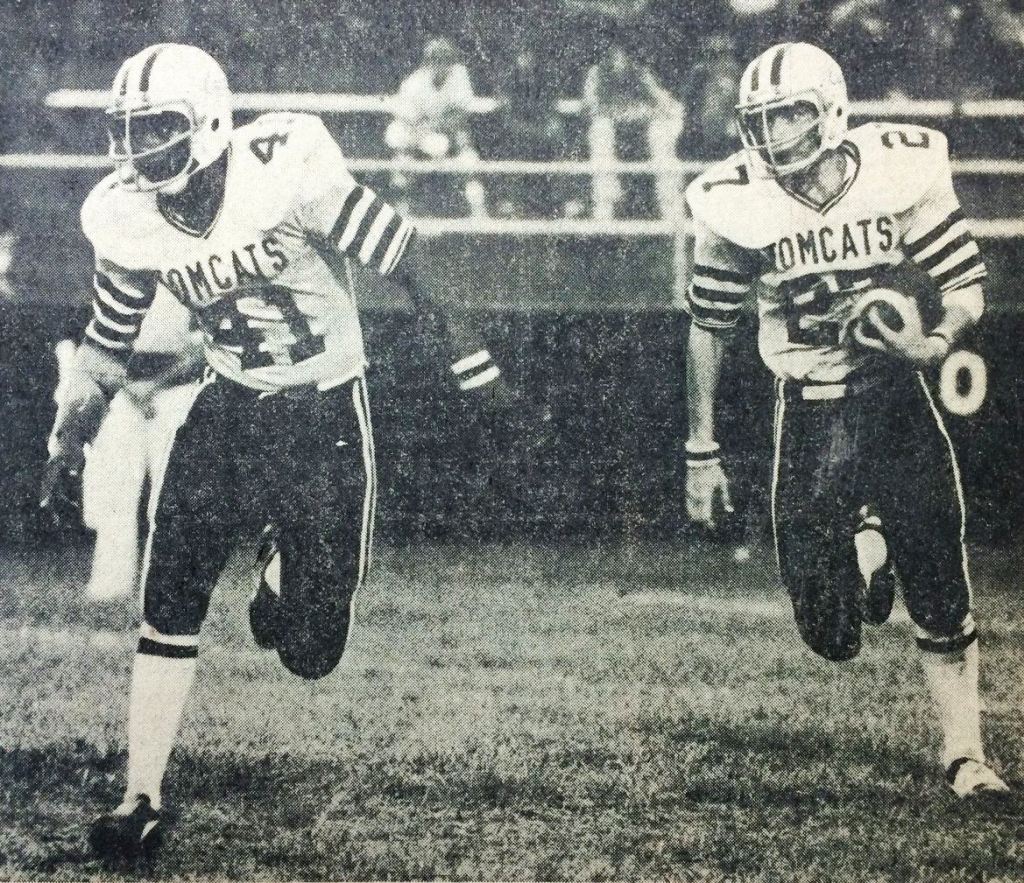
Jim Johnson (41) leads the blocking for Greg Jackson.
Many of the players were making their first plane flight and it was a quiet trip with nobody saying anything. It was only five years since the horrific Marshall University plane crash,
The flight kept their legs fresh for Paducah and Thomas broke a 7-7 deadlock with a 75-yard touchdown run with three minutes to play that gave the Tomcats a 13-7 victory and a spot in the overall state championship game against Jefferson County champion St. Xavier.
St. Xavier was undefeated and loaded with talent. The Tigers had 11 different players on offense and defense and that depth wore down the Tomcats, who lost 20-0 after a tight first half, trailing only 6-0 with Ashland missing at least two good scoring opportunities. It would be the only loss in a 14-1 season, but the 1975 Tomcats have remained one of the most beloved teams in Ashland history.
On Oct. 3, the Tomcats 1975 JAWS team will be recognized at Clark’s Pump-N-Shop Putnam Stadium on their 50th anniversary.






 MARK MY WORDS 2