
Terry Bell said going to a postseason award ceremony in Lexington after the 1975 high school football season didn’t interest him.
But at the urging of Ashland coach Herb Conley – and insistence of Bell’s mother – he went.
“I didn’t want to go down there,” Bell said. “Coach Conley talked to mom and them. They made me go. I was sitting there with Coach Conley, (assistant) coach (Mike) Holtzapfel, (assistant) coach (Bill Tom) Ross and (teammate) Casey (Jones). They announced the award for Lineman of the Year and said my name. They said: ‘Terry Bell of Ashland Blazer.’ I was surprised. I never expected it.”
The award meant a lot to Bell – not for his ego but because he understood the work it took to achieve it. He tragically lost the award in a house fire.
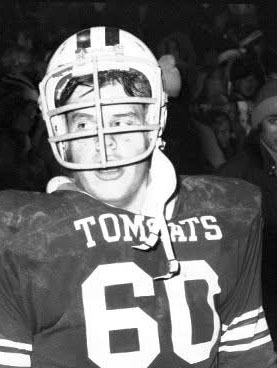
Bell, a two-way starter, was chosen as the “Lineman of the Year” in the entire state of Kentucky following his impressive play with the 1975 Ashland JAWS football team that finished 14-1, with the only loss coming 20-0 to undefeated St. Xavier in what was the first time a Jefferson County team played a team from within the rest of the state for the Class 4A championship, a new classification at the time.Even with that defeat, the 1975 JAWS team is one of the most beloved in Tomcat history. They have a 50th reunion celebration on Friday at the Clark’s Pump-N-Shop Putnam Stadium.

When it came to intimidation and toughness, Terry Bell was very much made in the image of his head coach and everybody knew it.
“Terry was silent, but he was probably the baddest of the Tomcats,” said Rick Sang, an All-State receiver for the Tomcats in 1975. “They gave the Bad Cat award for big hits every week but everybody on that team knew who the Bad Cat was, and it was Terry Bell. It was kind of unspoken, but they wouldn’t mess with Terry Bell. I’d be shocked if anybody didn’t agree with that.”
That Bell was there with Jones, who may have been a nominee for the top lineman award himself, was a statement as to how good Ashland’s line play was in 1975. Bell was a captain along with quarterback Chuck Anderson and Sang.
‘THEY WERE THE REASON WHY WE WON’
Bell was a guard and Jones a tackle on the Tomcats’ right side to propel a wishbone offense that terrorized opponents as much as the defense that carried the JAWS nickname of the blockbuster movie that had people afraid to go to the beach. The formula for what made Ashland’s 1975 team so memorable was Football 101: They knew how to block and tackle.
“He and Casey both were so good, it’s hard to say which one was better,” said Alan Mayo, a senior tight end and outside linebacker in 1975. “They were the reason why we won. The things we won with were defense and offensive line. You can find skill players out of 1,200 kids in school.”

Bell’s “Lineman of the Year” recognition was representative of all classes – from Class A to Class 4A – and it made him one of the most decorated linemen in Tomcat history. He was first-team All-State offensive guard by The Courier Journal (coaches vote) and the Associated Press (media vote) and made All-Area (The Daily Independent). The state’s “Lineman of the Year” award has not continued so there is some uniqueness to it as well. That same night, Herb Conley was named as the state’s Coach of the Year – the only time an Ashland coach has captured that award statewide.
It was a big night for the Tomcats and one that Bell has been able to carry with him for 50 years – except that’s not in his character to talk about himself. He’d rather talk about his teammates and appreciates how fans still remember them with great respect and fondest of memories.

Jones, who lined up beside him, was tremendous as well. He went to the University of Kentucky on scholarship and did as much as anyone to keep the wishbone machine in motion. And great line play did not end with Bell and Jones. There were also center Terry Lewis, guard Yancey Ramey, tackle Raymond Hicks and Sam Nunley and David Early, who added important depth.“Terry Lewis was the rock,” Bell said. “He was the anchor. I always respected him. He did his job. Yancey, you knew he was going to do it then you had Raymond. We went all the way through school together, starting with the Wylie Bulldogs. Raymond wasn’t big but he was tall, and he could block.”
of the offensive line, said Terry Bell.
Mayo said Lewis had an often-overlookd quickness about him. “Terry could snap the ball onehanded, and he had quick feet. He was moving as he snapped the ball. He couldn’t beat you with sheer size and strength, but he was proficient and quick. Coach Conley ran all those counters with everything we did. Our timing was impeccable by the time those guys were seniors.”
The tight ends – Sang and Mayo – and wide receivers Keith Hillman and Doug Paige were outstanding blockers, too, as were the running backs who all picked off defensive backs down the field, resulting in long carries and breakaway touchdowns.
“One thing about us,” Bell said, “everybody could block.”
The outside running lanes for halfbacks Gary Thomas, Jeff Slone and Greg Jackson were wide open while Anderson, who was as much bulldozer as quarterback, and fullbacks Jim Johnson and Jay Shippey made opponents pay with hard runs up the middle and off tackle.
BELL CREDITS MIKE HOLTZAPFEL FOR BUILDING TOMCATS’ LINE
When it came to the offensive line play, Bell said one important ingredient made it all mesh – line coach Mike Holtzapfel who played at Notre Dame and carried a similar toughness and no-nonsense attitude as Coach Conley, was the architect. He also called the defensive line and linebacker signals. Ross was the secondary coach.
“We had a helluva coach in him,” Bell said of Holtzapfel. “He was all right. He had his ways, but he made us learn and we learned. He knew so much about the line play and taught us so much. We became a great line because of him. He got out the old Notre Dame stuff.”
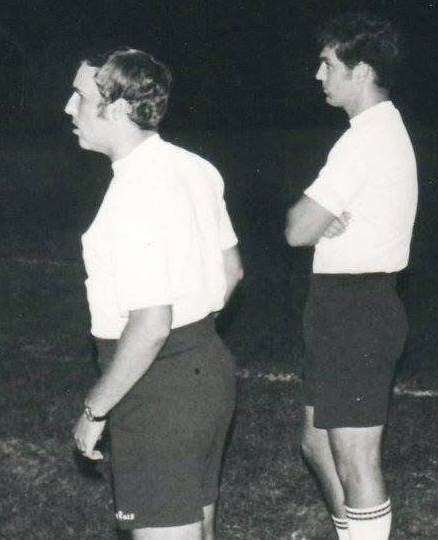
Holtzapfel would replace Conley as the head coach after the 1976 season and led Ashland for three seasons.
What the Tomcats had for that 1975 season was a veteran offensive line with four of the five interior linemen returning as starters in the 1974 season. That included Bell, although he missed a lot of his junior season due to a knee injury in a Sept. 13 game against Franklin County. He was clipped from behind while blocking on an interception return.
The injury did not require surgery, but it did mean two months of rehabilitation. Bell made it back for the last game of the season against Boyd County. Meanwhile, the rest of the linemen that would make the JAWS team special were gaining valuable experience. Terry Fish was the only starting senior lineman for the 1974 team.
Bell was healthy again going into the offseason and came back better and bigger for the 1975 season. “l played the whole season, all 15 games,” he said. “They taped my knee up every game; used three to four rolls of tape. Between Coach Conley and coach Holtzapfel, they get it on and got it tight,” he said.
Jackson said Bell set the example of hard work equaling success, coming back from the injury stronger than ever.
“He was not only a big lineman, he was one of the fastest linemen I have ever seen. As a running back, he is the one you wanted blocking for you. He would open holes you could take a truck through. They all worked so well as a set of linemen which made our jobs much simpler.”
As for his speed, Bell was clocked at 4.8 in the 40 – a fast time for a running back and an extremely quick time for a lineman.
Bell carried an intimidating presence even walking the hallways at the high school, often seen wearing a bandana. However, he could be a gentle giant and was seen as a protector to some in his class. He was a rare athlete who had speed and athleticism to go along with his power. He could dunk a basketball and was freakishly strong.
‘JUST A NATURALLY GIFTED ATHLETE’
Sang said the first time he met Bell was when they were in physical education class at Coles Junior High. “He grabs me and picks me up with one arm, has me leaning up against the wall. I thought, ‘Nobody except my dad can do that.’ He was just having fun. He wandered off and did something else. What a strong human being. He could jump and he could run, and he was quick, too. He could move laterally, fill in the gaps and he could run you down too. Just a naturally gifted athlete.”
Bell said the JAWS theme on the season made it fun and he can vividly recall the games and said the 22-12 win over No. 1 Bryan Station in the second week of the season was the springboard for what was to come. He said wins over Ironton with Kenny Fritz, Russell and Boyd County were all memorable moments. He also recalled the Class 4A State At-Large championship game at Paducah Tilghman, the flight – his first for him along with many teammates – to get there, and Gary Thomas breaking free on a 74-yard touchdown to win that game 13-7. “I remember seeing Gary’s back, and that was a good thing,” Bell said. And, of course, the St. Xavier game in Louisville in the overall Class 4A championship game.
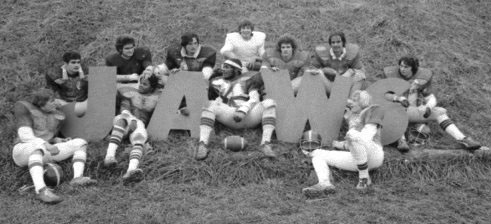
“I told somebody years ago if we could have played that game in Ashland, it might have been different because it’s a different atmosphere,” he said. “They never had to leave Louisville, and we had to fly to one of our games and played all but one (in the playoffs) on the road. I’d liked to have played them in Putnam Stadium.”
Depth was also a factor, he said. “There were so many of them. They had different players on offense and defense, special teams, everything. It was a tough loss.”
SNAPPING FOR FUTURE NFL GREAT PHIL SIMMS
Bell was a college prospect and he signed with Morehead State and coach Wayne Chapman. He played noseguard as a freshman and was switched to center his sophomore season before a knee injury ended his career.
Bell said he promised his mother he would stay two years and after the knee injury and a trip to the Cleveland Clinic, he decided that was enough. His hips and knee still bother him to this day, he said. Bell came home and graduated from vocational school.
Marshall talked to him and Kentucky came into the Ashland locker room after the game with St. Xavier and offered him a chance to play but would not guarantee a full scholarship. Bell said he signed with Morehead and was the center for quarterback Phil Simms’ sophomore season.
Bell said Simms and Anderson, his high school quarterback, had similar work ethic when it came to preparation. They studied film regularly and came to games ready to deliver, Bell said. He said Morehead State receivers would have Xs on their chests from catching Simms’ passes. Simms, of course, became a first-round NFL draft choice with the New York Giants and eventually was a winning quarterback in the Super Bowl.
A CHANCE TO PLAY FOR ROY KIDD AT EASTERN KENTUCKY?
Sang, who signed and played for four years at Eastern Kentucky, was on a recruiting visit to meet with coach Roy Kidd after the 1975 season. When he introduced himself to Kidd, the response from the Hall of Fame coach was “Where’s Terry Bell? Didn’t he come with you?” Kidd apparently wanted Kidd and Sang to both become Colonels. He left the room, made a phone call and learned that Bell had committed to Morehead. Kidd came back into the room seething,
It made for an uncomfortable visit although Sang was offered and had an outstanding career at EKU as a punter and tight end/wide receiver. He was on the 1979 Division I-AA national championship team and later was an assistant coach on EKU’s 1982 national champions.
Bell said he never talked to EKU coaches but did attend a game. Morehead State extended an offer and Bell accepted it.
During Bell’s freshman season at MSU, he lined up at noseguard opposite EKU center Roosevelt Kelly, an All-America center who was drafted into the NFL, and held his own against him, Sang said.
BELL GIVES SHOUTOUT TO TOMCATS’ 1972 STATE RUNNERUPS
Bell said while he appreciates the accolades that are heaped on the JAWS Tomcats, he feels bad for the 1972 Tomcats that were the Class AAA runner-up to Tates Creek who is seldom remembered or mentioned. His brother, Dwight, was on that team, he said, and he remembers the family going to Stoll Field in Lexington for the championship game that the Tomcats lost 16-7.
Bell said he modeled his game after a lineman from that team – All-State guard Steve Justice – and often wondered how the 1972 and 1975 offensive lines compared. Coach Conley has been asked but often shies away from any comparisons for understandable reasons. But strong line play was a common denominator for his best teams.
“They had a great team and a great line like we did,” Bell said of the ’72 team. “I always felt bad because they didn’t get as much recognition as we do. It doesn’t seem right.”
Spoken like a true Tomcat.
 MARK MY WORDS 2