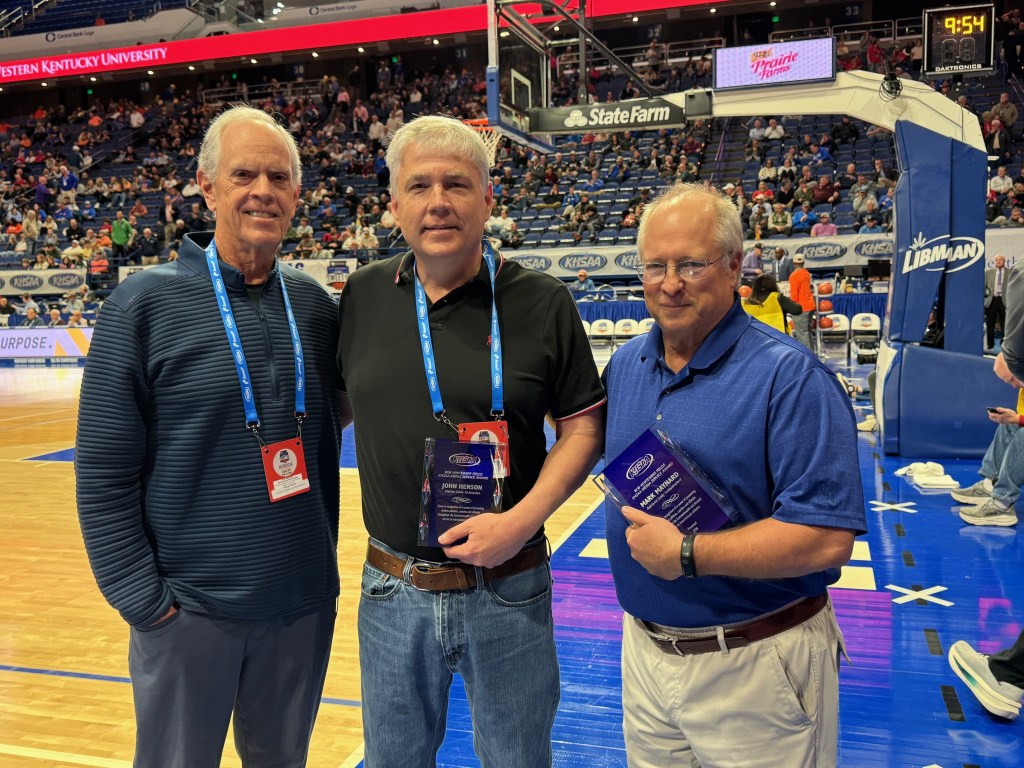
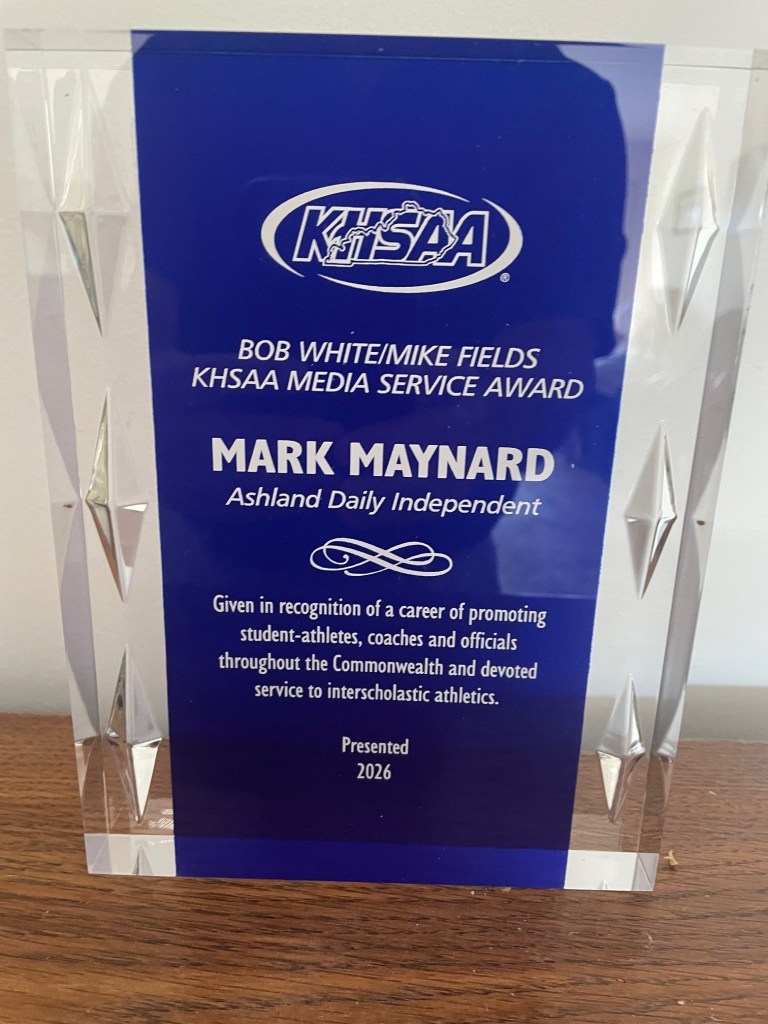
I received a special award Thursday afternoon at the Boys Sweet 16 in Rupp Arena during halftime of Boyd County’s game with Marshall County. Special because of the people whose names are attached to it. It was the Bob White/Mike Fields KHSAA Media Service Award. Bob (53 years writing for The Courier-Journal) and Mike (35 ½ years at Herald-Leader, 41 as a sportswriter) are the two best high school sports reporters in the state over the last 65 years.
From left: Mike Fields, John Henson, Mark Maynard.
Bob, who passed in 2024, was a mentor to many of us when he was at the C-J. What a kind person he was. Mike handed the award to me and that meant so much because of how much he has done for high school sports in the state. He was a peer and good friend during nearly all my 42 years at The Daily Independent.
Also, kudos to KHSAA Commissioner Julian Tackett, who started the award. He has been a tremendous leader for Kentucky high school sports. A really good man and someone I’ve known and respected for decades. Julian put the award together for the first time last year because he understood the importance Bob White and Mike Fields to Kentucky high school sports, and there were others in the state who should be honored, too. Thank you, KHSAA and Julian, for recognizing those who tell the stories of our high school sports heroes in Kentucky.
Along with myself, John Henson of the Harlan Enterprise and retired Kentucky Press Association chief David Thompson were recognized with the honor this year. That’s two more men that I admire greatly. Ivan Rice, Rick Shaw and Gary Ball were selected in the inaugural year.
Thankful to the Lord for a good day full of blessings. Never expected to be standing at midcourt in Rupp Arena at 68, or any age for that matter.
LEXINGTON, Ky. – Jody Hamilton, whose remarkable 41-year high school baseball coaching career includes 1,038 victories, two state championships and National Coach of the Year recognition, is part of the Dawahares’ Kentucky High Schol Athletic Association 2026 Hall of Fame class.
Hamilton, a 1976 graduate of Ashland, won state championships at Boyd County in 2001 and West Jessamine in 2015. He also captured the All-A State title in 2024 at Owensboro Catholic and was the All-A runnerup at that school in 2025.
Hamilton was at Boyd County and West Jessamine for 16 years apiece and at Raceland for four years. This spring will be his fifth season at Owensboro Catholic,
He became only the fifth coach in Kentucky history to reach 1,000 victories, crossing that milestone in 2024. He is the only coach with state championships at two different schools.
The top four coaches on the Kentucky win list accomplished their 1,000-plus victories while coaching at the same school. All-time wins leader Mac Whitaker is still coaching at Harrison County and Bill Krumplebeck of Covington Catholic retired after last season.
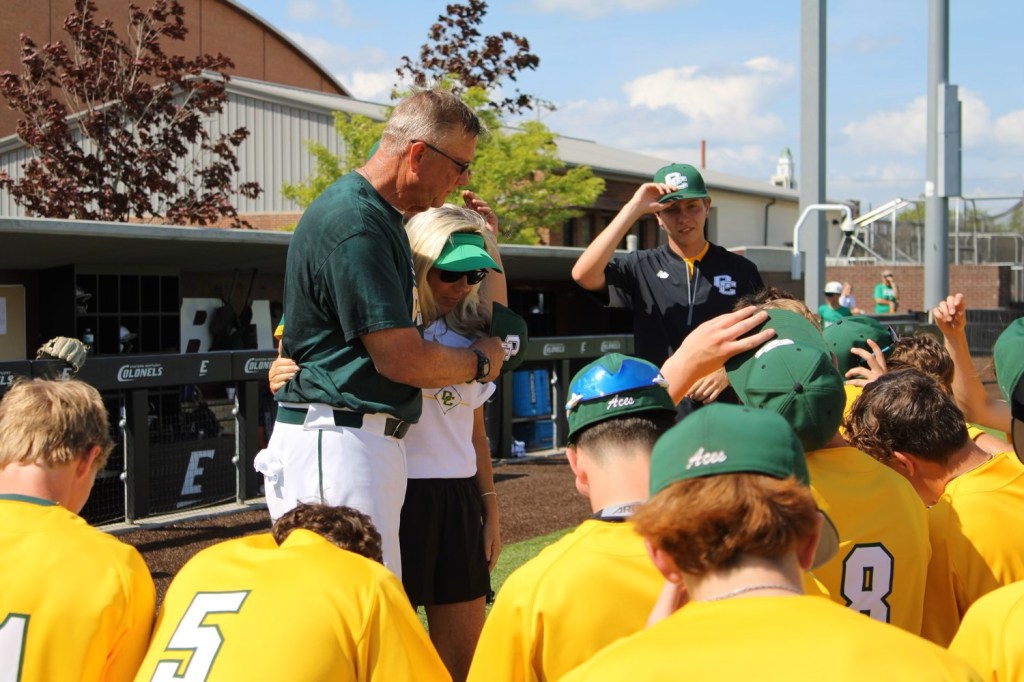
Jody Hamilton with wife Denise after Owensboro Catholic captured the All-A state title in 2024.
Taking his place in the KHSAA Hall of Fame is an honor that is well deserved for one of the best high school baseball coaches in Kentucky history. He has helped countless players – his own and rivals alike – to college scholarships and was largely responsible for elevating baseball programs through the 16th Region during a dominating run there from 1987 to 2002.
Programs were forced to improve facilities and skills to try and keep pace with the Lions who were also state runnerups twice under Hamilton.
Hamilton, who is still the head coach at Owensboro Catholic, was the 2016 National High School Coaches Association Coach of the Year. He was a charter member in the Kentucky High School Coaches Hall of Fame, the 2016 NHSCA Coach of the Year and the Kentucky High School Baseball Coaches Association Coach of the Year in 2001 and 2015.
He was also a charter member of the Ashland Baseball CP-1 Hall of Fame in 2015 and is a member of the Morehead State Athletic Hall of Fame after an illustrious playing career that included being named Ohio Valley Conference Player of the Year after winning the league Triple Crown in 1977. His 49 career home run record stood until being eclipsed in 2024.
Jody played one year professionally for the Paintsville Yankees, including debuting the same night that Darryl Strawberry did for the Kingsport Mets.
Despite a successful first season in pro ball where he hit better than .300 with the prospects of moving up in the Yankee organization, he decided to embark on a coaching career that has been full of highlights. His career began as the head coach at Raceland High School in 1983. He later moved to Boyd County, then West Jessamine and is currently at Owensboro Catholic.
Jody Hamilton led West Jessamine to the 2015 state championship.
Hamilton coached golf from 2007-2010 where his teams were four-year regional champions and finished third at state in 2010 and seventh in 2009 at West Jessamine. He served as an assistant football coach at Raceland and West Jessamine in a career defined by success.
He endured only one losing season in his career, going 15-17 in his last year at Raceland in 1986 when every game was played on the road. Raceland won the district crown in ’86, anyway, and was the home team on the scoreboard for the first time — in 28 total games — in the opening round of the 16th Region Tournament.
Hamilton moved to Boyd County and captured his first of 11 region championship trophies with the Lions in 1988, taking them to the state championship game. Casey Hamilton, Jody’s son, helped bring Boyd County to a state title in 2001. He started at West Jessamine in 2004 and the Colts collected four region crowns (2008, ’10, ’15, ’16) under his leadership. He has two regional titles at Owensboro Catholic.
Winning the state championship and getting attention from college recruiters for his players was always the goal for Hamilton, who estimated 70 percent of the seniors who played for him found themselves on college rosters.
The secret sauce for Hamilton’s teams have been pitching and defense. All but “one or maybe two” of his starting catchers throughout his 41 seasons have gone on to play college baseball. Two of his pitchers at Boyd County, Jason Keyser and Casey Davis, were drafted in the eighth and ninth rounds, respectively. He has helped more than 125 players find a place to play in college.
Hamilton operated a baseball school while coaching at Boyd County and one of the pupils was Brandon Webb, a future Cy Young Award winner for the Arizona Diamondbacks. Webb was 10 when his father, Phil, took him to Hamilton. He worked with him for five years before telling him he had to stop because Webb would soon be pitching for Ashland, Boyd County’s biggest rival.
“I said, ‘Brandon, here’s what’s going to happen. I have to stop giving you lessons because, if I keep giving you lessons, you’re going to beat me. People aren’t going to like that. If I don’t keep giving you lessons, I’m going to recruit you, and then I’m going to get fired.’”
In an unusual twist, Webb never faced Boyd County as a Tomcat. Coaches held their top pitchers during the regular season for a potential district matchup. Ashland and Boyd County never drew in the first round through his junior year. Webb’s senior season was cut short by an injury.
“How many coaches can say they gave lessons to a Cy Young winner?” Hamilton asked.
Jody and wife, Denise, have two grown children and several grandchildren and live on a farm in the Owensboro area.
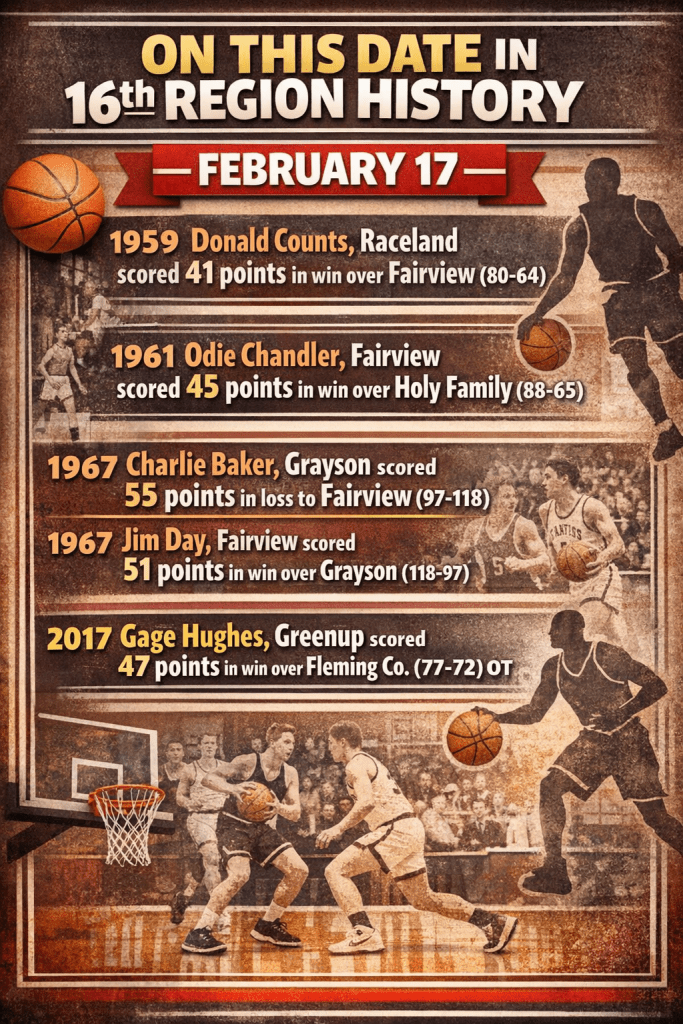
Curtis Crye, the 16th Region statistical guru, reminds us that February 17 is a night in area basketball history where points come out in bunches.
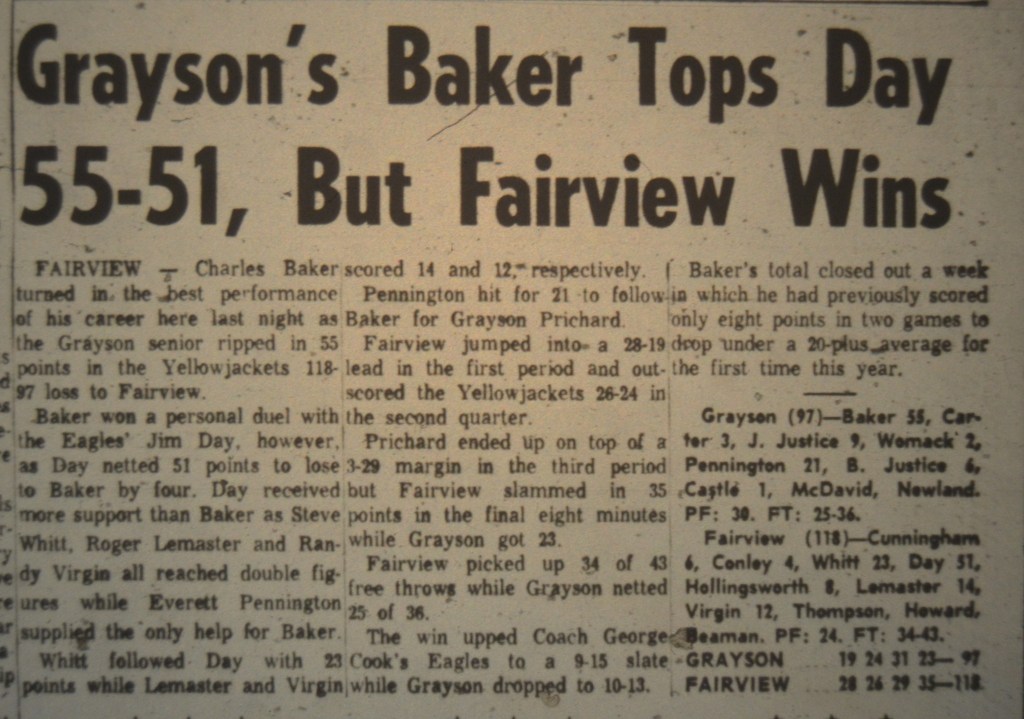
One game particularly stands out though and here is a column written a few years ago about that individual scoring battle that will likely never be matched.
Grayson and Fairview met late in the season with little on the line. Neither team was above .500, and neither was expected to make postseason noise.
But for one February night in 1967, none of that mattered.
Grayson’s Charles Baker and Fairview’s Jim Day staged one of the greatest scoring duels in 16th Region history. Baker poured in 55 points. Day answered with 51. Fairview won, 118-97.
The outburst capped a strange week for Baker, who had scored just eight total points in his previous two games, dropping his average below 20 for the first time all season. Against Coach George Cooke — the original “Wizard from Westwood” — in Fairview’s old gym, Baker couldn’t miss.
The tiny gym was packed, helped by the presence of University of Kentucky assistants Harry Lancaster and Joe B. Hall, there to watch Day play for Adolph Rupp.
“They weren’t coming to see me,” Baker said. “But there was a buzz in the crowd.”
There was plenty to buzz about. Baker and Day matched each other shot for shot in a relentless, up-and-down showcase. In the end, Fairview pulled away with 64 second-half points.
Steve Whitt added 23 and Roger Lemaster 14 for the Eagles. Everett Pennington scored 21 for Grayson, giving Baker the support he needed.
“Looking back, I couldn’t ask for a better bunch of guys,” Baker said of his teammates. “They’d say, ‘We need you to win.’ We still have a good relationship today.”
Grayson coach Dick Vincent understood scoring, too. He once had 67 points in a game for Hitchins — a school record.
Baker remembers being completely in rhythm.
“Looking back, it was what everybody calls being in the zone,” he said. “It was going in. Day would turn around and shoot it, then I’d come back on the other end. It was like a fast-moving picture.”
The game was physical — the teams combined for 79 free throws — and it came during an era built for scorers. Pistol Pete Maravich was lighting up college basketball at LSU, and Oscar Robertson had recently dropped 46 for the Cincinnati Royals.
Day, the area’s leading scorer that season, had already scored 60 in a win over Wurtland earlier that month, breaking Brice Thornbury’s record of 58. The 6-foot-9 standout finished with 23 field goals and 14 of 16 free throws in that game.
“Jim Day was a tremendous player,” Baker said. “He had great hands and touch. Just a natural shot.”
Day went on to an outstanding career at Morehead State, earning All-Ohio Valley Conference honors. Baker also played in college, shifting from scorer to facilitator at Rio Grande.
“I was an assist man and defense man,” he said. “If I wanted to start, I had to find my role. We already had All-American scorers.”
Some players struggled with that adjustment.
“They wondered why they weren’t playing,” Baker said. “I knew the secret — sometimes you have to adjust your role.”
In high school, though, both Baker and Day had one job: score. They were part of a region loaded with offensive talent in 1967, a season that featured multiple players averaging 20 or more points per game even though the 3-point shot was still 20 years away.
Late in the 1967 high school season, the top 10 scorers included Day (30.2), Louisa’s Herb Lemaster (22.9), Louisa’s Larry Edwards (21.1), Greenup’s Reece Stephenson (20.7), Hitchins’ Kevin Young (20.1), Raceland’s Mike Hewlett (20.0), Baker (19.6), Catlettsburg’s Roger Zornes (18.8), Boyd County’s Phillip Dowdy (18.1) and Blaine’s Roger Young (18.0).
Russell, which would go on to win the region, had five — Tookie Hilton (16.0), Roger Vanover (15.3), Tom Roberts (13.6), Lanny Miller (11.8) and Steve Radcliff (10.9) — scoring in double figures.
Ashland had four, led by Bob Lynch (17.9), Dan Owens (14.3), John Sieweke and Joe Conley (both 12.0).
Holy Family had four in double figures, too — John Layne (14.7), Tom Davis (13.2), Bucky Morris (12.5) and Maynard Thomas (12.1).
Dave Stultz was Greenup’s second-leading scorer at 12.
But on that February night, there were no better scorers in the 16th Region — and probably not in the state — than Jim Day and Charles Baker.
The toughest job in the 16th Region this season had nothing to do with coaching, handling the basketball or knocking down shots from beyond the arc.
It had everything to do with following a familiar voice—one that had become iconic.
Tyler Rowland stepped into the enormous shoes of the late, great Dicky Martin. When Dicky passed away toward the end of the high school football season, the question of who could follow him wasn’t really meant to be answered.
Who could replace him?
The answer then—and now—is nobody.
Dicky Martin was an original. One of one. A voice so memorable that replays of his calls still circulate on Facebook, and people still stop to listen. He is missed, without question, and things simply aren’t the same.
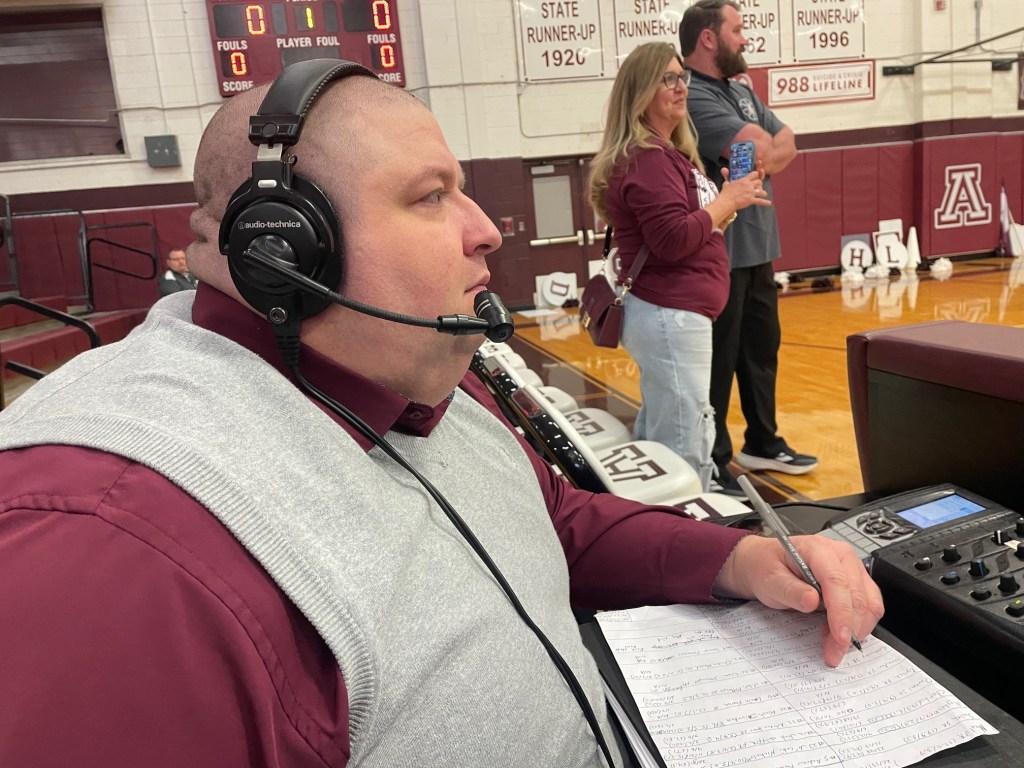
Tyler Rowland has taken on the toughest job in the 16th Region – the challenge of replacing the legendary broadcaster Dicky Martin as the Voice of the Ashland Tomcats. He is near the end of his first season.
But the man who stepped into his place has done a remarkable job.
Tyler Rowland isn’t Dicky Martin—and expecting him to be would be unfair to anyone. What Tyler has done, though, is begin to grow comfortable in a seat Dicky occupied for more than 50 years of Tomcat sports. Dicky was loud, proud, and unmistakable—a voice even rival fans couldn’t help but hear night after night. He was must-listen radio.
Times have changed, even during Dicky’s era. High school sports once lived exclusively on the radio. Now, fans can watch games from their living rooms through streaming services like My Town TV and Kool Hits. I’m thankful for both. Watching is fun, though I hope radio never disappears. There’s a charm to it that pulls you back in time.
This region has produced a Hall of Fame list of broadcasters—so many that naming them risks leaving someone out. Tyler Rowland has the potential to belong in that conversation.
For Ashland fans especially, radio remains a lifeline. Whether it’s listening live during a game or tuning in afterward for Ryan Bonner’s postgame analysis with Tyler, people are still listening. And if you’ve tuned in, what you’ve heard is a polished broadcaster who improves with every call.
Tyler considers himself a disciple of Dicky, and it shows—especially in his preparation. An accountant by day, his command of numbers is impressive. He’s a savant with statistics. While he has years of broadcasting experience, including time with My Town TV, radio is a different animal. Early on, Tyler was known for his loud excitement on TV. As his voice has matured, it’s grown softer—but also stronger—on the radio.
Tomcat radio is unlike most broadcasts. The tradition built by the Martin family—Dicky and his father, Dick—set the standard for 75 years. Imagine being the person tasked with replacing that kind of history.
It’s overwhelming. But Tyler never let it swallow him, largely because of how much he admired the man who came before him.
The advice he heard most was simple: Don’t try to be Dicky. Be Tyler.
That’s exactly what he’s done. And by doing so, he’s validated the decision made by Tomcat athletic director Jim Conway to hand him the microphone. Tyler’s play-by-play is descriptive, his knowledge sound. You always know the score, the time on the clock, and how far that corner jumper really was. He paints a clear picture without being overly excitable. His strong vocabulary and statistical awareness make his calls both informative and entertaining.
I’ve listened to several of his broadcasts and come away impressed every time. Even when things aren’t going Ashland’s way, he doesn’t rush to blame officials. You might hear, “I’m not sure about that one,” and then he moves on. It’s professional broadcasting—with just the right tint of maroon.
I listened to his call of the most recent Ashland–Boyd County game, a high-scoring Tomcat win. I watched on YouTube while listening to Tyler’s call—barely a second of delay—and he didn’t miss a thing. What he described matched exactly what I was seeing. It was impressive.
If you haven’t listened to this young man yet, give him a chance.
Replacing Dicky Martin was a mission impossible. Everyone knew nobody could truly do it.
But Tyler Rowland is the next man up—and he is the right man to handle the toughest job in the 16th Region, and maybe in the entire state of Kentucky.
And I know this much: Dicky would approve of the job that Tyler has done.

 MARK MY WORDS 2