‘The Boys They Called JAWS’ on sale now

By MATT SPARKS, The Daily Independent

Writers write about what they know.

One of the area’s best storytellers has penned another informative tale about 11 players who have stood the test of time, and one of the most cherished rosters in the rich Ashland football history.

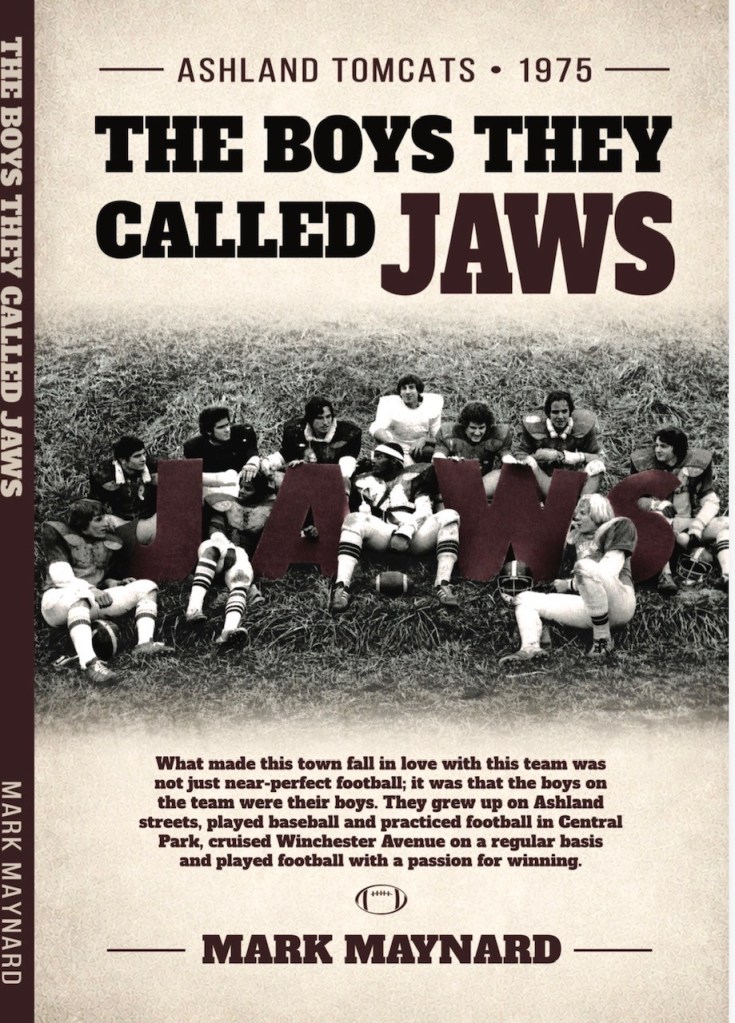
Mark Maynard, former editor and longtime sportswriter for The Daily Independent and current managing editor of Kentucky Today, releases a new book next month titled “The Boys They Called JAWS.”

It’s a deeper, more detailed story about a beloved Tomcats team, a fierce defense and an unforgettable season.

Maynard believes a book can offer more than a well-crafted article or feature. The pages offer a rousing chance to reminisce and relive memories still talked about today.

“It’s not news, it’s reacting to something that’s happened,” Maynard said. “I think it’s important to give some of the background that people don’t know. I’ve only written one fiction book. Everything else has been about things people may already know, and generally they know that Ashland’s 1975 team was called JAWS. Why were they called JAWS? Not everybody knows that, and it has some other neat things that happened during that time.”

Maynard graduated from Ashland in 1975 and became great friends with many on the vaunted Ashland defense that dominated the gridiron the following fall. The Tomcats would win 14 games that season, tied for the most with the 1990 state champions.
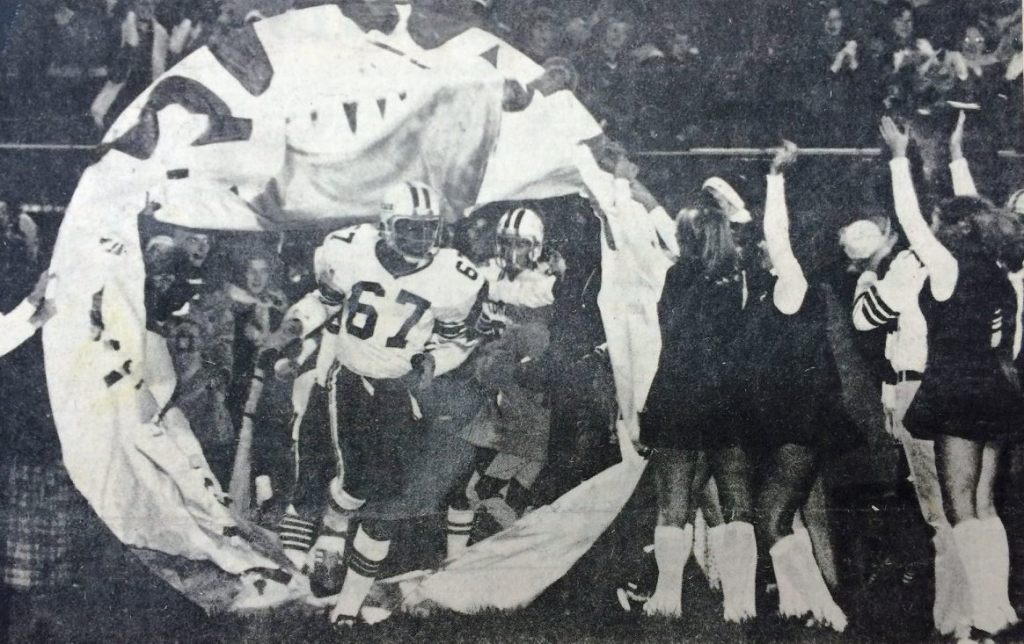
The 1975 Cats earned the at-large state championship. Due to unfortunate timing, a thrilling road playoff win at Paducah did not come with a Class 3A title. In February of that year, the Board of Control for the Kentucky High School Athletic Association met and implemented a four-class system for football. The champion from the Louisville area would meet the at-large champion in a winner-take-all scenario.

It was the first season in which any Louisville school played a team from outside Jefferson County for a state title.

St. Xavier, a private school, wore down the Tomcats in the second half on its home field, using a massive roster and constant substitutions on both offense and defense. Ashland gave the Tigers their toughest test of the season. The Tomcats only trailed 6-0 at halftime before falling for the only time that year, 20-0.

“I grew up with those guys,” Maynard said. “I knew many of them very well. I have written a ton about them throughout my time at The Daily Independent. I interviewed (former coach) Herb Conley in podcasts, and I have a lot of fresh quotes from him that people have never heard. I went back and got more information from the newspapers and writers who covered them at the time.

“They know what happened, but people may not know everything about them,” he added. “I hope that they will pick this book up and go through it and see what an amazing season that was and how good they were.”

The JAWS nickname originated after Conley and family attended the famous JAWS movie over a summer vacation. Ashland was enjoying one of its most successful stretches during Conley’s tenure, and a defining description of his defense could add extra motivation and reignite the physicality of a team that didn’t make the playoffs the previous year.

“Herb knew they could be really good,” Maynard recalled. “The other coaches were into it. They talked to the team and told them they were thinking about it. The team wanted to do it. Of course, 18-year-olds would want that nickname. Herb told them that they need to live up to it. If you do this, you need to live up to it. They proved it early in the season. They didn’t give them the name until they upset No. 1 Bryan Station in the second week of the season. They did it with defense. After that, it took off. They just annihilated people. The offense was good too. It wasn’t solely built on defense.”

Maynard said the personal connection to the team was the main reason he wrote the book. He also knew the team’s connection to the community. The players bleed maroon. They grew up on their streets. They were friends with their kids. They called Ashland home.

“The team holds special memories for me,” Maynard said. “They were a bunch of fun guys. They weren’t prima donnas or anything like that at all. They were respected. They were all Ashland kids. There were no recruits or transfers that came in to help them. They were Ashland kids, and that made it more special. It’s why the community wrapped their arms around them. They loved them. They had the band play the JAWS theme when the defense came on the field. The place was packed every Friday night.”

The postseason included a long cross-state trip to Paducah for the at-large state championship. It would be a six-hour bus ride, but the town had other plans. The community raised money for a Southern Airways flight so they could arrive for the biggest game of the season in just 60 minutes.

Maynard has many of these stories inside the new book. It speaks highly of a group and a team that people are still talking about them a half century later.

“This team did a lot of firsts,” Maynard said. “It was a fun book to write, and it was fun to revisit those games again. I had been planning to write this book for 10 years. The team was adored in Ashland.

“I have thought so much about this book for so many years that the words just came out,” he added. “ I knew the games, and I knew what had happened. We have stats in the back of the book. The cover has the iconic picture of that team. I really enjoyed writing it. I have written so many stories, but books have a different excitement. You try to make it as perfect as can be.”

“The Boys They Call JAWS” will be released in late September. Readers can preorder a softback or hardback edition of the book.

Preorder your copy at the following link: https://www.paypal.com/ncp/payment/TU53F77YFGW5Y

Was Terry Fish’s field goal in 1974 a state record?

Rick Sang and I took a deeper dive on the photograph of Terry Fish’s reported 47-yard field goal in 1974 for the Ashland Tomcats.

If you look at the photo, the 40-yard marker painted on the wall is clearly shown behind the Bryan Station bench. So, it was probably kicked from about the 44. Greg Estep’s hold looks to be on or about that spot. BUT the reported distance doesn’t account for the extra 10 yards from the goal line to the back of the end zone. That would make it a 54-yard field goal, which would have been a state record and still would rank sixth all-time in Kentucky high school football history.

A newspaper story about the game reveals the line of scrimmage was the 32 and then there was a 5-yard penalty on the Tomcats pushing it back to the 37. The standard from the snap to holder is seven yards, putting the hold on the 44, and the photograph shows that to be true.

My best guess is that the ball was on the 37 and they added 10 yards for the goal line-to-end zone distance to make it a 47-yard kick. But that’s now how it should have been scored. Ten yards is added from the point of the kick, not the line of scrimmage, making it a 54-yard kick.

The photo also shows the perfect technique on display. His kick made it 3-0 and Wendell Fugitt returned a fumble for a touchdown for a 9-0 lead. The extra point was blocked, which again shows you how much had to go right for Fish to boom a field goal of that distance. It took a perfect snap, perfect hold, perfect blocking and perfect kick.

And if he kicked it from the 44, which sure looks like happened, it was a 54-yard kick. He would have had the record until 2004 when Taylor Long kicked a 55-yard field goal for Christian County. That would mean Fish had the state record for 30 years before it would have been broken. But it was never recognized as such.

Schools must turn in a verified account of records for the KHSAA to consider them. Ashland apparently did not do that – or even think to do it – in 1974. I’m not even sure when the KHSAA began accepting records to be quite honest.

Tyler Pack of Johnson Central holds the state record of a 60-yard field goal. It was interesting because it came on a free kick in a game the Golden Eagles’ won easily. On a punt or kickoff, you can make a fair catch, and the coach can send out the kicker for a free kick from that spot. No rush from the opponents; just tee it up and kick. It usually happens with not much time remaining in a quarter, half or game. A missed kick can be returned, and the opponent takes possession if the kick is missed. (Note to coaches: It’s an interesting play to consider if you have a good kicker and if you have somebody who can fair catch a ball on the opponents’ side of the field).

Pack also had a 58-yard field goal and his 89-yard punt is also a state record. He had some kind of leg.

Aaron Pettrey of Raceland had field goals of 58 yards in 2003 and 52 in 2002. He went on to kick for Ohio State and had a cameo with the Cincinnati Bengals.

But Terry Fish’s long kick between the uprights on scoreboard side of the field in a 9-6 win over Bryan Station at Putnam Stadium remains the Tomcat record, but belongs in the state record book as well.

 I’m sure he would been proud to own the state record for so long.

FLASHBACK: Love and devotion

This was written back in 2014 following the death of Herb Conley’s wife, Janice. It is a tribute to her but also to every coach’s wife. They go through more than you think. Herb called Janice his “inspiration” and the thought of them reuniting made the sting of his death easier to bear.

Here is the column:

Nobody ever pushed around Herb Conley. Nobody ever dared.

He was tough as nails. As a kid growing up. As a blossoming athlete. As a coach. As a father. Always, tough as nails.

He was a Beast, and this Beast had a Beauty.

Her name was Janice.

Janice was the love of his life, the one person who could tame this Tough Guy who would become a football coaching legend in his hometown.

She could melt him with the batting of her eyes.

She had him at hello and, boy, was he ever glad she did.

Whenever things were tough, and they weren’t always easy for Herb Conley, he had Janice.

Always there to lift him up.

Always there to tell him how proud she was of him.

Always there to keep him in line.

Whenever Herb Conley needed a boost, she was there for him. She could pick up his spirit like he picked up weights. Effortlessly.

They lived a storybook life, these high school sweethearts did. That’s because anything they did together, they did well. They were soulmates who raised three boys in their hometown. Grew old together, yet still loved each other like school kids.

She had one of the toughest jobs on earth, that of being the wife of a high school football coach, in a town that expected a lot from its team. Every week. Every game. Every minute.

We’re with you win or tie, they would say.

Conley was no newcomer when he became Ashland’s head coach in 1968. He was a former star player for the Tomcats, a member of their last undefeated team in 1958, and had been an assistant the prior two years under Jake Hallum. The ’67 Tomcats won a state championship and Herbie was a big reason why.

But when you step into that head coaching position, the pressure intensifies. Ask anyone who has coached here where your fate is determined every Friday night.

When the Tomcats weren’t winning like the fans thought they should be winning, the fingers started pointing and they were pointing in Herb’s direction in 1970.

Legend or not, they were ready to run him out of town.

Ashland had lost to Russell for the first time in school history and angry fans trashed Conley’s yard and home with garbage.

“Herb wasn’t always the legend he is now,” said longtime friend Bill Tom Ross. “Early in a coach’s career, you have difficulties. I had the same thing at Boyd County (his first head coaching assignment).

“Imagine being Herb Conley’s wife? The toughness, the mental toughness, raising three sons. That house was overflowing with testosterone.”

But Ross remembers Janice as being upbeat in the face of adversity. She was that to the end.

“I remember back in those days she was never down, never depressed,” said Ross, who credits his wife Brenda with his coaching success.

The life of the high school coach’s wife is never easy. The divorce rate is high. The criticism you hear from fans can be cruel.

“Not only in the stands but, when you’re coaching at a high-profile place like Ashland, you can’t go to the grocery store or the bank without hearing something,” Ross said. “Somebody is always talking about the game.”

But the wife must bite her tongue, smile and take it. They must be there for their husband and their family. They better be strong.

“I’m not sure in that household that Janice wasn’t the toughest one of the bunch,” Ross said.

Back in 1970, when things were tough, a letter came to the Conley’s house. Inside it had a cartoon drawn of a man with a noose around his neck with another man leading him out of town.

Janice never showed it to Herb, but he found it rummaging through a drawer a couple of years later.

“What’s this?” he asked her.

 “Oh, where do you find that?” she said. “I thought I threw that away. It was nothing.”

She told Herb it had come a few years ago, but she didn’t want to bother him with it. Truth is, Janice was protecting her man from one more dart being thrown in his direction.

The rest of the story went well for Herb Conley after he survived that 1970 season. The Tomcats took off on a six-year run that produced 56 victories, a state runner-up finish in 1972 and the 1975 state at-large championship.

Guess who was there cheering him all the way?

She loved her Tomcats. Always. Even in her last days of a losing battle with cancer, when she was mostly unresponsive, when Herb was wearing a Tomcat shirt she would look down at it and then up to his face. Down again and up to his face.

It’s been a difficult 19 months for the Conleys, who were set to enjoy a long retirement together with long walks on the beach. They loved their stretch of paradise on Myrtle Beach.

They enjoyed life together, right to the end. It was a never-ending love story like you wouldn’t believe.

Coaches’ wives are given something special inside. They are patient and thick-skinned. They know the importance of supporting their man through the good times and bad.

Janice Conley was like that for Herb.

“They were the ultimate team,” said Ross. “He didn’t lose her. He knows exactly where she is. He’s got that peace that passes all understanding.”

And he’ll never stop loving her.

‘Shorty’ Blanton, Tomcat state championship baseball coach in 1968, dies at 94

Leonard “Shorty” Blanton, who coached the Ashland Tomcats baseball team for only three years but his legacy includes a state championship in 1968 and state runner-up finish in 1969, died in Florida on Aug. 30. He was 94.

Blanton took over the Tomcats’ baseball job in 1968 after Zeke Meyers had led Ashland to back-to-back state titles in 1966 and 1967. Meyers, who took an administration position at Marshall University following his time in Ashland, went 47-4 in two seasons including a perfect 25-0 in 1967.

Even though the cupboard was hardly bare, who wanted to replace that coaching legend?

Blanton told me a few years ago in an interview for the book Tomcat Dynasty he got the job because “no one else wanted it.” During those days the principal selected the coaches for the so-called “minor” sports of track and baseball. He appointed Blanton to be the baseball coach.

A good football coach at several levels in the Ashland system, including the junior varsity coach the year the Tomcats won the state title in 1967 and the head coach at Coles Jr. High in 1971, Blanton admittedly didn’t have a wealth of baseball knowledge and had never coached the sport on any level. And now he was taking over the two-time defending state champions with a wealth of returning players, including Bobby Lynch, John Mullins, Steve Hemlepp, Fred Leibee, Tim Huff, Bo Carter, Dave Staten and Mike Tackett. These days people would be knocking each other over to get that job.

Leonard “Shorty” Blanton celebrates after winning the 1968 state baseball championship as coach for the Ashland Tomcats. It was the third consecutive title for the Tomcats.

Lynch and Hemlepp were like unofficial assistant coaches and knew the team better than anyone. Blanton said he welcomed their suggestions and knew these Tomcats were not just good at baseball, they were good at winning.

It proved to be true as those Tomcats became Kentucky’s first program to win three consecutive state championships. It did not happen again until Pleasure Ridge Park won it from 1994-96.

Blanton said the players taught him a lot about baseball and were “easy to coach.”

The ’68 champions finished 23-3 and surrendered only one run in three games in the state tournament. Lynch won two of those games, including being the winning pitcher in the finals for the second time in three years. If not for a strange scoring decision, he would have been the winning pitcher in all three championship games.

But what Blanton did with the ’69 team was the most surprising. He took them back to the state tournament and reached the finals where they dropped a 1-0 decision to Owensboro in heartbreaking fashion.

In the state championship game against Owensboro, a pair of errors brought home the winning run – and only run of the game – in the bottom of the seventh inning. There may have been three errors since the baserunner was thought to have missed third. Ashland never protested. Leonard talked about that play nearly 50 years later.

“Someone told me the runner didn’t even touch third base,” he said. “I missed it and none of my boys saw it either. Who knows? The umpire may not have noticed either. I guess we’ll never know.”

The Tomcats finished 19-4 including a 1-0 victory over Don Gullett-led McKell in the regional semifinals in Morehead. Ashland had only one hit in the game, a triple from Dave Damron who then scored the game’s only run on Tackett’s sacrifice fly. Gullett struck out 11 and allowed the lone hit but Huff outdueled him.

“Those guys were outstanding, some of the best in the state, and they knew how to win, too,” Blanton said. “It’s a shame it turned out like it did.”

Blanton was not planning on coming back for the 1970 season after that stinging loss and announced in the newspaper that Steve Gilmore would be replacing him. But that didn’t happen until the following year. Blanton coached the Tomcats to a 12-10 season in 1970, losing in the regional finals to Russell.

He finished his high school coaching career with a 54-17 record. Not bad for somebody who admitted having limited baseball coaching knowledge when he took the job.

Blanton was much more than a good coach, though. He was a fine Christian gentleman, husband and father and a friendly and popular man in Ashland. His wife, Ada, who died in 2020, was a beautiful lady and powerful singer who was crowned Mrs. Kentucky in 1968. She represented the state along with the 1968 Miss Kentucky and Col. Harland Sanders of Kentucky Fried Chicken fame on the Kentucky state float during the inauguration parade for President Richard Nixon in Washington, D.C., in 1968.

Shorty and Ada sang together in church at Unity Baptist and in local dramas and musicals. They have a son, Ted Blanton, who played on Ashland’s 1967 state football championship team.

Blanton was born in 1931 and graduated from Ashland High School in 1949. He played on the Tomcats’ 1946-1948 football teams. He rushed for 339 yards and had 152 yards receiving while scoring five touchdowns on a 5-4-1 team in ’48 that was ranked No. 3 in the final AP state poll. The losses and tie came to four out-of-state teams (Charleston, Stonewall Jackson, Huntington High, Ironton and Portsmouth).