‘Shorty’ Blanton, Tomcat state championship baseball coach in 1968, dies at 94

Leonard “Shorty” Blanton, who coached the Ashland Tomcats baseball team for only three years but his legacy includes a state championship in 1968 and state runner-up finish in 1969, died in Florida on Aug. 30. He was 94.

Blanton took over the Tomcats’ baseball job in 1968 after Zeke Meyers had led Ashland to back-to-back state titles in 1966 and 1967. Meyers, who took an administration position at Marshall University following his time in Ashland, went 47-4 in two seasons including a perfect 25-0 in 1967.

Even though the cupboard was hardly bare, who wanted to replace that coaching legend?

Blanton told me a few years ago in an interview for the book Tomcat Dynasty he got the job because “no one else wanted it.” During those days the principal selected the coaches for the so-called “minor” sports of track and baseball. He appointed Blanton to be the baseball coach.

A good football coach at several levels in the Ashland system, including the junior varsity coach the year the Tomcats won the state title in 1967 and the head coach at Coles Jr. High in 1971, Blanton admittedly didn’t have a wealth of baseball knowledge and had never coached the sport on any level. And now he was taking over the two-time defending state champions with a wealth of returning players, including Bobby Lynch, John Mullins, Steve Hemlepp, Fred Leibee, Tim Huff, Bo Carter, Dave Staten and Mike Tackett. These days people would be knocking each other over to get that job.

Leonard “Shorty” Blanton celebrates after winning the 1968 state baseball championship as coach for the Ashland Tomcats. It was the third consecutive title for the Tomcats.

Lynch and Hemlepp were like unofficial assistant coaches and knew the team better than anyone. Blanton said he welcomed their suggestions and knew these Tomcats were not just good at baseball, they were good at winning.

It proved to be true as those Tomcats became Kentucky’s first program to win three consecutive state championships. It did not happen again until Pleasure Ridge Park won it from 1994-96.

Blanton said the players taught him a lot about baseball and were “easy to coach.”

The ’68 champions finished 23-3 and surrendered only one run in three games in the state tournament. Lynch won two of those games, including being the winning pitcher in the finals for the second time in three years. If not for a strange scoring decision, he would have been the winning pitcher in all three championship games.

But what Blanton did with the ’69 team was the most surprising. He took them back to the state tournament and reached the finals where they dropped a 1-0 decision to Owensboro in heartbreaking fashion.

In the state championship game against Owensboro, a pair of errors brought home the winning run – and only run of the game – in the bottom of the seventh inning. There may have been three errors since the baserunner was thought to have missed third. Ashland never protested. Leonard talked about that play nearly 50 years later.

“Someone told me the runner didn’t even touch third base,” he said. “I missed it and none of my boys saw it either. Who knows? The umpire may not have noticed either. I guess we’ll never know.”

The Tomcats finished 19-4 including a 1-0 victory over Don Gullett-led McKell in the regional semifinals in Morehead. Ashland had only one hit in the game, a triple from Dave Damron who then scored the game’s only run on Tackett’s sacrifice fly. Gullett struck out 11 and allowed the lone hit but Huff outdueled him.

“Those guys were outstanding, some of the best in the state, and they knew how to win, too,” Blanton said. “It’s a shame it turned out like it did.”

Blanton was not planning on coming back for the 1970 season after that stinging loss and announced in the newspaper that Steve Gilmore would be replacing him. But that didn’t happen until the following year. Blanton coached the Tomcats to a 12-10 season in 1970, losing in the regional finals to Russell.

He finished his high school coaching career with a 54-17 record. Not bad for somebody who admitted having limited baseball coaching knowledge when he took the job.

Blanton was much more than a good coach, though. He was a fine Christian gentleman, husband and father and a friendly and popular man in Ashland. His wife, Ada, who died in 2020, was a beautiful lady and powerful singer who was crowned Mrs. Kentucky in 1968. She represented the state along with the 1968 Miss Kentucky and Col. Harland Sanders of Kentucky Fried Chicken fame on the Kentucky state float during the inauguration parade for President Richard Nixon in Washington, D.C., in 1968.

Shorty and Ada sang together in church at Unity Baptist and in local dramas and musicals. They have a son, Ted Blanton, who played on Ashland’s 1967 state football championship team.

Blanton was born in 1931 and graduated from Ashland High School in 1949. He played on the Tomcats’ 1946-1948 football teams. He rushed for 339 yards and had 152 yards receiving while scoring five touchdowns on a 5-4-1 team in ’48 that was ranked No. 3 in the final AP state poll. The losses and tie came to four out-of-state teams (Charleston, Stonewall Jackson, Huntington High, Ironton and Portsmouth).

Greg Jackson, community champion and driving force of the Putnam Stadium project, selected as Sports Day honoree

ASHLAND – Greg Jackson, who spearheaded and practically willed the rebuilding of Putnam Stadium from rubble to spectacular showcase, will be honored this summer on Elks Sports Day.

Jackson spent countless hours overseeing the Putnam Stadium restoration project for 17 years, serving as everything from fundraiser to cheerleader to give the Tomcats and their fans one of the most complete and impressive stadiums in the South. Nobody could question the resolve of Jackson whose expansive vision for what Putnam Stadium could be came to life this fall.

A born leader who graduated from the U.S. Military Academy at West Point in 1980, Jackson is also a community champion who has served on countless boards and is a leader at his church. He was a two-sport star in high school for Ashland. Jackson was a running back and outside linebacker on the famed JAWS 1975 champions and a third baseman for the 1975 and 1976 regional baseball champions.

Jackson also played on freshmen football and baseball teams at West Point. He served six years in the Army after graduating from West Point. He went there with classmate and teammate Chuck Anderson, a past Sports Day honoree, who went on to a career in the Army that saw him rise to become a Two-Star General. Anderson will introduce Jackson at the Sports Day banquet.

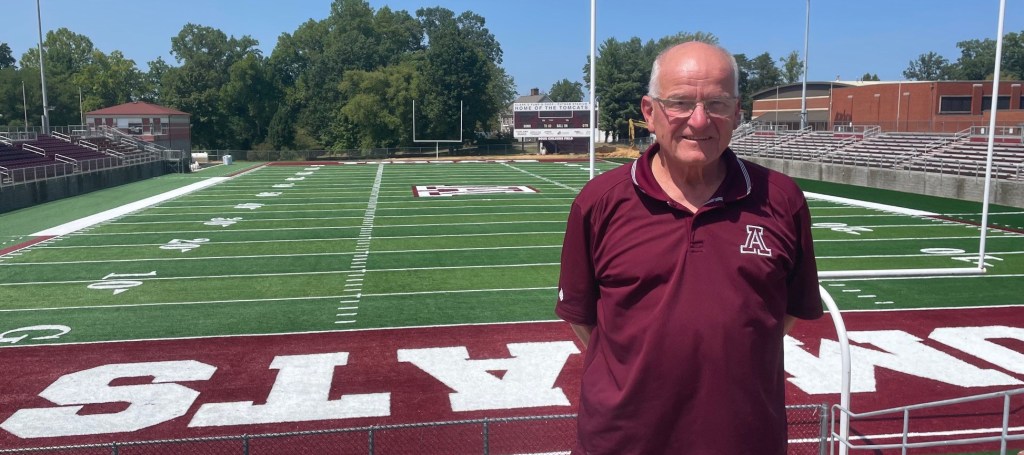
Greg Jackson spent 17 years as chairman of the Putnam Stadium Restoration Committee, finishing the job in the fall of 2024.

Beyond playing, Jackson served as an assistant coach for Ashland Kittens softball for eight seasons, including six regional champions, and was president of the Tomcat Band Booster Club for one year and active for eight years when his daughters were in band. He also was a youth softball, baseball, football, and basketball coach when his three children were young.

All that while working 34 years in Human Resources with Ashland Oil and Marathon Petroleum Corporation and serving on a dozen community boards.

The exhaustive list of accomplishments checked all the boxes for making him the perfect choice for Sports Day, said Dale Sexton, who is serving as co-chairman with Steve Towler. Sexton said Jackson was a unanimous selection of the committee.

Greg Jackson with his coach, Herb Conley, in September 2024 to dedicate the stadium’s new look.

“He’s definitely somebody that needed to be honored for all he’s done for the Ashland community,” Sexton said. “He is very deserving, and we are glad to have him as the honoree. I think it will be a great night to honor a great man who obviously loves Ashland.”

The banquet is on June 14 at Elks Lodge. Jackson’s portrait will be hung on the lodge’s back wall joining the honorees who have come before him. Mark Maynard, another former Sports Day honoree and former editor of The Daily Independent, will be the speaker.

“You look at those names and it is hard to feel like you’re in that group,” Jackson said. “I’m humbled to have even been considered but appreciative of being selected by the committee.”

Jackson, 67, was inducted in 2022 to the CP-1 Ashland Baseball Hall of Fame.

Jackson is the ultimate volunteer, using his time and skills to make Ashland a better place throughout his life. His board work was exemplary, even reaching the state level where he was on the state United Way board from 2015-2018.

As an athlete, few played harder than Jackson, who missed five weeks of his senior football season with a broken foot. Although he did not know it, he had broken the foot two days before the opener against Johnson Central.

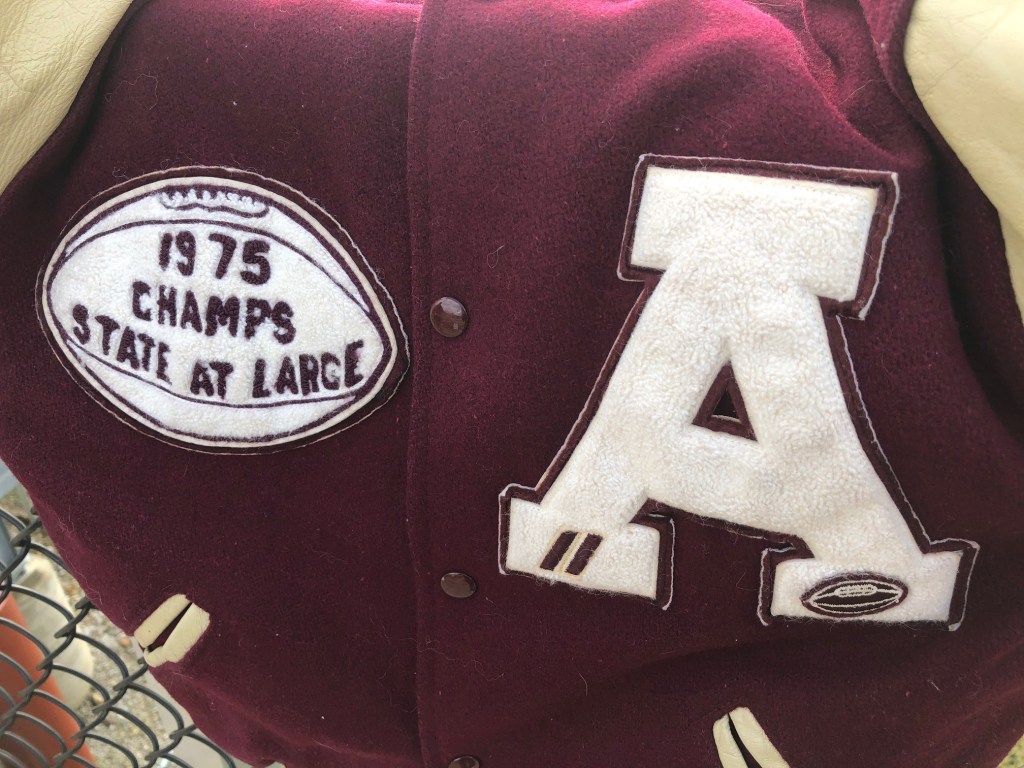
JAWS 1975 team was the State At Large champions.

The night before the opener he had a temperature of 102 but tried to hide the injury from the coaches because he wanted to play the first game of his senior season. Jackson played and on his first carry dashed 53 yards for a touchdown. Jackson carried three more times and had 100 yards rushing at halftime.

His foot was throbbing and after sitting through halftime, it swelled so much that he could not put weight on it. An x-ray the next morning revealed the break. Jackson said he asked the doctor if he could just give him a cortisone shot on game days and was met with a resounding no.

“I didn’t think so, but I thought it was worth asking,” he said.

Jackson eventually returned to the playing field and was a key player on defense for the famed JAWS team that finished 14-1, losing their last game to St. Xavier 20-0 in the Class AAAA overall state championship. The week before against Paducah Tilghman, Jackson had a fourth-down touchdown run that put the Tomcats in front 7-0 in a 13-7 victory in the Class AAAA State At-Large state championship.

JAWS defense dominated Class AAAA in 1975.

Although his carries were limited because of the foot injury, Jackson still rushed for 350 yards and was second on the team in yards per carry at 8.1.

That Ashland team became the first in Kentucky to fly to a game. The Tomcat Boosters raised money to transport the team to Paducah to save them from a long bus ride across the state.

The Tomcats have always been high on Jackson’s priority as evidenced by taking on the job of rebuilding Putnam Stadium. He became chair in 2008 and finished the project last fall. His advice to others is to volunteer time and expertise.

“Get involved in all the things you can for your community to make it a better place,” Jackson said. “I would not trade my time coaching for anything. You do for others what people did for me. My first coach was my father passing ball with me in the backyard.”

He worked with strong board members throughout his time serving in the community.

“It takes so many people to take on big projects. You must have volunteers. It does not just happen. The stadium is a prime example.”

Jackson’s inner determination made the project happen. Not only was the old stadium razed because of safety concerns but the new one was built with the same footprint. It took years to accomplish everything on his to-do list including a turfed field, flags to display championship seasons and new flagpoles and flags behind the end zone, Tomcat Donor Corner to honor those who gave, a statue of coach Herb Conley representing Ashland’s past and present, a Tomcat statue at the top of the stairs going down to the field to motivate players, the (Jumbotron) video scoreboard, LED lights, a sound system with mics for the referees, a banked end zone, new press box, bucket seating, locker rooms, wall dedications, a catch net behind the open end zone and decorative screens along the walls to tie colors together.

There was no stone left unturned for Jackson who was determined to make it all happen. Anything less was a failure in his mind.

“Fortunately, I got support from the school board, superintendents and the stadium restoration committee all along,” Jackson said. “They supported everything. Also, Donna (Suttle) was instrumental in fundraising early on and Steve (Conley) was with me every step of the way.”

Longtime stadium groundskeeper Steve Conley hugs Jackson.

Jackson said fundraising was not one of his strengths, but he found himself in that role with the stadium project. He was able to bring in one-third of the total cost through fundraising efforts including Clark’s Pump-N-Shop donation and naming rights to bring turf to the stadium, which was one of the biggest pieces.

“There were times when I thought, ‘Are we really going to get there?’” he said. “I know what I wanted to do and kept adding things and told everybody we were going to get it done.”

He had everything but the video (Jumbotron) scoreboard by the end of April but had no more money in the stadium account and it was going to cost $260,000. Jackson told his wife, Cindy, that he had to raise a quarter million in the next month.

“I wasn’t going to stop until I have it,” he said.

Not only did he raise enough for the football scoreboard but also was able to add almost another $100,000 for a video board that was put in the gymnasium on the Ashland campus.

Jackson is an avid Ashland Tomcat, Kentucky Wildcat, and Army fan (Go Army! Beat Navy!). He remains active in church leadership at Unity Baptist serving as a deacon. He and his wife have three grown children – Josh Griffith (Marie), Becca Doss (Roger), and Kathryn Jackson – who came up through the Ashland school system and two grandchildren (Joshua Griffith and Talula Mae Griffith).

Johnny Mullins made lasting impact as athlete, friend

The 1960s are considered a golden era in Ashland Tomcat sports. They won state high school championships in basketball, football and baseball in the decade and had some of the greatest athletes to ever wear maroon and white.

JOHN MULLINS

Few teams anywhere – not just in the 16th Region but in all of Kentucky – could match them. Ashland put together powerful youth programs, especially in baseball, where state championships were quickly accumulated. That translated later to high school baseball teams from 1965-1969 when Ashland dominated the state with three titles, a semifinal finish and a runner-up finish during a five-year Tomcat Dynasty period that remains unmatched in state history.

The names from that era are forever remembered in Ashland. We sadly lost one of them last month with the passing of Johnny Mullins on Oct. 18. He was a brilliant athlete who excelled in baseball and basketball for the Tomcats while also starring on three memorable youth league championship teams, including the 1963 and 1964 Ashland American Little League state champions. The ’63 team was one win shy of being in the Little League World Series, losing to a team from North Houston 6-3. The following year, as a 13-year-old, he was on a Babe Ruth state champion, and he was just getting started. He was a star from the beginning with clutch performances on the mound and at the plate.

John Mullins stands behind Jim Speaks, a pair of fireball pitchers who were inducted into the CP-1 Hall of Fame in 2017. Both former Tomcat stars passed away in 2024.

Johnny was loved and admired by his teammates because if he was on your team, he made you better. He was a special talent.

Ashland’s baseball coaches recognized that in 1967 when they invited Mullins, who was a freshman at Coles Jr. High, to try out for the team. During that era, freshmen never played varsity in any sport. Ever. They would wait their turn not just in the freshman year but usually the sophomore year, too. But the Tomcats needed a shortstop and Mullins’ talent was undeniable. Let’s give the kid a shot, they said.

While he didn’t ultimately start at shortstop, he was a valuable reserve and pitched some too. That was unheard of for a freshman, and this was a team coming off an undefeated state championship season. All they did that season was win another state championship, and then another during Mullins’ sophomore year when he played a starring role.

Mullins was an easy selection for the CP-1 Hall of Fame in 2017 because of the gigantic roles he played on Tomcat teams of that era, including as a junior when he helped the Tomcats reach the state championship game for an unprecedented fourth consecutive year where they suffered a 1-0 loss to Owensboro in the championship game. As a senior, he took a depleted Tomcat team back to the regional championship game and Mullins’ will to win had a lot to do with that.

As a standout basketball player, he started on teams that went to the Sweet 16 in back-to-back seasons in 1969 and 1970 and reached the state semifinals in ’69 before losing an 82-80 heartbreaker to Ohio County. Playing in the final four is rare air even for Ashland, which has advanced that far only three times in the 55 years since.

Johnny Mullins was a natural athlete and good at anything he tried. He could have jumped off the high dive at Southside Pool for the first time and splashed down into the water after doing a triple flip without creating so much as a ripple, then move over’ to the basketball court and play the rest of the day because his team would never lose – and winners always stayed up at Southside. Then he might go down to the park and throw horseshoes and win there, too. Athletes like him do not come along often. The 1960s were full of them at Ashland and John Mullins rightly stands with the best of them.

The characteristics that made him a good athlete also made him a loyal friend and a loving husband, father, grandfather and brother. Family and friends mattered most to him.

Was he perfect? Of course not. None of us are. But it is what we do with those learning experiences that matter. As a professional, Mullins worked as a counselor at a day treatment center to help troubled youth in Ashland. Helping was what he did best. He related well to those he counseled, and they listened to his advice.

If you were in his circle, you could always count on him to be there in difficult times. He wanted to be that person who makes a difference, just like he did as an athlete.

Ashland lost a treasured friend on Oct. 18, but his legacy as an athlete, friend, and family man will be everlasting. A memorial ceremony to honor John Mullins will take place in the lobby of Paul G. Blazer High School on Nov. 16 from 2-4 p.m.

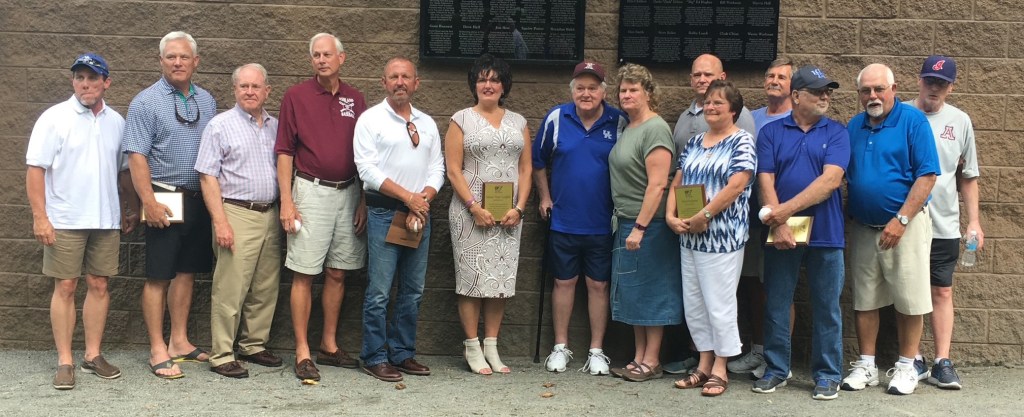
The 2017 CP-1 Hall of Fame class that included John Mullins who is on the far right of the back row.