Rick Sang and I took a deeper dive on the photograph of Terry Fish’s reported 47-yard field goal in 1974 for the Ashland Tomcats.
If you look at the photo, the 40-yard marker painted on the wall is clearly shown behind the Bryan Station bench. So, it was probably kicked from about the 44. Greg Estep’s hold looks to be on or about that spot. BUT the reported distance doesn’t account for the extra 10 yards from the goal line to the back of the end zone. That would make it a 54-yard field goal, which would have been a state record and still would rank sixth all-time in Kentucky high school football history.
A newspaper story about the game reveals the line of scrimmage was the 32 and then there was a 5-yard penalty on the Tomcats pushing it back to the 37. The standard from the snap to holder is seven yards, putting the hold on the 44, and the photograph shows that to be true.
My best guess is that the ball was on the 37 and they added 10 yards for the goal line-to-end zone distance to make it a 47-yard kick. But that’s now how it should have been scored. Ten yards is added from the point of the kick, not the line of scrimmage, making it a 54-yard kick.
The photo also shows the perfect technique on display. His kick made it 3-0 and Wendell Fugitt returned a fumble for a touchdown for a 9-0 lead. The extra point was blocked, which again shows you how much had to go right for Fish to boom a field goal of that distance. It took a perfect snap, perfect hold, perfect blocking and perfect kick.
And if he kicked it from the 44, which sure looks like happened, it was a 54-yard kick. He would have had the record until 2004 when Taylor Long kicked a 55-yard field goal for Christian County. That would mean Fish had the state record for 30 years before it would have been broken. But it was never recognized as such.
Schools must turn in a verified account of records for the KHSAA to consider them. Ashland apparently did not do that – or even think to do it – in 1974. I’m not even sure when the KHSAA began accepting records to be quite honest.
Tyler Pack of Johnson Central holds the state record of a 60-yard field goal. It was interesting because it came on a free kick in a game the Golden Eagles’ won easily. On a punt or kickoff, you can make a fair catch, and the coach can send out the kicker for a free kick from that spot. No rush from the opponents; just tee it up and kick. It usually happens with not much time remaining in a quarter, half or game. A missed kick can be returned, and the opponent takes possession if the kick is missed. (Note to coaches: It’s an interesting play to consider if you have a good kicker and if you have somebody who can fair catch a ball on the opponents’ side of the field).
Pack also had a 58-yard field goal and his 89-yard punt is also a state record. He had some kind of leg.
Aaron Pettrey of Raceland had field goals of 58 yards in 2003 and 52 in 2002. He went on to kick for Ohio State and had a cameo with the Cincinnati Bengals.
But Terry Fish’s long kick between the uprights on scoreboard side of the field in a 9-6 win over Bryan Station at Putnam Stadium remains the Tomcat record, but belongs in the state record book as well.
I’m sure he would been proud to own the state record for so long.
There have been three sets of goalposts in the 89-year history of Putnam Stadium. The first ones were shaped like an H and that were the standard from 1937 to at least 1972 (still researching that one). There have been two sets of the t-shaped goalposts – the first coming in 1974 when the goalposts were moved from the goal line to the back of the end zone – and the second when the renovation took place following the 2013 season.
That set of goal posts are the same ones being used now and were donated by Rick and Jana Sang. They have one of the goal posts from 1974-2013 in pieces and would like to give it a good home somewhere. It needs some work done to put it back together again. Somewhere outside Putnam Stadium might be a good place for this great piece of history.
Some quick research revealed unusual statistics concerning field goals and the Putnam Stadium goalposts who, if they could talk, may remember the field goals missed more than the ones that were made. I may try and set up that interview later.
One of Ashland’s most famous field goals didn’t happen in a home game. That one belonged to John Paul Walters, AKA “The Toe,” who kicked a game-winning field goal against Ironton in a 3-0 victory at Beechwood Stadium in 1950. It was the only field goal of his career, but it was a big one. He did connect on a dozen extra points.
Walters’ game-winning kick from 15 yards out grazed the crossbar before tricking over. He used a square-toed shoe and he had to practically beg coach Charlie Eblen he could make it. The kick became so famous that it was rumored someone had offered him $500 for his cleats. Walters told me that was “misleading because they’d have sure got it.”
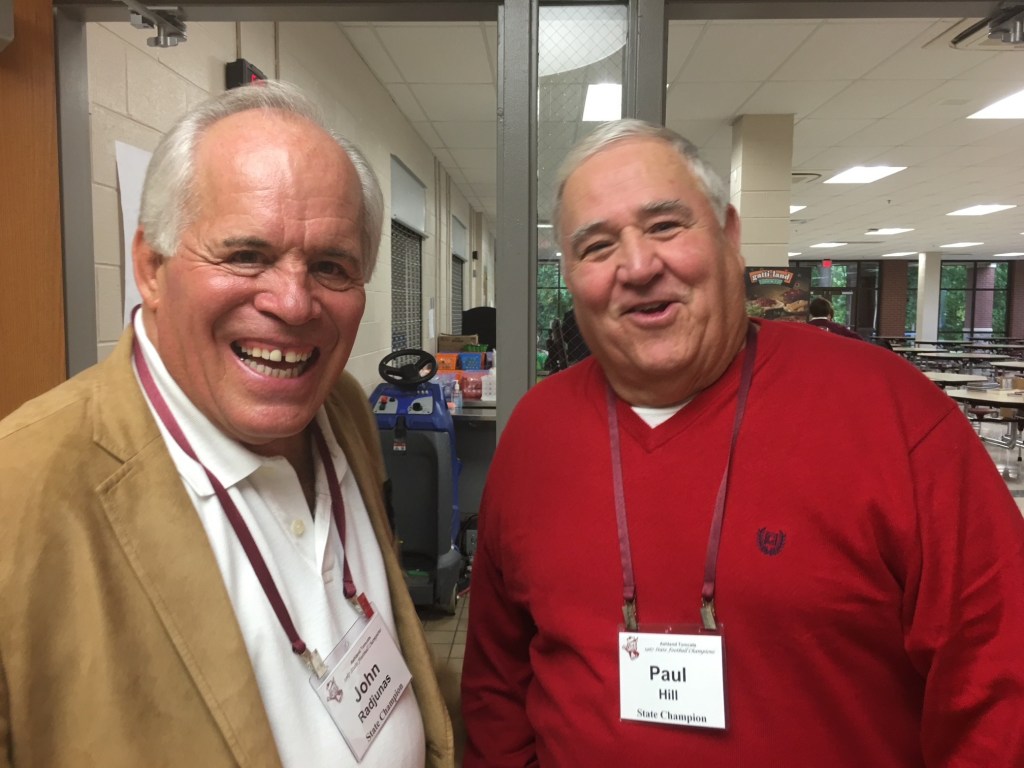
Paul Hill (kicker) and John Radjunas (holder) were part of the first field goal in Putnam Stadium history.
But the FIRST field goal made in Putnam Stadium didn’t come in the 1930s, 1940s or even the 1950s. It came during the state championship season of 1967 when Paul Hill connected on 24-yard field goal against Stonewall Jackson. It put the Tomcats ahead 3-0 in an eventual 13-3 loss. That was the only defeat in a 13-1 Class AA championship season.
Now, there were some extra point kicks in that 30-year span from 1937 to 1967 but that was the first field goal at Putnam Stadium. Hill was a straight-on kicker who tied the top of his cleat back to make a good kicking surface.
Here’s another inside story: The Tomcats didn’t have a kicker in coach Jake Hallum’s first season in 1966 when Hill and John Radjunas were juniors. They talked about it and decided they would sneak into Putnam Stadium and practice during the spring prior to the 1967 season. Whoever would make the first field goal would be the kicker and the other would be the holder.
But when they started to practice, Hill decided he would kick until he made one and settle the issue quicker. When he missed, he told Radjunas he was “bigger and meaner and he was going to get another turn.”
Radjunas was anything but stupid so he “allowed” Hill to have enough mulligans before he eventually made one.
That took hours and Speed Bailey, the Putnam Jr. High School janitor, spotted them on the field and chased them off. He lived in the white house that used to sit just outside the end zone. But the persistent duo kept trying to improve their skills (and increase their chances of having their name in the newspaper) so they kept sneaking into the stadium and Speed was there to shoo them off. He eventually went to Hallum and figured that would be the end of that stunt. But Hallum liked the idea and gave them keys to the stadium and a bag full of footballs.
They did a few more times but with the thrill of sneaking into the stadium gone, so was most of the fun.
Nearly 60 yards later, Hill still remembers making that 24-yard field goal against Stonewall Jackson. He had made his first one in the second game of the season against Boyd County, a 25-yard field goal in Cannonsburg.
It wasn’t the field goal that was most memorable about the Stonewall Jackson game to Hill though. It’s the nightmarish memory of Harry “Sugar Bear” Lyles, the dynamic Stonewall linebacker who was all over Putnam Stadium for 26 tackles.
“I’m an old man and I ain’t never forgot that man,” Hill said. “I’ve never seen anything like him.”
Hill didn’t have any professional kicking instruction except for a conversation with Bubby Payne, a former kicker for Ashland who played at UK years prior. Soccer-style had not arrived in America, so it was a straight-on approach. He ran a shoestring around the back of his shoe and then through his first single clean on the front of the shoe. He then pulled the string as tight as he could to force his ankle to be locked in a better kicking position. Hill did that regularly for kickoffs and many of them reached the goal line.
Hill remembers missing some field goals with line drive kicks that crashed into the crossbar and came right back at him. “I came up short,” he said. “Story of my life.”
Hill’s last field goal came against Covington Catholic the week after the Stonewall Jackson game and it was also at Putnam Stadium.
His most important kick though may have come in a 21-20 victory over McKell at Putnam Stadium. The extra point on the last touchdown provided the winning margin in one of Ashland’s toughest games of the season besides Stonewall Jackson.
Ashland was trailing 20-14 in the fourth quarter when Radjunas famously told Coach Hallum before the game-winning drive to save a timeout so Paul could have time to tie up his shoe. He did and then boomed it through the uprights for the narrow win in what Hill called “the best game we ever won.”
Don Gullett scored three touchdowns and ran for 88 yards in the game for McKell. Hill said his best play was chasing down Gullett and he told Don’s brother, Jack, about it later in life.
“Donnie’s pretty quick but I ran him down before he could score another touchdown that would have beaten us,” he told Jack.
“You couldn’t run him down!’ Jack shot back.
“I could if I had the angle and I did.”
Paul’s nephew, Clayton Hill, was a soccer star for the Tomcats and the kicker for the 1990 state champions. He didn’t have a field goal, but he did make 42 extra points. That Tomcat team went for it on most fourth downs.
The kicker with the most field goals, at least through the 2020 season, was Preston Freeman with nine over two years and seven in the 2006 season. He was another outstanding soccer player.
Jim Ward in 1965 used the dropkick to kick a dozen extra points but no field goals.
The first field goal in Ashland Tomcat history came in 1919 but I don’t have a name. The next came in 1923 by Wilfrey Wolfrey, who booted two including one that provided a 3-0 road victory over Millersburg Military Institute. He also made one at Armco Field in a 51-0 win over Paris.
Adam Howard always seemed destined to become a head coach, so it came as no surprise to those who have followed his career that Troy selected him Saturday night to lead one of the Sun Belt Conference’s most successful basketball programs.
Coaching has been in his blood since he was a kid. More on that in a moment.
Howard was essentially a coach on the floor for Mike Flynn during his high school basketball days at Ashland. He rarely made mistakes, didn’t force bad shots and kept the offense running smoothly. Flynn proved to be a tremendous coaching mentor. Howard was a solid player for the Tomcats, but he understood that playing wasn’t going to be his long-term ticket.
When he signed with Western Kentucky University, he was given no promises about playing time. That didn’t matter. He remained a great teammate despite limited minutes, and what he was really doing was learning. He watched and absorbed everything from the best seat in the house.
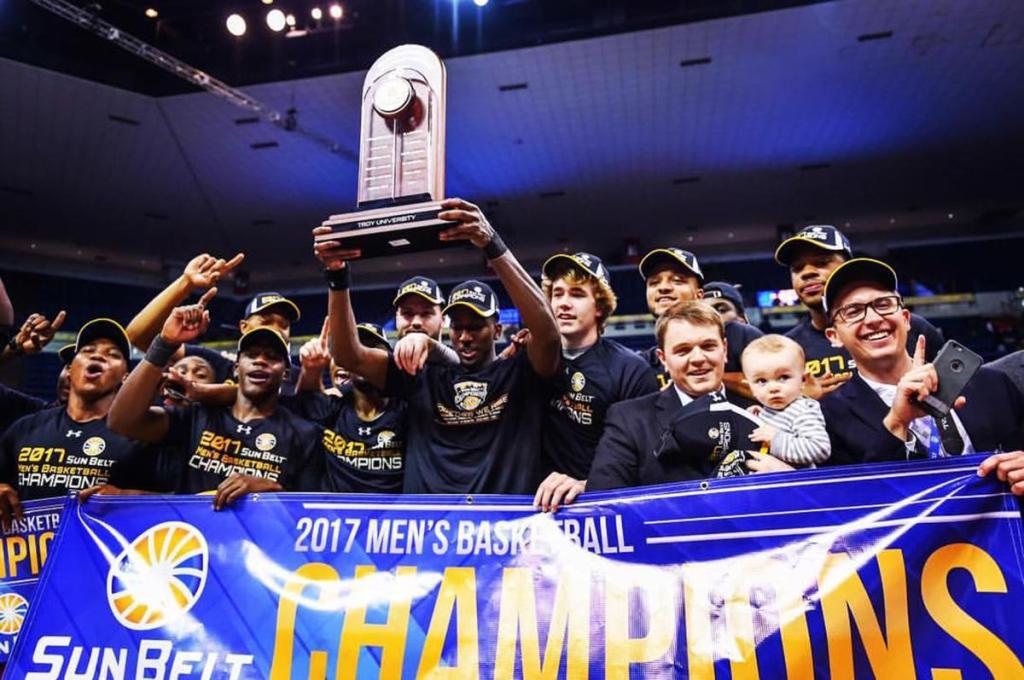
Adam Howard, holding his 7-month-old son, after Troy captured the Sun Belt Conference tournament to qualify for the NCAA tournament.
Howard spent most of his four seasons at WKU on the bench, but it was far from wasted time. Not for someone like him, who was like a sponge when it came to learning the game and the coaching profession. And no one worked harder. As it turns out, he was also a strong student.
From 2009 to 2026, Howard built his coaching résumé as an assistant coach, associate head coach, recruiting specialist and defensive guru at eight different schools. He was on Donnie Tyndall’s staff at Morehead State in 2011 when the Eagles stunned Louisville in the NCAA Tournament. As a player at WKU, he was also part of two postseason teams.
Howard’s coaching stops include Morehead State (2009–12), Southern Miss (2012–14), Tennessee (2014), South Alabama (2018–22) and Nebraska (2022–25), along with stints at Troy and NC State. He served as associate head coach at South Alabama during the 2021–22 season.
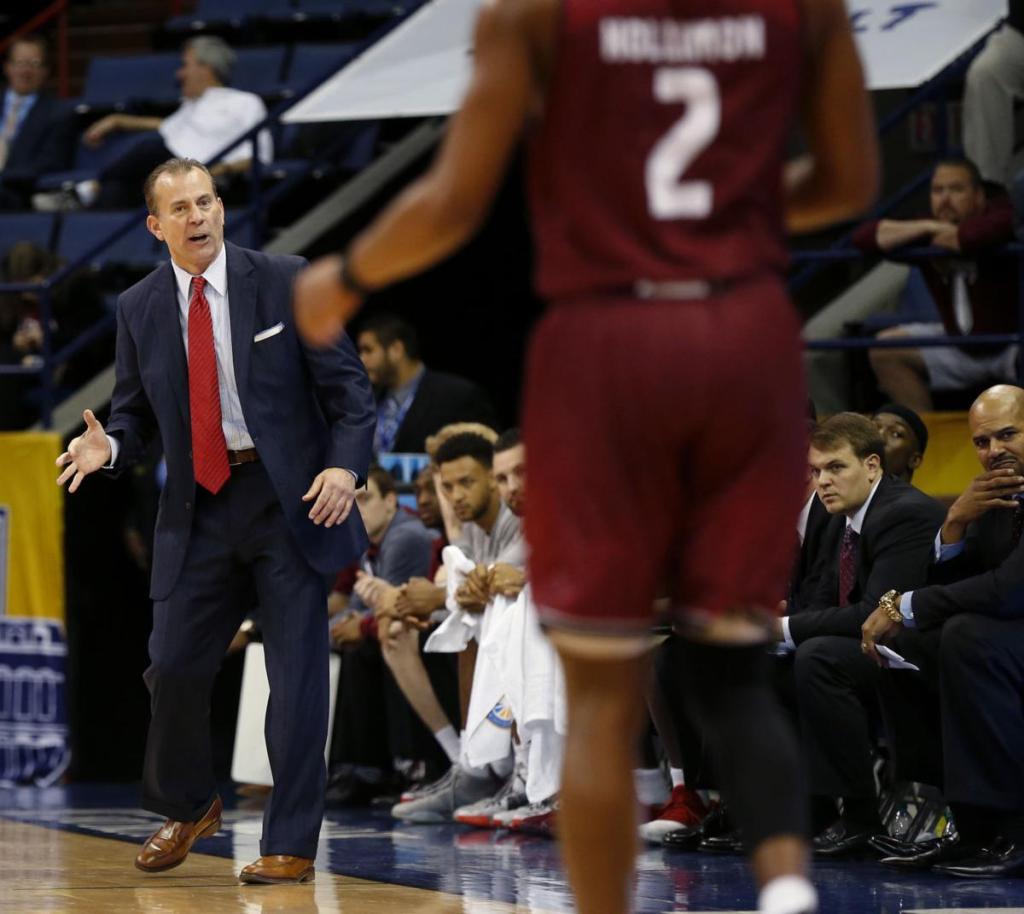
Adam Howard on the bench during Troy’s 2017 Sun Belt Conference play in 2017. He has become the head coach of Troy on Saturday night.
He now takes over a Troy program that has won 20 games in each of the last five seasons and reached the NCAA Tournament in the last two. The Trojans lost to Nebraska in the first round of this year’s tournament on March 19.
Howard previously served on the Troy staff under fellow Kentuckian Phil Cunningham from 2016–18, helping the Trojans win the Sun Belt Conference Tournament and reach the NCAA Tournament in 2017. He spent this past season as an assistant coach at North Carolina State.
Every step along the way, Howard has continued to learn, soaking up knowledge from every coach he worked with. Head coaches admired his work ethic and relied on it.
Howard replaces Scott Cross, who left last week to take the Georgia Tech job. Cross coached the Trojans to 125 wins in seven seasons, including Sun Belt regular-season and tournament championships and NCAA Tournament appearances in each of the last two years.
Now Howard moves over one chair and becomes the man in charge. He’ll have to be a good salesman in his new role. He will try to keep much of Troy’s roster together, but senior guard Victor Valdes has already entered the transfer portal. Among key returning players with eligibility remaining are All-Sun Belt forward Thomas Dowd and starting guards Cooper and Cobi Campbell.
If there’s one thing Howard can do, it’s recruit. He has an electric personality and is known as an outstanding recruiter, something that should serve him well at Troy.
Howard comes from a great family. His parents, Rick and Chris, are his biggest supporters, along with sister Jenni and brother Chad. They are down-to-earth Ashland people who have proudly worn whatever school colors their youngest son represented.
Now, here’s how I knew years ago that Adam Howard was born to coach.
He played Little League for the Ashland American Indians coached by Tony Grossl and was teammates with my son for a couple of years. Stephen was two years older than Adam, who at age 10 put on the catching gear because we didn’t have anyone better suited for the job.
That’s not a knock on our team — he was simply the best option, even though the catching gear looked a few sizes too big on him. To this day, I still picture that 75-pound Little Leaguer wearing that oversized catcher’s gear.
One game, Stephen was throwing a no-hitter and had two outs in the bottom of the sixth inning. He fired a fastball right down the middle, but the umpire called it a ball. Stephen was visibly upset and thought the game was slipping away. Adam called timeout, walked to the mound and calmly settled him down. On the next pitch, a ground ball to second base ended the game.
Without whatever Adam said in that moment, that no-hitter might have disappeared quickly. And he was only 10 years old. As a side note, Stephen pitched that game with a black eye – the result of a bad-hop grounder in practice the day before – and Adam was battling pink eye.
I enjoyed following Adam’s career as a basketball player at Ashland, including his first varsity game when he lit it up from 3-point range, and have continued to follow his coaching journey. He once gave my wife, me and some friends a tour of the basketball facilities at Tennessee when he was an assistant there. He always returned my calls when he took a new coaching job. Adam Howard has simply been a joy to follow.
Troy and Liberty University will now be two of my must-watch teams during the college basketball season especially when Kentucky frustrates me (often here recently). I believe Adam will be successful has a head because he’s successful in life. He and his wife, Renee, have three children. Their life is immersed in basketball. Make that Troy basketball now.
The bottom line with Adam Howard is simple: He is a winner who was born to coach.
In 1975, the stakes for the Boyd County-Ashland football rivalry moved beyond bragging rights. It meant everything. The season was on the line. For the winning team, it meant a trip to the Class AAAA state playoffs. For the losing team, it meant basketball season.
Unlike today’s playoff format, where four teams from each district advance, only the district champion went to the postseason party in 1975. As if it didn’t already mean everything, that made the game even bigger. There were no second chances. It was take-your-breath-away football.
It was played in the last week of the regular season, only adding to the drama that was building since before the season started when fans began comparing the rivals. The game was always big, and the series was tied 5-5 going into the 1975 battle between the Tomcats and Lions. Both came in with outstanding teams and the game was played in Cannonsburg.
They played in the preseason, meeting in a Grid-O-Rama game in Putnam Stadium on a rainy night that ended with Ashland winning 12-0. The teams played only for about a half on a muddy turf, so it wasn’t a true measure of what could be and everybody knew it. But it still added to the discussion throughout the week leading up to the game.
Herb Conley was the architect of the Ashland JAWS Tomcats in 1975.
Boyd County was coming off consecutive seasons where it made the Class AAA playoffs. The Lions were ranked No. 1 in 1974 and were stunned by Middlesboro 28-14 in the opening round. That came after the 1973 season when Boyd County roared into the state championship game before losing 27-8 to Paducah Tilghman at Hanger Field on EKU’s campus.
The Lions had beaten the Tomcats both of those years, albeit by narrow margins – 14-13 in 1973 and 20-8 in 1974. Those were the kind of scores that most fans expected when the bitter rivals met, no matter which team was superior. Ashland’s last win in the series was 24-8 in 1972 with a team that reached the Class AAA finals against Tates Creek, losing 16-7, at Stoll Field in Lexington.
The Boyd County and Ashland programs were recognized and highly respected statewide for their hard-nosed and hard-hitting styles of play.
Ashland went into the 1975 game looking for perfection and a district championship. It could be a historic night with the last undefeated Tomcat team coming in 1958 when Herb Conley was playing. Even that team had a blemish – a tie against Huntington East – in a 10-0-1 season.
Casey Jones was a standout tackle for the Tomcats.
The last undefeated and untied team in Ashland history came in 1942. The JAWS Tomcats were chasing history. They were more interested in making their own legacy in the Tomcat program and knew they had the makings of greatness.
The Ashland-Boyd County games of the 1970s and 1980s were almost always played on the last Friday of the regular season, always had high stakes and always drew a massive number of fans. Everybody in the area was watching and interested In the outcome. It was just that kind of game.
Given the Tomcats proudly using the JAWS nickname for its defense throughout much of the season, Boyd County’s fans decided to have some fun, calling their team the JAWBREAKERS. Electricity was in the air, the fans were packed in on Boyd County’s large home side and the smaller set of bleachers were full for the visiting fans. The hillside on the home side was crowded with a mix of fans too with the expectation that something special could happen no matter which side won.
Ashland came in a confident 10-0 and feeling good after blowing out Covington Catholic 56-14 the week prior. Boyd County was 7-3 and coming off a defensive battle with Russell won with a goal from Mark Rice that provided a 3-0 victory. The Lions had a star running back in James Tackett who was heading to play at West Virginia. He came into the game injured but still played, gaining 58 yards on 10 carries.
The Tomcats were ready and when big Terry Bell, Ashland’s All-State lineman, busted through a hoop coming onto the field it almost sent an instant message.
“Terry came running out there in the front,” remembered tight end Alan Mayo. “Terry, Chuck (Anderson) and Rick (Sang), were our captains. People came running out (behind them) and sprinted to the middle of the field. Everybody in the stadium went quiet. You knew he (Bell) was there and was going to give it his all.”
Mayo figured in setting up the game’s first touchdown. He slipped past the Lions defenders to pull in a catch and ran 41 yards to the Boyd County five. Mayo looked headed for the end zone until Tim Powers tripped him up from behind. But a three-yard run from Gary Thomas set up a two-yard plunge from Jay Shippey for the touchdown. Kevin Ward’s extra point made it 7-0 on Ashland’s first possession.
Terry Bell breaks through the hoop and runs onto the field.
Ashland made it 15-0 early in the second quarter when Jeff Slone finished off a drive with a seven-yard touchdown run. Anderson hit Mayo on the two-point conversion try.
Anderson, the quarterback-linebacker, played a huge role with a 6-for-13 passing performance that included a 20-yard touchdown pass to Sang eight seconds before halftime for a 23-0 lead. Anderson also rushed for 46 yards on 11 carries out of the wishbone.
In the second half, Thomas returned a punt 85 yards for a touchdown and Greg Jackson ran in the two-point conversion to push the margin to 31-0. Anderson later scored on a 13-yard run and the last touchdown, set up by a 25-yard strike from Anderson to Jim Johnson, moved the Tomcats inside the 20. Shippey rumbled into the end zone on a 16-yard run with 2:27 remaining to bring the final score to a whopping 43-0.
Ashland outgained Boyd County 477-175 as the JAWS defense stated its case, clamping down on the Lions from start to finish. Boyd County made it inside Ashland’s 30 only once in the game and that came on the last series. Tackett had a short run and a facemask penalty put the ball on the 22. But any hope of ruining the shutout ended when quarterback Wayne Chaffin was sacked for a 10-yard loss on the last play of the game.
Greg Jackson (27) runs behind Jim Johnson for a big gain.
A 43-0 shutout victory over its biggest rival was enough to put Herb Conley in rare form and he did not hold back his excitement over the victory that was the biggest margin in the series. It also sent Ashland into the state playoffs as the top-ranked team in Class AAAA.
“The best team showed that it was the best tonight. We have the best team in the Tri-State and I can say it now. I’ve kept my mount shut all year, but I can say it now … we’ve beaten them all. This win was especially good after the last two years.”
The perfect season was intact and the victory over Boyd County was sweeter than ever for the Tomcats. But now the fun would begin. Despite being undefeated and ranked No. 1, the Tomcats only had one playoff game in Putnam Stadium. They played at Dixie Heights, home against Lafayette, at Paducah Tilghman and in Louisville against St. Xavier for the state championship.