Sports Day honoree Greg Jackson big part of 1975 Ashland JAWS defense

This fall one of Ashland’s most beloved and feared football teams will celebrate a golden anniversary.

Ashland’s 1975 JAWS team struck fear in opponents throughout the state with a defense that lived up to its nickname.

Elks Sports Day honoree Greg Jackson, who is best known as a community champion and the ramrod behind the rebuild of Putnam Stadium, was an outside linebacker on the famed defense that led to a 14-1 season.

Jackson was a two-sport star for the Tomcats, also serving as a captain and starting third baseman on consecutive regional championship teams.

Even after suffering a broken foot in the first game of the football season, a game where he fought through the pain in the first half and rushed for 95 yards and a touchdown against Johnson Central. His foot swelled up so much at halftime he could not stand. He came back four games later, returning to the outside linebacker position on defense but was used less on offense.

Greg Jackson, left, gets a hug from Steve Conley, who worked beside him during the rebuild of Clark’s Pump-N-Shop Putnam Stadium.

Jackson’s speed and strength made him a natural for outside linebacker in the 4-4 scheme.

Although his carries were limited because of the foot injury, Jackson still rushed for 350 yards and was second on the team in yards per carry at 8.1.

Jackson was replaced in the backfield by Jeff Slone, who went on to have a 1,000-yard rushing season on a team that also had a 1,700-yard rusher in Gary Thomas and a bulldozing fullback in Jay Shippey. The quarterback, Chuck Anderson, doubled as one of the toughest middle linebackers in the state.

Jackson was still used in the backfield and had some valuable runs during the Tomcats’ playoff stretch including a touchdown against Lafayette in a 21-6 victory. He put Ashland ahead 7-0 on a fourth down, four-yard scoring run in an eventual 13-7 victory over Paducah Tilghman in the Class AAAA State At-Large championship game in Paducah.

Thomas broke a 7-7 deadlock with a 74-yard scamper late in the fourth quarter that put Ashland in the Class AAAA Super Bowl against Jefferson County champion St. Xavier.

Rick Sang hauls in a touchdown pass. He was one of the top athletes on the 1975 JAWS team starting both ways and punter on the way to being selected All-State.

“There were a lot of what ifs in that Paducah game,” Jackson said. “As coach (Herb) Conley has said to me, ‘I remember that play because the first three times (assistant) coach (Bill Tom) Ross wanted to run it up the gut and we weren’t getting anything.’ And a great call, Chuck had the fake to Gary and the linebacker would at least be stymied for split second. We were strong to our right and I knew it was going left. I see the end zone. It’s clear halfway between the pitch and the end zone. I feel like something just trips my foot. I got the video about 15 years ago. I always thought, and never knew for sure, until I looked at the video. When I looked at it, the defensive end got sucked in to Chuck, which is why Chuck pitched it to me. That’s the option. The defensive end recovered, and he dove and did swipe the bottom of my foot.” But Jackson made it to the end zone for his third touchdown of the season and second in the postseason.

That was the first year that the Kentucky High School Athletic Association instituted the Super Bowl type setup for the state’s largest class. The State At-Large champion, which included the biggest schools in the state outside of Louisville, played the Jefferson County champion for the overall Class AAAA title. Both Ashland and St. Xavier have trophies that say state champion, but St. Xavier has another one with overall champion in 1975. The KHSAA lists them as the sole champion in 1975. They scrapped that setup after eight years.

Terry Bell was a force on the offensive and defensive lines for the Ashland JAWS team in 1975. He was first-team All-State and named the top lineman in the state.

The Tomcats missed some scoring opportunities in the first half and still played St. Xavier to a near deadlock. The Tigers led 7-0 at the half and their depth – St. Xavier had separate offensive and defensive units – was simply too much to overcome and Ashland fell 20-0 in Louisville. St. Xavier’s strong senior class had not lost since they were freshmen.

Whether state champion or not, the beloved JAWS team remains one of the favorite and best remembered teams in Tomcat history. Coach Conley, who was an assistant on Ashland’s 1967 Class AA state championship team, said this to reporters after the game in 1975. “You can say whatever you want to, but this has just been a great year for us. These kids have given their all. They have done everything we have asked them to do. I think they’re better than the state champions of 1967. We beat everybody in the state but Louisville, and we didn’t have to play Louisville in ’67.”

In baseball, the Tomcats were regional champions in Jackson’s junior and senior seasons. He was inducted into the CP-1 Hall of Fame in 2022.

A born leader who graduated from the U.S. Military Academy at West Point in 1980, Jackson is also a community champion who has served on countless boards and is a leader at his church. Jackson also played on freshmen football and baseball teams at West Point. He served six years in the Army after graduating.

He went there with classmate and teammate, Chuck Anderson, a past Sports Day honoree, who went on to a career in the Army that saw him rise to become a Two-Star General. Anderson will introduce Jackson at the Sports Day banquet on June 14 at the Elks Lodge where tickets are on sale for $30. The event is open to the public, not just Elks members, which is a popular misconception. Mark Maynard, also a former Sports Day honoree, is the featured speaker.

Beyond playing, Jackson served as an assistant coach for Ashland Kittens softball for eight seasons, including six regional champions, and was president of the Tomcat Band Booster Club for one year and active for eight years when his daughters were in band. He also was a youth softball, baseball, football, and basketball coach when his three children were young.

All that while working 34 years in Human Resources with Ashland Oil and Marathon Petroleum Corporation and serving on a dozen community boards.

However, his claim to community fame may be the long hours and dedicated work he did as the chairman of the Putnam Stadium Restoration committee from the beginning in 2008 to the completion last fall.

Jeep Clark, who laid foundation for powerhouse basketball at Boyd County, has died at 92

Eugene “Jeep” Clark, who brought the intoxicating man-to-man defense that became the calling card of Boyd County basketball, died on Wednesday in Hattiesburg, Miss. He was 92.

Clark’s six-year coaching stint from 1976 to 1982 including back-to-back 16th Region championships in his last two seasons, paving the way for Roger Zornes to take the baton and carry the Lions’ tradition for the next 20 years.

Clark was a fierce competitor, and one of the nicest men you would ever meet. He taught more than great basketball to the players he coached.

Brock Walter, who was an exhausting, relentless presence as a point guard that epitomized what Clark wanted from his defense for the two-time regional champions, called him an “elite coach and person.”

“He assembled an unbelievable (coaching) staff allowing them each to have a unique input and impact on so many student athletes,” Walter said. “As a mentor to so many, his knowledge and wisdom became invaluable for both personal and professional growth throughout life. He grew us to be resilient, loving us and pushing us beyond our natural potential. He inspired us to be better individuals, better people. There were none with more class than Coach Jeep Clark.”

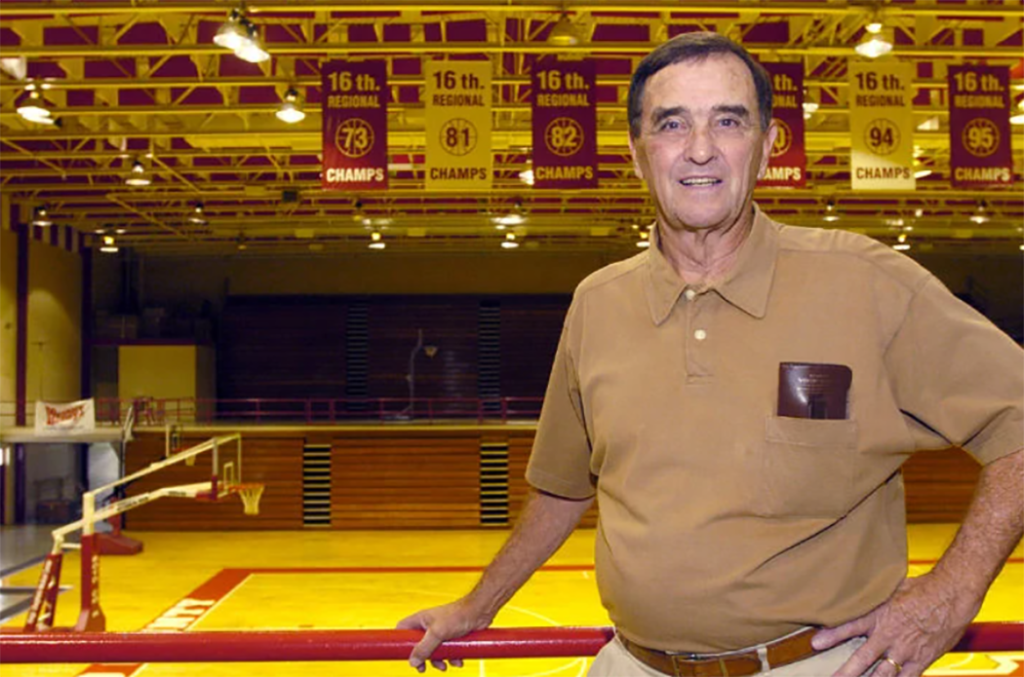
Jeep Clark led Boyd County basketball from 1976-1982, winning 16th Region championships his last two seasons. (Photo by Daily Independent)

Clark was 118-51 in six seasons at Boyd County before serving seven years as the school athletic director while watching Zornes continue to build on the foundation that he laid for the program. The Lions became a 16th Region powerhouse and a team that could compete anywhere because of that same relentless defense.

Clark was nothing but class in how he handled winning and losing. He dealt well with the rivalry with Ashland, too. Clark, who grew up on 32nd Street, was a terrific basketball and baseball player for the Tomcats in the late 1940s. He was an All-State basketball player as a senior on Ashland’s 1949 region runners-up. That Tomcat team fell to Clark County 46-33 in Winchester in the regional finals. Clark County was the No. 1 team in the state.

The game ended with coach Letcher Norton’s team clutching the championship trophy, just as it had the previous year when Clark County defeated Ashland 39-38 in Ashland.

Clark was the team captain and led the team with a 12.3 scoring average, but it was adept ballhandling that separated him from the rest.

Clark eventually went to Southern Mississippi after playing for a year at Ashland Junior College where he was the leading scorer in 17 of 27 games. Clark’s teammates included Marvin Meredith, Charlie “Stick” Stewart of Olive Hill and Jim Highley, a high school teammate.

Southern Miss went 76-31 during his playing days there. He also coached at Southern Miss for four years, going 41-61, before coming to Boyd County.

Clark had several high school coaching stopovers out of college, including a couple in Kentucky at Montgomery County (1954-59) and Paris (1954-62).

Clark eventually went to play at Southern Mississippi after playing a year at Ashland Junior College where he was the leading scorer in 17 of 27 games. Clark’s teammates included Marvin Meredith, Charlie “Stick” Stewart of Olive Hill and Jim Highley, a high school teammate.

Southern Miss went 76-31 during his playing days there. He also coached at Southern Miss for four years before coming to Boyd County.

Clark had several high school coaching stopovers, including a couple in Kentucky at Montgomery County (1954-59) and Paris (1954-62).

Former East Carter coach Charles Baker broke into coaching when Clark came to Boyd County. In an interview in 2006, when Clark was being recognized by the Ashland Elks on Sports Day, Baler called him “a mastermind of the game.”

“The way he carried himself with so much confidence but no arrogance. He makes you feel so at ease when talking to him,” he said. “Here I was, up and coming, trying to make it, and this guy has been around the world in the coaching area. He was so humble.”

Baker said Clark’s philosophy of aggressiveness and hard-nosed defense took the program to great levels.

“It was nothing dirty,” Baker said. “He had his players take your space away. They would bang on you and bang on you. They (the referees) would get tired of blowing the whistle. It proved out and it carried over. He had his stamp on it.”

Much like Coach Baker starting in the business, I was just starting in the journalism business when Jeep Clark came to Boyd County. He was always a gentleman – win or lose – and always complimentary of the opponent. I cannot recall him ever questioning a referee’s call, at least in public, or making excuses for losses. He was so kind to this still green-behind-the-ears sportswriter.

Zornes was an assistant under Clark for seven years and carried that same defensive philosophy with him. It served him well with multiple regional crowns and his name on the gymnasium wall at Boyd County.

“The big thing on Jeep was just the way he handled people,” Zornes said in a 2006 interview. “He had a knack of getting things out of kids without the fussing and hollering at them. I really liked the way Jeep did things. I picked up a lot from him.”

Zornes said Clark was also good at giving his assistant coaches responsibility.

“Jeep would listen to his assistant coaches,” he said. “I had a lot of ideas. Of course, he was going to make the final decision. But he allowed me to do a lot of things.”

Clark, a strong Christian man of the Methodist faith, was married for 69 years to wife, Mary, who passed away in 2020 at the age of 88. He also had a son, Gary, who preceded him in death.

Arrangements have not been made.

Coach Haywood’s life wasn’t just football. He was a guiding light for others.

The late great Philip Haywood was a mountain mover, putting that brand of football on the Kentucky high school football stage in magnificent ways throughout a brilliant career. During a 50-year coaching career, he amassed eight state championships, six runner-up finishes and an astounding 491 victories – more than any coach in Kentucky high school history – while serving as the head coach at Prestonsburg (nine seasons) and Belfry (41).

Fifty-years!

His passing on Wednesday doesn’t just leave a void, it leaves a deep hole in the heart of the Pond Creek community – and the Kentucky high school football community for that matter – that will be impossible to replace. I’m certain they are in shock that he’s gone. When I saw the report on Wednesday afternoon that he had died, it literally took my breath away. Even knowing that he was in a serious accident with severe injuries from a car accident a few days earlier, I was not expecting that news. Not Coach Haywood. He was going to recover and be fine. Such a good, good man.

It wasn’t just his football coaching skills that made him extraordinary. His interpersonal skills with players, teachers, sportswriters and anybody that crossed his path made him a master of communications. You walked away from any conversations with Coach Haywood feeling better about yourself because that’s how he affected people and that was his aim.

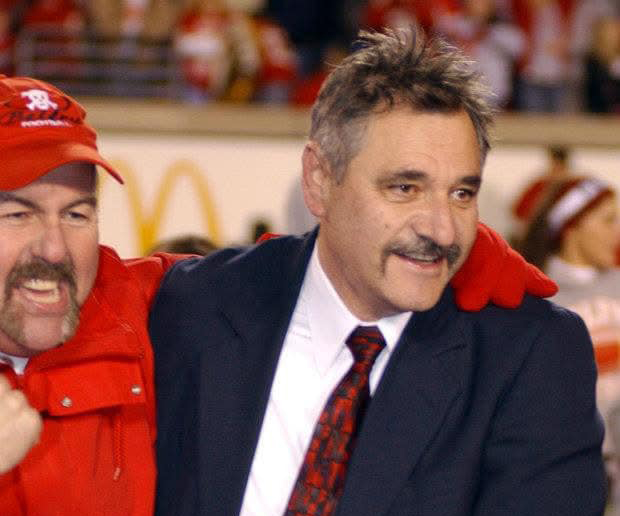
Coach Philip Haywood was successful in football and life. (Photo by Joshua Ball)

It was never about him. “How are you doing? How is your family?” and on and on the questions would go. We would eventually get around to football, which he loved to talk about, too. “How are the Tomcats doing?” he would ask me even if I was calling him about an upcoming game with Russell.

After serving as an assistant coach for three years at Tates Creek and Meade County, he took his first head coaching assignment at Prestonsburg, his alma mater, in 1975. That’s also the year I started working for the Ashland Daily Independent. Over the next few years, as he was building on an incredible coaching resume, I was learning the ropes of a sportswriter.

Prestonsburg was on the edge of our coverage area and, being at the bottom of the food chain in the sports department, that’s where I was to begin. I can remember interviewing him even then and coming away thinking how likeable he was. And I’m sure he had to answer (endure?) some dumb questions from this still green-behind-the-ears aspiring journalist.

We spoke off and on throughout his Prestonsburg tenure. Not often but often enough that we knew each other. If he didn’t answer the phone himself, he always called me back even though the ADI wasn’t really the paper of Prestonsburg. We might have sent a few hundred copies to that part of the Big Sandy area. Our reach mostly stopped around Paintsville (I had a good relationship with the great Walter Brugh, too).

Over the years both of our careers were moving. When he took over at Belfry High School in 1984, I had moved up the ladder and mostly covered the bigger schools in the closer part of our coverage area – Russell, Boyd County and Ashland.

Coach Haywood and I spoke on occasion, especially for some incredible battles with Russell and coach Ivan McGlone. They were important games and always a great chess match between Hall of Fame coaches. They were usually defense-dominated games with a conversion or extra point deciding the outcome.

Win or lose, both of those coaches were humble. They may have been disappointed if defeat came but understood how the game was played, and life was more than what happened on Friday nights. They were incredible men who offered life lessons to players during good times and bad. Both offered such dynamic insight into life even on the hardest of days.

Coach Haywood and I continued to be friends as our careers continued. I began covering more of Ashland games and eventually became the sports editor in 1989. That came during Haywood’s building of Belfry’s great program.

Belfry and Ashland knocked heads a lot during his time – 16 games to be exact. The Tomcats got the better of him in 12 of those, including a state semifinal game in 2020 at Putnam Stadium when Ashland won 10-3 on the way to the Class 3A state championship.

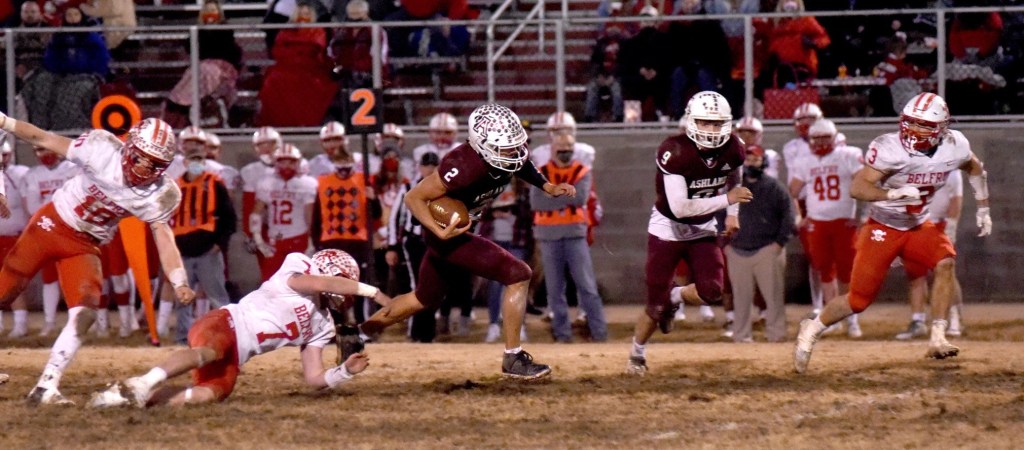
Keontae Pittman races for a 17-yard gain against Belfry in the 2020 state semifinals at Putnam Stadium. The Tomcats won 10-3 and won the Class 3A title a week later. (Photo by Don McReynolds)

He always had a healthy respect for the Tomcats and during many of our conversations he said just that to me. That may date back to his first coaching job as an assistant coach at Tates Creek for Roy Walton in 1972. The Creekers defeated Ashland 16-7 in the state championship that season in the last game ever played at UK’s Stoll Field. That Tomcat team never got the lasting respect they deserved but that’s a column for another day.

It might also be because of a conversation he had once with Herb Conley, who came over to his bus after a Tomcat game, put his hand on his shoulder and told him he was a great coach and was going to have a great career. Haywood never forgot the gesture.

Walton was a mentor for Haywood right down to the reason he wore a coat and tie on the sidelines every Friday night. Walton told him coaching on Friday nights was like going to the symphony so why not dress up. Tates Creek was 13-0 in that 1972 season.

Ashland was 4-3 at Belfry when Haywood was coaching and 8-1 in Putnam Stadium with the defeat (31-14) coming in 1989. That was the year before the Tomcats won the Class 4A title in 1990, which included a 35-20 victory at Belfry after the Tomcats had fallen behind at the half.

There were some important battles between Russell and Belfry over the years as well. Games that meant state championship appearances for the winner.

He carried so much respect for Ashland and Russell as I suspect he did for any opponent he was preparing to play. That’s just how he rolled. Respect the game, respect the opponent.

But Coach Haywood knew at the end of the day there were things a lot more important than a football game. He instilled that notion in his players, modeling what a Christian should be, showing these young men the importance of a relationship with Jesus. They didn’t have to look far for a role model that would not steer them wrong.

I cannot imagine what the Belfry community is experiencing right now. The word “loss” isn’t enough. Irreplaceable comes to mind. Greatness comes to mind. But not loss, because Coach Haywood was never about that word. It was always gain for him. Even in defeat there was something to be learned. He found a way to learn and teach even on the hardest days. He is teaching now that this is how you live and there is a reward. “Well done good and faithful servant” is what he heard Wednesday. And it wasn’t for his 491 victories and eight state championships. It was for a life that led others to Jesus. There is no bigger victory.

Johnny Mullins made lasting impact as athlete, friend

The 1960s are considered a golden era in Ashland Tomcat sports. They won state high school championships in basketball, football and baseball in the decade and had some of the greatest athletes to ever wear maroon and white.

JOHN MULLINS

Few teams anywhere – not just in the 16th Region but in all of Kentucky – could match them. Ashland put together powerful youth programs, especially in baseball, where state championships were quickly accumulated. That translated later to high school baseball teams from 1965-1969 when Ashland dominated the state with three titles, a semifinal finish and a runner-up finish during a five-year Tomcat Dynasty period that remains unmatched in state history.

The names from that era are forever remembered in Ashland. We sadly lost one of them last month with the passing of Johnny Mullins on Oct. 18. He was a brilliant athlete who excelled in baseball and basketball for the Tomcats while also starring on three memorable youth league championship teams, including the 1963 and 1964 Ashland American Little League state champions. The ’63 team was one win shy of being in the Little League World Series, losing to a team from North Houston 6-3. The following year, as a 13-year-old, he was on a Babe Ruth state champion, and he was just getting started. He was a star from the beginning with clutch performances on the mound and at the plate.

John Mullins stands behind Jim Speaks, a pair of fireball pitchers who were inducted into the CP-1 Hall of Fame in 2017. Both former Tomcat stars passed away in 2024.

Johnny was loved and admired by his teammates because if he was on your team, he made you better. He was a special talent.

Ashland’s baseball coaches recognized that in 1967 when they invited Mullins, who was a freshman at Coles Jr. High, to try out for the team. During that era, freshmen never played varsity in any sport. Ever. They would wait their turn not just in the freshman year but usually the sophomore year, too. But the Tomcats needed a shortstop and Mullins’ talent was undeniable. Let’s give the kid a shot, they said.

While he didn’t ultimately start at shortstop, he was a valuable reserve and pitched some too. That was unheard of for a freshman, and this was a team coming off an undefeated state championship season. All they did that season was win another state championship, and then another during Mullins’ sophomore year when he played a starring role.

Mullins was an easy selection for the CP-1 Hall of Fame in 2017 because of the gigantic roles he played on Tomcat teams of that era, including as a junior when he helped the Tomcats reach the state championship game for an unprecedented fourth consecutive year where they suffered a 1-0 loss to Owensboro in the championship game. As a senior, he took a depleted Tomcat team back to the regional championship game and Mullins’ will to win had a lot to do with that.

As a standout basketball player, he started on teams that went to the Sweet 16 in back-to-back seasons in 1969 and 1970 and reached the state semifinals in ’69 before losing an 82-80 heartbreaker to Ohio County. Playing in the final four is rare air even for Ashland, which has advanced that far only three times in the 55 years since.

Johnny Mullins was a natural athlete and good at anything he tried. He could have jumped off the high dive at Southside Pool for the first time and splashed down into the water after doing a triple flip without creating so much as a ripple, then move over’ to the basketball court and play the rest of the day because his team would never lose – and winners always stayed up at Southside. Then he might go down to the park and throw horseshoes and win there, too. Athletes like him do not come along often. The 1960s were full of them at Ashland and John Mullins rightly stands with the best of them.

The characteristics that made him a good athlete also made him a loyal friend and a loving husband, father, grandfather and brother. Family and friends mattered most to him.

Was he perfect? Of course not. None of us are. But it is what we do with those learning experiences that matter. As a professional, Mullins worked as a counselor at a day treatment center to help troubled youth in Ashland. Helping was what he did best. He related well to those he counseled, and they listened to his advice.

If you were in his circle, you could always count on him to be there in difficult times. He wanted to be that person who makes a difference, just like he did as an athlete.

Ashland lost a treasured friend on Oct. 18, but his legacy as an athlete, friend, and family man will be everlasting. A memorial ceremony to honor John Mullins will take place in the lobby of Paul G. Blazer High School on Nov. 16 from 2-4 p.m.

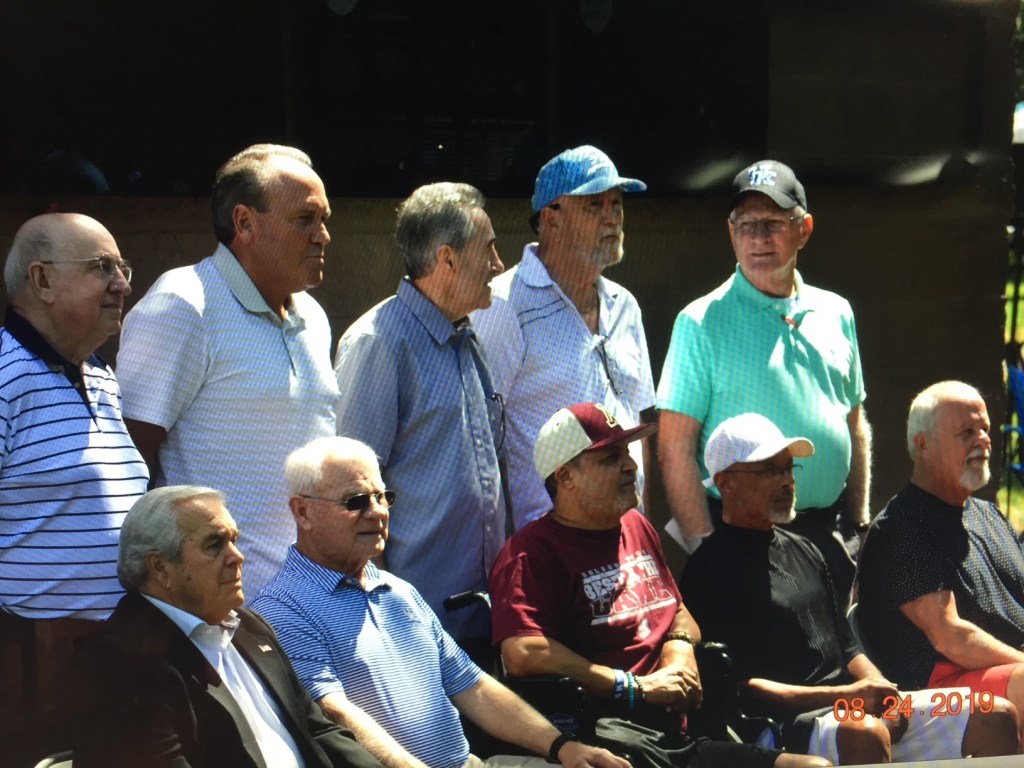
The 2017 CP-1 Hall of Fame class that included John Mullins who is on the far right of the back row.