Roger that: Robinson takes Ashland ties with him into baseball coaches Hall of Fame

An Ashland native who cut his baseball teeth in his hometown was elected to the Kentucky Baseball Coaches Hall of Fame on Friday night.

Roger Robinson, a 1984 graduate of Ashland where he played for Frank Sloan, was recognized for building the Bethlehem baseball program for nearly 20 seasons. He has accumulated 327 victories despite being the smallest school in the Fifth Region. That’s an average of 20 wins per season in a program that, before his arrival, had only one district tournament victory.

He has changed the attitude and expectations for Bethlehem since taking over in 2007. That’s 18 seasons in 19 years with the COVID year included when no games were played. He starts season No. 20 in the spring.

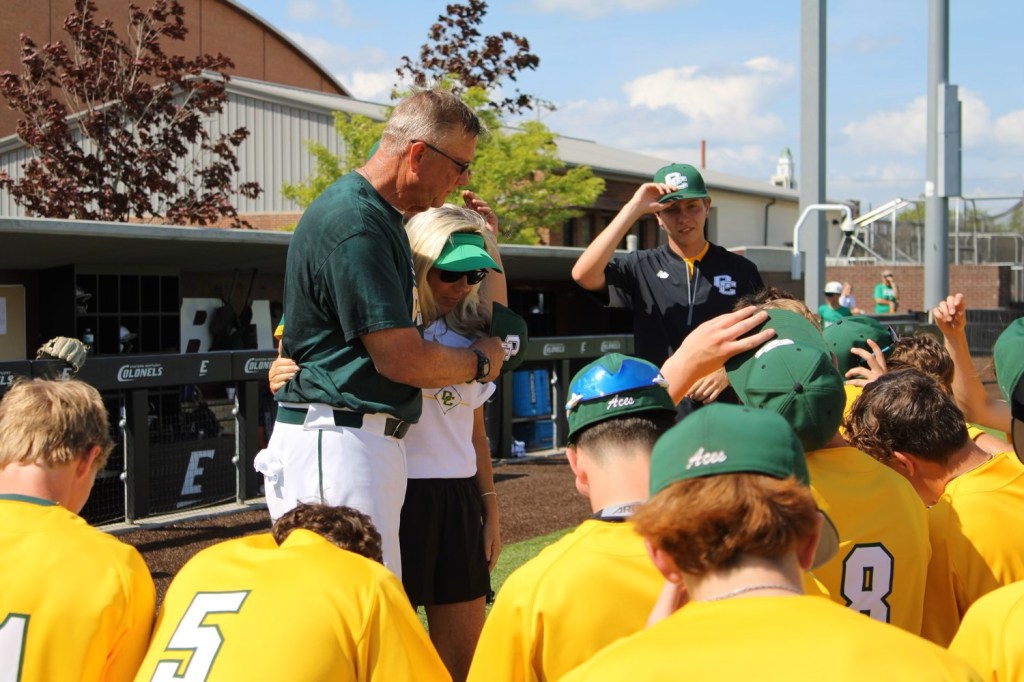
Ashland native and Bethlehem High School coach Roger Robinson was inducted into the Kentucky High School Baseball Coaches Association Hall of Fame on Friday, Jan. 16, 2026.

Bethlehem, a private school, has a boy-girl enrollment of about 300 so his pool of players to choose from is around 150. Compare that with Central Hardin Elizabethtown and Taylor County who have enrollment in the thousands, and it has been an uphill battle, Robinson said.

However, he guided them to the regional championship game in 2013, falling to perennial power Elizabethtown 2-1. He was named Fifth Region Coach of the Year that season.

“That’s as close as we’ve been to winning the region but historically, we go to the region (since his arrival) every year,” said Robinson, who also credited longtime assistant Billy Lyons with the program’s success.

Robinson’s baseball knowledge comes through some good genes. His father, also named Roger Robinson, was a highly successful youth league baseball coach in Ashland for many years. He coached in Little League (major and minor), Babe Ruth and Senior Babe Ruth. The elder Robinson was on the ground floor of getting Babe Ruth baseball started in Ashland in the 1950s.

Roger played for his father throughout his youth career and said the experience was a great one.

“A couple of stories I can think about dad and baseball and the differences of then and now, back when he was coach, they got the practice field on first-come, first-serve basis,” he said. “He’d work the midnight shift at Armco, get off work at 6 a.m. and take the bat bag and put it on the diamond. We’d have early-morning practices.”

It was a baseball family for the Robinsons. Roger’s late mother, Margie, learned to keep the scorebook for her husband and his little sister, Jill, learned how to spend her free time at the ballpark, too.

When Roger Sr. was coaching Armco in the Senior Babe Ruth, Roger Dean was a batboy from 4 years old to 8, taking in the experience of being at the ballfield and around some elite Ashland players. Five decades later, the love of the game has not faded and he’s still on the ballfield.

He has translated that into a successful high school coaching career at Bethlehem. As a professional, he was a physical therapist until he retired. Now he helps with medical assistance for high school teams.

His wife, Cindy, attended private schools and they enrolled their four children at Bethlehem. Roger watched the team play when his boys were young and it wasn’t always pretty. He became an assistant coach and a year later was promoted to the head coach and the rest is history, including have both of his son play for him – like father, like son.

They have won the All “A” regional tournament four times.

“It was a start-from-nothing kind of process,” he said. “A lot of fundraising, an indoor facility and a much nicer field than they used to have made a difference. One of the things I’m most proud of is that we have a full varsity, junior varsity and freshmen teams. To have teams on all three levels for a school our size is tremendous.”

Robinson started the Bethlehem Prep Baseball Program that develops players from K-8th grade for students attending a Bethlehem feeder school.

In his speech on Friday, Robinson said it’s not all about wins and losses at Bethlehem.

“The biggest reason I got into coaching, and one of the things that drives me, and the person I thank most is our Lord and Savior Jesus Christ,” he said. “I’m trying to represent the Lord when I’m out on that field. It’s what we try to do every time we play at Bethlehem. That is the reason I continue to coach.”

Hearing some of the other speeches about their playing days, Robinson said he once pitched a no-hitter as an 8-year-old on the Foodland Rockets that drew some laughs.

“What I didn’t tell them was I walked 17 and gave up 15 runs,” he said.

Roger played for the White Sox in Ashland American, the Eagles in Babe Ruth, the Tomcats in high school and for Post 76 under Frank Wagner and Paul Reeves.

Robinson thanked his father, his coach throughout his youth baseball days, for instilling in him a love for the game.

“He certainly doesn’t agree with all my philosophies, but that’s OK, he will learn,” Robinson said.

He also thanked his wife for putting up with him and always being supportive. Besides the four grown children, he also has seven grandboys so that means more coaching in his future.

“I had them in the (batting) cage yesterday,” he said.

High-scoring George Carroll and the first AIT 70 years ago

Ashland’s first game in the Ashland Invitational Tournament – originally called the Greenbo Lake Invitational – took place on Dec. 27,1955 at the Ashland Armory against Raceland.

George Carroll poured in 24 points, and it was only a sign of things to come for the little guard with the dead-eye shooting touch. The Tomcats defeated Raceland 66-47 in the opening game.

Carroll scored 35 as Ashland defeated Holy Family 79-66 in the semifinals and then the Tomcats upended Flat Gap and the great Charlie Osborne, 72-66, in the first championship with Carroll scoring 39.

That’s 98 points in three games, a nearly 33 points per game average, from the senior guard.

Here are the scores from the first tournament:

Opening round

Olive Hill 77, Clark County 61

Ashland 66, Raceland 47

Flat Gap 96, Montgomery County 78

Holy Family 88, Boyd County 67

Semifinals

Flat Gap 62, Olive Hill 56

Ashland 79, Holy Family 66

Championship

Ashland 72, Flat Gap 66

It was a star-studded tournament that came about because of ADI sports editor John McGill. Here is how some of the postseason honors for players in the AIT that first season.

Kenny Meyer of Montgomery County, All-State second team.

Charlie Osborne of Flat Gap, All-State second team.

George Carroll of Ashland, All-State third team.

J.D. Kiser of Olive Hill, All-State third team.

Bill Emmett of Ashland, Buddy Banks of Raceland and Bert Greene of Olive Hill were All State Honorable Mention.

The tournament was called the Ashland Holiday Tournament the second year before becoming the Ashland Invitational Tournament in the third year.

The Ashland Armory was good for Carroll later when he put 52 points on Carr Creek in a game thar preceded the Harlem Globetrotters putting on a show for a packed house of 1,500.

The Tomcats won the game 98-90 in an old-fashioned shootout. It featured Carr and Bobby Ray Shepherd from Kingdom Come. He transferred to Carr Creek and was probably the key to them winning the 1956 state championship a month after playing Ashland. Shepherd was a strong center known for his natural strength, like lifting 100-pound sacks of corn with ease.

His move in 1954-55 from Kingdom Come’s Wildcats to Carr Creek was likely a recruiting issue but due to economic reasons, given his coal-miner family. But he was a big reason the Indians won the crown that March

Two other important people crammed their way into the Armory to watch – Kentucky coaches Adolph Rupp and Harry Lancaster who came to scout Shepherd and got an eyeful from Carroll, too.

The game was played there because it was a preliminary game to the Harlem Globetrotters and basketball magician Meadowlark Lemon. The Globetrotters came out to watch the Ashland-Carr Creek game when they heard the fans stomping and cheering.

What everybody saw was the amazing Carroll scoring what was then a Tomcat record 52 points. He made shots from every conceivable angle as the Tomcats knocked off sixth-ranked Carr Creek. The two-team total of 188 was also an Ashland High School record at the time.

Carroll’s 52-point outburst stood as the Ashland record until Marty Thomas broke it in 1993 with 54 points in the 121-33 win over Jellico, Tenn., that also represents the most points scored by a Tomcat team. Carroll’s total pushed him past Bill Gray’s 48 points in the district win over Wurtland in 1954.

It was an age of basketball when the object was more to outscore the opponent than stop them. Most teams stayed back in 2-3 zone defenses and tried to outrun the opponent in racehorse-style games.

A big reason for that was the coming of age of the jump shot. It had been around just long enough for teams to have players almost perfect it. Ashland had its share of shooters during that time — Earl “Brother” Adkins, Gray and Carroll among them. The fans were eating it up.

Holy Family had Fred Simpson and later his brother, Tim, putting in points from deep outside.

Some of Carroll’s teammates included Don Church, Don Wellman, Dale Griffith, Howard Humphreys and Bill Emmett. Church was a rebounder supreme for the Tomcats who never minded feeding it back out to Carroll, who could stop on a dime from behind the circle and pop them in.

The 5-foot-10 Carroll scored in double figures every game in the 1955-56 season and finished with a 24.3 scoring average. Ashland finished 20-9 after losing to Mt. Sterling in the regional semifinals.

Remember, of course, this was all 30 years before the 3-point line came into being. Carroll and Gray were both bombers from well behind what is now the 3-point arc.

The Globetrotters were so entertained by the Ashland-Carr Creek game that when a reporter came up to talk to them, Meadowlark Lemon told them they needed to talk to those boys. “I’ve never seen a game anything like this,” he said. “These boys are the stars tonight.”

The Globetrotters came out and put on a show for the 1,500 who had jammed their way into the armory. But they couldn’t outscore Ashland or Carr Creek, recording a 74-69 win over the Honolulu Surfriders in a game marked more by showmanship than anything else. The newspaper report said the fans especially howled when the Trotters warmed up with the invisible ball routine.

Remembering Don McReynolds: A coach, fan and faithful friend of the Ashland Tomcats

Don McReynolds—a former Ashland Tomcats assistant coach, dedicated fan, and longtime sideline photographer—passed away Friday. He spent a decade coaching Tomcat football and more than 30 years afterward capturing the action through a camera lens, becoming a familiar presence at games long after his coaching days ended.

McReynolds also coached girls track and field at Ashland and was known as a well-liked, effective high school history and science teacher. Though his role as a coach placed him in the press box as an offensive coordinator, his later role behind the camera made him just as recognizable to generations of players and fans. He first served as offensive coordinator for his longtime friend and classmate Mike Manley, and later for Vic Marsh.

Though he became synonymous with Ashland athletics, McReynolds wasn’t an Ashland native. He grew up in Mt. Sterling and played receiver on the 1967 state runner-up team that shocked McKell and star athlete Don Gullett, 21-13, in the semifinals before falling to Bardstown in the Class A championship. That title game was played just before Ashland claimed its own Class AA championship with a win over Elizabethtown.

Don McReynolds loved the hobby of photography after his coaching days ended.

That Mt. Sterling team also featured a future Tomcat connection: Manley, who would later coach Ashland for the 1980 season, was the quarterback. His punt return for a touchdown sealed the semifinal win over McKell, and years later he would help bring McReynolds to Ashland.

Thirteen years after their high school run, Manley was hired to revive an Ashland program coming off three straight losing seasons following Herb Conley’s successful 1971–76 run. After one season, Manley left to become offensive coordinator and quarterbacks coach at Morehead State—just 29 years old at the time.

McReynolds had been coaching at Fleming County before Manley persuaded him to join the Tomcat staff in 1980. Marsh, then the defensive coordinator and the only holdover from Mike Holtzapfel’s staff, would eventually take over as head coach after Manley departed.

Manley and McReynolds shared more than a backfield history—they even shared a birthday. Their close friendship played a major role in McReynolds’s move to Ashland. He recalled the phone call in December 1979 when Manley invited him to the Ashland Invitational Tournament to watch the Tomcats face Phelps and high-scoring Ervin Stepp.

Don McReynolds

“I told him, ‘We won’t be able to get tickets,’ and he said, ‘Don’t worry about that,’’’ McReynolds once said. “So I told him I’d go with him. He also told me Ashland had a head coaching opening and he might apply for it. I said, ‘They’ll never hire you.’”

Manley slipped away during the first quarter of the opening AIT game for a meeting and didn’t return until the fourth quarter. “He told me he was going to apply and he was going to get the job,” McReynolds said. “He asked me if he did, would I come with him. That’s what brought me to Ashland.”

He may not have known it then, but that trip set the course for the rest of his life.

In 1980, McReynolds worked from the press box as offensive coordinator, though Manley—an offensive mind himself—was eager to call plays. It took some adjusting.

“I remember the first game against Scott County,” McReynolds said of the 35–0 win. “I was upstairs and didn’t get to call one play. He was calling everything. I came down after the game madder than a hornet. I told him if he was going to call all the plays, what am I supposed to be doing? … We came to an understanding. It got better as the season went along.”

Their offensive spark helped the Tomcats finish 9–4, led by junior quarterback Scott Crank (1,127 passing yards; 516 rushing), halfback Dave Hall (1,353 yards, 11 TDs), receiver and future MLB pitcher Drew Hall, lineman Tony Consiglio, future Tomcat quarterback Greg Conley, and hard-running Paul McPeek (563 yards, 8 TDs). The season ended in the quarterfinals with a 21–6 loss to Henry Clay.

After Manley left, Marsh took over and eventually became Ashland’s all-time wins leader, taking the Tomcats to a state championship in 1990. Ashland wouldn’t win another state title until 2020. Though McReynolds left coaching after the 1989 season, he had coached many of the players who would hoist the trophy the following year.

I got to know Don best through his photography. For two decades or more, he shot assignments for the newspaper, and we knew we could rely on “Donnie Mac” for quality work. He also photographed Kentucky football games for us. His talent behind the camera was matched by his easy humor—something our staff appreciated every bit as much.

He even once helped prevent what could have become a family feud. My daughter and her boyfriend had been using our UK football tickets all season, but when LSU came to town ranked No. 1, my son decided he wanted to go. My daughter was not pleased. Then Don called on Friday afternoon and offered me two extra tickets. I took them, crisis averted—and Kentucky went on to stun No. 1 LSU that night. I thanked Don more than once for keeping the peace in my household.

McReynolds and former Tomcat assistant Mark Renfroe remained close friends for years, bonding over football and traveling together on their own SEC stadium tour. Those who coached with Don could talk football with him for hours.

Students, coaches, players and fellow teachers admired him. He was respected, warm-hearted and deeply appreciated by those who knew him.

Former Tomcat quarterback Greg Conley, a player from that first 1980 team, remembered him fondly:

“He was a great person, coach, and had a creative offensive mind. He loved his players and coached with passion. He brought energy to every practice and game. Everyone loved being around coach. Lifting his family up in prayer. Another Tomcat who will be greatly missed.”

Amen to that.

Former Tomcat great Jay Rhodemyer was WWII bomber pilot, UK star under ‘Bear,’ and All-Pro with Packers

Jay Rhodemyer isn’t a name many Ashland Tomcat fans may recognize today, but they should. The 1940 Ashland graduate may be the most accomplished football player in school history — an All-SEC and third-team All-American center for Bear Bryant at Kentucky and a second-team All-Pro with the Green Bay Packers.

Rhodemyer was a first-team All-State center for a 5–4 Ashland team in 1940 after earning second-team All-State honors as a junior guard. His performance drew the attention of the University of Kentucky, which offered him the opportunity to play college football.

He enrolled at UK in 1942, but when World War II intensified, he left to join the Army Air Corps, serving as a bomber pilot. After the war, Rhodemyer returned to Lexington for the 1946 season — Bryant’s first — and became a cornerstone of the Wildcats’ resurgence. He earned second-team All-SEC honors in 1946 and followed that with first-team All-SEC and third-team All-America recognition in 1947.

He played in the 1947 Blue-Gray Game in Montgomery, Ala., and was named Most Valuable Player of the 1948 College All-Star Game at Soldier Field against the NFL champion Chicago Cardinals. The All-Stars lost 28–0, but Rhodemyer’s stellar performance earned him MVP honors.

Bryant said of Rhodemyer, “He was the doggondest best center I ever coached or have seen.” The Hall of Fame coach made that remark in 1968 after Rhodemyer died of a heart attack at age 45 in Lexington.

Rhodemyer was drafted in the seventh round (51st overall) of the 1948 NFL Draft by the Packers. He played center and linebacker, intercepting five passes and recovering a fumble during his career. Green Bay, then coached by Curly Lambeau, struggled during his tenure — going 3–9 in 1948 and peaking at 6–6 in 1952. He played in 1948, 1949, 1951, and 1952; records do not indicate why he did not play in 1950.

Two future Hall of Fame quarterbacks — Bobby Layne and Y.A. Tittle — were selected in the first round of that 1948 draft.

Rhodemyer, listed at 6-foot-1 and 210 pounds, appeared in 45 NFL games and was named second-team All-Pro by the New York Daily News in 1951. After retiring, he returned to Lexington, where he was part-owner and secretary-treasurer of Thermal Equipment Sales Co. and a member of Calvary Baptist Church. Following a memorial service in Lexington, his body was returned to Ashland for a second service at Steen Funeral Home and burial in Ashland Cemetery.


Arliss Beach and the NFL

Arliss Beach, a record-setting Tomcat running back from the Class of 2002 and a former UK standout, is the only other Ashland alum with NFL ties. He signed with the Green Bay Packers as an undrafted free agent in 2006 and impressed the staff enough to make the active roster. But in the final preseason game against the Cincinnati Bengals, he suffered a high ankle sprain and spent the season on injured reserve. Beach appeared on track for a spot on the 53-man roster before the injury. Green Bay released him the following June.

Beach signed with the Dallas Cowboys in August 2007 but was released before the season. He later joined the Houston Texans’ practice squad in December 2007, signed a futures contract in January 2008, and was waived that May.

At Kentucky, Beach played during a period of coaching turnover and was often underutilized, though he delivered one unforgettable performance against highly ranked Florida. UK lost 24–21, but Beach scored all three Wildcat touchdowns. He finished his UK career with 951 yards and 14 touchdowns.

Beach’s 2001 senior season at Ashland remains one of the greatest in program history: 2,533 rushing yards and 39 touchdowns on just 244 carries (10.4 yards per attempt), including three games over 300 yards. He ended his Tomcat career with 4,711 rushing yards, 62 touchdowns, 5,073 total yards, and 426 points.

Rhodemyer and Beach remain the only Tomcats ever to reach the NFL — one earning second-team All-Pro honors and the other coming agonizingly close to playing in a regular-season game.