
Herb Conley was the kind of man communities are built on and sustained by — tough, faithful, loyal and unwavering in his convictions. He was, in every sense, a man’s man, but also a steady friend, a devoted husband, and a guiding presence to generations who needed one. And in Ashland, he will forever stand as a Tomcat for the ages.
His passing Tuesday night leaves a void that won’t soon be filled. It is a sad day for Tomcats everywhere. But for Conley, it was also a day of fulfillment. He lived with a deep and abiding faith in Jesus Christ, one he didn’t keep to himself. He shared it often — especially with his former players — and in his final chapter, he embraced that calling even more, becoming, as some would say, an “overnight evangelist.” He stepped into eternity with what he believed was the ultimate victory, holding fast to the promise of 2 Corinthians 5:8.
There is comfort, too, in knowing what that moment meant to him. He was reunited with Janice, his wife and the love of his life. That reunion was something he spoke of in his final days, a hope that eased the weight of goodbye. No more pain. No more suffering. Only peace.
Conley’s story began in South Ashland, where he grew up admiring the great Tomcat teams of the 1950s. As a boy, he looked up to players whose names echoed through the community, never knowing he would one day join — and redefine — that legacy. When he broke onto the varsity roster as a sophomore in 1956, it was almost unheard of. But once he stepped on the field, he never stepped off. That moment sparked a three-year run that culminated in an undefeated 1958 season, a feat that stood unmatched for more than six decades.
He carried that same drive into his playing career beyond high school and later into coaching, where his true imprint was made. Herb Conley didn’t just coach football — he shaped men. His philosophy was simple and unmistakable: get tough. His teams reflected him — physical, relentless and unyielding. When you played against an Ashland team under Conley, you didn’t forget it by Monday morning.
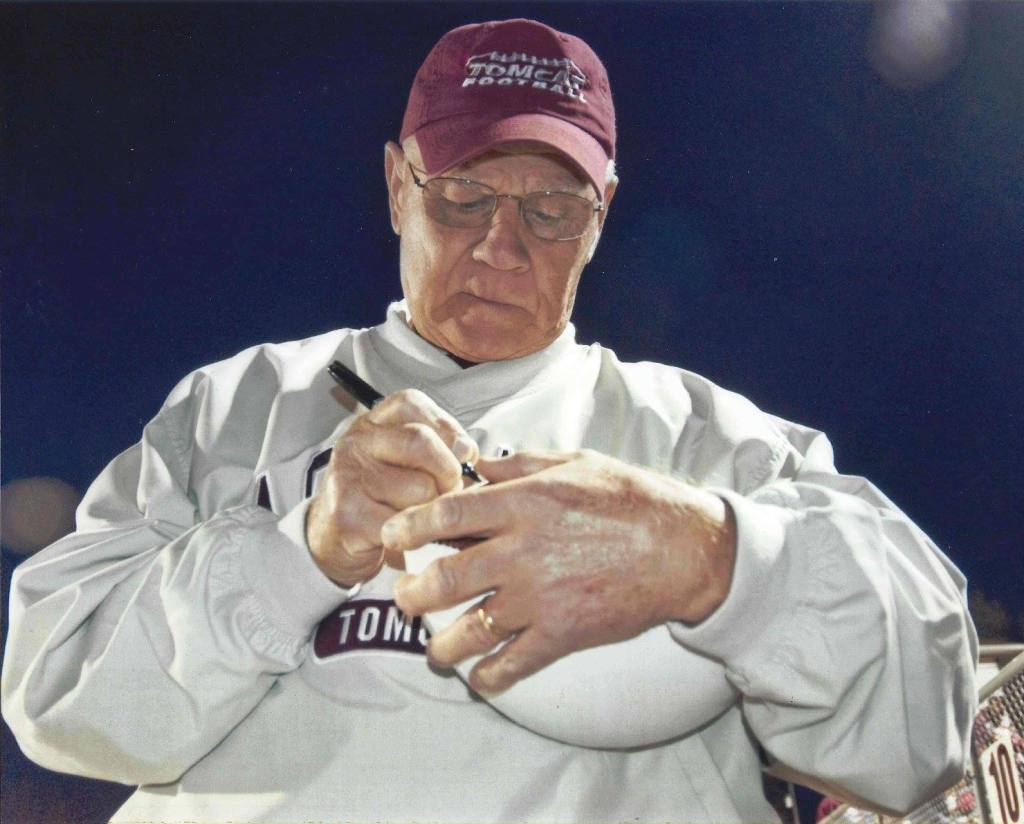
From his early days as an assistant to his tenure as head coach from 1968 to 1976, Conley built a program rooted in grit. His teams earned respect across the state, highlighted by a runner-up finish in 1972 and a championship run in 1975. That same year, he was named Kentucky’s Coach of the Year — a fitting recognition for a man whose teams mirrored his identity.
But his influence didn’t stop on the field. Conley stepped away from coaching to invest in his family, raising his three sons with Janice, whom he often called “my inspiration.” Even in education, first as an assistant principal and later as a principal, he carried the same standard. Discipline, accountability and respect weren’t optional — they were expected. And whether you were a student, teacher, or player, you understood quickly that he meant every word.
There was an edge to him, no doubt. A certain look, a scrunch of the nose, and you knew you were in for it. But beneath that toughness was consistency — and a desire to bring out the best in people, whether they appreciated it in the moment or not.
In Ashland, his legacy is etched in more than memory. It stands in bronze at Putnam Stadium, overlooking the field he loved in a familiar stance — watchful, commanding, present. It is a fitting tribute, but even that can’t fully capture what he meant to the program and the community.
If there were a Mount Rushmore for Ashland, Herb Conley would be the first name carved in stone.
He lived every role imaginable — player, coach, mentor, administrator, father, grandfather, fan. His influence stretched across generations, touching lives in ways that statistics and records never could.
Some legacies fade with time. His won’t.
Because in Ashland, and in the hearts of those who knew him, Herb Conley isn’t just remembered.
He endures.
 MARK MY WORDS 2