Some storytelling and thoughts from the mind of Mark Maynard.
Author: Mark Maynard
Managing editor of Kentucky Today, the digital newspaper of the Kentucky Baptist Convention, since July 2017. Worked 42 years for The Daily Independent in Ashland, Kentucky, the last 12 as managing editor and editor and the previous 30 in the sports department, including 17 years as sports editor. President of Amy For Africa, a faith-based Christian ministry serving Uganda. I'm a husband to Beth and father to Stephen and Sally, grandfather to Brooks and Addy.
Ashland Coach Jason Mays instructs on the sidelines.
The absolute laser focus of this Ashland Tomcat basketball team amazes me. And I’m not talking about their shooting, which has been pretty darn laser-focused, too.
It’s their attention to detail. Every. Single. Detail. No matter what teams have thrown at them – and the kitchen sink may be coming next – they have found a way to not only win but to capture a community’s attention with every shot attempt, every no-look pass, every dribble and every cameo on ESPN.
Even during a day where hearts were heavy on the high school campus, when things happen that we don’t understand and can’t explain, when there were more tears than cheers, and when things a lot bigger than basketball dominated our attention, they kept their focus. Then they lifted everybody up, putting together one more dazingly display of basketball, and demolishing a team that many believed had the best shot at ending this season of perfection.
Cole Villers drops a pass to a teammate against Rowan County.
Ashland’s 67-39 victory over Rowan County in the 16th Region tournament semifinals Thursday night was a rousing statement on the basketball floor, but it was so much more than that. It was salve for a school and a community that was going through a nightmare day that wouldn’t end, a day where there were a lot more questions than answers, a day when parents hugged their kids a little tighter when they came home.
These Tomcats are good young men who seem to have priorities in the right place. They have made remarkable gestures that even go beyond what a remarkable time they’ve had on the basketball floor. Ashland’s head coach Jason Mays marvels at his players too but don’t underestimate the man who is pushing all the right buttons on the sidelines and has said all the right things in the locker room, where he gets between their ears. He’s a good man, the right leader for these good young men, and Ashland should know that.
Colin Porter drives against Rowan County.
This is a mentally tough team. They proved it again by keeping focused on the job in front of them, and then recording win 32 for No. 32. That job represented not only each teammate, each coach and each fan but you can include classmates, teachers, an entire school and a small-town community, and a Tomcat family that endured the most horrendous of losses. It’s a family that needs our constant prayers because only God Almighty can bring them comfort. Please pray for them.
The Tomcats will try to keep this one-of-a-kind season going on Tuesday night against Lewis County in the regional championship game and there are no guarantees of what might happen.
Well, maybe one. The Tomcats will be focused. I’ve never seen them lose that, or a game, yet.
Ashland once upon a time had a coach who knew a little bit about the subject of perfect records.
Paul Patterson, who left for Taylor University after winning four consecutive 16th Region boys basketball championships at Ashland in 1979, retired in 2013 after winning 734 collegiate basketball games. He died on Sept. 21, 2021 after an extended illness.
Coach Paul Patterson during his coaching days at Taylor University in Upland, Ind.
Those are some amazing numbers, but Patterson’s impact on the 16th Region was enormous, too. He was 44-0 against region competition, a mark that may never be duplicated. Patterson’s trademark man-to-man defense became the model for others and soon became this region’s calling card. It’s not much of a stretch to say he changed the way basketball was played here.
The Tomcats’ best season under Patterson was in 1976-77, when Ashland posted a 30-2 record that ended with a loss in the state semifinals. Jeff Kovach, Jim Harkins and Mark Swift were key players on a team that simply made opponents look helpless.
His well-disciplined teams were feared because of the tenacity that he instilled in them.
Patterson left after the 1979 season even though the roster was loaded with size and talent, a team that seemed perfectly suited for his style of play. Ernie Simpson took the baton from Patterson and won the regional championship for a fifth consecutive year, although the run of regional victories ended with a loss to Holy Family in the 64th District finals.
As unimaginable as it seems today, the fanbase wasn’t always happy with Patterson even though he won four regional championships in a row and never lost to a region foe in the regular season. The style of play was thought to be too methodical for fans who were used to three decades of running and gunning.
There was none of that with Patterson’s style of basketball. His teams worked for the highest percentage shot possible, most of the time a layup or short jumper, on every grinding possession. The recipe for success included limiting opponents to under 50 points a game. His 1976-77 team did just that, limiting foes to 48.3 per game.
Here’s an interesting tournament fact. In the four years that Patterson coached the Tomcats to the regional title, only once was an Ashland played named tournament MVP – Harkins in 1976. The other years the MVPs went to David Rowe of Fairview (1977), Mark Dingess of Boyd County (1978) and Dave Layne of Holy Family (1979).
Coach Paul Patterson, far right second row, with his first Ashland Tomcat team in 1975-76.
Patterson went 91-35 in his four seasons as the Tomcats’ head coach. His teams were always prepared and fundamentally solid at every position. Their lockdown man-to-man defense was, in a word, vicious.
He took that same coaching philosophy to Taylor University, where he has retired after becoming the second-winningest coach in Indiana college history behind you-know-who. He is one of the winningest coaches in basketball history period.
Patterson won 15 conference championships and made 14 appearances in the NAIA national tournament. He was a 12-time conference Coach of the Year and the NAIA national Coach of the Year in 1991 when he led Taylor to a school-record 34 victories and the program’s only Final Four berth.
Patterson, who is a member of the NAIA, Hanover College and Grant County (Ind.) halls of fame, leaves Taylor after amassing 28 winning seasons and 23 campaigns with 20-or-more victories. He also guided Taylor through one of the most successful 10-year stretches with 10 straight seasons of at least 25 victories from 1984 to 1994. That span put Taylor in the company of UCLA, UNLV and Lipscomb as the only men’s basketball programs to accomplish that feat.
Along the way, Patterson coached 24 NAIA All-Americans and boasts an extensive coaching tree that includes collegiate and high school coaches around the nation.
It was also during Patterson’s tenure that Taylor started its Silent Night game.
Every year, the Friday before final exams, Taylor University has the Silent Night game where students remain quiet until the 10th point is scored and then erupt in wild and boisterous cheering. In the late moments of the game, “Silent Night” is sung by everyone in the gym. A former assistant coach came up with the idea in the late 1980s and it was a packed event by the mid-to-late 1990s.
But if anybody was ever born to coach, it was Paul Patterson, and he proved it both in Upland, Ind., and Ashland, Ky.
His imprint on 16th Region basketball history will remain with us forever.
Donna Childers Suttle’s passion for all things Ashland Tomcat is well established.
She has been a mega-fundraiser for the razing and rebuild of Putnam Stadium, a place she holds dear to her heart, and she has done so much behind the scenes for Tomcat athletics that the team mascot should blush when he’s around her.
It was Donna who raised the money to rebuild the trophy cases inside Anderson gym. It was Donna who during the past Christmas season wrapped presents at Corbie’s three to four days a week – for any sized donation to Putnam Stadium. She works tirelessly if it’s connected with the Tomcat name on it. Cut her and maroon would come gushing out.
Donna also saved a scholarship that was going to Ashland Tomcat basketball players for more than 30 years around 2000 with a public plea. Without her efforts, there would be no Joe Franklin Memorial Scholarship and a part of Tomcat history would have gone with it. The scholarship was going bust and Donna would have none of it. She contacted me and we put together a story for the newspaper about the Franklin scholarship’s dire need for money and why it was important. The donations began rolling back in and it has been running strong ever since, with $500 donated just the other day. (Contributions to the scholarship are always appreciated).
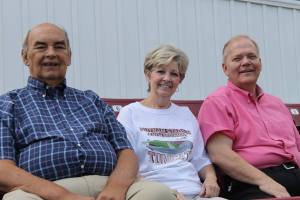
Donna between two of her favorites, the late David Payne, left, and Tomcat announcing legend Dicky Martin.
Here’s something you might not have known: When the scholarship was fading in the late 1990s, with not enough funds to give the scholarship, it was Donna and husband Jeff and the late David Payne who supplied the funding to keep it going.
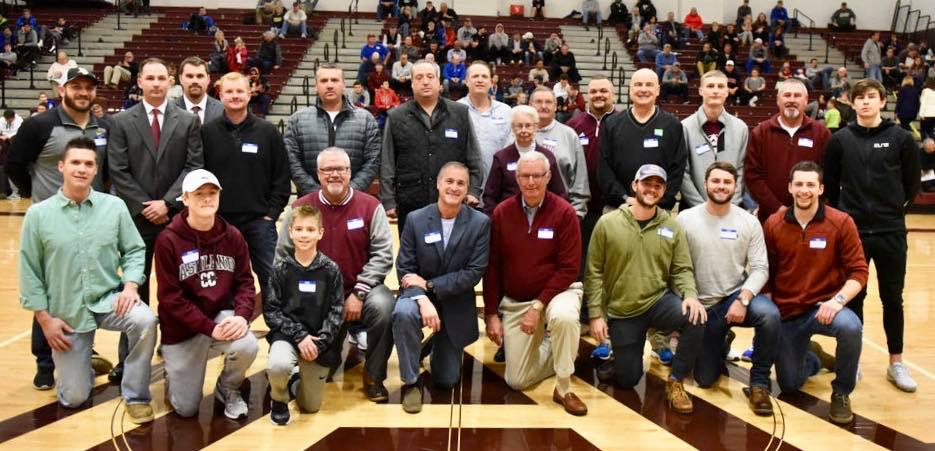
Some of the Joe Franklin Memorial Scholarship winners. Photo was taken in 2017.
It has honored more than 50 Tomcat players over the years with scholarships between $500 and $1,000. The first one was issued to Greg Salyer in 1968. It is given to seniors who are of high character first and foremost. It’s not decided on statistics but on life superlatives. It’s the best honor any Tomcat senior basketball player can receive.
There were a lot of reasons for Donna to do what she could to save the scholarship. For one, the memorial scholarship is one of the longest running in the state, going on now for 52 years. For another, it’s a Tomcat scholarship, and we know what that means to her. But, most importantly, she was a friend of Joe Franklin, a Tomcat basketball player who tragically died in a car wreck the day the Ashland Tomcats won the 1967 state football championship. Donna, a 1970 Ashland grad, was a sophomore in the fall of ’67 and she knew the handsome 16-year-old well. A lot of the girls had crushes on him (not saying Donna did or didn’t).
Joe was a basketball player, and a good one, but he was much more. He was also the epitome of the All-American boy, squeaky clean, a member and active in youth activities at First Methodist (Chocolate) Church downtown, a great son and brother, and a one-of-a-kind athlete who put teammates first. He was on the football team as a sophomore but stepped away to concentrate on basketball, his best sport.
Franklin, three other players and a manager were traveling by car to a scrimmage game in Frankfort the day of the football championship. They were heading over to Louisville after the scrimmage to watch the Tomcats hopefully win a title.
But a tragic morning accident just past Morehead ended that and took the life of Franklin while severely injuring one other passenger. It was a tragedy of epic proportions for the Ashland community.
To purchase the book, contact mainrod@windstream.net
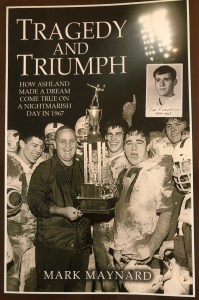
I was a 10-year-old Tomcat fan who traveled to Louisville that day with my brother and father to watch Ashland play Elizabethtown. The dark and dreary gray day always stuck with me, so much so that in 2012 I wrote a book about it, Tragedy and Triumph, that told the story of the 1967 season that will be forever linked to Joe Franklin’s death.
The football team, in its travel to the game that night, stopped in Mt. Sterling for a planned rest stop. When they parked, an Ashland man pecked on the window of the rented bus — Ashland Independent Schools didn’t have school buses at the time – and shared some startling news about the accident with Tomcat coach Jake Hallum.
Hallum gathered his assistants and collectively decided they wouldn’t tell the team until after the game. Typically, the state finals were played at University of Kentucky’s Stoll Field. This particular season, Kentucky and Tennessee scheduled a late game and thus the field was unavailable for the high school event.
It was payed at the Louisville Fairgrounds, which had bleachers on only one side of the field. Ashland’s bench was on the vacant side, so no fans could reach the field to inform the players of the tragic event that had transpired earlier.
Many of the band members, cheerleaders and fans in the stands heard the news in various ways before kickoff. The team still knew nothing about it.
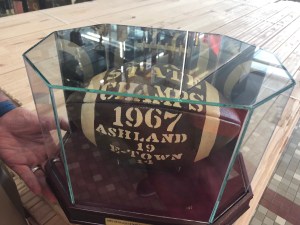
Game ball from 1967 in the Tomcat trophy case.
Ashland rolled to a 19-0 halftime lead before hanging on to beat Elizabethtown 19-14 for the first official football state championship in school history. After some celebration in the locker room, Hallum informed the team about Franklin and another classmate who was injured badly in the accident.
On their way home the next day, Hallum called co-captains Paul Hill and John Radjunas to the front of the bus around Grayson. He told the guys he didn’t think they should experience their normal celebration, which included a fire truck ride, upon arriving home out of respect for the Franklin family. So they didn’t.
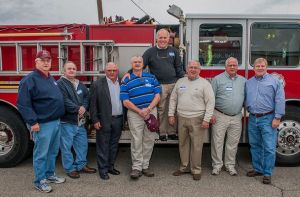
Players from the 1967 Tomcat state champions got their fire truck ride more than 40 years later.
The ’67 Tomcats never got their fire truck ride. The bus zoomed past an awaiting crowd on U.S. 60, pulled in front of the school gym and everybody filed out. They never celebrated the championship, even days later, and that was the impetus behind the book – it would be their firetruck ride.
Donna had a book signing for me at her florist shop, complete with a firetruck from the Ashland Fire Department. As the players jumped up on the truck to pose for a photograph, they were transported back 40 years ago with the smiles of boys 16 to 18 years old celebrating a championship season.
Ashland was one game from a perfect season in 1961.
Those Tomcats, still considered one of the greatest teams in Sweet 16 history, will celebrate a 60th anniversary next March.
It was an amazing team with future college stars all around, including Rupp’s Runt Larry Conley, who was a junior on that Tomcat team who helped take them back to the state finals in 1962. He was a stud, an all-around player with a high basketball IQ and a determination to win that inside him like fire. He could be summed up in one word: winner.
But he wasn’t alone. It was a team of stars: Harold Sergent (Morehead), Gene Smith (Cincinnati), Bob Hilton (West Point) and Steve Cram (LSU). Dale Sexton, Larry Fairchild and Jerry Daniel completed the top eight.
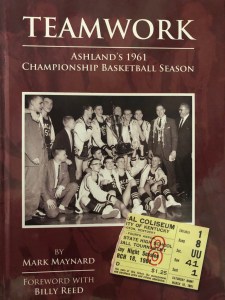
Email mainrod@windstream.net to order a copy of Teamwork.
Taskmaster coach Bob Wright was the architect of an Ashland team that finished 36-1 with that one blemish. They were so close to perfection.
Just how dominant? Only one of the 36 victories was less than double figures – 63-59 over Maysville in a January home game – and 20 of the wins came with margins of 20 or more.
By contract, so far the 30-0 Tomcats of 2019-2020 had eight games of less than 10-point margin and six of those by less than five, including 66-65 over Mason County and 57-54 over West Carter on a 60-foot bomb at the buzzer. Forty percent (12) of their wins have come by 20 or more.
The 1961 Tomcats rattled off 21 victories to begin the season including clobbering favored and top-ranked Louisville Seneca 79-50 in the championship game of the Ashland Invitational Tournament. A crowd of 1,561 watched the game that was played in what is now Alumni Gym on Lexington Avenue.
Can you even imagine? The gymnasium seated only 800 so that announced total seems a little inflated. But from what those who say they saw the game reflect, there was hardly room to breathe. Bill Lynch said he and his brother, Bobby, went to the AIT with his father who found a seat. They were relegated to the top of the bleachers, leaning against those red-hot radiated heaters.
With everybody stuffed inside, they would open the large windows in the top of the gym and let cool winter air flow down. It had to be a sight to behold!
Seneca was ranked No. 1 in the UPI (United Press International) and the Tomcats were ranked No. 2. It was supposed to be a battle to the end but turned into a runaway.
Conley scored 28, a season-high for him, but more importantly fouled out George Unseld and others by using a shot fake that Dean Church, a former Tomcat before him, had taught him. It was an up-and-under move after the shot fake and Unseld bit on it every time.
Seneca was stunned and mad. They would get another crack at the Tomcats in the Sweet 16.
The AIT also included Wheelwright, the eventual 15th Region champions, and Ashland hammered them in the semifinals 79-62 as Sergent scored 28 this time around.
Wheelwright, like Seneca, would get a rematch with the Tomcats in the state tournament.
Ashland basketball was the talk of town (sound familiar?) and rolling along with a 21-0 record. They looked unbeatable and were maybe feeling a little too good about themselves.
On a cold February night in Morehead, the Tomcats felt the sting of defeat. Lexington Lafayette won 59-58. It was shocking to watch the Lafayette fans storm the floor like they’d won the state championship. The perfect season was over.
Coach Wright, some say, allowed the Tomcats to lose. He didn’t substitute much and even left Sexton, who was sulking before the game, out of the game completely. Sexton had decided he’d go to the end of the bench before the game and when Wright needed him, he could just come and get him. But he never did. Sexton said he learned his lesson, too, and never sat at the end of the bench again.
Conley fouled out and then Smith, which is when momentum shifted. Ashland was leading 52-47 at the time. The Tomcats scored only once in five possessions over the last 2½ minutes, a one-hander by Cram with 1:25 remaining that put them ahead 58-57. Lafayette scored with under a minute to play for a 59-58 lead and Ashland missed a hurried jumper at the end. Jerry Daniel rebounded the miss and laid it back in but it was clearly after the buzzer. The unthinkable had happened.
The Generals won because they were able to handle Ashland’s devastating zone trap and because the Tomcats were uncharacteristically off their game.
Wright told me during an interview for the book Teamwork, “We just didn’t play. Seventeen-year-olds get overconfident. Sometimes, as a coach, you let things happen because you have to learn instead of me telling them. What they learned was much better than me telling them.”
Ashland was shocked by the defeat and many of them cried all the way home from Morehead. But the Tomcats also circled the wagons and said it would never happen again.
Wright said the loss was good for the team, that “we might have lost a game that really meant something” down the road. “In all probability, that would have happened. I don’t know if I allowed (the loss) or not.”
Ashland poured it on in the next four games prior to the postseason winning by margins of 33, 13, 40 and 18.
The 64th District was much the same with wins of 34, 38 and 37. Then they scored 95, 97 and 90 in the three regional tournament victories. In the semifinals against Grayson they outrebounded the Yellowjackets by an astounding 87-21 during a 97-49 victory. Ashland defeated Clark County 90-73 in the championship as Conley collected 27 points and 23 rebounds in a remarkable performance.
It was more double-figure wins in the Sweet 16 with margins of 17 (Covington Grant), 26 (rematch with Seneca), 11 (rematch with Wheelwright) and then 69-50 over Lexington Dunbar in the championship game.
The stomped on the gas pedal after the loss to Lafayette, leaving every opponent in their wake, wiping away the bitter taste of defeat by bringing home the state championship trophy in one of the most dominating performances in Sweet 16 history.


 MARK MY WORDS 2