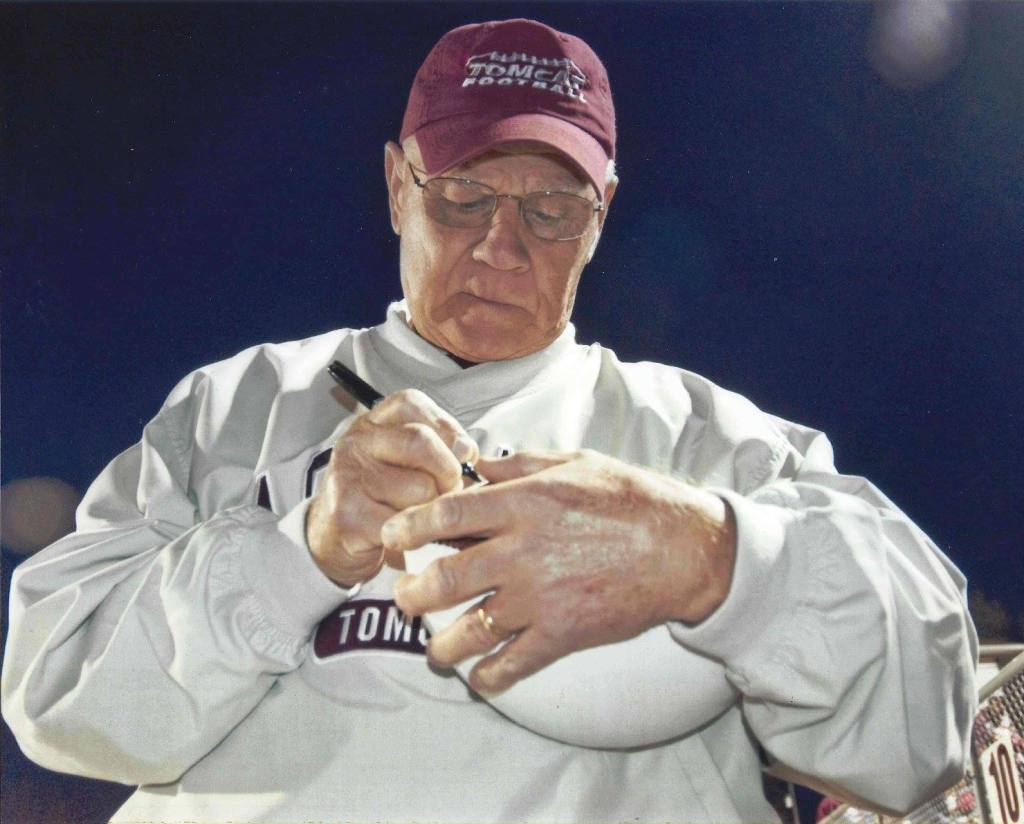
Herb Conley was a Tomcat for the ages

Herb Conley was the kind of man communities are built on and sustained by — tough, faithful, loyal and unwavering in his convictions. He was, in every sense, a man’s man, but also a steady friend, a devoted husband, and a guiding presence to generations who needed one. And in Ashland, he will forever stand as a Tomcat for the ages.

His passing Tuesday night leaves a void that won’t soon be filled. It is a sad day for Tomcats everywhere. But for Conley, it was also a day of fulfillment. He lived with a deep and abiding faith in Jesus Christ, one he didn’t keep to himself. He shared it often — especially with his former players — and in his final chapter, he embraced that calling even more, becoming, as some would say, an “overnight evangelist.” He stepped into eternity with what he believed was the ultimate victory, holding fast to the promise of 2 Corinthians 5:8.

There is comfort, too, in knowing what that moment meant to him. He was reunited with Janice, his wife and the love of his life. That reunion was something he spoke of in his final days, a hope that eased the weight of goodbye. No more pain. No more suffering. Only peace.

Conley’s story began in South Ashland, where he grew up admiring the great Tomcat teams of the 1950s. As a boy, he looked up to players whose names echoed through the community, never knowing he would one day join — and redefine — that legacy. When he broke onto the varsity roster as a sophomore in 1956, it was almost unheard of. But once he stepped on the field, he never stepped off. That moment sparked a three-year run that culminated in an undefeated 1958 season, a feat that stood unmatched for more than six decades.

He carried that same drive into his playing career beyond high school and later into coaching, where his true imprint was made. Herb Conley didn’t just coach football — he shaped men. His philosophy was simple and unmistakable: get tough. His teams reflected him — physical, relentless and unyielding. When you played against an Ashland team under Conley, you didn’t forget it by Monday morning.

Herb Conley’s legacy and connection with Tomcat football is everlasting.

From his early days as an assistant to his tenure as head coach from 1968 to 1976, Conley built a program rooted in grit. His teams earned respect across the state, highlighted by a runner-up finish in 1972 and a championship run in 1975. That same year, he was named Kentucky’s Coach of the Year — a fitting recognition for a man whose teams mirrored his identity.

But his influence didn’t stop on the field. Conley stepped away from coaching to invest in his family, raising his three sons with Janice, whom he often called “my inspiration.” Even in education, first as an assistant principal and later as a principal, he carried the same standard. Discipline, accountability and respect weren’t optional — they were expected. And whether you were a student, teacher, or player, you understood quickly that he meant every word.

There was an edge to him, no doubt. A certain look, a scrunch of the nose, and you knew you were in for it. But beneath that toughness was consistency — and a desire to bring out the best in people, whether they appreciated it in the moment or not.

In Ashland, his legacy is etched in more than memory. It stands in bronze at Putnam Stadium, overlooking the field he loved in a familiar stance — watchful, commanding, present. It is a fitting tribute, but even that can’t fully capture what he meant to the program and the community.

If there were a Mount Rushmore for Ashland, Herb Conley would be the first name carved in stone.

He lived every role imaginable — player, coach, mentor, administrator, father, grandfather, fan. His influence stretched across generations, touching lives in ways that statistics and records never could.

Some legacies fade with time. His won’t.

Because in Ashland, and in the hearts of those who knew him, Herb Conley isn’t just remembered.

He endures.

The toughest job in the 16th Region this season

The toughest job in the 16th Region this season had nothing to do with coaching, handling the basketball or knocking down shots from beyond the arc.

It had everything to do with following a familiar voice—one that had become iconic.

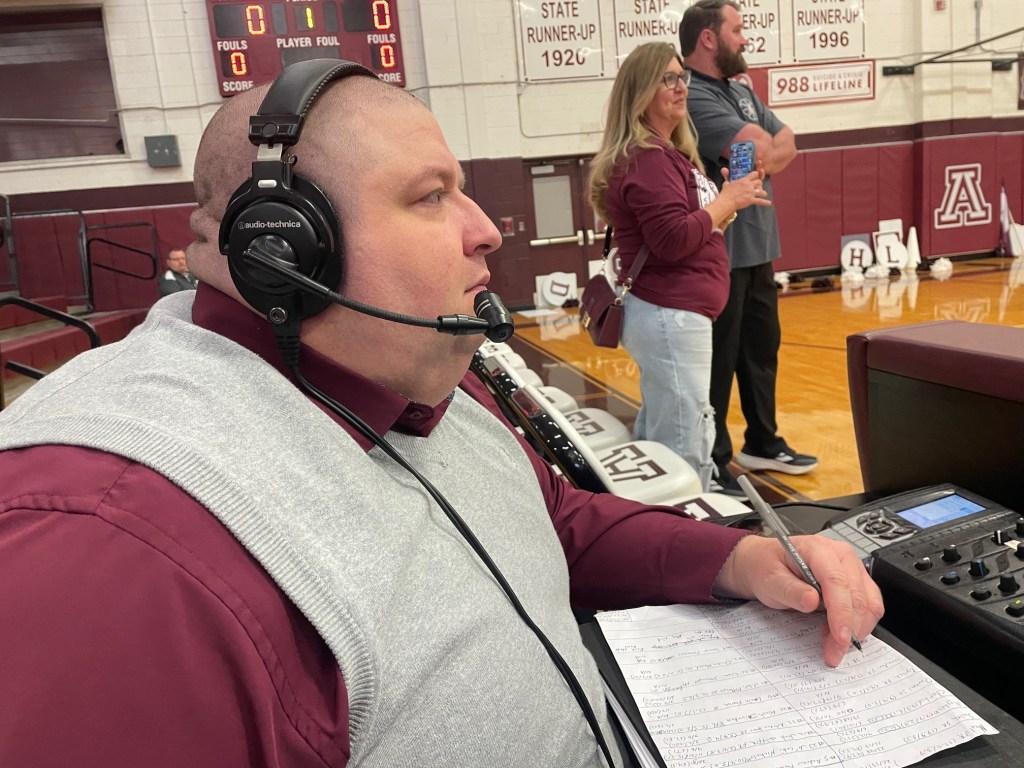
Tyler Rowland stepped into the enormous shoes of the late, great Dicky Martin. When Dicky passed away toward the end of the high school football season, the question of who could follow him wasn’t really meant to be answered.

Who could replace him?

The answer then—and now—is nobody.

Dicky Martin was an original. One of one. A voice so memorable that replays of his calls still circulate on Facebook, and people still stop to listen. He is missed, without question, and things simply aren’t the same.

Tyler Rowland has taken on the toughest job in the 16th Region – the challenge of replacing the legendary broadcaster Dicky Martin as the Voice of the Ashland Tomcats. He is near the end of his first season.

But the man who stepped into his place has done a remarkable job.

Tyler Rowland isn’t Dicky Martin—and expecting him to be would be unfair to anyone. What Tyler has done, though, is begin to grow comfortable in a seat Dicky occupied for more than 50 years of Tomcat sports. Dicky was loud, proud, and unmistakable—a voice even rival fans couldn’t help but hear night after night. He was must-listen radio.

Times have changed, even during Dicky’s era. High school sports once lived exclusively on the radio. Now, fans can watch games from their living rooms through streaming services like My Town TV and Kool Hits. I’m thankful for both. Watching is fun, though I hope radio never disappears. There’s a charm to it that pulls you back in time.

This region has produced a Hall of Fame list of broadcasters—so many that naming them risks leaving someone out. Tyler Rowland has the potential to belong in that conversation.

For Ashland fans especially, radio remains a lifeline. Whether it’s listening live during a game or tuning in afterward for Ryan Bonner’s postgame analysis with Tyler, people are still listening. And if you’ve tuned in, what you’ve heard is a polished broadcaster who improves with every call.

Tyler considers himself a disciple of Dicky, and it shows—especially in his preparation. An accountant by day, his command of numbers is impressive. He’s a savant with statistics. While he has years of broadcasting experience, including time with My Town TV, radio is a different animal. Early on, Tyler was known for his loud excitement on TV. As his voice has matured, it’s grown softer—but also stronger—on the radio.

Tomcat radio is unlike most broadcasts. The tradition built by the Martin family—Dicky and his father, Dick—set the standard for 75 years. Imagine being the person tasked with replacing that kind of history.

It’s overwhelming. But Tyler never let it swallow him, largely because of how much he admired the man who came before him.

The advice he heard most was simple: Don’t try to be Dicky. Be Tyler.

That’s exactly what he’s done. And by doing so, he’s validated the decision made by Tomcat athletic director Jim Conway to hand him the microphone. Tyler’s play-by-play is descriptive, his knowledge sound. You always know the score, the time on the clock, and how far that corner jumper really was. He paints a clear picture without being overly excitable. His strong vocabulary and statistical awareness make his calls both informative and entertaining.

I’ve listened to several of his broadcasts and come away impressed every time. Even when things aren’t going Ashland’s way, he doesn’t rush to blame officials. You might hear, “I’m not sure about that one,” and then he moves on. It’s professional broadcasting—with just the right tint of maroon.

I listened to his call of the most recent Ashland–Boyd County game, a high-scoring Tomcat win. I watched on YouTube while listening to Tyler’s call—barely a second of delay—and he didn’t miss a thing. What he described matched exactly what I was seeing. It was impressive.

If you haven’t listened to this young man yet, give him a chance.

Replacing Dicky Martin was a mission impossible. Everyone knew nobody could truly do it.

But Tyler Rowland is the next man up—and he is the right man to handle the toughest job in the 16th Region, and maybe in the entire state of Kentucky.

And I know this much: Dicky would approve of the job that Tyler has done.

Remembering Don McReynolds: A coach, fan and faithful friend of the Ashland Tomcats

Don McReynolds—a former Ashland Tomcats assistant coach, dedicated fan, and longtime sideline photographer—passed away Friday. He spent a decade coaching Tomcat football and more than 30 years afterward capturing the action through a camera lens, becoming a familiar presence at games long after his coaching days ended.

McReynolds also coached girls track and field at Ashland and was known as a well-liked, effective high school history and science teacher. Though his role as a coach placed him in the press box as an offensive coordinator, his later role behind the camera made him just as recognizable to generations of players and fans. He first served as offensive coordinator for his longtime friend and classmate Mike Manley, and later for Vic Marsh.

Though he became synonymous with Ashland athletics, McReynolds wasn’t an Ashland native. He grew up in Mt. Sterling and played receiver on the 1967 state runner-up team that shocked McKell and star athlete Don Gullett, 21-13, in the semifinals before falling to Bardstown in the Class A championship. That title game was played just before Ashland claimed its own Class AA championship with a win over Elizabethtown.

Don McReynolds loved the hobby of photography after his coaching days ended.

That Mt. Sterling team also featured a future Tomcat connection: Manley, who would later coach Ashland for the 1980 season, was the quarterback. His punt return for a touchdown sealed the semifinal win over McKell, and years later he would help bring McReynolds to Ashland.

Thirteen years after their high school run, Manley was hired to revive an Ashland program coming off three straight losing seasons following Herb Conley’s successful 1971–76 run. After one season, Manley left to become offensive coordinator and quarterbacks coach at Morehead State—just 29 years old at the time.

McReynolds had been coaching at Fleming County before Manley persuaded him to join the Tomcat staff in 1980. Marsh, then the defensive coordinator and the only holdover from Mike Holtzapfel’s staff, would eventually take over as head coach after Manley departed.

Manley and McReynolds shared more than a backfield history—they even shared a birthday. Their close friendship played a major role in McReynolds’s move to Ashland. He recalled the phone call in December 1979 when Manley invited him to the Ashland Invitational Tournament to watch the Tomcats face Phelps and high-scoring Ervin Stepp.

Don McReynolds

“I told him, ‘We won’t be able to get tickets,’ and he said, ‘Don’t worry about that,’’’ McReynolds once said. “So I told him I’d go with him. He also told me Ashland had a head coaching opening and he might apply for it. I said, ‘They’ll never hire you.’”

Manley slipped away during the first quarter of the opening AIT game for a meeting and didn’t return until the fourth quarter. “He told me he was going to apply and he was going to get the job,” McReynolds said. “He asked me if he did, would I come with him. That’s what brought me to Ashland.”

He may not have known it then, but that trip set the course for the rest of his life.

In 1980, McReynolds worked from the press box as offensive coordinator, though Manley—an offensive mind himself—was eager to call plays. It took some adjusting.

“I remember the first game against Scott County,” McReynolds said of the 35–0 win. “I was upstairs and didn’t get to call one play. He was calling everything. I came down after the game madder than a hornet. I told him if he was going to call all the plays, what am I supposed to be doing? … We came to an understanding. It got better as the season went along.”

Their offensive spark helped the Tomcats finish 9–4, led by junior quarterback Scott Crank (1,127 passing yards; 516 rushing), halfback Dave Hall (1,353 yards, 11 TDs), receiver and future MLB pitcher Drew Hall, lineman Tony Consiglio, future Tomcat quarterback Greg Conley, and hard-running Paul McPeek (563 yards, 8 TDs). The season ended in the quarterfinals with a 21–6 loss to Henry Clay.

After Manley left, Marsh took over and eventually became Ashland’s all-time wins leader, taking the Tomcats to a state championship in 1990. Ashland wouldn’t win another state title until 2020. Though McReynolds left coaching after the 1989 season, he had coached many of the players who would hoist the trophy the following year.

I got to know Don best through his photography. For two decades or more, he shot assignments for the newspaper, and we knew we could rely on “Donnie Mac” for quality work. He also photographed Kentucky football games for us. His talent behind the camera was matched by his easy humor—something our staff appreciated every bit as much.

He even once helped prevent what could have become a family feud. My daughter and her boyfriend had been using our UK football tickets all season, but when LSU came to town ranked No. 1, my son decided he wanted to go. My daughter was not pleased. Then Don called on Friday afternoon and offered me two extra tickets. I took them, crisis averted—and Kentucky went on to stun No. 1 LSU that night. I thanked Don more than once for keeping the peace in my household.

McReynolds and former Tomcat assistant Mark Renfroe remained close friends for years, bonding over football and traveling together on their own SEC stadium tour. Those who coached with Don could talk football with him for hours.

Students, coaches, players and fellow teachers admired him. He was respected, warm-hearted and deeply appreciated by those who knew him.

Former Tomcat quarterback Greg Conley, a player from that first 1980 team, remembered him fondly:

“He was a great person, coach, and had a creative offensive mind. He loved his players and coached with passion. He brought energy to every practice and game. Everyone loved being around coach. Lifting his family up in prayer. Another Tomcat who will be greatly missed.”

Amen to that.

Dicky Martin Memorial Scholarship being established

Dicky Martin’s voice rang out all over Ashland on the radio for five decades and his death leaves an irreplaceable hole in the Tomcats’ heart.

His family wants that voice to continue in a tangible way through a memorial scholarship. Dicky loved his Tomcats when they were playing and remembered them years later after they had hung up their jersey. He did more for Ashland students than anyone will ever know, putting them on a pedestal long after their playing days.

The Dicky Martin Memorial Scholarship will be a way to say thank you to him for the memorable moments and thrilling calls he gave Ashland fans for 50 years, not to mention the ways he gave back to the program without anyone ever knowing it.

Dicky Martin provided plenty of chills and thrills with his radio broadcasts of Tomcat sports for 50 years.

Donna Suttle is helping the Martin family establish the fund which they hope could be effective by the end of the school year. It would be extended to an Ashland athlete (a particular sport has not been decided).

Suttle manages the Joe Franklin Memorial Scholarship that goes to Tomcat basketball players, the Doug Childers Memorial Scholarship for Tomcat football players and has started the Johnny Mullins Memorial Scholarship that tentatively is going to an Ashland baseball player. The Bill Gammon Scholarship for Tomcat football players is managed through a trust fund established upon his death in 1973.

The Martins are on the ground floor for the latest scholarship opportunity for an Ashland athlete. Guidelines have not been established until some funding has been secured to make sure it has a solid foundation.

What they are asking is for Ashland fans to remember Dicky Martin with a donation to get the scholarship off to a strong start. It is a simple way to say thank you to Dicky for all he did for Tomcat sports. Not only was in the “Voice of the Tomcats” but he essentially was the Tomcat Boosters Club. He did everything he could to make sure Ashland athletes had the very best while representing the Tomcats.

Now his family is asking for help so Dicky’s memory will carry on for decades to come through this scholarship. If you are willing to give, please send a check to Donna Suttles at 1520 Lexington Avenue, Ashland, Ky. 41101. Make the check to: Dicky Martin Memorial Scholarship Fund. You can also Venmo your donation to Whitney Martin.

The family is grateful for the love and compassion shown during his recent passing.

Let’s keep Dicky Martin’s voice alive through this scholarship program.