ASHLAND, Ky. (KT) – Bill Grimes doesn’t remember everything about his Ashland Tomcat football career in 1961 and 1962.
But there is one collision he will never forget.
Grimes was a junior in 1961, and things weren’t going well on the second Friday in October when Ironton came to town. Ashland was 1-5 and hadn’t scored since the second week of the season, a 12-6 loss to Point Pleasant, W.Va. The Tomcats had opened the year with a 7-0 victory over Catlettsburg.
On the opening kickoff at Putnam Stadium, the stocky, 181-pound Grimes sprinted toward Ironton’s Coy Bacon.
They didn’t collide. They crashed.
Grimes went flying backward through the air and landed hard on the turf. He collected himself and walked off the field.
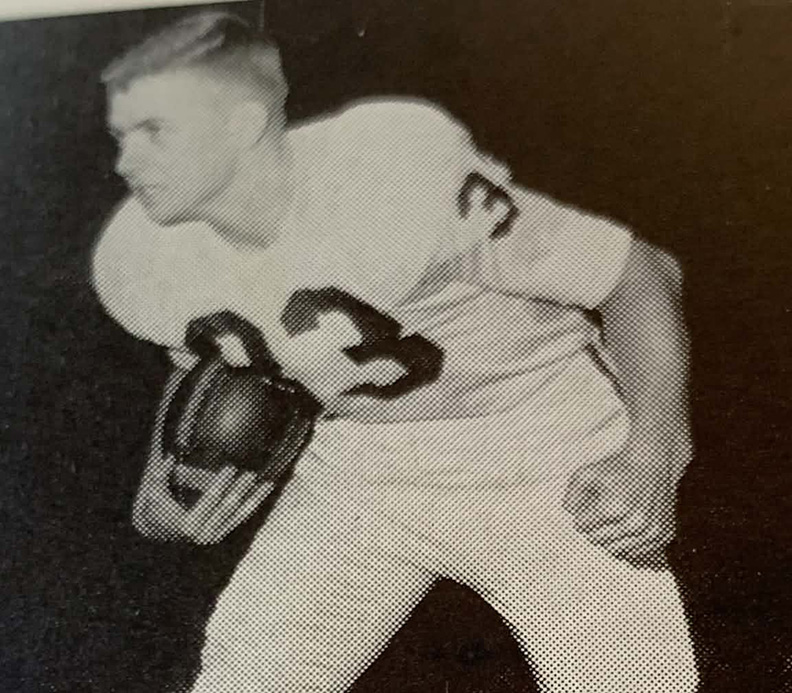
Sixty-five years later, he can still feel it.
Bacon did all right for himself, too. He was selected to three Pro Bowls during a 14-year NFL career and recorded 130.5 sacks before sacks became an official statistic.
That was the stone wall Grimes ran into – and wished he hadn’t.
“I wasn’t afraid of anything, even Coy Bacon,” Grimes said. “He hit me and I’m flying in the air going backwards. It was on the film. The coaches said, ‘Grimes goes in the air and then gets back up ready to play.’ They were trying to make me feel better. Coy was a class guy, I really liked him. I kept thinking this guy is 23, 24 years old. He knocked the crap out of me. I sure do remember that.”
Grimes, now 81 and living in Mt. Pleasant, S.C., won’t soon forget it.
Ashland lost that night, 13-0, for its fourth consecutive shutout. The Tomcats lost to Fort Thomas Highlands the following week, 34-12, falling to 1-6 before winning their final three games to finish 4-6.
It was a sign of things to come.
“We started meshing and it carried over,” Grimes said.
It certainly did.
The 1962 Tomcats went 8-1-1, with the only blemish a 28-0 loss to Highlands. That loss kept them out of the state playoffs, which had begun in 1959.
Ashland’s first postseason appearance came in 1966, when Highlands again ended the Tomcats’ season with a 27-12 victory. A year later, Ashland returned to the playoffs and won the Class AA state championship.
The 1962 season deserves more attention than it gets.
Grimes was a versatile player who ran the ball, kicked and played linebacker. He averaged 7 yards a carry but had only 30 attempts for 212 yards. Chip Miller led the ground game with 566 yards and 10 touchdowns.
And talented sophomore Tom Ferguson started at quarterback during an era when sophomores seldom dressed. Only five did that season.
Ferguson started all three seasons before signing with the University of Kentucky. He played quarterback on the freshman team before moving to linebacker, where he started three years for the Wildcats.
From Alabama to Ashland
Grimes moved to Ashland from Alabama before his sophomore year. His father was a career Army man, and the family was supposed to move to Berlin. But the Berlin crisis changed those plans, and his father decided to retire.
His mother, an Ashland native, insisted they return to her hometown.
Grimes loved football, and his mother gave him some simple advice.
If you want to play football, go to Ashland and become a Tomcat.
He moved in with his aunt and started school. His parents arrived two months later and bought a home on Woodlawn Avenue.
He attended the old high school on Lexington Avenue, but the construction of Paul G. Blazer High School was already changing the landscape. Grimes called the new campus a showplace and believes it helped bring the team together.
His cousin, Bob Patterson, played in the band and introduced Grimes to the Cincinnati Reds. Patterson also taught him a lesson Grimes still lives by:
Once you’re a Tomcat, you’re always a Tomcat.
Basketball was another story.
“I had no idea why these guys were running around in shorts,” Grimes said. “Bear (Bryant) wouldn’t let me go anywhere in shorts. It was a real awakening.”
During Grimes’ junior year, the 1961 Tomcats basketball team produced one of the greatest seasons in Sweet Sixteen history, going 36-1 behind Harold Sargent, Gene Smith and Larry Conley.
The next year, Ashland nearly repeated as state champion, losing to St. Xavier, 62-58, in the finals.
But Grimes’ game was football.
He had thick thighs and ran with authority, even though he didn’t get a lot of carries. He attempted six passes – all incompletions – and was an accurate placekicker, making 21 extra points. “I did whatever I could to get on the field,” he said.
The Tomcats opened the 1962 season with four straight victories, including a 7-6 win over Huntington High.
That one mattered.
It matched coaching brothers Rex Miller of Ashland and Claude Miller of Huntington. Grimes put the Tomcats ahead 7-0 before the Pony Express scored. Huntington’s chance to tie was denied when Eddie Radjunas broke through the line and blocked the kick.
John Stafford, Tim Brown, Fred Cooper, Vic McGuire and Radjunas were honorable mention All-State selections. Nick Jordan, a junior who joined the team late that season, would become a first-team All-State defensive tackle in 1963.
Grimes still remembers the teammates who became lifelong friends: David Alban, J.B. Conley, Bob Yancey, George Branham, Bob Reynolds, Charlie Jordan, Radjunas and Larry Fairchild.
“I loved that team,” he said. “Those guys took me in as a sophomore and we grew to like each other. All of them grew up in Ashland. They knew their people. But they took care of me. We had confidence in our coaching staff. They called me The Bull believe it or not. The funny thing, Bob Yancey once told me, ‘Coach should have put you in more.’”
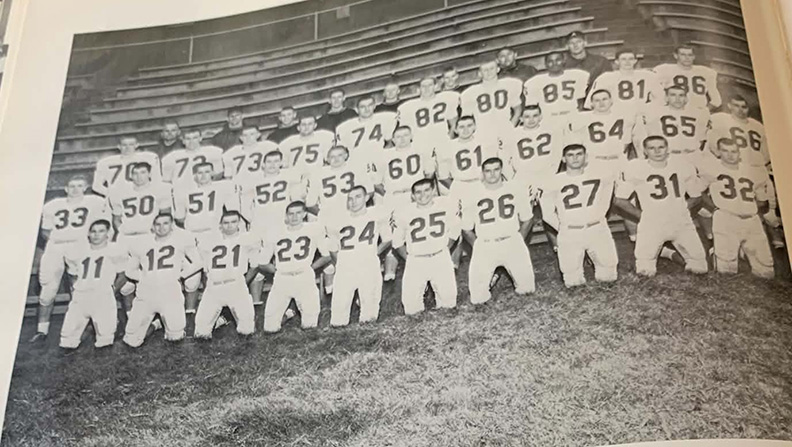
Ashland tied Hazard 20-20, and Grimes played a role in preserving the tie. He missed the extra point after the second touchdown but made the kick after the third score to keep the Tomcats undefeated.
He remembered playing at Hazard the previous season, too. The field was uneven, he said, and coal miners watched from the sidelines covered in coal dust.
“All you could see were their white teeth and eyes,” he said.
After beating Ironton 25-6 in his ssenior season, Ashland took its 5-0-1 record to Highlands with little hope of winning, Grimes said.
“A lot of the guys were just trying to get the game over with,” he said. “We knew we were going to get beat; just don’t get beat too bad. On the way home the coaches said you guys are too happy. The idea was, we got through it, we didn’t get killed (28-0). We still had three at the end (of the season).”
The Tomcats regrouped.
They won their final three games by a combined 102-25 to finish 8-1-1, their best record since the 10-0-1 team of 1958.
Grimes’ best game came in a 34-6 rout of Russell. He rushed for 67 yards.
“They turned me loose,” he said, chuckling. “I carried a guy about 30 yards on my back before somebody hit me and knocked me down. That’s where the name Bull came from.”
Once a Tomcat
Grimes moved to South Carolina in 2014, where he eventually ran into a player from Stonewall Jackson, which Ashland had defeated 27-20 in 1962.
The man talked about how Stonewall Jackson had won the game.
Grimes didn’t correct him.
Instead, the conversation led Grimes and his wife to a church where they remain members.
Grimes’ life after Ashland was as remarkable as his football career.
He joined the Army out of high school and served in Vietnam from 1966 to 1969, eventually rising to captain. He retired from the military after 32 years.
At one point, he served a midnight shift guarding the Tomb of the Unknown Soldier at Arlington National Cemetery, an honored reserved for the elite soldier.
He later earned a law degree and spent 32 years as a prosecutor in Indiana.
He said 50 men he sent to prison are now Facebook friends with him.
Grimes and his wife Valorie will celebrate 39 years of marriage in December. He has three adult sons from a previous marriage, all of whom played high school football. His middle son, Matthew, played at Centre College.
And there is one more thing worth knowing about Bill Grimes.
He coached youth league football for 20 years.
A Tomcat football player. A Vietnam veteran. A prosecutor who put bad guys away. A youth football coach.
Not a bad legacy.
And perhaps not a bad legacy for a Tomcat team that deserves a little more love than it has received over the years.
Grimes certainly hasn’t forgotten it.
“Once a Tomcat, always a Tomcat,” he said. “I loved it!”