
Any list of the greatest athletes in Ashland High School history must include Bert Edward Johnson. A standout for the Tomcats before continuing his career at the University of Kentucky and later in the NFL, Johnson left a lasting legacy at every level he played.
Johnson’s high school career unfolded during the Great Depression, before Putnam Stadium existed. From 1930 to 1932, he starred as a dynamic running back, scoring 247 points while earning All-State honors twice and All-South recognition as a senior. Ashland captured state titles in all three of those seasons and was even named the nation’s top team in 1931. The Tomcats went 10-0 in both 1930 and 1931 and 8-2 in 1932.
Despite the rarity of sophomores seeing playing time, Johnson not only played but started in the backfield alongside standout Eck Allen. Known for his explosive acceleration, he contributed as a running back, quarterback and punter.
During Johnson’s three-year tenure, Ashland compiled a 28-2 record, claiming three mythical state championships and the 1931 national title. His 30-game totals are remarkable:
- 2,700 rushing yards on 245 carries (11.0 yards per carry)
- 46 rushing touchdowns
- 56 completions on 87 attempts for 945 yards and 15 touchdowns
- 5 receptions for 144 yards and one touchdown
Johnson often delivered his best performances against Louisville teams. In October 1930, Ashland traveled by train to face unbeaten Louisville Manual and returned with a stunning 91-0 victory. Back home, fans gathered on 17th Street outside The Daily Independent, cheering as scores were relayed via ticker-tape from a second-floor window.
The following year, Ashland again traveled to Louisville and defeated Male, a top contender, 31-6. Johnson rushed for 194 yards, while teammate Glenn Overley added 170 in a dominant showing. Later that season, the Tomcats crushed Decatur, Georgia, 85-6 in the Southern Bowl, with Johnson setting career highs of 213 rushing yards and 37 points. National polls later crowned Ashland the best team in the country.
In 1932, Johnson quarterbacked one of the most dramatic games in program history. Ashland’s 66-game unbeaten streak (62-0-4) ended in a heartbreaking 19-13 loss to Erie East, Pennsylvania. After tying the game late and setting up for a final drive, a pass by Johnson was intercepted and returned for a touchdown as time expired. It was Ashland’s first loss since 1925, leaving players and fans stunned.
The Tomcats’ only other defeat that season was a 7-6 loss to Huntington High, but they remained unbeaten against Kentucky opponents and still claimed the state title.
Johnson’s high school success drew national attention, but he chose to stay close to home and attend the University of Kentucky. There, he lettered in football from 1934 to 1936 and briefly played basketball, scoring two points in a single appearance during the 1934-35 season.
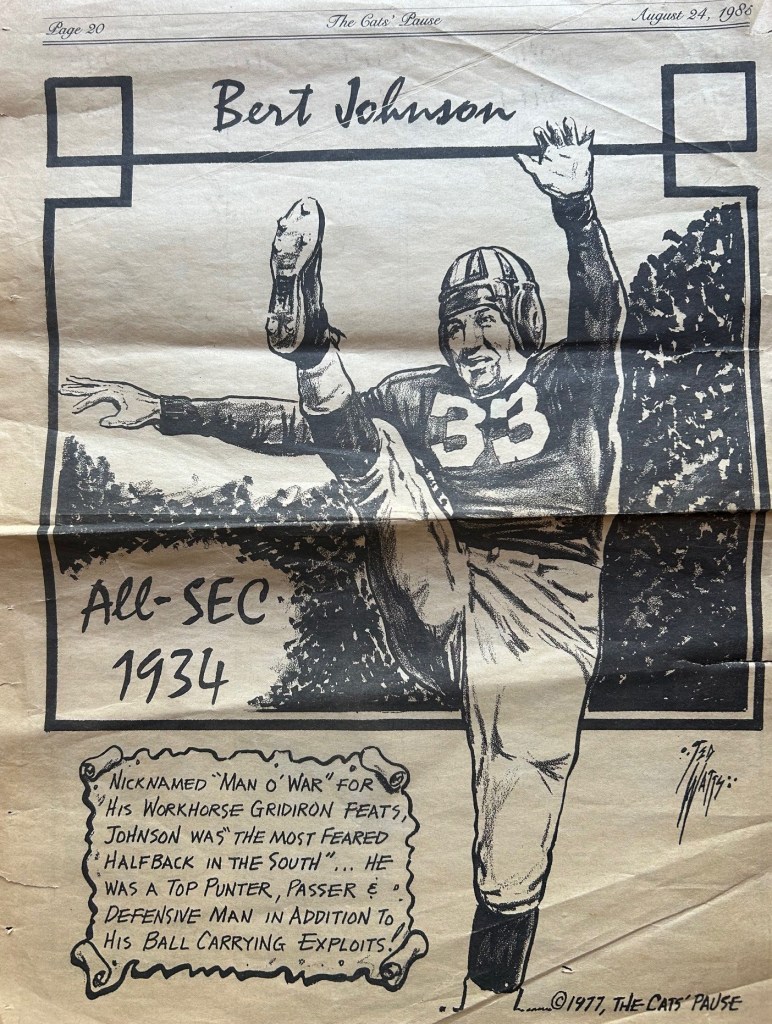
Nicknamed “Man o’ War” for his burst off the line, Johnson’s standout college performance came in 1934 against Alabama, when he scored both of Kentucky’s touchdowns in a 34-14 loss. That Alabama team would go on to an undefeated season capped by a Rose Bowl victory. Johnson became Kentucky’s second All-Southeastern Conference selection, earning the honor as a sophomore.
He went on to play six seasons in the NFL, suiting up for Brooklyn, the Chicago Bears under legendary coach George Halas, the Chicago Cardinals and the Philadelphia Eagles. Among his highlights were a pair of 50-yard runs—one with the Bears and another in an exhibition game for Brooklyn in Louisville.
Athletic success ran in the family. His son, Phil Johnson, later played basketball for Kentucky from 1956 to 1959, appearing in 64 games.
Bert Johnson passed away in 1993 at the age of 81. He was the third inductee into the Ashland Sports Hall of Fame, selected by the late John McGill. His legacy remains firmly cemented among the greatest in Tomcat football history.

